Paper II — Q6
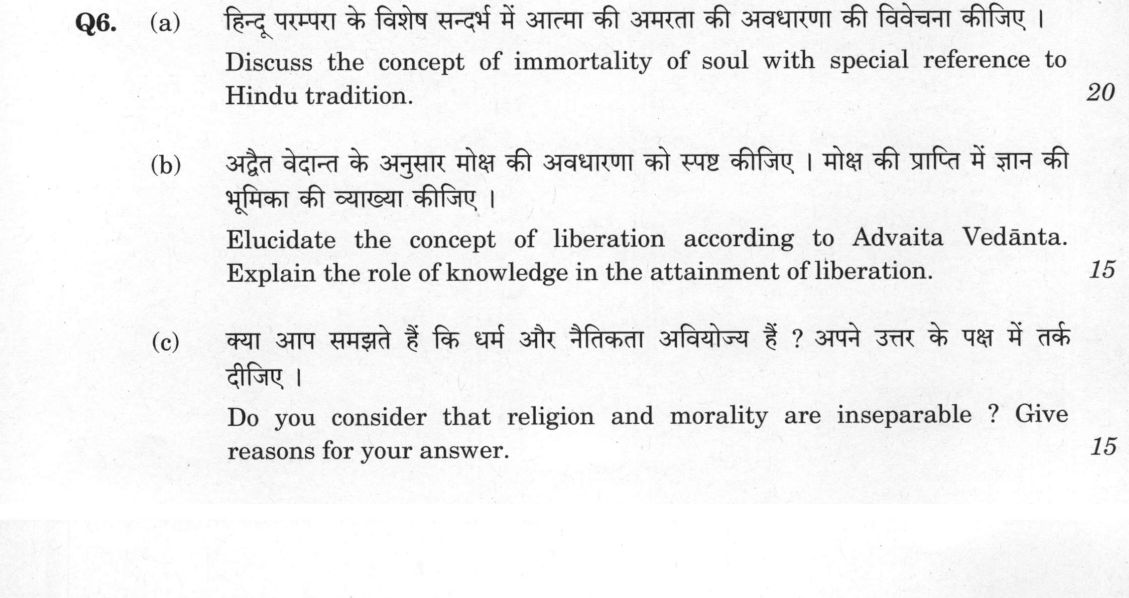
(a) Discuss the concept of immortality of soul with special reference to Hindu tradition. (20 marks) (b) Elucidate the concept…
Discuss the concept of immortality of soul with special reference to Hindu tradition. 20 marks
Elucidate the concept of liberation according to Advaita Vedānta. Explain the role of knowledge in the attainment of liberation. 15 marks
Do you consider that religion and morality are inseparable? Give reasons for your answer. 15 marks
हिंदी में प्रश्न पढ़ें
हिन्दू परम्परा के विशेष संदर्भ में आत्मा की अमरता की अवधारणा की विवेचना कीजिए । (20 अंक)
अद्वैत वेदान्त के अनुसार मोक्ष की अवधारणा को स्पष्ट कीजिए । मोक्ष की प्राप्ति में ज्ञान की भूमिका की व्याख्या कीजिए । (15 अंक)
क्या आप समझते हैं कि धर्म और नैतिकता अविभाज्य हैं ? अपने उत्तर के पक्ष में तर्क दीजिए । (15 अंक)
Model answer
Written by UPSC Answer Check against this question's marking rubric, to the expected length. UPSC does not publish answers for Mains — this is one way to score well, not an official key.
Indian philosophical traditions anchor their metaphysical and ethical inquiries in the structural nexus between soul (ātman), transcendental freedom (mokṣa), and moral order (dharma).
Immortality of the Soul in Hindu Tradition
Hindu thought fundamentally distinguishes between the transcendental, immutable self (ātman) and the empirical, psycho-physical individuality (jīva). Immortality (amṛtatva) does not denote the eternal persistence of individual egoic identity, but rather the cessation of particularized, fragmented existence through the realization of unconditioned consciousness.
The jīva, conditioned by ignorance (avidyā) and accumulated karmic bondage (karma-bandha), undergoes cyclical transmigration (saṃsāra). Within this framework, physical death (mṛtyu) is not ultimate annihilation (uccheda), but an ontological transition—the shedding of the gross physical sheath (sthūla-śarīra), described in the Bhagavadgītā (2.22) as discarding worn-out garments.
In the Upaniṣads, ātman is revealed through the apophatic method of neti, neti ("not this, not this") as the pure witness consciousness (sākṣī). The Bhagavadgītā (2.20–25) articulates its indestructible essence: unborn, eternal, immutable, and incapable of being pierced by weapons or burnt by fire.
Classical schools conceptualize this immortality differently. Sāṅkhya maintains a pluralistic doctrine of multiple eternal souls (puruṣa-bahutva), distinct from material nature (prakṛti). Conversely, Advaita Vedānta posits absolute non-dual unity: individual multiplicity is merely an empirical appearance, and true immortality consists in dissolving finite individuality into the one undivided reality (Brahman).
Liberation and the Role of Knowledge in Advaita Vedānta
In Advaita Vedānta, liberation (mokṣa) is neither a produced effect (janya) nor an alteration of being (vikārya), but the realization of the beginningless, inherent identity between the individual self and the Absolute (jīva-brahma-aikya). Bondage is caused by *adhyāsa*—the illicit superimposition of the objective, transient world onto pure consciousness.
Śaṅkara formulates a three-tiered ontology to explain this experiential reality: the illusory (prātibhāsika), the empirical (vyāvahārika), and the absolute (pāramārthika). Bondage persists only at the empirical level due to ignorance (avidyā). Consequently, since the bondage is epistemic rather than ontological, its removal requires brahma-jñāna (intuitive, non-dual knowledge).
In Śaṅkara’s framework, ritualistic action (karma) and devotional meditation (bhakti/upāsanā) cannot directly grant mokṣa; their role is auxiliary and preparatory, serving merely to purify the mind (citta-śuddhi). Direct liberation proceeds through the fourfold prerequisites (*sādhana-catuṣṭaya*—discrimination, dispassion, self-restraint, and intense desire for liberation), followed by the cognitive path (jñāna-mārga) of listening to Upaniṣadic revelations (śravaṇa), rational dialectical reflection (manana), and deep contemplative meditation (nididhyāsana), culminating in unmediated self-realization (aparokṣānubhūti).
Religion and Morality: Inseparability versus Autonomy
The relationship between religion and morality admits competing perspectives across philosophical traditions.
Arguments for inseparability maintain that religion provides the cosmic sanction and ultimate foundation for ethical values. In classical India, the Dharmaśāstra tradition exemplifies this through the seamless fusion of sacred rituals (ācāra) and universal moral duties (sādhāraṇa-dharma). In Western philosophy, Immanuel Kant demonstrated their practical integration by postulating God and immortality as necessary requirements for the highest good (summum bonum), while Paul Tillich situated morality as an expression of an individual’s "ultimate concern."
Conversely, the autonomy thesis argues that morality is logically independent of religion. Kai Nielsen demonstrated the logical independence thesis by showing that recognizing divine commands as good already presumes an antecedent moral standard. Sociologically, Émile Durkheim established that moral norms stem from social cohesion rather than divine decree. Within Indian heterodox philosophy, early Buddhism demonstrated that a comprehensive, rigorous ethical code (śīla) functions autonomously without reference to a supreme creator God (īśvara).
This dynamic was critically evaluated in modern Indian thought. Mahatma Gandhi unified them by redefining religion ethico-centrically as the pursuit of Truth ("Truth is God"). In contrast, B. R. Ambedkar rejected metaphysical theism and embraced an ethical Buddhism, asserting that true religion must be judged purely by its moral capacity to promote liberty, equality, and fraternity.
Therefore, religion and morality are historically and phenomenologically interconnected, but they remain logically distinct and autonomous. In the final analysis, metaphysical understanding illuminates ethical practice: moral life serves as the empirical foundation for spiritual realization, transforming moral duties from external mandates into natural expressions of universal oneness.
What "Discuss" is asking you to do
Lay the issue out from more than one side — how it arose, what is claimed for it, what is held against it, and where it now stands. UPSC attaches discuss to broad topics with several live dimensions, so coverage of the dimensions earns more than the strength of your opinion.
Structure that answers it
Set the issue up → the case as it is made → the case against → the dimension both sides leave out → where the balance now lies
Where marks are lost
Listing facts with no thread between them, or arguing one side throughout and calling it a discussion.
How this answer will be evaluated
Approach
Framework: UPSC Philosophy Paper II. (a) discuss: intro > 3-4 dimensions > example > balanced close | (b) explain: definition/context > points in order > small example > short close | (c) comment: context > arguments both sides > judgment > close Full marks: Precise technical vocabulary, strong textual references, clear argumentation, and balanced evaluation.
Key points expected
- Define Atman and its ontological status
- Explain the mechanism of transmigration (punarjanma)
- Reference specific Hindu texts (e.g., Upanishads, Gita)
- Address the relationship between Atman and Brahman
- Define Moksha in the context of Advaita
- Explain the role of Jnana (knowledge) in liberation
- Discuss the concept of Avidya (ignorance) and its removal
- Clarify the identity of Atman and Brahman
Evaluation rubric
Each sub-part is marked on its own, against the marks and word limit printed on the paper.
- (a) Analytical discussion of the soul's immortality within the Hindu tradition. 20 marks
discuss— intro → 3-4 dimensions → example → balanced close
Must cover
- Define Atman and its ontological status
- Explain the mechanism of transmigration (punarjanma)
- Reference specific Hindu texts (e.g., Upanishads, Gita)
- Address the relationship between Atman and Brahman
Loses marks
- Vague generalities without textual reference
- Confusing the soul with the body or mind
- Biographical details of philosophers
Earns more
- Distinguish between Advaita and Dvaita views of the soul
- Use precise Sanskrit terminology (e.g., Tattva, Samsara)
- Reference specific Upanishadic verses (e.g., Brihadaranyaka)
Extra mark
- Cite specific Gita verses on the soul's nature
- Mention specific commentators like Shankara or Ramanuja
- (b) Explanation of Advaita Vedanta's concept of liberation and the role of knowledge. 15 marks
explain— definition/context → points in order → small example → short close
Must cover
- Define Moksha in the context of Advaita
- Explain the role of Jnana (knowledge) in liberation
- Discuss the concept of Avidya (ignorance) and its removal
- Clarify the identity of Atman and Brahman
Loses marks
- Confusing Advaita with other Vedanta schools
- Vague description of 'knowledge' without technical precision
- Ignoring the role of Avidya
Earns more
- Use precise Sanskrit terms (e.g., Jnana, Avidya, Moksha)
- Reference Shankara's specific arguments
- Distinguish between Jivanmukti and Videhamukti
Extra mark
- Cite specific verses from the Brahma Sutras
- Mention specific works by Shankara (e.g., Vivekacudamani)
- (c) Critical assessment of the inseparability of religion and morality. 15 marks
comment— context → arguments both sides → judgment → close
Must cover
- State a clear position on the inseparability
- Provide arguments supporting the position
- Present the strongest counter-argument
- Offer a balanced evaluation or judgment
Loses marks
- Failing to present a clear position
- Ignoring the counter-argument
- Vague generalities without specific examples
Earns more
- Reference specific philosophical arguments (e.g., Euthyphro dilemma)
- Use concrete examples of religious and moral codes
- Distinguish between divine command theory and natural law
Extra mark
- Cite specific philosophers (e.g., Kant, Hume, Aquinas)
- Reference specific religious texts or moral codes
Practice this exact question
Write your answer and it is marked point by point against the model answer above — what you covered, what you missed, what you got wrong.
Evaluate my answer →More from Philosophy 2021 Paper II
- Q3 (a) Discuss anarchism as a political ideology. Is it possible to dispense with political…
- Q4 (a) Discuss the views of Dr. B.R. Ambedkar regarding caste-discrimination in Indian socie…
- Q5 Answer the following questions in about 150 words each: (a) Discuss the nature of God as…
- Q6 (a) Discuss the concept of immortality of soul with special reference to Hindu tradition.…
- Q7 (a) Discuss the role of reason and faith in religion. Can reason be a regulative force in…
- Q8 (a) What is non-cognitive theory of religious language? Explain critically in the light o…