Paper II — Q3
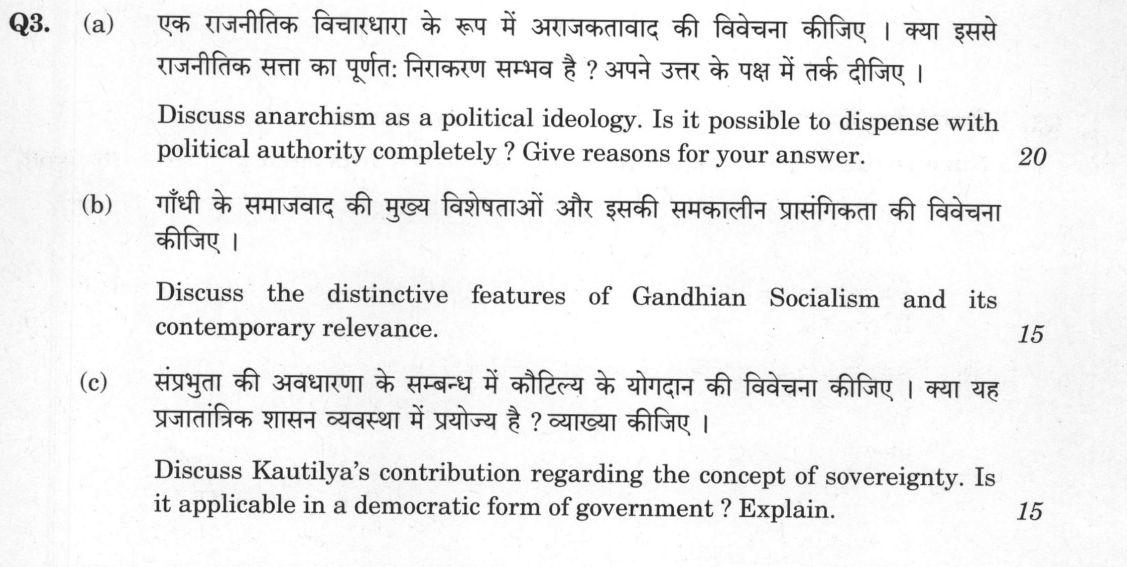
(a) Discuss anarchism as a political ideology. Is it possible to dispense with political authority completely? Give reasons for…
Discuss anarchism as a political ideology. Is it possible to dispense with political authority completely? Give reasons for your answer. 20 marks
Discuss the distinctive features of Gandhian Socialism and its contemporary relevance. 15 marks
Discuss Kautilya's contribution regarding the concept of sovereignty. Is it applicable in a democratic form of government? Explain. 15 marks
हिंदी में प्रश्न पढ़ें
एक राजनीतिक विचारधारा के रूप में अराजकतावाद की विवेचना कीजिए । क्या इससे राजनीतिक सत्ता का पूर्णतः निराकरण सम्भव है ? अपने उत्तर के पक्ष में तर्क दीजिए । (20 अंक)
गांधी के समाजवाद की मुख्य विशेषताओं और इसकी समकालीन प्रासंगिकता की विवेचना कीजिए । (15 अंक)
संप्रभुता की अवधारणा के सम्बन्ध में कौटिल्य के योगदान की विवेचना कीजिए । क्या यह प्रजातांत्रिक शासन व्यवस्था में प्रयोज्य है ? व्याख्या कीजिए । (15 अंक)
Model answer
Written by UPSC Answer Check against this question's marking rubric, to the expected length. UPSC does not publish answers for Mains — this is one way to score well, not an official key.
Political philosophy continuously negotiates the boundaries between individual freedom, ethical community, and the institutional necessity of state authority.
Anarchism and the Question of Authority
Anarchism is an anti-statist political ideology rooted in the premise that political authority, institutionalized in the state, is inherently coercive, exploitative, and destructive of human potential. It encompasses distinct strands: Individualist Anarchism (such as Pierre-Joseph Proudhon’s mutualism and critique of property as theft) and Collectivist or Communist Anarchism (such as Mikhail Bakunin’s revolutionary overthrow of the state and Pyotr Kropotkin’s theory of "mutual aid"). Kropotkin argued that human evolution is driven by cooperation, enabling a spontaneous social and economic order without central enforcement.
Whether political authority can be dispensed with completely depends on one's conception of human nature. Anarchists view human nature as inherently sociable, corrupted only by hierarchical institutions. Conversely, classical political realism posits that without an overarching power, human self-interest degenerates into conflict. Historically, stateless attempts—such as the Paris Commune (1871) or the revolutionary syndicates of the Spanish Civil War—remained short-lived under external military pressure and internal logistical strain. In contemporary India, anti-statist violent expressions like the Naxalite insurgency illustrate that rejecting legitimate state authority often yields alternative forms of local coercive domination rather than egalitarian self-rule. Thus, while absolute state violence can and must be constrained, completely eliminating coordinating and adjudicating authority remains practically unfeasible in complex, plural societies.
Gandhian Socialism and Contemporary Relevance
Gandhian Socialism departs sharply from Marxist and Fabian models by rejecting state-centric industrialism and coercive expropriation. Its defining features include:
- Sarvodaya (the moral and material upliftment of all, prioritizing the last individual);
- Trusteeship, wherein the wealthy hold capital in ethical trust for the community, negating violent class warfare;
- Gram Swaraj (decentralized, self-reliant village republics);
- Opposition to state violence, viewing the centralized modern state as an engine of institutional coercion.
In the contemporary era, Gandhian socialism offers a potent critique of unregulated neoliberal globalization, environmental degradation, and rising inequality. Its ethos of sustainable, localized production directly informs global Sustainable Development Goals (SDGs) and India’s Gram Swaraj Abhiyan. Real-world cooperative enterprises like AMUL and self-help federations like SEWA operationalize Trusteeship and decentralized labor ownership, proving that economic democracy can thrive through voluntary cooperation rather than top-down bureaucratic control.
Kautilyan Sovereignty and Democratic Applicability
In the Arthashastra, Kautilya formulates a realist conception of sovereignty centered on the Saptanga (seven constituent elements of the state), placing the Swami (sovereign ruler) at the apex. Sovereignty is justified as the indispensable instrument to eliminate Matsyanyaya (the law of the fish, where the strong devour the weak). Kautilya distinguishes between de facto coercive power (Danda) and ethical-normative legitimacy derived from Dharma. The ruler’s authority is bound to the welfare of the people: "In the happiness of his subjects lies his happiness" (Yogakshema).
Kautilya’s framework remains applicable to modern constitutional democracies. His functional division among the Saptanga prefigures modern institutional checks and the division of public administration (Amatya). The modern democratic state similarly relies on the Rule of Law and Constitutional Morality to prevent Matsyanyaya and protect vulnerable citizens. Furthermore, Kautilya’s realistic provisions for state survival under crisis parallel contemporary constitutional mechanisms, such as Emergency Provisions (Articles 352–360 of the Indian Constitution), which preserve the sovereign framework against internal and external disintegration.
Synthesis
Political thought reflects a spectrum from the anarchist rejection of state coercion to the Kautilyan consolidation of strong, protective statecraft. Gandhian socialism bridges this divide by reimagining sovereignty not as concentrated coercive force, but as decentralized, ethical responsibility. A viable modern polity must secure public order and the rule of law as envisioned by Kautilya, while actively decentralizing power to foster Gandhian democratic self-reliance.
What "Discuss" is asking you to do
Lay the issue out from more than one side — how it arose, what is claimed for it, what is held against it, and where it now stands. UPSC attaches discuss to broad topics with several live dimensions, so coverage of the dimensions earns more than the strength of your opinion.
Structure that answers it
Set the issue up → the case as it is made → the case against → the dimension both sides leave out → where the balance now lies
Where marks are lost
Listing facts with no thread between them, or arguing one side throughout and calling it a discussion.
How this answer will be evaluated
Approach
Framework: UPSC Mains Philosophy Paper II. (a) discuss: intro > 3-4 dimensions > example > balanced close | (b) discuss: intro > 3-4 dimensions > example > balanced close | (c) discuss: intro > 3-4 dimensions > example > balanced close Full marks: Precise terminology, strong counter-arguments, clear contemporary links.
Key points expected
- Define anarchism as rejection of coercive authority
- Distinguish individualist vs. collectivist anarchism
- Present strongest argument for state necessity
- Evaluate feasibility of complete authority removal
- Define 'Sarvodaya' and 'Swadeshi' as core tenets
- Contrast with Marxist/State Socialism
- Link to contemporary issues (e.g., sustainability)
- Mention 'trusteeship' or 'self-reliance'
Evaluation rubric
Each sub-part is marked on its own, against the marks and word limit printed on the paper.
- (a) Analyze anarchism as an ideology and evaluate the feasibility of a stateless society. 20 marks
discuss— intro → 3-4 dimensions → example → balanced close
Must cover
- Define anarchism as rejection of coercive authority
- Distinguish individualist vs. collectivist anarchism
- Present strongest argument for state necessity
- Evaluate feasibility of complete authority removal
Loses marks
- Confusing anarchism with mere lawlessness
- Biographical focus on Kropotkin/Proudhon
- Ignoring the 'feasibility' aspect of the question
Earns more
- Reference to Proudhon or Bakunin
- Mention of voluntary association
- Critique of 'state monopoly of violence'
- Reference to 'mutual aid' (Kropotkin)
Extra mark
- Reference to 'The Conquest of Bread'
- Mention of 'collective bargaining' as alternative
- (b) Identify core tenets of Gandhian Socialism and link them to modern issues. 15 marks
discuss— intro → 3-4 dimensions → example → balanced close
Must cover
- Define 'Sarvodaya' and 'Swadeshi' as core tenets
- Contrast with Marxist/State Socialism
- Link to contemporary issues (e.g., sustainability)
- Mention 'trusteeship' or 'self-reliance'
Loses marks
- Treating Gandhian Socialism as mere charity
- Ignoring the 'contemporary relevance' part
- Vague generalities without specific terms
Earns more
- Reference to 'Breadstuff' vs 'Luxury'
- Mention of 'village republics'
- Link to 'sustainable development goals'
- Reference to 'Ahimsa' in economic context
Extra mark
- Reference to 'Hind Swaraj'
- Mention of 'Khadi' as economic symbol
- (c) Explain Kautilya's concept of sovereignty and assess its democratic applicability. 15 marks
discuss— intro → 3-4 dimensions → example → balanced close
Must cover
- Define 'Saptanga' theory of state
- Explain 'Rajadharma' (duty of king)
- Address 'applicability in democracy' explicitly
- Distinguish 'Svatantrya' (sovereignty) from 'Svatantra'
Loses marks
- Ignoring the 'democratic applicability' question
- Confusing Kautilya with modern Realism
- Biographical details of Kautilya
Earns more
- Reference to 'Mandala' theory
- Mention of 'Danda' (force) as instrument
- Link to 'social contract' (modern)
- Reference to 'Arthashastra' specific chapters
Extra mark
- Reference to 'Saptanga' specific components
- Mention of 'Matsyanyaya' (law of fish)
Practice this exact question
Write your answer and it is marked point by point against the model answer above — what you covered, what you missed, what you got wrong.
Evaluate my answer →More from Philosophy 2021 Paper II
- Q1 Answer the following questions in about 150 words each: (a) Discuss critically the distri…
- Q2 (a) Discuss whether Amartya Sen's idea of justice is an improvement upon Rawl's theory of…
- Q3 (a) Discuss anarchism as a political ideology. Is it possible to dispense with political…
- Q4 (a) Discuss the views of Dr. B.R. Ambedkar regarding caste-discrimination in Indian socie…
- Q5 Answer the following questions in about 150 words each: (a) Discuss the nature of God as…
- Q6 (a) Discuss the concept of immortality of soul with special reference to Hindu tradition.…