Paper II — Q8
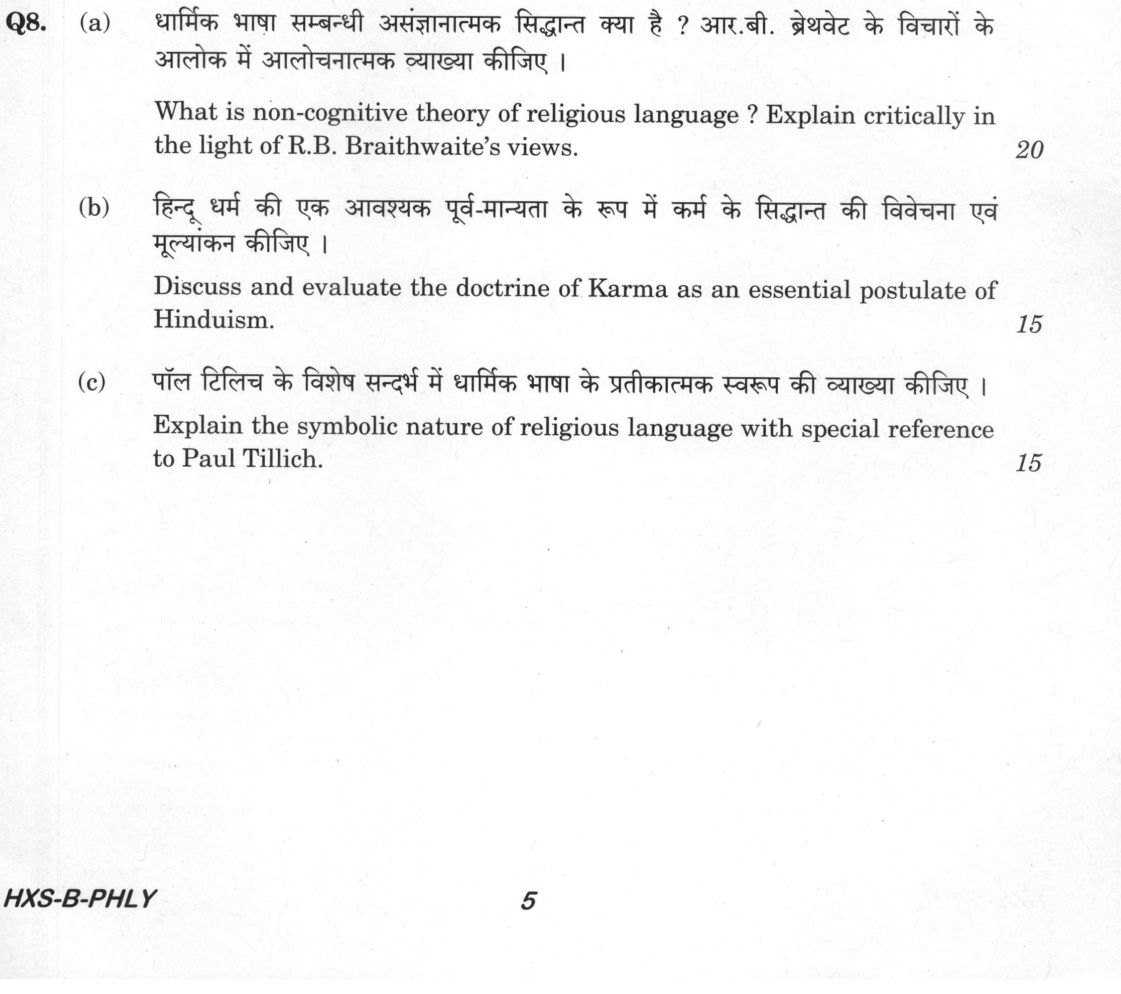
(a) What is non-cognitive theory of religious language? Explain critically in the light of R.B. Braithwaite's views. (20…
What is non-cognitive theory of religious language? Explain critically in the light of R.B. Braithwaite's views. 20 marks
Discuss and evaluate the doctrine of Karma as an essential postulate of Hinduism. 15 marks
Explain the symbolic nature of religious language with special reference to Paul Tillich. 15 marks
हिंदी में प्रश्न पढ़ें
धार्मिक भाषा संबंधी असंज्ञानात्मक सिद्धांत क्या है ? आर.बी. ब्रेथवेट के विचारों के आलोक में आलोचनात्मक व्याख्या कीजिए । (20 अंक)
हिंदू धर्म की एक आवश्यक पूर्व-मान्यता के रूप में कर्म के सिद्धांत की विवेचना एवं मूल्यांकन कीजिए । (15 अंक)
पॉल टिलिच के विशेष संदर्भ में धार्मिक भाषा के प्रतीकात्मक स्वरूप की व्याख्या कीजिए । (15 अंक)
Model answer
Written by UPSC Answer Check against this question's marking rubric, to the expected length. UPSC does not publish answers for Mains — this is one way to score well, not an official key.
Theories of religious language divide over whether statements about God make truth-claims or merely express attitudes. Non-cognitive theories deny that religious utterances are fact-stating; R.B. Braithwaite's version is the most rigorous empiricist rendering of this position.
Braithwaite's Non-Cognitive Theory
Braithwaite, in "An Empiricist's View of the Nature of Religious Belief," holds that religious assertions are not descriptions of transcendent facts but expressions of an intention to follow a way of life. A religious belief is a policy of action anchored to a story: the Christian's assertion that "God is love" means the commitment to an agapeistic life, with the parable of Christ as the psychological vehicle sustaining that commitment. Crucially, Braithwaite is agnostic about metaphysical claims—two believers with identical moral commitments but opposed theological beliefs are, for him, not really disagreeing. Religious language thus reduces to moral language plus story.
Critically, this is both its strength and weakness. Its strength is honesty about verification: since no empirical test settles God-talk, construing it as commitment avoids falsification. But Hick objects that this is reductionist—it empties religious language of its referential intent, and the believer who says "God exists" does not mean merely "I intend to be loving." D.Z. Phillips, from a Wittgensteinian angle, criticises Braithwaite for making religion a mere means to morality, whereas in genuine religious life the moral and the devotional are inseparable. Theological realists add that if religious claims are not truth-claims, inter-religious disagreement, martyrdom, and prayer become unintelligible. Braithwaite's theory explains the ethical function of religious language but not its apparent cognitive force.
Karma as an Essential Postulate of Hinduism
Karma is the cosmic moral law that every action (karma) bears its fruit (phala), binding the agent to rebirth until liberation. Its textual basis runs from the Brihadaranyaka and Chandogya Upanishads through the Bhagavad Gita and the Dharmaśāstra traditions, where it grounds varṇa, āśrama, and soteriology. As an "essential postulate," it explains suffering without a capricious God and motivates ethical living.
Yet its essentiality is contestable. Buddhism accepts karma but denies the enduring self (anattā), showing karma need not presuppose a substantial ātman. Jainism materialises karma as pudgala, a different metaphysics altogether. Within Hinduism itself, bhakti traditions relativise ritual-karmic accumulation before divine grace, and Śaṅkara's Advaita sublates karma into jñāna-mārga—karma is real at the empirical level but transcended in liberating knowledge. Mīmāṃsā, by contrast, treats karma and apūrva as the very core of Dharma. Karma is thus central to Hindu moral cosmology, but "essential postulate" overstates its uniformity across Hindu schools.
Tillich's Symbolic Theology
Paul Tillich distinguishes sign from symbol: a sign merely points, while a symbol participates in the reality it signifies and opens levels of being otherwise closed. Religious language is necessarily symbolic because God as Ground of Being is unconditionally transcendent—no literal predicate can capture the infinite. "God is love" is symbolic, not a description of a being among beings.
Critically, MacIntyre charges that Tillich's symbolic theology smuggles in a disguised metaphysics while claiming to avoid literalism, and that symbolic correspondence cannot be verified. Tillich's reply—that symbols are validated by their existential power—risks making religious truth merely expressive, converging uncomfortably with Braithwaite.
Conclusion
Braithwaite reduces religious language to moral commitment, Tillich elevates it to participatory symbol; both evade crude literalism but risk losing cognitive content. A defensible position lies between: religious language is symbolic and practical, yet not wholly non-cognitive, since it makes claims about ultimate reality that can be rationally debated.
What "Critically examine" is asking you to do
Test the proposition the question puts to you and return a finding on how far it holds. Examine stems carry a claim, or ask whether something has happened, and expect evidence weighed both ways before the extent is stated — often with remedial measures attached. “Critically” is not a section added at the end: name the yardstick you are judging by — the evidence, the stated objective, a constitutional principle, a rival explanation — and let a verdict close each part of the body. Where the question quotes a claim, that verdict must land on the claim itself, accepted, qualified or rejected, and not on the theme in general.
Structure that answers it
Restate the claim as the question frames it → evidence that supports it → evidence that undercuts it → the conditions under which it holds → verdict on how far it stands
Where marks are lost
Merits in one paragraph, demerits in the next, and a conclusion calling for a balanced and holistic approach. That is a survey with the judgement left out and it holds the answer in the middle band. The opposite error is reading “critically” as permission to attack — and with the odd pairings, critically describe or critically explain, the exposition still carries most of the marks, the judgement being a layer on it rather than a substitute for it.
How this answer will be evaluated
Approach
Framework: UPSC Philosophy Paper II. (a) critically evaluate: positives > negatives/limits > conditions/safeguards > conclusion | (b) evaluate: criteria > evidence > balanced judgment | (c) explain: definition/context > points in order > small example > short close Full marks: Precise reconstruction, strong critical evaluation, technical vocabulary, concrete examples.
Key points expected
- Define non-cognitive theory of religious language
- Explain Braithwaite's 'commitment' or 'way of life' view
- Contrast with cognitive/verificationist theories
- Critically evaluate strengths and weaknesses
- Define Karma as essential postulate
- Explain its role in moral order
- Discuss connection to rebirth/samsara
- Evaluate its philosophical significance
Evaluation rubric
Each sub-part is marked on its own, against the marks and word limit printed on the paper.
- (a) Reconstruct Braithwaite's non-cognitive theory and evaluate its limits. 20 marks
critically evaluate— positives → negatives/limits → conditions/safeguards → conclusion
Must cover
- Define non-cognitive theory of religious language
- Explain Braithwaite's 'commitment' or 'way of life' view
- Contrast with cognitive/verificationist theories
- Critically evaluate strengths and weaknesses
Loses marks
- Biographical details of Braithwaite
- Vague paraphrase without technical terms
- Failure to distinguish from cognitive theory
Earns more
- Reference to 'The Meaning of God'
- Comparison with Ayer's verificationism
- Discussion of 'expressive' function of language
- Mention of 'practical' vs 'theoretical' statements
Extra mark
- Reference to 'Theism and Ethics'
- Mention of 'moral commitment' aspect
- (b) Discuss Karma as essential postulate and evaluate its role in Hinduism. 15 marks
evaluate— criteria → evidence → balanced judgment
Must cover
- Define Karma as essential postulate
- Explain its role in moral order
- Discuss connection to rebirth/samsara
- Evaluate its philosophical significance
Loses marks
- Superficial description without evaluation
- Confusion with 'karma' in popular culture
- Failure to link to essential postulate
Earns more
- Reference to 'karma-vada' in Sanskrit
- Discussion of 'moral causality'
- Comparison with Western moral theories
- Mention of 'karma yoga' or 'karma-kanda'
Extra mark
- Reference to specific Upanishadic texts
- Mention of 'karma-phala' (fruit of action)
- (c) Explain symbolic nature of religious language via Paul Tillich. 15 marks
explain— definition/context → points in order → small example → short close
Must cover
- Define symbolic nature of religious language
- Explain Tillich's 'symbol' vs 'sign'
- Discuss 'participatory' nature of symbols
- Apply to concrete religious concepts
Loses marks
- Biographical details of Tillich
- Vague paraphrase without technical terms
- Failure to distinguish symbol from sign
Earns more
- Reference to 'Dynamics of Faith'
- Discussion of 'ultimate concern'
- Comparison with literal language
- Mention of 'symbolic' vs 'propositional' language
Extra mark
- Reference to 'Theology of Culture'
- Mention of 'symbolic' vs 'mythical' language
Practice this exact question
Write your answer and it is marked point by point against the model answer above — what you covered, what you missed, what you got wrong.
Evaluate my answer →More from Philosophy 2021 Paper II
- Q5 Answer the following questions in about 150 words each: (a) Discuss the nature of God as…
- Q6 (a) Discuss the concept of immortality of soul with special reference to Hindu tradition.…
- Q7 (a) Discuss the role of reason and faith in religion. Can reason be a regulative force in…
- Q8 (a) What is non-cognitive theory of religious language? Explain critically in the light o…