Paper II — Q7
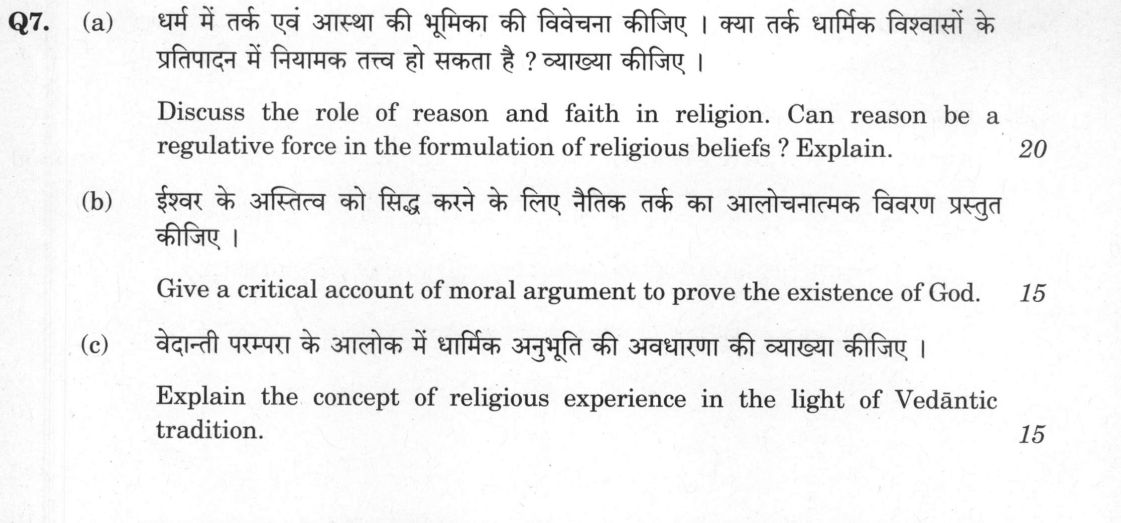
(a) Discuss the role of reason and faith in religion. Can reason be a regulative force in the formulation of religious beliefs?…
Discuss the role of reason and faith in religion. Can reason be a regulative force in the formulation of religious beliefs? Explain. 20 marks
Give a critical account of moral argument to prove the existence of God. 15 marks
Explain the concept of religious experience in the light of Vedāntic tradition. 15 marks
हिंदी में प्रश्न पढ़ें
धर्म में तर्क एवं आस्था की भूमिका की विवेचना कीजिए । क्या तर्क धार्मिक विश्वासों के प्रतिपादन में नियामक तत्व हो सकता है ? व्याख्या कीजिए । (20 अंक)
ईश्वर के अस्तित्व को सिद्ध करने के लिए नैतिक तर्क का आलोचनात्मक विवरण प्रस्तुत कीजिए । (15 अंक)
वेदांती परंपरा के आलोक में धार्मिक अनुभूति की अवधारणा की व्याख्या कीजिए । (15 अंक)
Model answer
Written by UPSC Answer Check against this question's marking rubric, to the expected length. UPSC does not publish answers for Mains — this is one way to score well, not an official key.
Reason and Faith in Religion
Reason operates as a cognitive faculty grounded in logical coherence, empirical verification, and conceptual analysis, whereas faith is an existential, fiducial commitment involving trust (fiducia) and assent (assensus) to transcendent truths. In religion, their relationship is best understood through the Kantian distinction between constitutive and regulative principles: while reason cannot constitutively construct the transcendent content of religious reality, it serves an indispensable regulative function.
As a regulative force, reason examines the internal consistency of dogmas, purges religion of uncritical superstition, and provides analogical frameworks for unintelligible claims. Thomas Aquinas demonstrated how reason clarifies revelation through analogy; Paul Tillich framed reason as the cognitive structure that receives the ecstatic content of faith; and Sarvepalli Radhakrishnan emphasized that religion, to remain viable, must submit its claims to critical rational scrutiny.
However, reason possesses structural limits. Radical fideists like Søren Kierkegaard and Karl Barth argue that reason cannot bridge the infinite qualitative distinction between God and humanity, requiring a "leap of faith." Conversely, the classical synthesis formulated by Anselm—*fides quaerens intellectum* (faith seeking understanding)—demonstrates that faith provides the primary experiential orientation, while reason functions regulatively to clarify, order, and defend those convictions.
Critical Account of Moral Arguments
Moral arguments infer the existence of God from the reality of moral obligation and the necessity of moral order. Immanuel Kant rejected theoretical proofs of God, instead framing theism as a necessary postulate of practical reason. For Kant, morality commands the realization of the *Summum Bonum*—the union of perfect virtue with proportionate happiness. Because moral agents cannot align natural reality with moral desert, practical reason must postulate a supreme, holy moral governor capable of harmonizing morality and happiness.
John Henry Newman advanced an intuitive moral argument, asserting that the prescriptive authority of conscience implies a transcendent Lawgiver. Through the *Illative Sense*—the non-formal convergence of experiential probabilities—Newman argued that the feeling of moral accountability rationally justifies theistic belief.
Critically, Kant’s transition from moral autonomy to theistic postulates is contested; critics argue that moral duty derives authority solely from reason itself, and the obligation to pursue an ideal does not ontologically guarantee its objective actualization. Furthermore, naturalistic and evolutionary accounts—such as Freudian psychoanalysis and sociobiology—explain conscience as an internalized social construct rather than a divine imprint, exposing Newman's inference to potential circularity without antecedent faith.
Religious Experience in the Vedāntic Tradition
In Indian philosophy, Vedānta treats religious experience (anubhava) not as subjective emotion, but as an epistemic realization validating śruti (scripture). Vedānta categorizes meditative absorption into savikalpa samādhi (absorption retaining subject-object distinctions) and nirvikalpa samādhi (unmediated, non-dual absorption).
For Śaṅkara's Advaita Vedānta, ultimate anubhava is identical with Brahma-jñāna. It is self-luminous (svayaṃprakāśa) and non-sublatable (abādhita), entirely transcending the empirical dichotomy of reason and faith. Rāmānuja’s Viśiṣṭādvaita rejects contentless, unqualified experience, defining religious experience as *bhakti-rūpāpanna-jñāna*—a continuous, loving meditation on a qualified personal God (Saguṇa Brahman). While Śaṅkara prioritizes anubhava as transcending relational knowing, Rāmānuja insists that religious experience remains distinctively personal and relational.
Vedānta resolves the reason-faith dialectic through the threefold discipline of śravaṇa (hearing revelation through faith or śraddhā), manana (rational reflection or vicāra), and nididhyāsana (meditative contemplation). A balanced approach to religious epistemology thus emerges when faith provides the initial receptivity, reason acts as a regulative and purifying filter, and direct spiritual experience (anubhava) provides ultimate epistemic validation.
What "Discuss" is asking you to do
Lay the issue out from more than one side — how it arose, what is claimed for it, what is held against it, and where it now stands. UPSC attaches discuss to broad topics with several live dimensions, so coverage of the dimensions earns more than the strength of your opinion.
Structure that answers it
Set the issue up → the case as it is made → the case against → the dimension both sides leave out → where the balance now lies
Where marks are lost
Listing facts with no thread between them, or arguing one side throughout and calling it a discussion.
How this answer will be evaluated
Approach
Framework: UPSC Philosophy Paper II. (a) discuss: intro > 3-4 dimensions > example > balanced close | (b) critique: the claim > its strengths > its weaknesses > your judgment | (c) explain: definition/context > points in order > small example > short close Full marks: Precise reconstruction of arguments, strong counter-arguments, clear evaluation, and use of technical vocabulary.
Key points expected
- Define the distinct roles of reason and faith in religion
- Explain reason as a regulative force in belief formulation
- Present the strongest objection to reason's regulative role
- Provide a balanced evaluation of the tension between the two
- Reconstruct the moral argument (e.g., Kant's)
- Identify the strongest objection to the argument
- Evaluate the validity of the argument
- Provide a clear judgment on its success
Evaluation rubric
Each sub-part is marked on its own, against the marks and word limit printed on the paper.
- (a) Analyze the interplay of reason and faith and reason's role in regulating religious belief. 20 marks
discuss— intro → 3-4 dimensions → example → balanced close
Must cover
- Define the distinct roles of reason and faith in religion
- Explain reason as a regulative force in belief formulation
- Present the strongest objection to reason's regulative role
- Provide a balanced evaluation of the tension between the two
Loses marks
- Biographical details of philosophers
- Vague paraphrase of arguments
- Failure to address the 'regulative force' aspect
Earns more
- Reference to Kant's regulative vs constitutive use of reason
- Reference to Aquinas' harmony of faith and reason
- Reference to Hume's critique of religious belief
- Reference to Tillich's 'rational faith'
Extra mark
- Reference to specific philosophical texts (e.g., Critique of Pure Reason)
- Reference to specific Indian philosophical schools (e.g., Nyaya)
- (b) Critically evaluate the moral argument for the existence of God. 15 marks
critique— the claim → its strengths → its weaknesses → your judgment
Must cover
- Reconstruct the moral argument (e.g., Kant's)
- Identify the strongest objection to the argument
- Evaluate the validity of the argument
- Provide a clear judgment on its success
Loses marks
- Biographical details of philosophers
- Vague paraphrase of arguments
- Failure to present a clear judgment
Earns more
- Reference to Kant's 'moral proof' of God
- Reference to the Euthyphro dilemma
- Reference to naturalistic explanations of morality
- Reference to the problem of evil
Extra mark
- Reference to specific philosophical texts (e.g., Groundwork of the Metaphysics of Morals)
- Reference to specific Indian philosophical schools (e.g., Dharma)
- (c) Explain the concept of religious experience within the Vedantic tradition. 15 marks
explain— definition/context → points in order → small example → short close
Must cover
- Define religious experience in the Vedantic context
- Explain the nature of the experience (e.g., Moksha, Brahman)
- Provide a small example of such an experience
- Provide a short conclusion on its significance
Loses marks
- Biographical details of philosophers
- Vague paraphrase of concepts
- Failure to ground the explanation in Vedantic tradition
Earns more
- Reference to Advaita Vedanta
- Reference to Dvaita Vedanta
- Reference to specific Upanishadic texts
- Reference to specific Vedantic philosophers (e.g., Shankara, Ramanuja)
Extra mark
- Reference to specific philosophical texts (e.g., Brahma Sutras)
- Reference to specific Indian philosophical schools (e.g., Yoga)
Practice this exact question
Write your answer and it is marked point by point against the model answer above — what you covered, what you missed, what you got wrong.
Evaluate my answer →More from Philosophy 2021 Paper II
- Q4 (a) Discuss the views of Dr. B.R. Ambedkar regarding caste-discrimination in Indian socie…
- Q5 Answer the following questions in about 150 words each: (a) Discuss the nature of God as…
- Q6 (a) Discuss the concept of immortality of soul with special reference to Hindu tradition.…
- Q7 (a) Discuss the role of reason and faith in religion. Can reason be a regulative force in…
- Q8 (a) What is non-cognitive theory of religious language? Explain critically in the light o…