Paper II — Q5
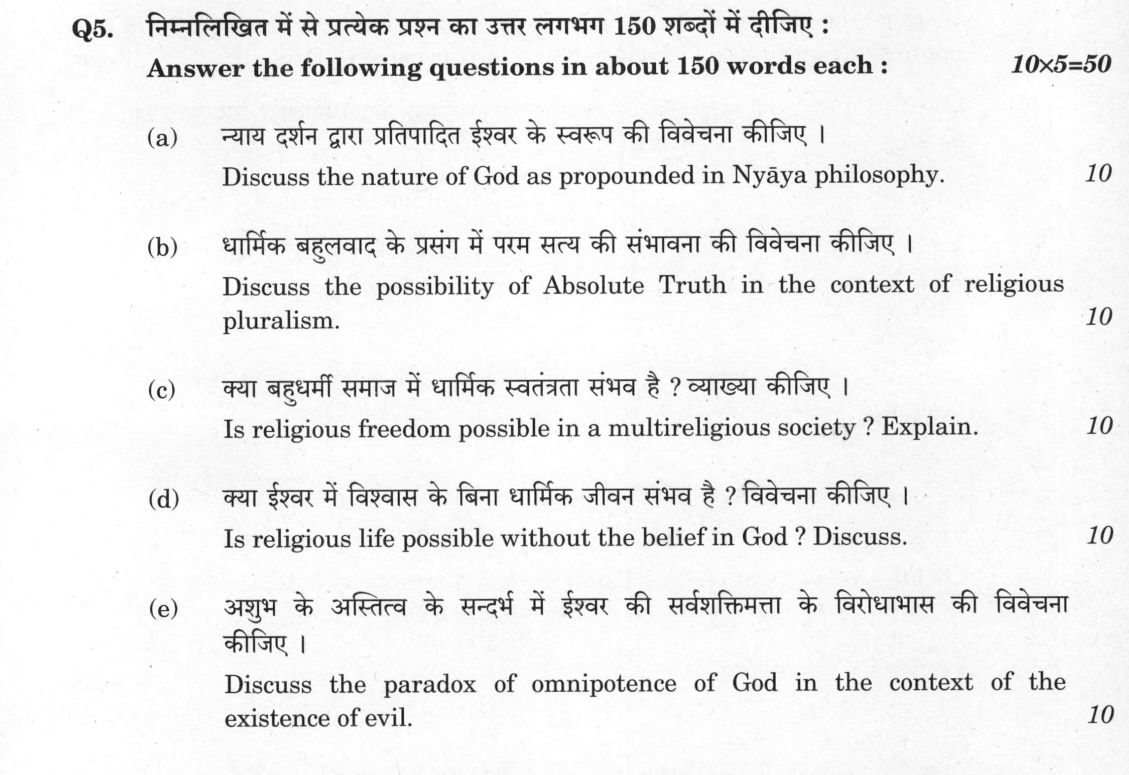
Answer the following questions in about 150 words each: (a) Discuss the nature of God as propounded in Nyāya philosophy. (10…
Answer the following questions in about 150 words each:
Discuss the nature of God as propounded in Nyāya philosophy. 10 marks
Discuss the possibility of Absolute Truth in the context of religious pluralism. 10 marks
Is religious freedom possible in a multireligious society? Explain. 10 marks
Is religious life possible without the belief in God? Discuss. 10 marks
Discuss the paradox of omnipotence of God in the context of the existence of evil. 10 marks
हिंदी में प्रश्न पढ़ें
निम्नलिखित में से प्रत्येक प्रश्न का उत्तर लगभग 150 शब्दों में दीजिए :
न्याय दर्शन द्वारा प्रतिपादित ईश्वर के स्वरूप की विवेचना कीजिए । (10 अंक)
धार्मिक बहुलवाद के प्रसंग में परम सत्य की संभावना की विवेचना कीजिए । (10 अंक)
क्या बहुधर्मी समाज में धार्मिक स्वतंत्रता संभव है ? व्याख्या कीजिए । (10 अंक)
क्या ईश्वर में विश्वास के बिना धार्मिक जीवन संभव है ? विवेचना कीजिए । (10 अंक)
अशुभ के अस्तित्व के संदर्भ में ईश्वर की सर्वशक्तिमता के विरोधाभास की विवेचना कीजिए । (10 अंक)
Model answer
Written by UPSC Answer Check against this question's marking rubric, to the 150-word length. UPSC does not publish answers for Mains — this is one way to score well, not an official key.
(a) Nature of God in Nyāya Philosophy
Nyāya conceives God (Īśvara) not as the material cause (upādāna-kāraṇa) or an absolute monistic reality, but strictly as the efficient cause (nimitta-kāraṇa) of the universe. Eternal entities—atoms (paramāṇus), space, time, ether, and individual souls (jīvas)—coexist with God. God does not create from nothing; instead, He synthesizes and orders pre-existing, unconscious atoms into a cosmos. Classical Nyāya thinkers like Udayana formulate rational proofs for God’s reality: the cosmological argument from effect (kāryāt), asserting that the composite physical world requires an intelligent maker; the argument from atomic combination (āyojanāt), positing an initial divine volition to set inert atoms into motion; and the argument from moral desert (adṛṣṭa), requiring an omniscient supervisor to distribute karmic fruits to souls. Unlike Advaita Vedānta’s distinction between phenomenal Saguṇa Brahman and ultimate Nirguṇa Brahman, Nyāya views God as an eternally distinct, individual Supreme Soul (Paramātman) endowed with perfect consciousness, omniscience, and agency.
(b) Absolute Truth and Religious Pluralism
Religious pluralism confronts the epistemological tension between exclusivism (only one faith holds saving truth) and inclusivism (one faith fulfills all others) in light of conflicting doctrinal claims. To reconcile these, John Hick proposes the 'pluralistic hypothesis', using a Kantian distinction between the transcendent 'Real' (an sich) and its culturally conditioned phenomenal manifestations across diverse world religions. Raimon Panikkar develops a 'cosmotheandric' insight, viewing reality as an intrinsically relational synthesis of the divine, the human, and the cosmic, thereby validating diverse religious paths without homogenizing them. The apparent contradictions among historical truth-claims do not negate Absolute Truth; rather, they demonstrate human epistemic limitation before an inexhaustible transcendent reality. Hick further suggests 'eschatological verification', where ultimate truth-claims remain subject to post-mortem validation. Thus, in a pluralistic framework, Absolute Truth shifts from being the exclusive possession of a single creed to a shared, transcendent horizon.
(c) Religious Freedom in a Multireligious Society
Religious freedom in a plural society demands harmonizing individual belief with collective order. Conceptually, it requires distinguishing between the inviolable inner freedom of conscience (the private right to hold any belief) and the outer freedom to manifest, practice, and propagate religion. In contemporary political philosophy, John Rawls accommodates this pluralism through an 'overlapping consensus', wherein diverse comprehensive religious doctrines converge on shared principles of justice. The Indian constitutional paradigm illustrates this balance through Articles 25 to 28. Article 25 guarantees both freedom of conscience and the right to profess, practise, and propagate religion, while explicitly subjecting external practices to state regulation on grounds of 'public order, morality, and health', as well as social reform. Rather than adopting an aloof Western wall-of-separation secularism, Indian secularism exercises principled intervention and equal treatment (sarva dharma sambhava), ensuring that diverse religious freedoms flourish within the boundaries of constitutional morality.
(d) Religious Life Without Belief in God
Religious life is fundamentally defined by ultimate concern, moral transformation, and the pursuit of spiritual liberation, none of which conceptually depend on metaphysical theism. Classical Indian heterodox systems present rigorous non-theistic frameworks: early Buddhism rejects a creator deity (anīśvara) and an eternal soul (anattā), structuring the religious life entirely around the Four Noble Truths, moral discipline (śīla), mindfulness, and the attainment of nirvāṇa. Similarly, Jainism rejects a divine creator and grounds religious devotion in the veneration of *tīrthaṅkaras*—historical human beings who attained supreme spiritual perfection through self-conquest and non-violence (ahiṃsā). In Western thought, Auguste Comte’s 'Religion of Humanity' and contemporary secular spirituality demonstrate that sacredness, ethical duty, and communal ritual can center on human solidarity rather than transcendence. Thus, religious life flourishes wherever existential meaning, self-transcendence, and ethical commitments are cultivated, with or without a personal God.
(e) Paradox of Omnipotence and the Problem of Evil
The paradox of omnipotence emerges from the coexistence of an all-powerful, all-good deity and worldly suffering. J.L. Mackie formulated this as a logical contradiction: an omnipotent God could prevent evil, and an omnibenevolent God would desire to, yet evil exists. William Rowe developed the evidential problem, arguing that vast, gratuitous suffering renders an omnipotent deity improbable. In response, Alvin Plantinga’s Free Will Defense argues that omnipotence does not extend to performing logical impossibilities; creating genuinely free creatures inherently carries the risk of moral evil. Process theology alters the classical premise by positing a dipolar God whose power is persuasive rather than coercive, thereby dissolving the paradox. Conversely, Indian theodicy relies on the autonomous karma-saṃsāra framework, where suffering is the direct consequence of an individual’s past actions across lifetimes, leaving God's omnipotence and benevolence uncompromised as an impartial dispenser of cosmic moral law.
What "Discuss" is asking you to do
Lay the issue out from more than one side — how it arose, what is claimed for it, what is held against it, and where it now stands. UPSC attaches discuss to broad topics with several live dimensions, so coverage of the dimensions earns more than the strength of your opinion.
Structure that answers it
Set the issue up → the case as it is made → the case against → the dimension both sides leave out → where the balance now lies
Where marks are lost
Listing facts with no thread between them, or arguing one side throughout and calling it a discussion.
How this answer will be evaluated
Approach
Framework: State the position > Argument > Strongest objection > Evaluation. (a) discuss: intro > 3-4 dimensions > example > balanced close | (b) discuss: intro > 3-4 dimensions > example > balanced close | (c) explain: definition/context > points in order > small example > short close | (d) discuss: intro > 3-4 dimensions > example > balanced close | (e) discuss: intro > 3-4 dimensions > example > balanced close Full marks: Precise reconstruction, Sanskrit/Greek terms, strongest objection, balanced evaluation
Key points expected
- God as intelligent, eternal, omnipotent creator
- Inference from order of world (vyavahāra)
- Distinction from Sāṃkhya and Vedānta views
- Strongest objection to Nyāya theism
- Define Absolute Truth (paramārtha)
- Pluralism's challenge to exclusivism
- Strongest argument for/against Absolute Truth
- Balanced conclusion on possibility
Evaluation rubric
Each sub-part is marked on its own, against the marks and word limit printed on the paper.
- (a) Reconstruct the Nyāya argument for God's existence and nature. 10 marks · 150 words
discuss— intro → 3-4 dimensions → example → balanced close
Must cover
- God as intelligent, eternal, omnipotent creator
- Inference from order of world (vyavahāra)
- Distinction from Sāṃkhya and Vedānta views
- Strongest objection to Nyāya theism
Loses marks
- Biographical details of Gautama
- Vague paraphrase of 'God is good'
- Confusing Nyāya with Vedānta
Earns more
- Use of Sanskrit terms (Iśvara, pramāṇa)
- Reference to Uddyotakara or Vācaspati Miśra
- Mention of Nyāya Sūtra 1.1.38
Extra mark
- Citation of specific Nyāya Sūtra
- Comparison with Dignāga's critique
- (b) Evaluate if Absolute Truth is possible given religious pluralism. 10 marks · 150 words
discuss— intro → 3-4 dimensions → example → balanced close
Must cover
- Define Absolute Truth (paramārtha)
- Pluralism's challenge to exclusivism
- Strongest argument for/against Absolute Truth
- Balanced conclusion on possibility
Loses marks
- Listing religions without analysis
- Assuming one religion is 'correct'
- Ignoring the 'Absolute' qualifier
Earns more
- Reference to John Hick or Raimond Guralnik
- Use of 'soteriological pluralism'
- Mention of 'incommensurability' argument
Extra mark
- Citation of specific pluralist philosopher
- Reference to 'cognitive closure' argument
- (c) Explain the feasibility of religious freedom in multireligious societies. 10 marks · 150 words
explain— definition/context → points in order → small example → short close
Must cover
- Define religious freedom in plural context
- Tension between individual and group rights
- Legal/constitutional framework (e.g., Art. 25-28)
- Concrete example of conflict/resolution
Loses marks
- Vague assertion that 'freedom is possible'
- Ignoring the 'multireligious' constraint
- No concrete example or legal reference
Earns more
- Reference to 'secularism' vs 'laïcité'
- Mention of 'reasonable accommodation' doctrine
- Citation of specific court case
Extra mark
- Reference to specific Supreme Court judgment
- Mention of 'internal limits' doctrine
- (d) Discuss if religious life is possible without belief in God. 10 marks · 150 words
discuss— intro → 3-4 dimensions → example → balanced close
Must cover
- Define 'religious life' (ritual, ethics, community)
- Arguments for non-theistic religion (Buddhism, Jainism)
- Strongest objection (e.g., 'religion requires transcendence')
- Balanced evaluation of the claim
Loses marks
- Assuming 'religion = God worship'
- Ignoring non-theistic traditions
- No evaluation of the 'possibility' claim
Earns more
- Reference to 'non-theistic' vs 'atheistic' distinction
- Mention of 'spiritual but not religious' movement
- Use of 'dharma' as non-theistic framework
Extra mark
- Citation of specific non-theistic text
- Reference to 'process theology' as middle ground
- (e) Discuss the paradox of God's omnipotence given evil's existence. 10 marks · 150 words
discuss— intro → 3-4 dimensions → example → balanced close
Must cover
- State the 'Problem of Evil' (logical/moral)
- Omnipotence vs. omnibenevolence tension
- Strongest theodicy (e.g., free will, soul-making)
- Evaluation of theodicy's adequacy
Loses marks
- Vague statement 'God allows evil'
- Ignoring the 'omnipotence' component
- No evaluation of theodicy
Earns more
- Reference to 'Epicurean paradox'
- Mention of 'Irenaean theodicy'
- Use of 'soul-making' (John Hick)
Extra mark
- Citation of specific theodicy philosopher
- Reference to 'greater good' defense
Practice this exact question
Write your answer and it is marked point by point against the model answer above — what you covered, what you missed, what you got wrong.
Evaluate my answer →More from Philosophy 2021 Paper II
- Q2 (a) Discuss whether Amartya Sen's idea of justice is an improvement upon Rawl's theory of…
- Q3 (a) Discuss anarchism as a political ideology. Is it possible to dispense with political…
- Q4 (a) Discuss the views of Dr. B.R. Ambedkar regarding caste-discrimination in Indian socie…
- Q5 Answer the following questions in about 150 words each: (a) Discuss the nature of God as…
- Q6 (a) Discuss the concept of immortality of soul with special reference to Hindu tradition.…
- Q7 (a) Discuss the role of reason and faith in religion. Can reason be a regulative force in…
- Q8 (a) What is non-cognitive theory of religious language? Explain critically in the light o…