Paper II — Q1
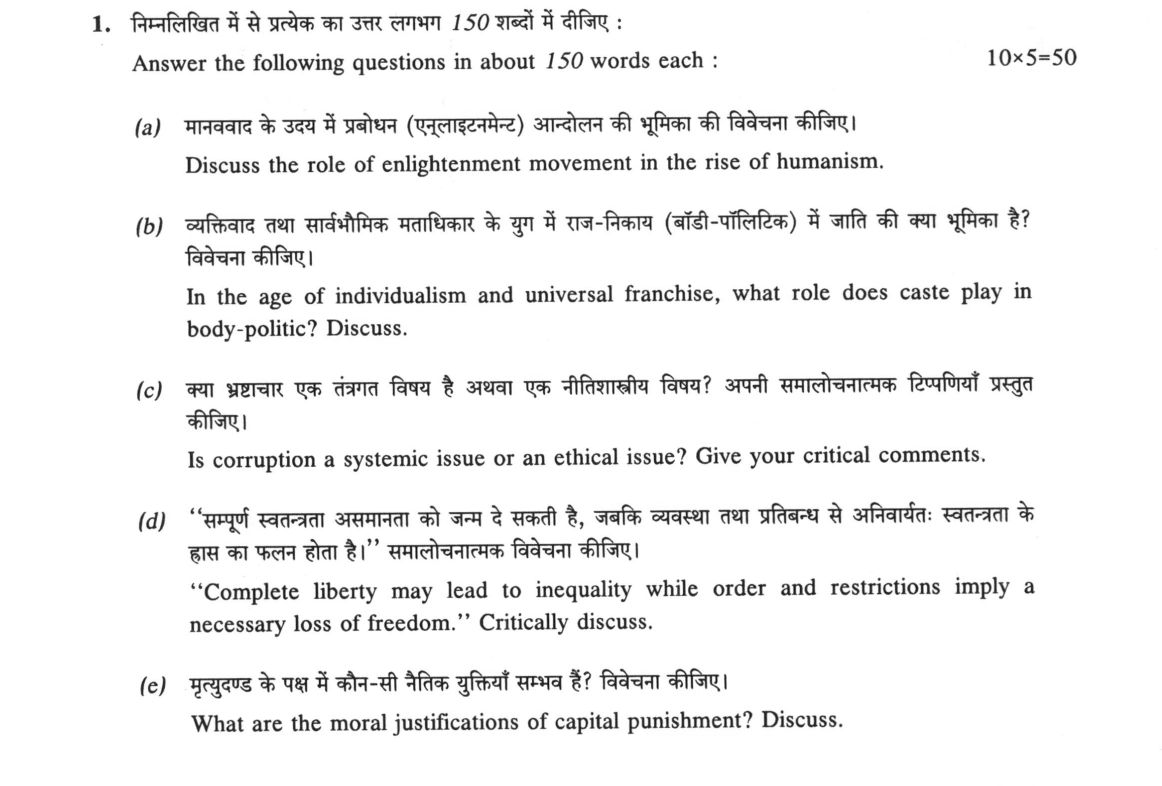
Answer the following questions in about 150 words each: (a) Discuss the role of enlightenment movement in the rise of humanism…
Answer the following questions in about 150 words each:
Discuss the role of enlightenment movement in the rise of humanism. 10 marks
In the age of individualism and universal franchise, what role does caste play in body-politic? Discuss. 10 marks
Is corruption a systemic issue or an ethical issue? Give your critical comments. 10 marks
"Complete liberty may lead to inequality while order and restrictions imply a necessary loss of freedom." Critically discuss. 10 marks
What are the moral justifications of capital punishment? Discuss. 10 marks
हिंदी में प्रश्न पढ़ें
निम्नलिखित में से प्रत्येक का उत्तर लगभग 150 शब्दों में दीजिए :
मानववाद के उदय में प्रबोधन (एनलाइटनमेंट) आंदोलन की भूमिका की विवेचना कीजिए। (10 अंक)
व्यक्तिवाद तथा सार्वभौमिक मताधिकार के युग में राज-निकाय (बॉडी-पॉलिटिक) में जाति की क्या भूमिका है? विवेचना कीजिए। (10 अंक)
क्या भ्रष्टाचार एक तंत्रगत विषय है अथवा एक नीतिशास्त्रीय विषय? अपनी समालोचनात्मक टिप्पणियाँ प्रस्तुत कीजिए। (10 अंक)
"सम्पूर्ण स्वतंत्रता असमानता को जन्म दे सकती है, जबकि व्यवस्था तथा प्रतिबंध से अनिवार्यतः स्वतंत्रता के ह्रास का फलन होता है।" समालोचनात्मक विवेचना कीजिए। (10 अंक)
मृत्युदंड के पक्ष में कौन-सी नैतिक युक्तियाँ संभव हैं? विवेचना कीजिए। (10 अंक)
Model answer
Written by UPSC Answer Check against this question's marking rubric, to the 150-word length. UPSC does not publish answers for Mains — this is one way to score well, not an official key.
(a) Enlightenment Movement and the Rise of Humanism
The Enlightenment marked a radical paradigm shift from a theocentric to an anthropocentric worldview, placing human reason, dignity, and autonomy at the center of philosophical inquiry. Immanuel Kant encapsulated this spirit in his call Sapere Aude ("dare to know"), urging humanity to emerge from its self-incurred tutelage by relying on rational intellect rather than dogmatic authority.
By systematically dismantling the divine right of kings and scholastic metaphysics, Enlightenment thinkers decoupled morality from theological sanction. Denis Diderot and Jean le Rond d'Alembert’s Encyclopédie epitomized this transition by secularizing knowledge, viewing human beings as rational agents capable of understanding and transforming the world through science and empirical inquiry. Consequently, ethics was grounded in human reason and social utility rather than divine revelation. This reason-centered anthropology redefined human beings not as fallen creatures dependent on divine grace, but as autonomous moral agents possessed of inherent worth, thereby laying the foundations of modern secular humanism.
(b) Caste in the Body-Politic
In an era defined by universal adult franchise and individualist democratic theory, caste occupies an ambivalent and contested space within India’s body-politic. Theoretically, universal franchise presupposes the autonomous, rights-bearing individual citizen possessing one vote of equal value. In practice, caste operates as a potent instrument of collective mobilization and identity assertion.
On one hand, democratic politics has enabled historically oppressed communities to organize politically, capture state power, and challenge traditional hierarchies. On the other hand, caste often degenerates into entrenched vote-bank politics and sectarian patronage, frustrating B.R. Ambedkar’s vision of the Annihilation of Caste, which sought a moral democracy rooted in fraternity and social endosmosis. Furthermore, the persistence of intra-caste stratification—evident in the "creamy layer" discourse—demonstrates that formal political equality does not automatically dismantle entrenched social capital inequalities. Caste thus functions paradoxically: while it provides an avenue for democratic assertion, it also reproduces structural inequalities that undermine substantive citizenship.
(c) Corruption: Systemic vs. Ethical Issue
Corruption is neither exclusively a systemic dysfunction nor purely an individual moral failing; rather, it is a dialectical interplay of both dimensions.
From a systemic perspective, corruption arises from institutional decay, excessive bureaucratic discretion, opaque administrative processes, and asymmetric information that create rent-seeking opportunities. When institutions lack credible enforcement and accountability mechanisms, corrupt behavior becomes structurally incentivized. Conversely, from an ethical standpoint, corruption reflects a collapse of moral character, the erosion of public duty, and personal greed. As Kautilya observed in the Arthashastra, just as it is impossible not to taste honey placed on the tongue, public officials lacking internal ethical restraint and commitment to dharma inevitably succumb to illicit gain.
Viewing corruption through a single lens is inadequate. Institutional mechanisms remain ineffective without moral actors to enforce them, while individual integrity is difficult to sustain within corrupt systems. The solution lies in institutional moral agency, wherein robust structural transparency works symbiotically with the cultivation of professional public-service ethics.
(d) Liberty, Order, and Inequality
The tension between liberty and order reflects the philosophical challenge of balancing negative and positive freedoms. As Isaiah Berlin articulated, negative liberty denotes the absence of external obstacles, whereas positive liberty entails the capacity for autonomous self-realization. If negative liberty is absolute and unregulated, the unrestrained exercise of economic and social power by the strong inevitably results in exploitation and severe inequality for the weak.
To prevent such domination, order and restrictions become essential. Thomas Hobbes emphasized that without sovereign order, life descends into chaos, while Jean-Jacques Rousseau paradoxically argued that individuals may be "forced to be free" by submitting to the General Will to secure genuine moral and civic liberty. John Rawls addressed this tension through his lexical ordering, prioritizing equal basic liberties while utilizing the Difference Principle to regulate social and economic inequalities. In the Indian constitutional framework, this delicate synthesis is institutionalized: Article 19 guarantees fundamental freedoms, but explicitly subjects them to "reasonable restrictions" under clauses (2) to (6) to harmonize individual liberty with social order and collective welfare.
(e) Moral Justifications of Capital Punishment
The moral justification of capital punishment rests primarily on retributive and utilitarian theories of justice, both of which are countered by human rights and restorative paradigms.
The retributive framework, rooted in Kant’s categorical imperative and the principle of lex talionis, asserts that a person who commits an atrocious crime morally deserves proportional punishment. Kant argued that executing a murderer respects their status as a rational agent accountable for their actions, thereby restoring cosmic and moral equilibrium. Utilitarian justifications, by contrast, focus on consequentialist outcomes: deterrence theory claims that the death penalty discourages prospective offenders from committing heinous crimes, while incapacitation ensures the offender permanently ceases to be a social threat.
Opponents argue from restorative justice that capital punishment violates the inviolable right to life, precludes moral reformation, and risks irreversible execution of the innocent. Reflecting this moral tension, the Supreme Court of India in Bachan Singh v. State of Punjab (1980) formulated the "rarest of rare" doctrine, permitting execution only when the alternative option of life imprisonment is unquestionably foreclosed.
What "Discuss" is asking you to do
Lay the issue out from more than one side — how it arose, what is claimed for it, what is held against it, and where it now stands. UPSC attaches discuss to broad topics with several live dimensions, so coverage of the dimensions earns more than the strength of your opinion.
Structure that answers it
Set the issue up → the case as it is made → the case against → the dimension both sides leave out → where the balance now lies
Where marks are lost
Listing facts with no thread between them, or arguing one side throughout and calling it a discussion.
How this answer will be evaluated
Approach
Framework: UPSC Mains Philosophy Paper II. (a) discuss: intro > 3-4 dimensions > example > balanced close | (b) discuss: intro > 3-4 dimensions > example > balanced close | (c) comment: context > arguments both sides > judgment > close | (d) critique: the claim > its strengths > its weaknesses > your judgment | (e) discuss: intro > 3-4 dimensions > example > balanced close Full marks: Precise philosophical terminology, clear argument structure, strong counter-arguments, and specific references to thinkers or concepts.
Key points expected
- Define Enlightenment (Aufklärung) and its core tenets
- Identify specific humanist values (autonomy, reason, dignity)
- Name at least one key thinker (Kant, Rousseau, Voltaire)
- Explain the causal link between the movement and the rise of humanism
- Define 'body-politic' in the context of modern democracy
- Explain the tension between universal franchise and caste identity
- Discuss caste as a basis for political mobilization (vote banks)
- Mention the role of caste in social stratification and resource distribution
Evaluation rubric
Each sub-part is marked on its own, against the marks and word limit printed on the paper.
- (a) Link Enlightenment rationalism to the emergence of humanist values. · 150 words
discuss— intro → 3-4 dimensions → example → balanced close
Must cover
- Define Enlightenment (Aufklärung) and its core tenets
- Identify specific humanist values (autonomy, reason, dignity)
- Name at least one key thinker (Kant, Rousseau, Voltaire)
- Explain the causal link between the movement and the rise of humanism
Loses marks
- Biographical details of philosophers
- Vague generalities without specific philosophical concepts
- Confusing Enlightenment with the Renaissance
Earns more
- Reference to 'Sapere Aude' (Kant)
- Mention of the shift from theocentric to anthropocentric worldview
- Reference to the French Revolution as a political manifestation
Extra mark
- Reference to the 'Encyclopédie' as a vehicle for humanist ideas
- (b) Analyze the persistence of caste in modern democratic politics. · 150 words
discuss— intro → 3-4 dimensions → example → balanced close
Must cover
- Define 'body-politic' in the context of modern democracy
- Explain the tension between universal franchise and caste identity
- Discuss caste as a basis for political mobilization (vote banks)
- Mention the role of caste in social stratification and resource distribution
Loses marks
- Descriptive account of caste system without political analysis
- Ignoring the 'universal franchise' aspect of the question
- Vague statements about 'social harmony'
Earns more
- Reference to Ambedkar's critique of caste
- Mention of Mandal Commission or reservation policy
- Use of the term 'Sanskritization' (M.N. Srinivas)
Extra mark
- Reference to specific political movements (e.g., Dalit politics)
- (c) Critically evaluate whether corruption is systemic or ethical. · 150 words
comment— context → arguments both sides → judgment → close
Must cover
- Define corruption in a political/ethical context
- Present arguments for it being a systemic issue (incentives, structures)
- Present arguments for it being an ethical issue (individual character)
- Provide a critical judgment synthesizing both views
Loses marks
- One-sided argument without critical evaluation
- Vague moralizing without structural analysis
- Ignoring the 'systemic' vs 'ethical' dichotomy
Earns more
- Reference to 'Moral Hazard' or 'Institutional Failure'
- Mention of 'Nepotism' or 'Cronyism' as specific forms
- Reference to 'Rule of Law' vs 'Rule of Man'
Extra mark
- Reference to specific anti-corruption laws (e.g., Lokpal Act)
- (d) Critically discuss the trade-off between liberty and order. · 150 words
critique— the claim → its strengths → its weaknesses → your judgment
Must cover
- Analyze the claim that 'complete liberty leads to inequality'
- Analyze the claim that 'order implies loss of freedom'
- Reference to a specific political philosopher (Mill, Rawls, Hobbes)
- Provide a balanced judgment on the necessity of restrictions
Loses marks
- Ignoring the 'inequality' aspect of the quote
- Vague generalities about 'freedom' without philosophical grounding
- Failing to address the 'necessary loss' claim
Earns more
- Reference to 'Harm Principle' (Mill)
- Mention of 'Negative' vs 'Positive' liberty (Isaiah Berlin)
- Reference to 'Social Contract' theory
Extra mark
- Reference to specific constitutional provisions (e.g., Article 19)
- (e) Explain the moral justifications for capital punishment. · 150 words
discuss— intro → 3-4 dimensions → example → balanced close
Must cover
- Define capital punishment (death penalty)
- Present the 'Retributive' justification (lex talionis)
- Present the 'Deterrent' justification (prevention of crime)
- Present the 'Incapacitation' justification (removal of threat)
Loses marks
- Focusing only on the 'against' arguments (question asks for justifications)
- Vague moralizing without specific philosophical theories
- Ignoring the 'moral' aspect of the justification
Earns more
- Reference to Kant's retributive argument
- Mention of 'Utilitarian' justification (Bentham)
- Reference to 'Just Deserts' theory
Extra mark
- Reference to specific legal cases or constitutional debates
Practice this exact question
Write your answer and it is marked point by point against the model answer above — what you covered, what you missed, what you got wrong.
Evaluate my answer →More from Philosophy 2022 Paper II
- Q1 Answer the following questions in about 150 words each: (a) Discuss the role of enlighten…
- Q2 (a) What arguments does Bodin present to contend that sovereignty must be absolute, perpe…
- Q3 (a) Do you agree that economic development does not on its own lead to human development…
- Q4 (a) Discuss propaganda as a challenge to democratic form of government. (20 marks) (b) Do…