Paper II — Q3
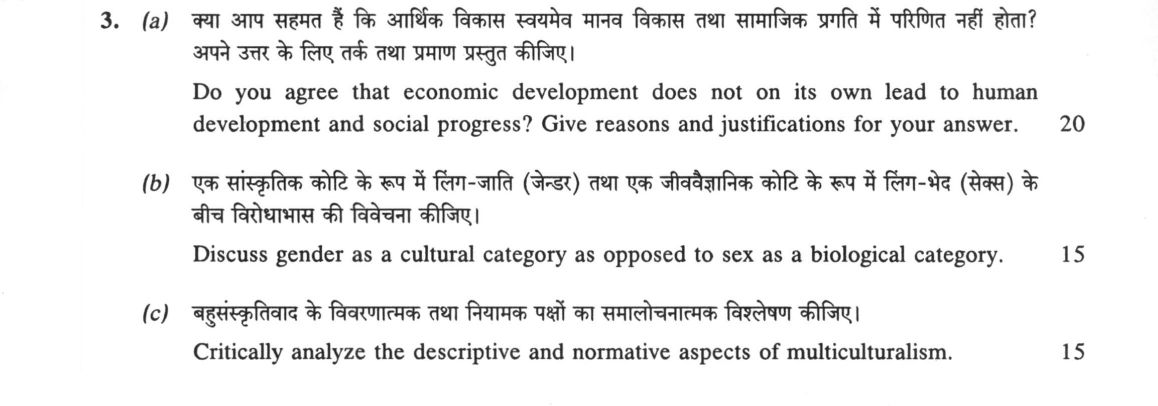
(a) Do you agree that economic development does not on its own lead to human development and social progress? Give reasons and…
Do you agree that economic development does not on its own lead to human development and social progress? Give reasons and justifications for your answer. 20 marks
Discuss gender as a cultural category as opposed to sex as a biological category. 15 marks
Critically analyze the descriptive and normative aspects of multiculturalism. 15 marks
हिंदी में प्रश्न पढ़ें
क्या आप सहमत हैं कि आर्थिक विकास स्वयमेव मानव विकास तथा सामाजिक प्रगति में परिणत नहीं होता? अपने उत्तर के लिए तर्क तथा प्रमाण प्रस्तुत कीजिए। (20 अंक)
एक सांस्कृतिक कोटि के रूप में लिंग-जाति (जेंडर) तथा एक जैववैज्ञानिक कोटि के रूप में लिंग-भेद (सेक्स) के बीच विरोधाभास की विवेचना कीजिए। (15 अंक)
बहुसंस्कृतिवाद के विवरणात्मक तथा नियामक पक्षों का समालोचनात्मक विश्लेषण कीजिए। (15 अंक)
Model answer
Written by UPSC Answer Check against this question's marking rubric, to the expected length. UPSC does not publish answers for Mains — this is one way to score well, not an official key.
Development ethics establishes that economic growth is merely an instrumental means, whereas human flourishing is the substantive end of social progress.
Economic Development versus Human Development
Economic development, measured primarily through Gross Domestic Product (GDP) and market expansion, tracks commodity production and income levels. However, as Amartya Sen argues in his Capability Approach, well-being must be evaluated not by the bundle of goods an individual commands, but by their substantive freedoms—the "capabilities" to achieve valued functionings like being educated, healthy, and socially integrated. The UNDP’s Human Development Index (HDI) operationalizes this critique by incorporating health and education alongside income, demonstrating that economic growth does not automatically expand human capabilities without deliberate redistributive policies.
In India, this divergence is stark. Kerala, historically exhibiting moderate industrial growth, consistently outperforms high-income states like Gujarat and resource-rich states like Jharkhand in human development indices, infant mortality reduction, and literacy due to sustained public investment in social infrastructure. Conversely, mining-driven growth in central-eastern India frequently yields high revenues alongside extensive tribal displacement, dispossession, and acute malnutrition. Without institutional mechanisms ensuring distributive justice and democratic empowerment, economic expansion often exacerbates spatial and social inequality rather than fostering genuine human progress.
Sex as Biological Category and Gender as Cultural Category
Philosophical and sociological inquiry distinguishes biological sex from gender. Sex refers to physiological, chromosomal, and anatomical characteristics. Gender, by contrast, constitutes a socio-cultural system that assigns normative meanings, behavioral expectations, and power hierarchies to those physical differences.
Simone de Beauvoir captured this social construction in The Second Sex, declaring that "one is not born, but rather becomes, a woman." Expanding on this, Judith Butler conceptualizes gender as *performative*—an ongoing, stylized repetition of acts and norms enforced through social discipline rather than an innate ontological essence.
This cultural constructedness is evident in the Indian context. Kinship arrangements such as patrilocal marriage, dowry practices, and entrenched son preference construct women as socio-economic liabilities, translating biological reproduction into gendered subordination. Concurrently, traditional Indian society has long recognized indigenous gender variance—such as hijras and *kinnars*—demonstrating that binary gender categories are historically and culturally contingent rather than biologically fixed.
Descriptive and Normative Multiculturalism
Descriptive multiculturalism refers to the empirical, sociological reality of diverse ethnocultural groups coexisting within a single political space. Normative multiculturalism, however, is a prescriptive political philosophy asserting that cultural diversity possesses moral worth and demands public accommodation through group-differentiated rights.
Charles Taylor anchors normative multiculturalism in the "politics of recognition," arguing that individual identity is dialogically constructed, and misrecognition or non-recognition by the state inflicts severe moral harm. Bhikhu Parekh advances this through "pluralist universalism," positing that no single culture embodies the totality of human values; thus, intercultural dialogue is essential for reciprocal moral critique.
Critically, normative multiculturalism faces profound internal tensions. Susan Moller Okin’s feminist critique highlights that granting unconditional autonomy and group rights to cultural communities often preserves patriarchal practices, thereby subordinating women within minority groups ("minorities within minorities"). The Indian constitutional framework illustrates this balancing act: it normatively affirms cultural pluralism through Articles 29 and 30 and the retention of personal laws, while simultaneously subjecting cultural practices to the fundamental rights of individual equality (Article 14), non-discrimination (Article 15), and dignity (Article 21).
Ultimately, human flourishing requires moving beyond commodity-centric growth toward an expansive capability model. This progress remains incomplete without dismantling gender as a mechanism of cultural subordination and adopting a reflexive multiculturalism that balances group recognition with individual rights and gender justice.
What "Critically analyse" is asking you to do
Break the subject into its working parts and show how they act on each other. The marks are in the interconnections — which factor drives which, and what the resulting structure explains — not in the inventory of factors. “Critically” is not a section added at the end: name the yardstick you are judging by — the evidence, the stated objective, a constitutional principle, a rival explanation — and let a verdict close each part of the body. Where the question quotes a claim, that verdict must land on the claim itself, accepted, qualified or rejected, and not on the theme in general.
Structure that answers it
Define the whole → separate it into its parts → show which part drives which → what that interaction produces → what the structure implies
Where marks are lost
Merits in one paragraph, demerits in the next, and a conclusion calling for a balanced and holistic approach. That is a survey with the judgement left out and it holds the answer in the middle band. The opposite error is reading “critically” as permission to attack — and with the odd pairings, critically describe or critically explain, the exposition still carries most of the marks, the judgement being a layer on it rather than a substitute for it.
How this answer will be evaluated
Approach
Framework: UPSC Mains Philosophy Paper II. (a) justify: claim > 3-4 reasons > evidence > conclusion | (b) discuss: intro > 3-4 dimensions > example > balanced close | (c) critique: the claim > its strengths > its weaknesses > your judgment Full marks: Precise definitions, strong arguments, specific examples, balanced critique.
Key points expected
- Define human development (e.g., Amartya Sen's capability approach).
- Distinguish economic growth from human development.
- Provide 3-4 reasons why economic growth is insufficient.
- Cite specific evidence or examples (e.g., India's HDI vs GDP).
- Define sex as biological (chromosomes, anatomy).
- Define gender as cultural/social construct.
- Explain the socialization process creating gender roles.
- Provide examples of gender differences across cultures.
Evaluation rubric
Each sub-part is marked on its own, against the marks and word limit printed on the paper.
- (a) Justify the claim that economic development alone does not lead to human development and social progress. 20 marks
justify— claim → 3-4 reasons → evidence → conclusion
Must cover
- Define human development (e.g., Amartya Sen's capability approach).
- Distinguish economic growth from human development.
- Provide 3-4 reasons why economic growth is insufficient.
- Cite specific evidence or examples (e.g., India's HDI vs GDP).
Loses marks
- Confusing economic growth with development.
- Vague generalities without specific examples.
- Ignoring the 'social progress' aspect of the question.
Earns more
- Reference to HDI or Gini coefficient.
- Mention of structural inequalities (caste, gender).
- Discussion of environmental degradation.
- Reference to specific philosophers (Sen, Nussbaum).
Extra mark
- Citation of specific World Bank or UNDP report data.
- Reference to specific Indian policy (e.g., NITI Aayog).
- (b) Discuss gender as a cultural category as opposed to sex as a biological category. 15 marks
discuss— intro → 3-4 dimensions → example → balanced close
Must cover
- Define sex as biological (chromosomes, anatomy).
- Define gender as cultural/social construct.
- Explain the socialization process creating gender roles.
- Provide examples of gender differences across cultures.
Loses marks
- Conflating sex and gender.
- Biological determinism (claiming gender is purely biological).
- Lack of specific cultural examples.
Earns more
- Mention of Judith Butler's performativity.
- Discussion of gender binary vs spectrum.
- Reference to specific cultural practices (e.g., Hijras, Two-Spirit).
Extra mark
- Citation of specific anthropological study.
- Reference to specific legal case on gender identity.
- (c) Critically analyze the descriptive and normative aspects of multiculturalism. 15 marks
critique— the claim → its strengths → its weaknesses → your judgment
Must cover
- Define descriptive multiculturalism (sociological fact).
- Define normative multiculturalism (political/moral ideal).
- Analyze strengths of normative multiculturalism (tolerance, rights).
- Analyze weaknesses/criticisms (fragmentation, essentialism).
Loses marks
- Confusing descriptive and normative aspects.
- One-sided analysis (only pros or only cons).
- Vague definitions without specific theorists.
Earns more
- Reference to Will Kymlicka's minority rights.
- Mention of Charles Taylor's recognition politics.
- Discussion of 'paradox of tolerance'.
- Reference to specific multicultural policies (e.g., Canada, India).
Extra mark
- Citation of specific Supreme Court judgment on cultural rights.
- Reference to specific academic work (e.g., Bhikhu Parekh).
Practice this exact question
Write your answer and it is marked point by point against the model answer above — what you covered, what you missed, what you got wrong.
Evaluate my answer →More from Philosophy 2022 Paper II
- Q1 Answer the following questions in about 150 words each: (a) Discuss the role of enlighten…
- Q2 (a) What arguments does Bodin present to contend that sovereignty must be absolute, perpe…
- Q3 (a) Do you agree that economic development does not on its own lead to human development…
- Q4 (a) Discuss propaganda as a challenge to democratic form of government. (20 marks) (b) Do…
- Q5 Answer the following questions in about 150 words each: (a) Write an essay on Spinoza's n…
- Q6 (a) Present a critical exposition of different arguments offered by St. Thomas Aquinas to…