Paper II — Q7
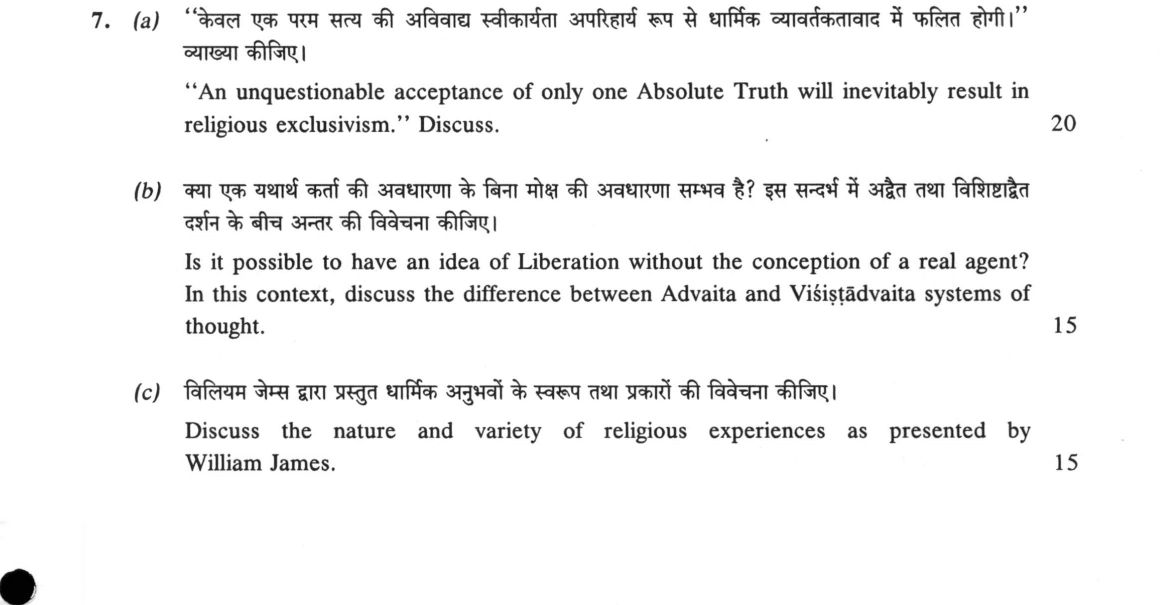
(a) "An unquestionable acceptance of only one Absolute Truth will inevitably result in religious exclusivism." Discuss. (20…
"An unquestionable acceptance of only one Absolute Truth will inevitably result in religious exclusivism." Discuss. 20 marks
Is it possible to have an idea of Liberation without the conception of a real agent? In this context, discuss the difference between Advaita and Viśiṣṭādvaita systems of thought. 15 marks
Discuss the nature and variety of religious experiences as presented by William James. 15 marks
हिंदी में प्रश्न पढ़ें
"केवल एक परम सत्य की अविवाद स्वीकार्यता अपरिहार्य रूप से धार्मिक व्यावर्तकतावाद में फलित होगी।" व्याख्या कीजिए। (20 अंक)
क्या एक यथार्थ कर्ता की अवधारणा के बिना मोक्ष की अवधारणा संभव है? इस संदर्भ में अद्वैत तथा विशिष्टाद्वैत दर्शन के बीच अंतर की विवेचना कीजिए। (15 अंक)
विलियम जेम्स द्वारा प्रस्तुत धार्मिक अनुभवों के स्वरूप तथा प्रकारों की विवेचना कीजिए। (15 अंक)
Model answer
Written by UPSC Answer Check against this question's marking rubric, to the expected length. UPSC does not publish answers for Mains — this is one way to score well, not an official key.
Absolute Truth and Religious Exclusivism
Epistemological absolutism—the conviction that truth is singular, complete, and uniquely possessed by one tradition—historically fosters soteriological exclusivism, often captured in maxims such as extra Ecclesiam nulla salus (no salvation outside the church). When a religious tradition equates its specific doctrinal formulations with the unmediated Absolute, differing paths are logically relegated to falsehood or spiritual inadequacy. John Hick highlights how dogmatic absolutism inevitably demands an exclusivist theology of religions, where only one historical revelation mediates genuine salvation.
However, the transition from metaphysical absolutism to religious exclusivism is not inevitable if accompanied by epistemological humility. A distinction exists between affirming an Absolute Truth and claiming exhaustive, monopolistic human knowledge of it. One can maintain an absolute ontological ground while recognizing that human linguistic and cultural conceptualizations are necessarily finite and perspectival.
Indian philosophy illustrates this synthesis. The Ṛgvedic insight, Ekam sat viprāḥ bahudhā vadanti ("Truth is one, the wise call it by many names"), affirms metaphysical absolutism without degenerating into exclusivism. Hick’s pluralistic hypothesis similarly distinguishes the ineffable "Real an sich" from its culturally conditioned phenomenal manifestations, demonstrating that an Absolute can support inclusive and pluralistic frameworks rather than dogmatic intolerance.
Liberation and the Question of a Real Agent: Advaita vs. Viśiṣṭādvaita
The conception of liberation without an enduring real agent represents the primary ontological divide between Śaṅkara’s Advaita and Rāmānuja’s Viśiṣṭādvaita.
In Advaita Vedānta, liberation (mokṣa) does not require the persistence of a real agent. Under the framework of vivartavāda (apparent transformation), the individual self (jīva) is an illusory limitation (upādhi) of pure consciousness brought about by māyā. Agency (kartṛtva) and enjoyership (bhoktṛtva) belong entirely to the psycho-physical apparatus, not the true Self (Ātman). Consequently, mokṣa is *jīva-brahma-aikya*—the immediate realization of identity between Ātman and Brahman upon the sublation of ignorance. Liberation is the cessation of the false sense of agency, requiring no surviving individual agent.
Conversely, Viśiṣṭādvaita insists that liberation is impossible without a real, eternal agent. Grounded in brahma-pariṇāmavāda, Rāmānuja posits the jīva as an irreducible aṃśa (part) and an eternal, conscious substance-attribute (dharmī-jñāna) of Brahman. Through the organic relation of śarīra-śarīri-bhāva (body-soul relationship), the world and souls form the real body of God. For Rāmānuja, the total dissolution of individuality in liberation is indistinguishable from annihilation. Mokṣa is therefore not identity (aikya), but sāyujya (communion) and kaiṅkarya (eternal, loving service) to Nārāyaṇa in Vaikuṇṭha, where the real agent retains its selfhood while enjoying divine bliss.
William James on the Nature and Variety of Religious Experiences
In The Varieties of Religious Experience, William James undertakes an empirical and psychological examination of religious phenomena, identifying four constitutive marks of mystical experience:
- Ineffability: The experience defies adequate verbal expression and must be directly felt.
- Noetic Quality: It yields states of profound, authoritative insight and knowledge beyond mere discursive intellect.
- Transiency: The mystical state is brief and cannot be sustained indefinitely.
- Passivity: The subject feels held and operated upon by a superior, external power.
James constructs a typology based on temperament, contrasting the "healthy-minded"—optimistic, "once-born" individuals who instinctively view the divine through harmony and goodness—with the "sick soul," who experiences a divided self, melancholy, and radical evil, requiring a "twice-born" conversion experience to achieve inner integration. He views conversion as the psychological unification of a previously divided consciousness, which culminates in "saintliness," marked by inner peace, charity, and ethical fortitude. Crucially, James offers a pluralistic conclusion: while mystical experiences provide immediate, self-authenticating certainty to the individual, they do not establish any single theological absolute, thereby providing strong empirical support for religious pluralism over exclusivism.
Ultimately, philosophical inquiry reveals that whether analyzing claims of the Absolute, the metaphysics of the liberated agent, or the psychology of mystical encounters, genuine spiritual insight demands reconciling profound ultimate commitments with an openness to diverse experiential pathways.
What "Discuss" is asking you to do
Lay the issue out from more than one side — how it arose, what is claimed for it, what is held against it, and where it now stands. UPSC attaches discuss to broad topics with several live dimensions, so coverage of the dimensions earns more than the strength of your opinion.
Structure that answers it
Set the issue up → the case as it is made → the case against → the dimension both sides leave out → where the balance now lies
Where marks are lost
Listing facts with no thread between them, or arguing one side throughout and calling it a discussion.
How this answer will be evaluated
Approach
(a) discuss: intro > 3-4 dimensions > example > balanced close | (b) discuss: intro > 3-4 dimensions > example > balanced close | (c) discuss: intro > 3-4 dimensions > example > balanced close Full marks: Precise reconstruction of arguments, strong counter-arguments, and exact technical vocabulary.
Key points expected
- Define 'Absolute Truth' and 'religious exclusivism' precisely
- Reconstruct the argument for the inevitability of exclusivism
- Present the strongest counter-argument (e.g., pluralism or inclusivism)
- Evaluate the validity of the claim with a balanced conclusion
- Address the possibility of liberation without a real agent
- Explain the Advaita view of the agent (Jiva/Brahman)
- Explain the Viśiṣṭādvaita view of the agent (Jiva/Ishvara)
- Highlight the key difference between the two systems
Evaluation rubric
Each sub-part is marked on its own, against the marks and word limit printed on the paper.
- (a) Analyse the logical link between monistic truth-claims and religious exclusivism. 20 marks
discuss— intro → 3-4 dimensions → example → balanced close
Must cover
- Define 'Absolute Truth' and 'religious exclusivism' precisely
- Reconstruct the argument for the inevitability of exclusivism
- Present the strongest counter-argument (e.g., pluralism or inclusivism)
- Evaluate the validity of the claim with a balanced conclusion
Loses marks
- Biographical details of philosophers
- Vague paraphrase without technical vocabulary
- Failure to present a counter-argument
Earns more
- Reference to John Hick's pluralistic hypothesis
- Distinction between ontological and epistemological exclusivism
- Use of Sanskrit terms like 'Satya' or 'Dharma'
Extra mark
- Citation of a specific philosophical text or thinker
- Reference to a specific historical instance of exclusivism
- (b) Compare Advaita and Viśiṣṭādvaita regarding the agent of liberation. 15 marks
discuss— intro → 3-4 dimensions → example → balanced close
Must cover
- Address the possibility of liberation without a real agent
- Explain the Advaita view of the agent (Jiva/Brahman)
- Explain the Viśiṣṭādvaita view of the agent (Jiva/Ishvara)
- Highlight the key difference between the two systems
Loses marks
- Confusing Advaita with Dvaita
- Failing to address the 'real agent' question
- Vague generalities without specific system details
Earns more
- Use of Sanskrit terms: 'Moksha', 'Jiva', 'Ishvara'
- Reference to specific texts (e.g., Brahma Sutra)
- Clear distinction between monistic and qualified monistic views
Extra mark
- Mention of Ramanuja or Shankara by name
- Reference to a specific concept like 'Tat Tvam Asi'
- (c) Outline William James's classification of religious experiences. 15 marks
discuss— intro → 3-4 dimensions → example → balanced close
Must cover
- Define the nature of religious experience per James
- Describe the 'healthy-minded' vs 'sick soul' varieties
- Mention the 'subconscious' or 'subliminal' self
- Provide a brief example of a religious experience
Loses marks
- Biography of William James
- Failure to distinguish between the two main varieties
- Vague description without specific Jamesian terminology
Earns more
- Reference to 'The Varieties of Religious Experience'
- Use of terms like 'conversion' or 'stigmata'
- Distinction between 'once-born' and 'twice-born' types
Extra mark
- Citation of a specific case study from James's work
- Reference to the 'subliminal self' concept
Practice this exact question
Write your answer and it is marked point by point against the model answer above — what you covered, what you missed, what you got wrong.
Evaluate my answer →More from Philosophy 2022 Paper II
- Q4 (a) Discuss propaganda as a challenge to democratic form of government. (20 marks) (b) Do…
- Q5 Answer the following questions in about 150 words each: (a) Write an essay on Spinoza's n…
- Q6 (a) Present a critical exposition of different arguments offered by St. Thomas Aquinas to…
- Q7 (a) "An unquestionable acceptance of only one Absolute Truth will inevitably result in re…
- Q8 (a) Discuss the main points of distinction between a priori and a posteriori arguments fo…