Paper II — Q5
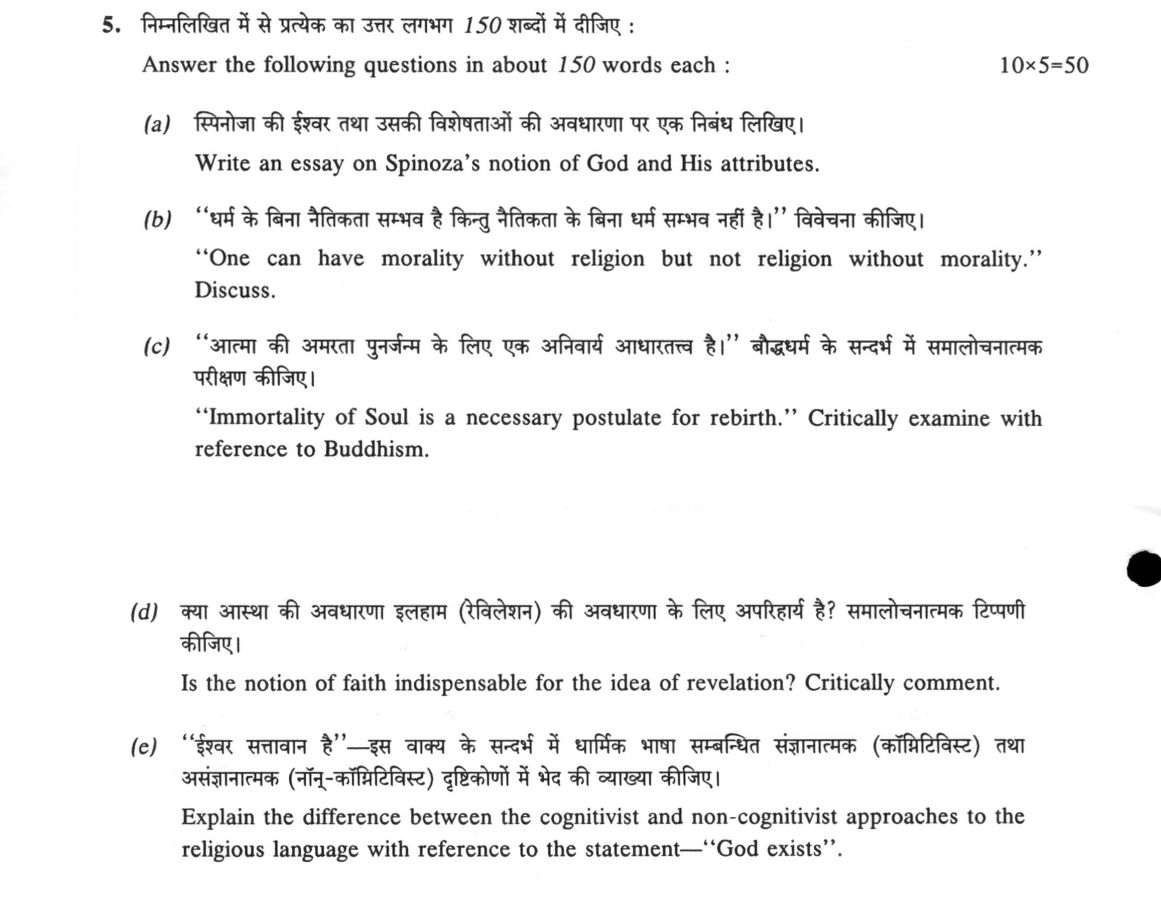
Answer the following questions in about 150 words each: (a) Write an essay on Spinoza's notion of God and His attributes. (10…
Answer the following questions in about 150 words each:
Write an essay on Spinoza's notion of God and His attributes. 10 marks
"One can have morality without religion but not religion without morality." Discuss. 10 marks
"Immortality of Soul is a necessary postulate for rebirth." Critically examine with reference to Buddhism. 10 marks
Is the notion of faith indispensable for the idea of revelation? Critically comment. 10 marks
Explain the difference between the cognitivist and non-cognitivist approaches to the religious language with reference to the statement—"God exists". 10 marks
हिंदी में प्रश्न पढ़ें
निम्नलिखित में से प्रत्येक का उत्तर लगभग 150 शब्दों में दीजिए :
स्पिनोजा की ईश्वर तथा उसकी विशेषताओं की अवधारणा पर एक निबंध लिखिए। (10 अंक)
"धर्म के बिना नैतिकता संभव है किन्तु नैतिकता के बिना धर्म संभव नहीं है।" विवेचना कीजिए। (10 अंक)
"आत्मा की अमरता पुनर्जन्म के लिए एक अनिवार्य आधारतत्व है।" बौद्धधर्म के संदर्भ में समालोचनात्मक परीक्षण कीजिए। (10 अंक)
क्या आस्था की अवधारणा इल्हाम (रिविलेशन) की अवधारणा के लिए अपरिहार्य है? समालोचनात्मक टिप्पणी कीजिए। (10 अंक)
"ईश्वर सत्तावान है"—इस वाक्य के संदर्भ में धार्मिक भाषा संबंधित संज्ञानात्मक (कोग्निटिविस्ट) तथा असंज्ञानात्मक (नॉन-कोग्निटिविस्ट) दृष्टिकोणों में भेद की व्याख्या कीजिए। (10 अंक)
Model answer
Written by UPSC Answer Check against this question's marking rubric, to the 150-word length. UPSC does not publish answers for Mains — this is one way to score well, not an official key.
(a) Spinoza's Notion of God and His Attributes
Spinoza rejects traditional theistic dualism, identifying God with the totality of reality through his pantheistic formula Deus sive Natura (God or Nature). God is the sole, self-caused (causa sui), and infinite Substance (substantia) that exists in itself and is conceived through itself. Spinoza defines an attribute as that which the intellect perceives of Substance as constituting its eternal and infinite essence.
While God possesses infinitely many attributes, the finite human intellect can comprehend only two: Thought (cogitatio) and Extension (extensio). These are not separate parts of God, but distinct expressions of the same single reality. Individual finite things, including human minds and physical bodies, are merely modes (modi)—the temporal affections or modifications of God's attributes (Natura naturata as opposed to God as Natura naturans).
Spinoza decisively eliminates anthropomorphism, transcendent agency, and divine teleology. God does not act out of free will or purpose, but from the absolute necessity of His own nature.
(b) "One can have morality without religion but not religion without morality." Discuss.
The autonomy of morality from religion is well demonstrated in philosophical ethics. Immanuel Kant establishes that moral duty originates from practical reason and the categorical imperative, making morality logically prior to and autonomous from religion; religion is merely the recognition of our duties as divine commands. Plato’s Euthyphro dilemma similarly demonstrates that the Good is independent of divine will. Secular systems—such as utilitarianism and constitutional human rights—further prove that robust ethical frameworks function without supernatural presuppositions.
Conversely, a religion devoid of morality ceases to be a genuine spiritual pursuit. As Swami Vivekananda observed, true religion is "morality internalized," manifesting humanity's innate divinity. Divorced from ethical righteousness, religion degenerates into hollow ritualism, dogma, or fanatical intolerance. Therefore, while morality stands independently on rational and humanist foundations, religion fundamentally relies on a moral core to retain its spiritual validity and normative authority.
(c) "Immortality of Soul is a necessary postulate for rebirth." Critically examine with reference to Buddhism.
Orthodox Indian systems, such as Nyaya-Vaisheshika and Advaita Vedanta, hold that an eternal, unchanging soul (Atman) is an indispensable substratum for transmigrating across births to reap the fruits of karma.
Buddhism fundamentally challenges this postulate through its twin doctrines of Anatta (non-soul) and Anicca (impermanence). Buddhism denies the existence of any immortal, substantial self. Rebirth is explained not through the migration of an enduring entity, but via the dynamic causal mechanism of Pratityasamutpada (dependent origination). Rebirth is the unbroken stream of psycho-physical aggregates (kandha-santana or citta-santana), where the last moment of consciousness in one life causally conditions the first moment in the next. In the Milindapanha, Bhikkhu Nagasena clarifies this to King Menander using the chariot analogy: just as a chariot is merely a functional assembly of parts without an independent essence, a person is a stream of ever-changing states. Rebirth is like lighting one lamp from another—the flame is causally transmitted without any substantial transfer.
Critically, Buddhism demonstrates that continuity does not require static identity. The immortal soul is not a necessary postulate for rebirth; dynamic causal continuity is philosophically sufficient.
(d) Is the notion of faith indispensable for the idea of revelation? Critically comment.
Revelation (sruti or divine self-disclosure) refers to the communication of truths that lie beyond the reach of natural human cognition. While classical thinkers like Thomas Aquinas maintained that natural theology can prove basic truths like God's existence through reason, revealed dogmas (such as the Incarnation or Grace) strictly demand faith (fides).
In modern theology, the connection between revelation and faith is organic. Karl Barth argues that revelation is God's sovereign self-manifestation, which cannot be objectified by empirical or rational faculties and can only be received through faith awakened by divine grace. Søren Kierkegaard contends that divine revelation presents an objective paradox to finite human reason, requiring a passionate "leap of faith" rather than intellectual assent. Paul Tillich emphasizes correlation: revelation is the objective divine self-disclosure, while faith is the subjective state of being grasped by an "ultimate concern."
Without faith, revelation is reduced to an inert, external text or myth. Faith constitutes the necessary epistemological condition through which revelation is actualized as transformative divine truth.
(e) Cognitivist and Non-Cognitivist Approaches to Religious Language
The statement "God exists" is interpreted divergently by cognitivist and non-cognitivist traditions in religious epistemology.
Cognitivism holds that "God exists" is an indicative, truth-apt assertion that makes a factual claim about an objective reality. Logical positivist A.J. Ayer rejected it as cognitively meaningless, arguing it fails empirical verification. Antony Flew challenged cognitivism via his falsification principle, arguing that if no empirical circumstance can count against "God exists," it dies "the death of a thousand qualifications." Defending cognitivism, John Hick proposed "eschatological verification," asserting that the statement entails factual expectations testable after death.
Non-cognitivism denies that "God exists" describes empirical facts. Instead, it interprets the statement as an expression of existential attitudes, values, or commitments. R.M. Hare interprets religious claims as unfalsifiable foundational worldviews or bliks. R.B. Braithwaite views "God exists" as an intention to adopt an agapic way of life. Ludwig Wittgenstein treats it within a distinct "language game," while Paul Tillich interprets it symbolically as pointing to the "Ground of Being." Cognitivism treats the statement as an objective truth claim, whereas non-cognitivism views it as an existential and regulative expression.
What "Critically examine" is asking you to do
Test the proposition the question puts to you and return a finding on how far it holds. Examine stems carry a claim, or ask whether something has happened, and expect evidence weighed both ways before the extent is stated — often with remedial measures attached. “Critically” is not a section added at the end: name the yardstick you are judging by — the evidence, the stated objective, a constitutional principle, a rival explanation — and let a verdict close each part of the body. Where the question quotes a claim, that verdict must land on the claim itself, accepted, qualified or rejected, and not on the theme in general.
Structure that answers it
Restate the claim as the question frames it → evidence that supports it → evidence that undercuts it → the conditions under which it holds → verdict on how far it stands
Where marks are lost
Merits in one paragraph, demerits in the next, and a conclusion calling for a balanced and holistic approach. That is a survey with the judgement left out and it holds the answer in the middle band. The opposite error is reading “critically” as permission to attack — and with the odd pairings, critically describe or critically explain, the exposition still carries most of the marks, the judgement being a layer on it rather than a substitute for it.
How this answer will be evaluated
Approach
Framework: UPSC Mains Philosophy Paper II. (a) explain: definition/context > points in order > small example > short close | (b) discuss: intro > 3-4 dimensions > example > balanced close | (c) examine: intro > how/why with reasoning > evidence > conclusion | (d) comment: context > arguments both sides > judgment > close | (e) explain: definition/context > points in order > small example > short close Full marks: Precise technical vocabulary, clear argument structure, strong counter-arguments, and specific references.
Key points expected
- Define God as 'Deus sive Natura'
- Explain 'Substance' as self-caused (causa sui)
- Identify 'Thought' and 'Extension' as attributes
- Mention 'Modes' as modifications of substance
- Define 'morality' and 'religion' distinctively
- Argue for secular morality (e.g., Kant, utilitarianism)
- Argue for religion's moral foundation (e.g., divine command)
- Provide a balanced conclusion on the interdependence
Evaluation rubric
Each sub-part is marked on its own, against the marks and word limit printed on the paper.
- (a) Essay on Spinoza's God and attributes. · 150 words
explain— definition/context → points in order → small example → short close
Must cover
- Define God as 'Deus sive Natura'
- Explain 'Substance' as self-caused (causa sui)
- Identify 'Thought' and 'Extension' as attributes
- Mention 'Modes' as modifications of substance
Loses marks
- Biographical details of Spinoza
- Confusing 'attribute' with 'mode'
- Vague paraphrase without technical terms
Earns more
- Reference to 'Ethics' Part I
- Distinction between 'God in se' and 'God in rebus'
- Mention of 'Infinite Attributes'
Extra mark
- Comparison with Descartes' dualism
- Reference to 'Natura naturans' and 'Natura naturata'
- (b) Discuss the relationship between morality and religion. · 150 words
discuss— intro → 3-4 dimensions → example → balanced close
Must cover
- Define 'morality' and 'religion' distinctively
- Argue for secular morality (e.g., Kant, utilitarianism)
- Argue for religion's moral foundation (e.g., divine command)
- Provide a balanced conclusion on the interdependence
Loses marks
- One-sided argument (only pro or con)
- Confusing 'ethics' with 'morality' without distinction
- Lack of concrete examples
Earns more
- Reference to 'Euthyphro Dilemma'
- Mention of 'Natural Law' theory
- Example of secular ethical framework
Extra mark
- Reference to specific philosopher (e.g., Hume, Mill)
- Mention of 'Moral Autonomy'
- (c) Critically examine the link between soul and rebirth in Buddhism. · 150 words
examine— intro → how/why with reasoning → evidence → conclusion
Must cover
- State the Buddhist doctrine of 'Anatta' (No-Self)
- Explain 'Rebirth' as a process, not a soul's migration
- Identify 'Karma' and 'Vasanas' as the causal link
- Contrast with Hindu 'Atman' concept
Loses marks
- Attributing a permanent soul to Buddhism
- Confusing 'rebirth' with 'reincarnation'
- Vague description of karma
Earns more
- Use of term 'Paticca Samuppada' (Dependent Origination)
- Reference to 'Five Aggregates' (Skandhas)
- Mention of 'Stream of Consciousness'
Extra mark
- Reference to specific sutra or text
- Mention of 'Nirvana' as cessation of the process
- (d) Critically comment on faith as a prerequisite for revelation. · 150 words
comment— context → arguments both sides → judgment → close
Must cover
- Define 'Revelation' (Divine disclosure)
- Define 'Faith' (Trust/Belief without proof)
- Argue for faith as the 'lens' for revelation
- Argue against (e.g., rationalism, empirical evidence)
Loses marks
- Defining faith as mere 'blind belief'
- Ignoring the role of reason in revelation
- Lack of critical analysis
Earns more
- Reference to 'Pascal's Wager'
- Mention of 'Mystical Experience'
- Distinction between 'General' and 'Special' revelation
Extra mark
- Reference to specific theologian (e.g., Kierkegaard, Aquinas)
- Mention of 'Epistemic Injustice'
- (e) Explain cognitivist vs non-cognitivist approaches to 'God exists'. · 150 words
explain— definition/context → points in order → small example → short close
Must cover
- Define 'Cognitivism' (truth-apt propositions)
- Define 'Non-cognitivism' (expressive/emotive function)
- Apply to 'God exists' (Cognitivist: factual claim)
- Apply to 'God exists' (Non-cognitivist: expression of attitude)
Loses marks
- Confusing 'cognitivism' with 'rationalism'
- Failing to apply the theories to the specific statement
- Vague definitions of the terms
Earns more
- Reference to 'Logical Positivism' (Ayer)
- Mention of 'Emotive Theory' (Stevenson)
- Reference to 'Verification Principle'
Extra mark
- Reference to 'Bultmann' (demythologization)
- Mention of 'Performative Utterance'
Practice this exact question
Write your answer and it is marked point by point against the model answer above — what you covered, what you missed, what you got wrong.
Evaluate my answer →More from Philosophy 2022 Paper II
- Q2 (a) What arguments does Bodin present to contend that sovereignty must be absolute, perpe…
- Q3 (a) Do you agree that economic development does not on its own lead to human development…
- Q4 (a) Discuss propaganda as a challenge to democratic form of government. (20 marks) (b) Do…
- Q5 Answer the following questions in about 150 words each: (a) Write an essay on Spinoza's n…
- Q6 (a) Present a critical exposition of different arguments offered by St. Thomas Aquinas to…
- Q7 (a) "An unquestionable acceptance of only one Absolute Truth will inevitably result in re…
- Q8 (a) Discuss the main points of distinction between a priori and a posteriori arguments fo…