Paper II — Q4
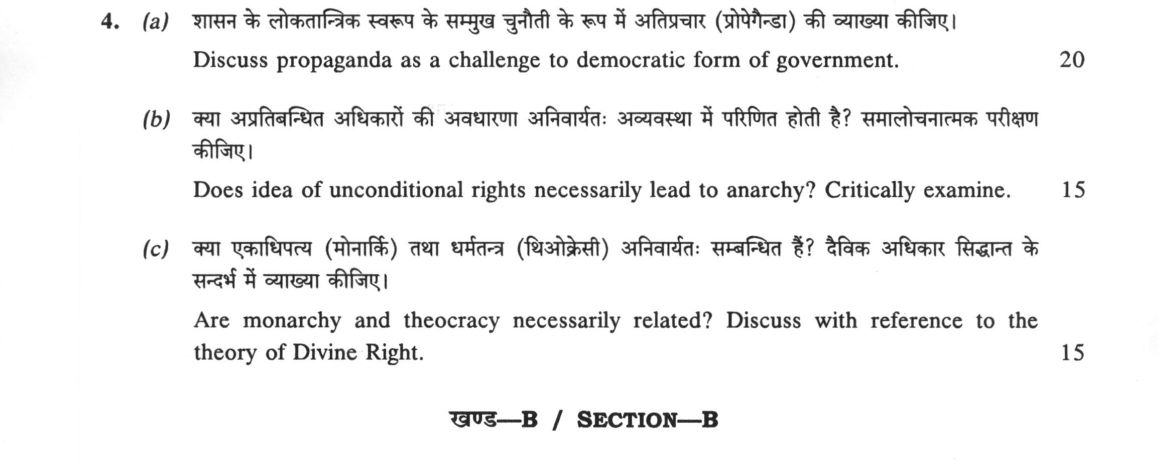
(a) Discuss propaganda as a challenge to democratic form of government. (20 marks) (b) Does idea of unconditional rights…
Discuss propaganda as a challenge to democratic form of government. 20 marks
Does idea of unconditional rights necessarily lead to anarchy? Critically examine. 15 marks
Are monarchy and theocracy necessarily related? Discuss with reference to the theory of Divine Right. 15 marks
हिंदी में प्रश्न पढ़ें
शासन के लोकतांत्रिक स्वरूप के सम्मुख चुनौती के रूप में अतिप्रचार (प्रोपेगैंडा) की व्याख्या कीजिए। (20 अंक)
क्या अप्रतिबंधित अधिकारों की अवधारणा अनिवार्यतः अराजकता में परिणत होती है? समालोचनात्मक परीक्षण कीजिए। (15 अंक)
क्या एकाधिपत्य (मोनार्की) तथा धर्मतंत्र (थियोक्रेसी) अनिवार्यतः संबंधित हैं? दैविक अधिकार सिद्धांत के संदर्भ में व्याख्या कीजिए। (15 अंक)
Model answer
Written by UPSC Answer Check against this question's marking rubric, to the expected length. UPSC does not publish answers for Mains — this is one way to score well, not an official key.
Propaganda as a Challenge to Democratic Governance
Democracy fundamentally presumes an autonomous, informed electorate capable of reasoned deliberation. Propaganda undermines this epistemic baseline by engineering deliberate epistemic corruption. Walter Lippmann observed that propaganda manufactures a distorted "pseudo-environment," while Noam Chomsky and Edward S. Herman demonstrated how structural media filters systematically "manufacture consent," reducing citizens from active political agents to managed spectators. In the contemporary digital landscape, this vulnerability is intensified through algorithmic amplification, echo chambers, and deepfakes. Under post-truth politics, emotive manipulation displaces empirical verification, fracturing shared factual reality. Consequently, propaganda paralyzes Jürgen Habermas’s ideal of communicative rationality, hollowing out deliberative democracy and eroding the institutional legitimacy of electoral mandates.
Unconditional Rights and the Question of Anarchy
The doctrine of unconditional or absolute rights posits entitlements that exist prior to and independent of state authority. In libertarian philosophy, Robert Nozick treats rights as inviolable "side-constraints," drawing on John Locke’s natural rights to life, liberty, and property. Critics argue that unconstrained rights inherently risk anarchy: if individual entitlements are absolute and divorced from reciprocal civic obligations, unresolvable rights-conflicts threaten to collapse society into a Hobbesian state of nature where order is impossible.
However, the assertion of rights does not necessarily induce anarchy when situated within a coherent normative framework. Ronald Dworkin conceives of rights as political "trumps" over utilitarian collective goals, designed specifically to safeguard minorities against majoritarian tyranny within a structured constitutional order. Furthermore, John Rawls demonstrates through his First Principle of Justice that equal basic liberties can be maximal, provided they are harmonized within a coherent system of equal liberty for all. Unconditional fundamental protections, when bounded by the equal moral worth of other individuals under the social contract, sustain constitutional stability rather than lawlessness.
Monarchy, Theocracy, and the Divine Right of Kings
Conceptually, monarchy denotes a system of governance centered on a single sovereign ruler, whereas theocracy signifies rule directed by divine mandate or clerical authority. While distinct in theory, the two merged historically in Europe through the doctrine of the Divine Right of Kings, articulated by theorists such as Robert Filmer and Jacques-Bénigne Bossuet, and asserted by monarchs like James I. This doctrine posited that the king is God’s direct earthly representative, possessing non-resistance accountability to heaven alone, thereby using theocratic legitimacy to centralize monarchical absolutism.
Nevertheless, their relationship is historically contingent rather than conceptually necessary. Secular monarchies—including modern constitutional systems—function entirely decoupled from ecclesiastical authority, whereas modern theocracies (such as Iran governed via the Guardian Council and Velayat-e Faqih) govern through clerical supremacy without hereditary kings. In Indian political thought, the classical model of Raja Dharma in the Mahabharata and Arthashastra subordinated monarchical power to moral and cosmic duty rather than clerical whim, while the Mughal model of Farr-i-Izadi under Akbar harmonized royal divine illumination with Sulh-i-Kul (universal peace), prioritizing pluralistic coexistence over sectarian theocracy.
Way Forward
Sustaining democratic resilience against both epistemic distortion and ideological absolutism requires strengthening epistemic democracy and institutional checks. Fostering Habermasian communicative spaces through transparent digital governance, safeguarding rights through proportional constitutionalism, and upholding secular accountability ensure that state authority remains firmly grounded in public reason rather than manufactured consensus or divine right.
What "Discuss" is asking you to do
Lay the issue out from more than one side — how it arose, what is claimed for it, what is held against it, and where it now stands. UPSC attaches discuss to broad topics with several live dimensions, so coverage of the dimensions earns more than the strength of your opinion.
Structure that answers it
Set the issue up → the case as it is made → the case against → the dimension both sides leave out → where the balance now lies
Where marks are lost
Listing facts with no thread between them, or arguing one side throughout and calling it a discussion.
How this answer will be evaluated
Approach
Framework: Philosophy Paper II: State position > Argument > Strongest objection > Evaluation. (a) discuss: intro > 3-4 dimensions > example > balanced close | (b) critically evaluate: positives > negatives/limits > conditions/safeguards > conclusion | (c) discuss: intro > 3-4 dimensions > example > balanced close Full marks: Precise definitions, strong arguments, clear counter-arguments, concrete examples, and accurate use of technical vocabulary.
Key points expected
- Define propaganda as systematic manipulation of public opinion
- Explain how propaganda undermines informed consent and rational choice
- Identify specific mechanisms (e.g., emotional appeal, repetition, framing)
- Provide a concrete historical or contemporary example
- Define 'unconditional rights' and 'anarchy' precisely
- Present the argument that absolute rights lead to conflict
- Present the counter-argument that rights can coexist with order
- Evaluate the logical connection between the two concepts
Evaluation rubric
Each sub-part is marked on its own, against the marks and word limit printed on the paper.
- (a) Analyze propaganda as a structural threat to democratic self-governance. 20 marks
discuss— intro → 3-4 dimensions → example → balanced close
Must cover
- Define propaganda as systematic manipulation of public opinion
- Explain how propaganda undermines informed consent and rational choice
- Identify specific mechanisms (e.g., emotional appeal, repetition, framing)
- Provide a concrete historical or contemporary example
Loses marks
- Vague generalities without specific mechanisms
- Failure to connect propaganda to democratic principles
- Biographical focus on propagandists rather than the concept
Earns more
- Reference to specific theorists (e.g., Lippmann, Chomsky)
- Distinction between legitimate persuasion and manipulative propaganda
- Discussion of media literacy as a democratic safeguard
- Link to specific democratic values (autonomy, equality, deliberation)
Extra mark
- Reference to specific historical case (e.g., Nazi Germany, Cold War)
- Mention of specific legal frameworks regulating political speech
- (b) Assess whether unconditional rights logically necessitate anarchy. 15 marks
critically evaluate— positives → negatives/limits → conditions/safeguards → conclusion
Must cover
- Define 'unconditional rights' and 'anarchy' precisely
- Present the argument that absolute rights lead to conflict
- Present the counter-argument that rights can coexist with order
- Evaluate the logical connection between the two concepts
Loses marks
- Failure to define key terms
- One-sided argument without considering the counter-view
- Vague statements without logical reasoning
Earns more
- Reference to specific philosophers (e.g., Locke, Mill, Rawls)
- Distinction between negative and positive rights
- Discussion of the role of the state in enforcing rights
- Example of a specific right and its potential conflict
Extra mark
- Reference to specific legal cases or constitutional provisions
- Mention of specific theories of rights (e.g., natural law, legal positivism)
- (c) Examine the relationship between monarchy and theocracy via Divine Right. 15 marks
discuss— intro → 3-4 dimensions → example → balanced close
Must cover
- Define monarchy and theocracy
- Explain the theory of Divine Right
- Analyze how Divine Right links monarchy to theocracy
- Provide a historical example of Divine Right monarchy
Loses marks
- Failure to define key terms
- Vague description of Divine Right
- Failure to connect Divine Right to the relationship between monarchy and theocracy
Earns more
- Reference to specific monarchs (e.g., Louis XIV, James I)
- Distinction between theocratic and secular monarchies
- Discussion of the political implications of Divine Right
- Mention of specific theological arguments used to justify Divine Right
Extra mark
- Reference to specific texts (e.g., 'The Divine Right of Kings')
- Mention of specific historical events related to Divine Right
Practice this exact question
Write your answer and it is marked point by point against the model answer above — what you covered, what you missed, what you got wrong.
Evaluate my answer →More from Philosophy 2022 Paper II
- Q1 Answer the following questions in about 150 words each: (a) Discuss the role of enlighten…
- Q2 (a) What arguments does Bodin present to contend that sovereignty must be absolute, perpe…
- Q3 (a) Do you agree that economic development does not on its own lead to human development…
- Q4 (a) Discuss propaganda as a challenge to democratic form of government. (20 marks) (b) Do…
- Q5 Answer the following questions in about 150 words each: (a) Write an essay on Spinoza's n…
- Q6 (a) Present a critical exposition of different arguments offered by St. Thomas Aquinas to…
- Q7 (a) "An unquestionable acceptance of only one Absolute Truth will inevitably result in re…