Paper II — Q2
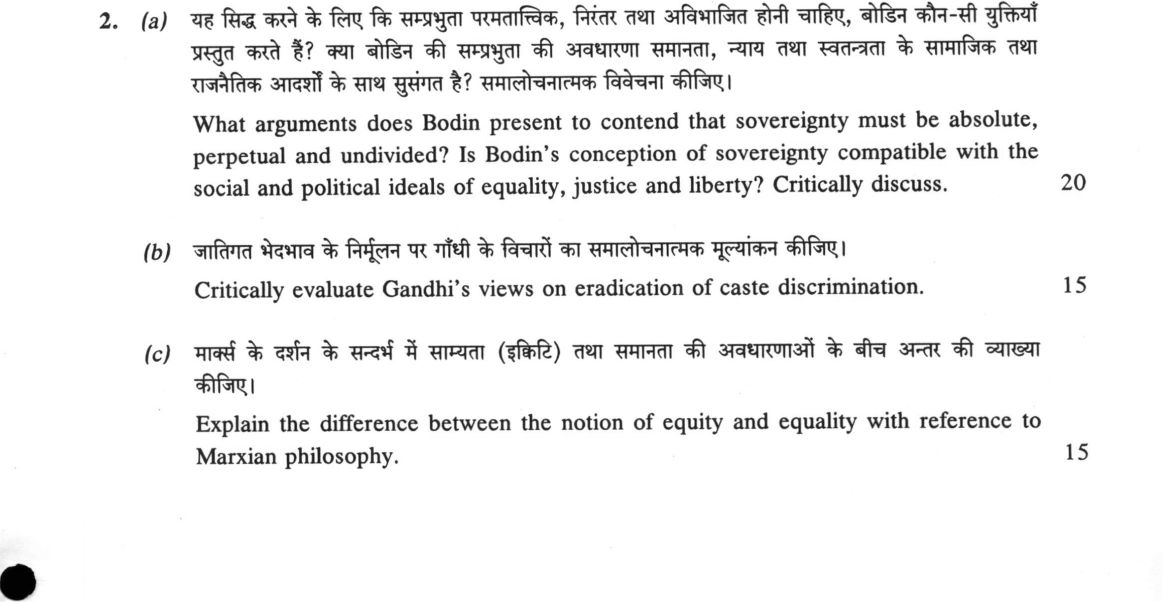
(a) What arguments does Bodin present to contend that sovereignty must be absolute, perpetual and undivided? Is Bodin's…
What arguments does Bodin present to contend that sovereignty must be absolute, perpetual and undivided? Is Bodin's conception of sovereignty compatible with the social and political ideals of equality, justice and liberty? Critically discuss. 20 marks
Critically evaluate Gandhi's views on eradication of caste discrimination. 15 marks
Explain the difference between the notion of equity and equality with reference to Marxian philosophy. 15 marks
हिंदी में प्रश्न पढ़ें
यह सिद्ध करने के लिए कि सम्प्रभुता परमतात्विक, निरंतर तथा अविभाजित होनी चाहिए, बोडिन कौन-सी युक्तियाँ प्रस्तुत करते हैं? क्या बोडिन की सम्प्रभुता की अवधारणा समानता, न्याय तथा स्वतंत्रता के सामाजिक तथा राजनीतिक आदर्शों के साथ सुसंगत है? समालोचनात्मक विवेचना कीजिए। (20 अंक)
जातिगत भेदभाव के निर्मूलन पर गांधी के विचारों का समालोचनात्मक मूल्यांकन कीजिए। (15 अंक)
मार्क्स के दर्शन के संदर्भ में साम्यता (इक्विटी) तथा समानता की अवधारणाओं के बीच अंतर की व्याख्या कीजिए। (15 अंक)
Model answer
Written by UPSC Answer Check against this question's marking rubric, to the expected length. UPSC does not publish answers for Mains — this is one way to score well, not an official key.
Bodin’s argument in the Six Books of the Commonwealth is that the commonwealth needs one supreme power to command without appeal, because divided sovereignty produces conflicting commands and civil disorder. Sovereignty is absolute because it is not subject to a higher human law or counter-power; perpetual because it cannot be time-limited without making the state temporary; undivided because sharing it among king, estates and parliaments creates mixed government that is in fact a struggle for sovereignty; and inalienable because a sovereign who can surrender or share supreme power ceases to be sovereign. Bodin distinguishes sovereignty from government: ministers and parliaments may administer, but the final right to make and unmake laws belongs to the sovereign. This gives order, but it is hard to reconcile with modern liberty. If sovereignty is absolute, liberty can only be negative non-interference or obedience to law, not republican self-government; Hobbesian security may be bought at the cost of political freedom. It also sits uneasily with equality, since Bodin accepts hierarchical corporate society and paternal authority. Yet order can be a precondition for justice, and in Indian constitutional debates the idea of a single sovereign centre is moderated by federalism, fundamental rights and the basic structure doctrine, which deny that any organ can claim absolute, undivided power.
Gandhi’s anti-caste programme combined moral reform with constructive work. He distinguished varna, which he treated as a flexible occupational division, from caste, which he condemned as birth-based exclusion and untouchability. He supported inter-dining and inter-marriage, promoted khadi and village industries, and used satyagraha against social exclusion, as in the Vaikom Satyagraha, which sought access to roads around a temple, and the Guruvayur movement, which pressed temple entry. His aim was to transform hearts and habits, not merely pass laws. Ambedkar, however, argued that caste was a structural system of hierarchy, not merely a moral failing, and that Gandhi’s romanticisation of the village, paternalism and reliance on persuasion were inadequate. Ambedkar publicly burned the Manusmriti and insisted on rejecting scriptural authority, while demanding constitutional rights and political representation. The 1932 Poona Pact, in which Gandhi’s fast led to a compromise on reserved seats, showed the limits of moral suasion; Gandhi continued to oppose untouchability but retained an idealised varnashrama, making his position more reformist than revolutionary.
Marx sharpens the distinction between equality and equity by criticising bourgeois equality as formal legal equality that preserves substantive inequality. In the Critique of the Gotha Programme, he argues that rights in the first phase of communist society remain “bourgeois” because they treat unequal workers as equal, giving each the same measure of labour and ignoring differences in need. Equity, for Marx, is not equal shares but distribution according to need, and ultimately “from each according to ability, to each according to need.” Equality of opportunity, and even formal equality of condition, can mask unequal starting points; equity requires correcting material and social disadvantage. In India, reservation policy can be read as an equity measure, seeking substantive justice for historically excluded groups, whereas formal equality arguments stress non-discrimination and individual merit. Bodin, Gandhi and Marx thus conceptualise justice differently: Bodin through sovereign order, Gandhi through moral and social reform, and Marx through structural transformation of property and production. A critical verdict is that Bodin’s sovereignty can secure order but not liberty or equality; Gandhi’s anti-caste praxis is morally powerful but structurally limited; and Marx’s equity is the most radical, though it demands transformation beyond legal rights.
What "Critically discuss" is asking you to do
Lay the issue out from more than one side — how it arose, what is claimed for it, what is held against it, and where it now stands. UPSC attaches discuss to broad topics with several live dimensions, so coverage of the dimensions earns more than the strength of your opinion. “Critically” is not a section added at the end: name the yardstick you are judging by — the evidence, the stated objective, a constitutional principle, a rival explanation — and let a verdict close each part of the body. Where the question quotes a claim, that verdict must land on the claim itself, accepted, qualified or rejected, and not on the theme in general.
Structure that answers it
Set the issue up → the case as it is made → the case against → the dimension both sides leave out → where the balance now lies
Where marks are lost
Merits in one paragraph, demerits in the next, and a conclusion calling for a balanced and holistic approach. That is a survey with the judgement left out and it holds the answer in the middle band. The opposite error is reading “critically” as permission to attack — and with the odd pairings, critically describe or critically explain, the exposition still carries most of the marks, the judgement being a layer on it rather than a substitute for it.
How this answer will be evaluated
Approach
Framework: UPSC Mains Philosophy Paper II. (a) discuss: intro > 3-4 dimensions > example > balanced close | (b) critically evaluate: positives > negatives/limits > conditions/safeguards > conclusion | (c) explain: definition/context > points in order > small example > short close Full marks: Precise reconstruction of arguments, strong critical evaluation, and use of technical vocabulary.
Key points expected
- Define sovereignty as absolute, perpetual, and undivided
- Reconstruct Bodin's arguments for indivisibility of power
- Analyze compatibility with equality, justice, and liberty
- Provide a balanced critical evaluation
- Outline Gandhi's views on caste (e.g., Harijans)
- Identify positive aspects of his approach
- Identify negative aspects or limitations
- Provide a balanced conclusion
Evaluation rubric
Each sub-part is marked on its own, against the marks and word limit printed on the paper.
- (a) Reconstruct Bodin's arguments for absolute sovereignty and evaluate its compatibility with modern political ideals. 20 marks
discuss— intro → 3-4 dimensions → example → balanced close
Must cover
- Define sovereignty as absolute, perpetual, and undivided
- Reconstruct Bodin's arguments for indivisibility of power
- Analyze compatibility with equality, justice, and liberty
- Provide a balanced critical evaluation
Loses marks
- Biographical details of Jean Bodin
- Vague paraphrase without argument reconstruction
- Failure to address the 'compatibility' aspect
Earns more
- Reference to 'The Six Books of the Commonwealth'
- Distinction between sovereignty and despotism
- Comparison with Locke or Montesquieu
- Use of precise technical vocabulary
Extra mark
- Mention of 'pouvoir souverain' (French term)
- Reference to specific historical context of Bodin
- (b) Assess the strengths and limitations of Gandhi's approach to eradicating caste discrimination. 15 marks
critically evaluate— positives → negatives/limits → conditions/safeguards → conclusion
Must cover
- Outline Gandhi's views on caste (e.g., Harijans)
- Identify positive aspects of his approach
- Identify negative aspects or limitations
- Provide a balanced conclusion
Loses marks
- Biographical details of Gandhi
- Vague generalizations without specific views
- Failure to provide a critical evaluation
Earns more
- Reference to 'Hind Swaraj' or 'Young India'
- Mention of 'untouchability' as a sin
- Comparison with Ambedkar's approach
- Use of specific examples from Gandhi's life
Extra mark
- Reference to 'Brahmacharya' in social context
- Mention of specific campaigns or events
- (c) Clarify the distinction between equity and equality within the framework of Marxian philosophy. 15 marks
explain— definition/context → points in order → small example → short close
Must cover
- Define equity and equality in Marxian context
- Explain the difference between the two notions
- Reference to Marx's critique of bourgeois equality
- Provide a clear and concise explanation
Loses marks
- Biographical details of Marx
- Vague definitions without context
- Failure to reference Marxian philosophy specifically
Earns more
- Reference to 'Critique of the Gotha Programme'
- Distinction between 'bourgeois' and 'proletarian' equality
- Use of specific Marxian terminology
- Clear and logical structure
Extra mark
- Reference to 'From each according to his ability'
- Mention of specific historical context of Marx
Practice this exact question
Write your answer and it is marked point by point against the model answer above — what you covered, what you missed, what you got wrong.
Evaluate my answer →More from Philosophy 2022 Paper II
- Q1 Answer the following questions in about 150 words each: (a) Discuss the role of enlighten…
- Q2 (a) What arguments does Bodin present to contend that sovereignty must be absolute, perpe…
- Q3 (a) Do you agree that economic development does not on its own lead to human development…
- Q4 (a) Discuss propaganda as a challenge to democratic form of government. (20 marks) (b) Do…
- Q5 Answer the following questions in about 150 words each: (a) Write an essay on Spinoza's n…