Paper II — Q6
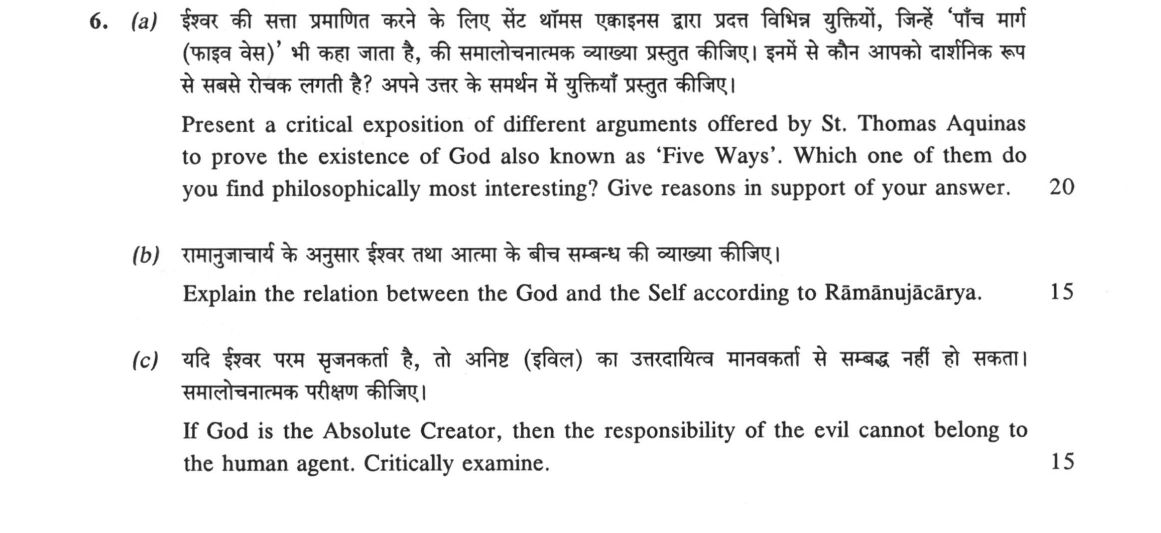
(a) Present a critical exposition of different arguments offered by St. Thomas Aquinas to prove the existence of God also known…
Present a critical exposition of different arguments offered by St. Thomas Aquinas to prove the existence of God also known as 'Five Ways'. Which one of them do you find philosophically most interesting? Give reasons in support of your answer. 20 marks
Explain the relation between the God and the Self according to Rāmānujācārya. 15 marks
If God is the Absolute Creator, then the responsibility of the evil cannot belong to the human agent. Critically examine. 15 marks
हिंदी में प्रश्न पढ़ें
ईश्वर की सत्ता प्रमाणित करने के लिए सेंट थॉमस एक्विनास द्वारा प्रदत्त विभिन्न युक्तियों, जिन्हें 'पाँच मार्ग (फाइव वेज़)' भी कहा जाता है, की समालोचनात्मक व्याख्या प्रस्तुत कीजिए। इनमें से कौन आपको दार्शनिक रूप से सबसे रोचक लगती है? अपने उत्तर के समर्थन में युक्तियाँ प्रस्तुत कीजिए। (20 अंक)
रामानुजाचार्य के अनुसार ईश्वर तथा आत्मा के बीच संबंध की व्याख्या कीजिए। (15 अंक)
यदि ईश्वर परम सृजनकर्ता है, तो अनिष्ट (इविल) का उत्तरदायित्व मानवकर्ता से संबद्ध नहीं हो सकता। समालोचनात्मक परीक्षण कीजिए। (15 अंक)
Model answer
Written by UPSC Answer Check against this question's marking rubric, to the expected length. UPSC does not publish answers for Mains — this is one way to score well, not an official key.
Aquinas’s Five Ways: Exposition and Critical Appraisal
St. Thomas Aquinas formulated the Quinque Viae (Summa Theologiae) to demonstrate God’s existence a posteriori, grounding natural theology in Aristotelian metaphysics of act and potency (actus et potentia).
The First Way (Motion/Change) argues that whatever moves is moved by another; to avoid an infinite regress in an essentially ordered series, there must be a First Unmoved Mover (Primum Movens Immobile). The Second Way (Efficient Cause) asserts that nothing can be the efficient cause of itself; hence, an uncaused First Efficient Cause is necessary. The Third Way (Contingency) observes that contingent beings can either exist or not exist. If all things were merely contingent, at one time nothing would exist, implying nothing could come into being; thus, an absolute Necessary Being (ens necessarium) must exist. The Fourth Way (Degrees of Perfection) posits that varying degrees of goodness, truth, and nobility require a maximum standard that is the exemplar cause of all perfections. The Fifth Way (Teleology/Governance) observes that non-conscious natural bodies act for an end, requiring an intelligent Governor to direct them.
Critically, the first three (cosmological) assume the impossibility of infinite regress and transition from empirical causation to a transcendent cause, while the Fourth Way risks reifying abstract predicates, and the Fifth Way anticipates the design argument.
The Third Way from Contingency is philosophically the most interesting. Unlike physical arguments from kinetic motion or biological design, it directly engages the radical ontological question of why contingent reality exists rather than nothing. By invoking the Principle of Sufficient Reason, it demonstrates that a chain of dependent entities, regardless of temporal length, cannot explain its own collective existence, logically necessitating a self-subsisting being whose essence is existence itself (Ipsum Esse Subsistens).
God and Self in Rāmānujācārya’s Viśiṣṭādvaita
Rāmānuja conceives the relation between Brahman (Īśvara) and the individual self (jīva) through the framework of Śarīra-śarīri-bhāva (body-soul relation), underpinned by apṛthaksiddhi (inseparable relation).
Rāmānuja defines a body (śarīra) as any substance which a conscious soul completely controls (niyāmya), supports (dhārya), and uses for its own purposes (śeṣa). The finite jīva is thus an eternal, conscious mode (prakāra) of Brahman, while Brahman is the Supreme Self and Inner Ruler (Antaryāmin or śeṣī).
This organic unity avoids Advaitic illusionism and Dvaitic absolute separation. Although the jīva is ontologically dependent on Brahman as an aṃśa (part/attribute), it retains real individuality, cognitive agency (kartṛtva), and moral responsibility. Brahman provides the underlying ground and initial permission (anumati), but the actual volitional choice to act belongs to the individual self, preserving moral culpability and spiritual striving (bhakti/prapatti).
Divine Creation and Moral Responsibility for Evil: Critical Examination
The thesis that absolute divine creation absolves human agents of the responsibility of evil assumes that an omnipotent, omniscient Creator is the causally sufficient ground of all effects, rendering human acts mere deterministic extensions of the divine will.
However, this argument is logically deficient because it conflates God’s primary ontological sustenance of being with the secondary, efficient moral agency of finite creatures:
First, Alvin Plantinga’s Free Will Defense shows that creating creatures capable of genuine moral goodness logically necessitates bestowing significant free will—the freedom to choose between good and evil. God cannot logically create genuinely free agents and simultaneously determine them to only choose good.
Second, the Augustinian tradition demonstrates that moral evil is not a created positive substance, but a privatio boni (privation of good), an ontological defect resulting from the disordered volition of the creature. John Hick’s Irenaean soul-making theodicy further shows that an environment containing moral challenge is necessary for finite spiritual maturity.
Third, in Indian philosophy, the doctrine of Karma explicitly exonerates Brahman from partiality (vaiṣamya) and cruelty (nairghṛṇya). Creation is beginningless (anādi), and individual suffering is the fruition of the jīva’s own self-generated karmic residues, not arbitrary divine infliction.
Therefore, the claim must be rejected: God’s absolute creation establishes the ontological precondition for agency, but moral responsibility rests squarely on the finite human agent. Divesting humans of moral responsibility reduces free agents to automata and dissolves ethical normativity.
Conclusion
Thomist natural theology, Rāmānuja’s qualified non-dualism, and theodicies of free agency collectively establish that divine absolute sovereignty does not eradicate creaturely distinction. God remains the transcendent-immanent ground of existence, while the moral agent retains authentic freedom and moral accountability.
What "Critically examine" is asking you to do
Test the proposition the question puts to you and return a finding on how far it holds. Examine stems carry a claim, or ask whether something has happened, and expect evidence weighed both ways before the extent is stated — often with remedial measures attached. “Critically” is not a section added at the end: name the yardstick you are judging by — the evidence, the stated objective, a constitutional principle, a rival explanation — and let a verdict close each part of the body. Where the question quotes a claim, that verdict must land on the claim itself, accepted, qualified or rejected, and not on the theme in general.
Structure that answers it
Restate the claim as the question frames it → evidence that supports it → evidence that undercuts it → the conditions under which it holds → verdict on how far it stands
Where marks are lost
Merits in one paragraph, demerits in the next, and a conclusion calling for a balanced and holistic approach. That is a survey with the judgement left out and it holds the answer in the middle band. The opposite error is reading “critically” as permission to attack — and with the odd pairings, critically describe or critically explain, the exposition still carries most of the marks, the judgement being a layer on it rather than a substitute for it.
How this answer will be evaluated
Approach
Framework: Philosophy Paper II: Reconstruct > Objection > Evaluation. (a) critique: the claim > its strengths > its weaknesses > your judgment | (b) explain: definition/context > points in order > small example > short close | (c) critique: the claim > its strengths > its weaknesses > your judgment Full marks: Precise reconstruction of arguments, strong critical engagement, and use of technical vocabulary.
Key points expected
- Reconstruct all five arguments (motion, causality, contingency, gradation, design)
- Identify one specific Way as 'most interesting'
- Provide philosophical reasons supporting the choice
- Present a critical objection to the chosen argument
- Define the relationship as 'Sesha' (dependent) and 'Sesin' (independent)
- Explain the concept of 'Sariribhava' (body-soul relation)
- Distinguish this from Advaita (identity) and Dvaita (total separation)
- Mention the 'Vishishtadvaita' framework
Evaluation rubric
Each sub-part is marked on its own, against the marks and word limit printed on the paper.
- (a) Reconstruct Five Ways, identify strongest, and provide reasoned justification. 20 marks
critique— the claim → its strengths → its weaknesses → your judgment
Must cover
- Reconstruct all five arguments (motion, causality, contingency, gradation, design)
- Identify one specific Way as 'most interesting'
- Provide philosophical reasons supporting the choice
- Present a critical objection to the chosen argument
Loses marks
- Summarizing the arguments without critical analysis
- Failing to justify the choice of the 'most interesting' Way
- Biographical details of Aquinas
Earns more
- Distinguishes between the 'unmoved mover' and 'first cause' concepts
- References the cosmological vs teleological distinction
- Mentions the 'contingency' argument (Quintus Modus) specifically
Extra mark
- References the specific Latin terms (e.g., Causa Prima)
- Mentions the 'Summa Theologica' I, Q2, A3
- (b) Explain the ontological relationship between God and Self in Ramanuja's Vedanta. 15 marks
explain— definition/context → points in order → small example → short close
Must cover
- Define the relationship as 'Sesha' (dependent) and 'Sesin' (independent)
- Explain the concept of 'Sariribhava' (body-soul relation)
- Distinguish this from Advaita (identity) and Dvaita (total separation)
- Mention the 'Vishishtadvaita' framework
Loses marks
- Confusing Ramanuja's view with Shankara's Advaita
- Vague description of 'connection' without technical terms
- Biographical details of Ramanuja
Earns more
- Explains the 'Prakara' (modes) of Brahman
- Mentions the 'Tat Tvam Asi' interpretation in this context
Extra mark
- References specific Sanskrit terms like 'Sesatva' or 'Sesitva'
- Mentions the 'Brahma Sutra Bhashya' as the source
- (c) Critically examine the claim that God's absolute creatorship negates human moral responsibility. 15 marks
critique— the claim → its strengths → its weaknesses → your judgment
Must cover
- State the problem of evil / divine determinism clearly
- Present the argument for human responsibility (free will)
- Present the argument for divine responsibility (omnipotence)
- Offer a balanced evaluation or resolution (e.g., compatibilism)
Loses marks
- One-sided argument (only for or against)
- Vague moralizing without philosophical reasoning
- Ignoring the 'Absolute Creator' premise
Earns more
- References the 'Problem of Evil' (Theodicy)
- Mentions 'Compatibilism' vs 'Incompatibilism'
- References specific philosophers (e.g., Leibniz, Hume)
Extra mark
- References the 'Euthyphro Dilemma'
- Mentions 'Divine Command Theory'
Practice this exact question
Write your answer and it is marked point by point against the model answer above — what you covered, what you missed, what you got wrong.
Evaluate my answer →More from Philosophy 2022 Paper II
- Q3 (a) Do you agree that economic development does not on its own lead to human development…
- Q4 (a) Discuss propaganda as a challenge to democratic form of government. (20 marks) (b) Do…
- Q5 Answer the following questions in about 150 words each: (a) Write an essay on Spinoza's n…
- Q6 (a) Present a critical exposition of different arguments offered by St. Thomas Aquinas to…
- Q7 (a) "An unquestionable acceptance of only one Absolute Truth will inevitably result in re…
- Q8 (a) Discuss the main points of distinction between a priori and a posteriori arguments fo…