Paper I — Q1
Write short answers to the following in about 150 words each: (a) "Precepts without concepts are blind and concepts without…
Write short answers to the following in about 150 words each:
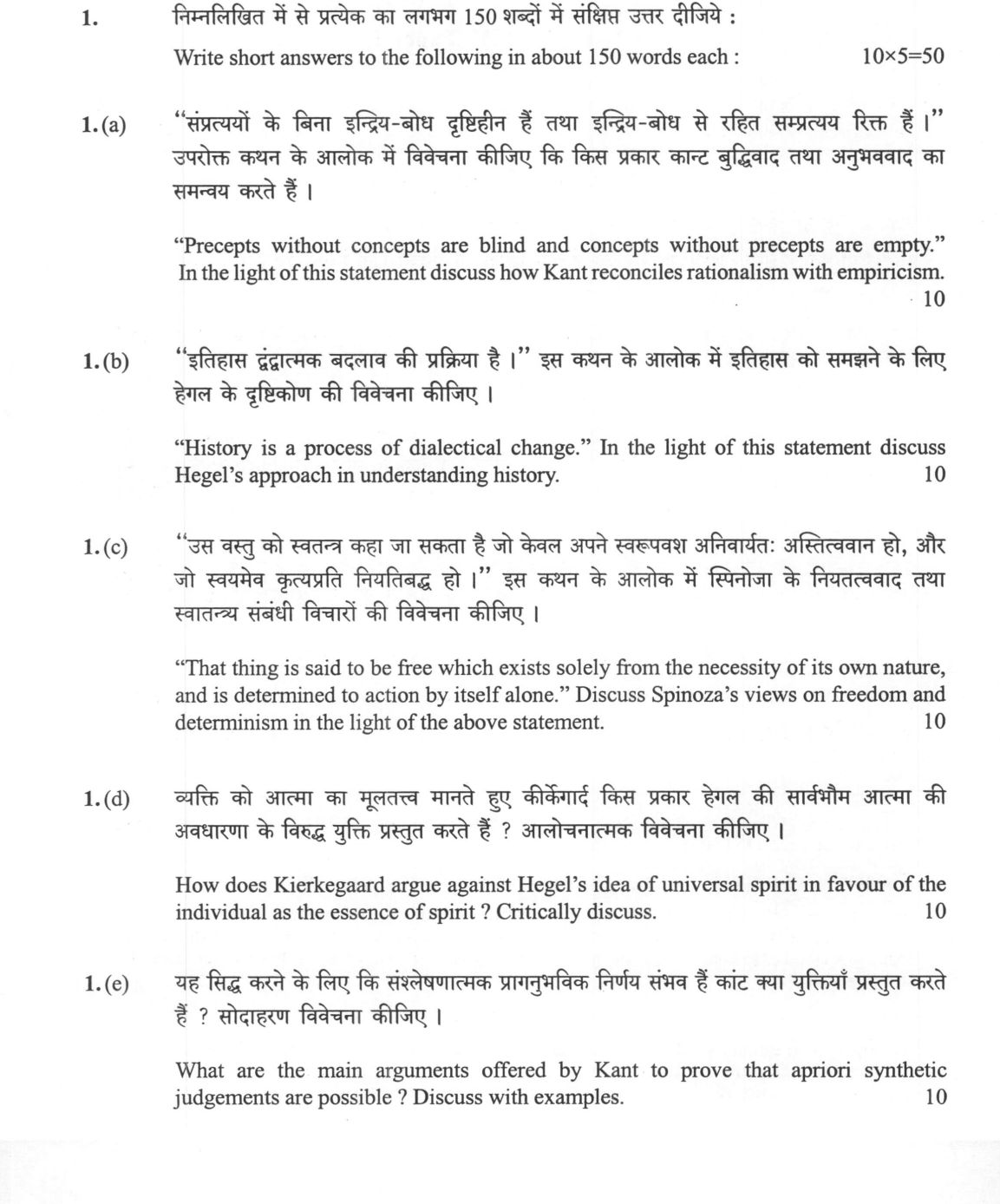
"Precepts without concepts are blind and concepts without precepts are empty." In the light of this statement discuss how Kant reconciles rationalism with empiricism. 10 marks
"History is a process of dialectical change." In the light of this statement discuss Hegel's approach in understanding history. 10 marks
"That thing is said to be free which exists solely from the necessity of its own nature, and is determined to action by itself alone." Discuss Spinoza's views on freedom and determinism in the light of the above statement. 10 marks
How does Kierkegaard argue against Hegel's idea of universal spirit in favour of the individual as the essence of spirit ? Critically discuss. 10 marks
What are the main arguments offered by Kant to prove that apriori synthetic judgements are possible ? Discuss with examples. 10 marks
हिंदी में प्रश्न पढ़ें
निम्नलिखित में से प्रत्येक का लगभग 150 शब्दों में संक्षिप्त उत्तर दीजिए :
"संप्रत्ययों के बिना इन्द्रिय-बोध दृष्टिहीन है तथा इन्द्रिय-बोध से रहित सम्प्रत्यय रिक्त है।" उपरोक्त कथन के आलोक में विवेचना कीजिए कि किस प्रकार कांट बुद्धिवाद तथा अनुभववाद का समन्वय करते हैं। (10 अंक)
"इतिहास द्वंद्वात्मक बदलाव की प्रक्रिया है।" इस कथन के आलोक में इतिहास को समझने के लिए हेगल के दृष्टिकोण की विवेचना कीजिए। (10 अंक)
"उस वस्तु को स्वतंत्र कहा जा सकता है जो केवल अपने स्वरूपवश अनिवार्यतः अस्तित्ववान हो, और जो स्वयमेव कृत्यप्रति नियतिबद्ध हो।" इस कथन के आलोक में स्पिनोजा के नियतत्ववाद तथा स्वातंत्र्य संबंधी विचारों की विवेचना कीजिए। (10 अंक)
व्यक्ति को आत्मा का मूलतत्त्व मानते हुए कीर्केगार्ड किस प्रकार हेगल की सार्वभौम आत्मा की अवधारणा के विरुद्ध युक्ति प्रस्तुत करते हैं ? आलोचनात्मक विवेचना कीजिए। (10 अंक)
यह सिद्ध करने के लिए कि संश्लेषणात्मक प्रागनुभविक निर्णय संभव हैं कांट क्या युक्तियाँ प्रस्तुत करते हैं ? सोदाहरण विवेचना कीजिए। (10 अंक)
Model answer
Written by UPSC Answer Check against this question's marking rubric, to the 150-word length. UPSC does not publish answers for Mains — this is one way to score well, not an official key.
The five prompts trace a German philosophical problem: how reason, experience, history and individual existence can be made coherent without reducing one to another.
(a) Kant’s reconciliation Kant’s dictum means that bare moral or rational precepts lack content if they are not applied to sensible experience, while raw experience is unintelligible without concepts. Empiricism is right that knowledge begins with sensibility; rationalism is right that the understanding supplies necessary forms. In the Critique of Pure Reason, the transcendental deduction shows that the categories are not copied from experience nor arbitrary rational inventions; they are the conditions under which intuitions become objects of experience. Thus sensibility gives matter, understanding gives form, and reason is limited to possible experience. It is not a compromise: experience is already structured by the understanding. This reconciles the two traditions by making rational structure empirical in application but a priori in validity.
(b) Hegel’s dialectical history For Hegel, history is not a random sequence but the self-development of World Spirit (Weltgeist) through contradiction and negation. The dialectic is often simplified as thesis-antithesis-synthesis, but Hegel’s movement is better understood as a concept confronting its limitations, being negated, and being sublated (Aufhebung) into a richer unity. The dialectic is immanent, not imposed from outside. Freedom is the end of history, but it is realized progressively and institutionally, not merely psychologically. In the Oriental world, one person is free; in the Greek and Roman world, some are free; in the Germanic-Christian world, the principle emerges that all are free as rational beings. This gives history meaning, but it can be Eurocentric and may rationalize domination by presenting particular regimes as necessary stages.
(c) Spinoza’s freedom and determinism Spinoza defines freedom not as arbitrary will or absence of causation, but as acting from the necessity of one’s own nature. A free thing is self-determined; a compelled thing is determined by external causes. Since everything follows from the necessity of God or Nature, human beings are not absolutely free in the libertarian sense. Yet freedom grows when we understand the causes that determine us. Ethics I, Prop. 7 shows that all things follow from divine necessity; the conatus, each thing’s striving to persist, is the basis of self-determination. Error arises when we are conscious of desires but ignorant of their causes. Adequate ideas align the mind with nature, making freedom compatible with determinism. Thus freedom is internal necessity, not exemption from law.
(d) Kierkegaard against Hegel Kierkegaard argues that Hegel’s universal spirit absorbs the existing individual into an abstract system. For Kierkegaard, spirit is not an objective totality but the concrete, passionate, choosing self; the self is in relation to itself and to God. Truth is subjectivity: what matters is how one relates to truth, not merely possessing objective propositions. The knight of faith makes a leap beyond ethical universality, whereas Hegelian objective spirit remains in the rational whole. It exposes the danger of systematizing life and neglecting anxiety, decision and commitment. Yet it can overstate the opposition to Hegel, neglect the ethical and social dimensions of selfhood, and risk arbitrariness if the leap is not accountable to reason or community. Hegel might reply that individuality is mediated by ethical life, while Kierkegaard’s faith may remain opaque to public justification.
(e) Kant on synthetic a priori judgments Kant distinguishes analytic from synthetic judgments and a priori from a posteriori knowledge. Analytic judgments unpack a concept; synthetic judgments add new content. A priori judgments are independent of particular experience. The problem, posed at B19, is how synthetic a priori judgments are possible. Kant’s answer is the Copernican turn: we cannot know objects as they are in themselves, but we can know a priori the conditions under which objects must appear to us. Categories do not create objects; they make experience unified. Pure mathematics, such as 7 + 5 = 12, is synthetic a priori because the result is not contained in the concepts of the numbers but is necessary. Pure natural science, such as every event has a cause, is likewise synthetic a priori because it applies the category of causality to experience. Metaphysics is possible only as critical metaphysics of experience; B19 marks the problem for critique, not unrestricted knowledge of things-in-themselves.
Together, the answers move from Kant’s synthesis of reason and experience, through Hegel’s historical dialectic and Spinoza’s necessity, to Kierkegaard’s protest that spirit must be lived by an existing individual. The issue remains how universal reason can be realized in concrete freedom without erasing necessity or personhood.
What "Discuss" is asking you to do
Lay the issue out from more than one side — how it arose, what is claimed for it, what is held against it, and where it now stands. UPSC attaches discuss to broad topics with several live dimensions, so coverage of the dimensions earns more than the strength of your opinion.
Structure that answers it
Set the issue up → the case as it is made → the case against → the dimension both sides leave out → where the balance now lies
Where marks are lost
Listing facts with no thread between them, or arguing one side throughout and calling it a discussion.
How this answer will be evaluated
Approach
Framework: UPSC Philosophy Paper I. (a) discuss: intro > 3-4 dimensions > example > balanced close | (b) discuss: intro > 3-4 dimensions > example > balanced close | (c) discuss: intro > 3-4 dimensions > example > balanced close | (d) critique: the claim > its strengths > its weaknesses > your judgment | (e) discuss: intro > 3-4 dimensions > example > balanced close Full marks: Precise technical vocabulary, clear reconstruction of arguments, strong counter-arguments, exact Sanskrit/Greek terms.
Key points expected
- Define 'concepts' as categories of understanding
- Define 'intuitions' as sensory manifold
- Explain 'blind' concepts (rationalism without data)
- Explain 'empty' intuitions (empiricism without form)
- Define 'dialectical change' as self-development
- Explain the role of 'negation' in history
- Link history to the progress of Spirit (Geist)
- Mention 'Aufhebung' (sublation) as the mechanism
Evaluation rubric
Each sub-part is marked on its own, against the marks and word limit printed on the paper.
- (a) Reconcile rationalism and empiricism via the synthesis of concepts and intuitions. 10 marks · 150 words
discuss— intro → 3-4 dimensions → example → balanced close
Must cover
- Define 'concepts' as categories of understanding
- Define 'intuitions' as sensory manifold
- Explain 'blind' concepts (rationalism without data)
- Explain 'empty' intuitions (empiricism without form)
Loses marks
- Biographical details of Kant
- Vague paraphrase of the quote
- Ignoring the 'blind/empty' distinction
Earns more
- Mention 'synthetic a priori' judgments
- Reference Transcendental Aesthetic
- Reference Transcendental Analytic
- Mention 'manifold of intuition'
Extra mark
- Cite Critique of Pure Reason (A494/B522)
- Use Sanskrit term 'pratyaksha' for intuition
- (b) Explain Hegel's dialectical method (thesis-antithesis-synthesis) applied to historical progress. 10 marks · 150 words
discuss— intro → 3-4 dimensions → example → balanced close
Must cover
- Define 'dialectical change' as self-development
- Explain the role of 'negation' in history
- Link history to the progress of Spirit (Geist)
- Mention 'Aufhebung' (sublation) as the mechanism
Loses marks
- Treating history as mere chronology
- Confusing Hegel with Marx
- Biographical details of Hegel
Earns more
- Reference 'Phenomenology of Spirit'
- Mention 'cunning of reason' (List der Vernunft)
- Cite specific historical examples (e.g., French Revolution)
- Use Sanskrit term 'virodha' for contradiction
Extra mark
- Reference 'Philosophy of History' lectures
- Mention 'World Spirit' (Weltgeist)
- (c) Analyze Spinoza's definition of freedom as self-determination within necessity. 10 marks · 150 words
discuss— intro → 3-4 dimensions → example → balanced close
Must cover
- Define 'freedom' as acting from own nature
- Define 'necessity' as causal determinism
- Explain 'adequate ideas' as the path to freedom
- Contrast 'free' vs 'compelled' things
Loses marks
- Confusing Spinoza with Descartes
- Ignoring the 'necessity' aspect of the quote
- Biographical details of Spinoza
Earns more
- Reference 'Ethics' Part I or V
- Mention 'God or Nature' (Deus sive Natura)
- Use Sanskrit term 'svatantrya' for freedom
- Mention 'conatus' (striving)
Extra mark
- Cite specific Proposition from Ethics
- Reference 'intellectual love of God'
- (d) Critically evaluate Kierkegaard's rejection of Hegel's universal spirit in favor of the individual. 10 marks · 150 words
critique— the claim → its strengths → its weaknesses → your judgment
Must cover
- State Hegel's 'universal spirit' position
- State Kierkegaard's 'individual' position
- Explain 'leap of faith' as the counter-argument
- Mention 'subjectivity is truth'
Loses marks
- Biographical details of Kierkegaard
- Vague paraphrase of 'universal spirit'
- Ignoring the 'critically' command word
Earns more
- Reference 'Concluding Unscientific Postscript'
- Mention 'stages on life's way'
- Use Sanskrit term 'vyakti' for individual
- Mention 'anxiety' (Angst)
Extra mark
- Reference 'Fear and Trembling'
- Mention 'the single individual' (den Enkelte)
- (e) Present Kant's arguments for the possibility of synthetic a priori judgments with examples. 10 marks · 150 words
discuss— intro → 3-4 dimensions → example → balanced close
Must cover
- Define 'synthetic a priori' judgments
- Explain the 'Copernican Revolution' in philosophy
- Provide example: Mathematics (7+5=12)
- Provide example: Physics (Causality)
Loses marks
- Confusing 'analytic' with 'synthetic'
- Biographical details of Kant
- Vague paraphrase of 'a priori'
Earns more
- Reference 'Critique of Pure Reason'
- Mention 'transcendental deduction'
- Use Sanskrit term 'purva' for a priori
- Mention 'categories of understanding'
Extra mark
- Cite specific section of Critique
- Reference 'metaphysics of nature'
Practice this exact question
Write your answer and it is marked point by point against the model answer above — what you covered, what you missed, what you got wrong.
Evaluate my answer →More from Philosophy 2023 Paper I
- Q1 Write short answers to the following in about 150 words each: (a) "Precepts without conce…
- Q2 (a) Critically analyse Hume's argument that causality is a matter of habit/custom involvi…
- Q3 (a) Does the rejection of metaphysics as proposed by Logical Positivists relate to proble…
- Q4 (a) Why does Strawson consider person to be a primitive concept ? What implication does i…