Paper I — Q3
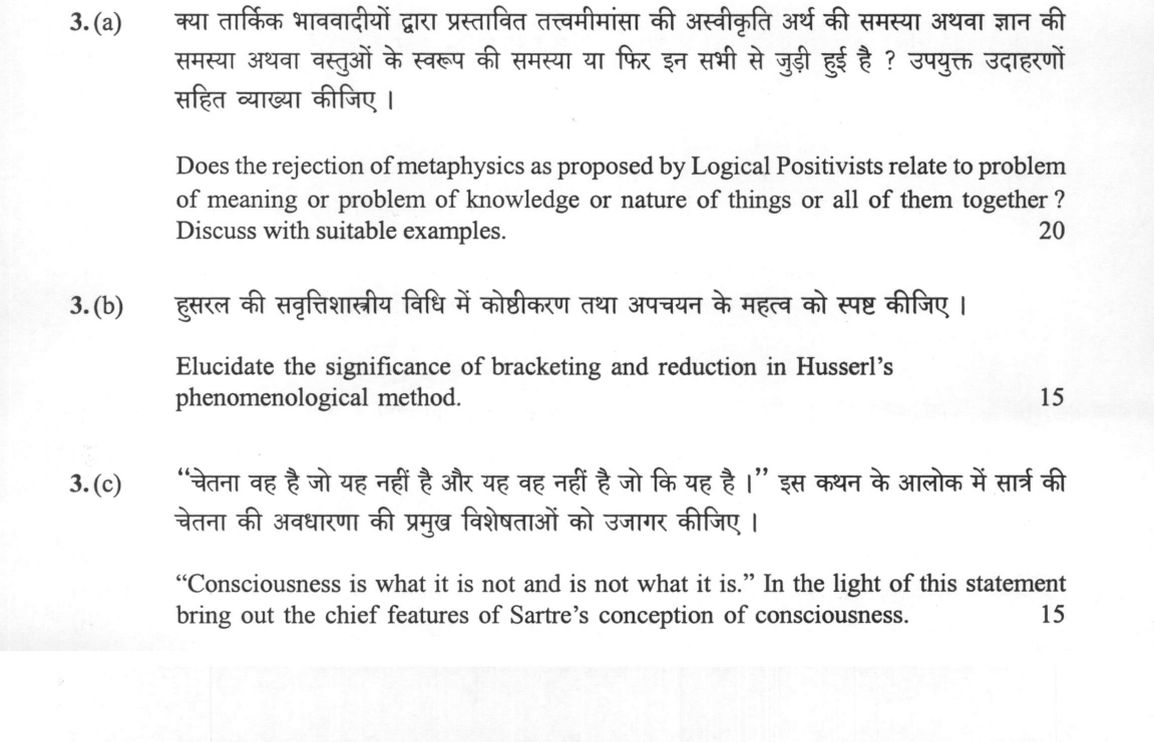
(a) Does the rejection of metaphysics as proposed by Logical Positivists relate to problem of meaning or problem of knowledge or…
Does the rejection of metaphysics as proposed by Logical Positivists relate to problem of meaning or problem of knowledge or nature of things or all of them together ? Discuss with suitable examples. 20 marks
Elucidate the significance of bracketing and reduction in Husserl's phenomenological method. 15 marks
"Consciousness is what it is not and is not what it is." In the light of this statement bring out the chief features of Sartre's conception of consciousness. 15 marks
हिंदी में प्रश्न पढ़ें
क्या तार्किक भाववादियों द्वारा प्रस्तावित तत्त्वमीमांसा की अस्वीकृति अर्थ की समस्या अथवा ज्ञान की समस्या अथवा वस्तुओं के स्वरूप की समस्या या फिर इन सभी से जुड़ी हुई है ? उपयुक्त उदाहरणों सहित व्याख्या कीजिए । (20 अंक)
हुसर्ल की सत्त्वितिशास्त्रीय विधि में कोष्ठीकरण तथा अपचयन के महत्व को स्पष्ट कीजिए । (15 अंक)
"चेतना वह है जो यह नहीं है और यह वह नहीं है जो कि यह है ।" इस कथन के आलोक में सार्त्र की चेतना की अवधारणा की प्रमुख विशेषताओं को उजागर कीजिए । (15 अंक)
Model answer
Written by UPSC Answer Check against this question's marking rubric, to the expected length. UPSC does not publish answers for Mains — this is one way to score well, not an official key.
Logical Positivism and the Rejection of Metaphysics
The Logical Positivist elimination of metaphysics is primarily a critique of meaning, but it simultaneously redefines epistemology and dissolves traditional questions regarding the nature of things. By deploying the Verifiability Criterion of Meaning, the Vienna Circle and A.J. Ayer (Language, Truth and Logic) argued that a proposition is cognitively meaningful if and only if it is either analytic (tautologies of logic and mathematics) or empirically verifiable (synthetic). Metaphysical assertions such as "The Absolute is perfect" or "God exists" do not assert matters of empirical fact, nor are they formal definitions; hence, they are not false, but literal pseudo-propositions devoid of cognitive sense.
Epistemologically, this restricts human knowledge strictly to the bounds of sense-experience and tautological transformations, echoing Wittgenstein’s Tractatus (Proposition 7: "Whereof one cannot speak, thereof one must be silent"). Ayer distinguished between "strong" verification (conclusive experiential proof) and "weak" verification (rendering an empirical hypothesis probable in principle). Because metaphysical concepts fail even weak verification, metaphysics cannot yield genuine knowledge. Consequently, the critique expands to ethics, aesthetics, and theology, reducing their claims to non-cognitive, emotive expressions. Regarding the "nature of things," positivism does not offer an alternative ontology (like materialism or idealism), but dissolves ontology entirely as an illusory byproduct of linguistic misuse. However, the criterion faces the classic charge of self-refutation, as the verification principle itself is neither tautological nor empirically verifiable.
Bracketing and Reduction in Husserl’s Phenomenology
Edmund Husserl developed the phenomenological method to overcome both psychologism and naturalism, establishing philosophy as a rigorous, presuppositionless science (strenge Wissenschaft). Central to this are epoché (bracketing) and the two-fold reduction.
Epoché demands the methodical suspension of the "natural attitude"—our naive, unexamined belief in the independent existence of the spatio-temporal world. Rather than doubting the world's existence (as in Cartesian skepticism), the phenomenologist brackets all existential claims and ontological presuppositions. Following this, the eidetic reduction strips away contingent, factual particulars to intuit universal essences (eidos) through imaginative variation. The transcendental reduction then suspends the empirical, psychological ego to uncover the "phenomenological residue"—pure, transcendental consciousness.
The profound significance of this process lies in securing an apodictic, absolute foundation for knowledge. Within this domain, consciousness is characterized by intentionality (noesis-noema correlation)—meaning is actively constituted by the transcendental ego. The world is thereby recovered not as a dogmatic, mind-independent substance, but as a validly constituted phenomenon of pure consciousness.
Sartre’s Paradox and the Conception of Consciousness
Jean-Paul Sartre’s formulation that consciousness "is what it is not and is not what it is" encapsulates the fundamental ontology of the Pour-soi (Being-for-itself) in Being and Nothingness. Rooted in intentionality, consciousness cannot exist in isolation; it is always consciousness of an object. Because it is directed outward toward the En-soi (Being-in-itself, the opaque, fully self-identical, solid object), consciousness in itself is an emptiness, a radical lack, or pure nothingness (néant).
The paradox illustrates the dynamic temporality and freedom of the For-itself: Consciousness is not what it is because it constantly nihilates its past facticity (its fixed history, body, and socio-historical situatedness), transcending it through perpetual choice. Consciousness is what it is not because its being is defined by its future possibilities and projects, which do not yet exist.
Unlike the In-itself, the For-itself lacks fixed essence; its existence precedes its essence. Attempting to evade this absolute freedom and its accompanying anguish results in mauvaise foi (bad faith)—exemplified by the café waiter who pretends to be a fixed object ("a waiter in-itself"). For Sartre, human beings are "condemned to be free," constitutionally incapable of freezing consciousness into a substantial identity.
Conclusion
Logical Positivism, Husserlian phenomenology, and Sartrean existentialism represent radically divergent responses to modern epistemology. While Positivism linguistically eliminated metaphysics, Husserl re-grounded first philosophy in the transcendental ego, which Sartre subsequently radicalized by stripping the ego of substantiality and locating pure freedom in existence. This trajectory continues to guide contemporary debates in the philosophy of mind regarding the irreducible nature of intentionality and first-person subjective experience.
What "Discuss" is asking you to do
Lay the issue out from more than one side — how it arose, what is claimed for it, what is held against it, and where it now stands. UPSC attaches discuss to broad topics with several live dimensions, so coverage of the dimensions earns more than the strength of your opinion.
Structure that answers it
Set the issue up → the case as it is made → the case against → the dimension both sides leave out → where the balance now lies
Where marks are lost
Listing facts with no thread between them, or arguing one side throughout and calling it a discussion.
How this answer will be evaluated
Approach
Framework: null. (a) discuss: intro > 3-4 dimensions > example > balanced close | (b) explain: definition/context > points in order > small example > short close | (c) explain: definition/context > points in order > small example > short close Full marks: Precise technical vocabulary, clear argument reconstruction, strong counter-arguments, and exact Sanskrit/Greek terms where apt.
Key points expected
- Define the Verification Principle of meaning
- Link metaphysics to the problem of knowledge
- Address the nature of things (ontology)
- Provide suitable examples of rejected statements
- Define the phenomenological reduction (epoché)
- Explain the suspension of the natural attitude
- Distinguish reduction from mere skepticism
- Link to the study of pure consciousness
Evaluation rubric
Each sub-part is marked on its own, against the marks and word limit printed on the paper.
- (a) Analyze the scope of Logical Positivist rejection of metaphysics across meaning, knowledge, and ontology. 20 marks
discuss— intro → 3-4 dimensions → example → balanced close
Must cover
- Define the Verification Principle of meaning
- Link metaphysics to the problem of knowledge
- Address the nature of things (ontology)
- Provide suitable examples of rejected statements
Loses marks
- Biographical details of the Vienna Circle
- Vague paraphrase of 'meaningless' without technical definition
- Ignoring the 'nature of things' dimension
Earns more
- Mention Carnap or Ayer specifically
- Distinguish analytic from synthetic a posteriori
- Reference the 'linguistic turn' in philosophy
- Discuss the 'pseudo-problem' status of metaphysics
Extra mark
- Reference the Vienna Circle manifesto
- Mention the 'principle of verification' by name
- (b) Elucidate the function of bracketing and reduction in Husserl's phenomenological method. 15 marks
explain— definition/context → points in order → small example → short close
Must cover
- Define the phenomenological reduction (epoché)
- Explain the suspension of the natural attitude
- Distinguish reduction from mere skepticism
- Link to the study of pure consciousness
Loses marks
- Confusing reduction with logical positivism
- Treating bracketing as a physical act
- Biography of Husserl
Earns more
- Use the term 'bracketing' (Einklammerung) correctly
- Mention the 'transcendental ego'
- Reference the 'phenomenological residue'
- Distinguish eidetic from transcendental reduction
Extra mark
- Reference the 'Cartesian Meditations'
- Mention the 'noema-noesis' correlation
- (c) Bring out chief features of Sartre's conception of consciousness based on the provided statement. 15 marks
explain— definition/context → points in order → small example → short close
Must cover
- Define consciousness as 'nothingness' (néant)
- Explain the distinction between being-in-itself and for-itself
- Discuss consciousness as 'transcendence' or 'negation'
- Address the 'look' (le regard) as an example
Loses marks
- Biography of Sartre
- Confusing Sartre with Heidegger's Dasein
- Vague paraphrase of 'consciousness' without technical terms
Earns more
- Reference the 'Being and Nothingness'
- Mention 'bad faith' (mauvaise foi)
- Explain consciousness as 'intentionality'
- Discuss the 'pre-reflective cogito'
Extra mark
- Reference the 'phenomenology of the look'
- Mention the 'facticity' of existence
Practice this exact question
Write your answer and it is marked point by point against the model answer above — what you covered, what you missed, what you got wrong.
Evaluate my answer →More from Philosophy 2023 Paper I
- Q1 Write short answers to the following in about 150 words each: (a) "Precepts without conce…
- Q2 (a) Critically analyse Hume's argument that causality is a matter of habit/custom involvi…
- Q3 (a) Does the rejection of metaphysics as proposed by Logical Positivists relate to proble…
- Q4 (a) Why does Strawson consider person to be a primitive concept ? What implication does i…
- Q5 Write short answers to the following in about 150 words each: (a) "All human knowledge is…
- Q6 (a) Discuss Rāmānuja's criticism of Śaṅkara's conception of Brahman and Īśvara (God). (20…