Paper I — Q4
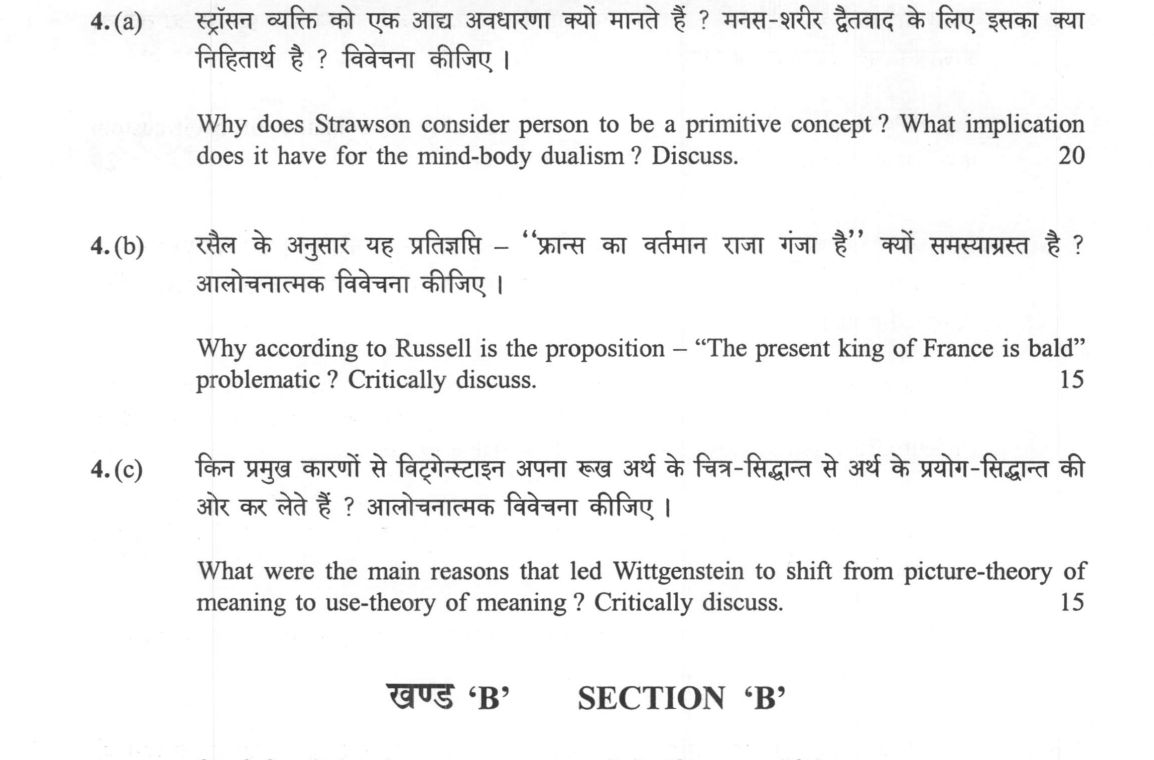
(a) Why does Strawson consider person to be a primitive concept ? What implication does it have for the mind-body dualism ?…
Why does Strawson consider person to be a primitive concept ? What implication does it have for the mind-body dualism ? Discuss. 20 marks
Why according to Russell is the proposition – "The present king of France is bald" problematic ? Critically discuss. 15 marks
What were the main reasons that led Wittgenstein to shift from picture-theory of meaning to use-theory of meaning ? Critically discuss. 15 marks
हिंदी में प्रश्न पढ़ें
स्ट्रॉसन व्यक्ति को एक आध अवधारणा क्यों मानते हैं ? मनस्-शरीर द्वैतवाद के लिए इसका क्या निहितार्थ है ? विवेचना कीजिए । (20 अंक)
रसेल के अनुसार यह प्रतिज्ञा – "फ्रांस का वर्तमान राजा गंजा है" क्यों समस्याप्रस्त है ? आलोचनात्मक विवेचना कीजिए । (15 अंक)
किन प्रमुख कारणों से विट्टजेन्स्टाइन अपना खण्ड अर्थ के चित्र-सिद्धान्त से अर्थ के प्रयोग-सिद्धान्त की ओर कर लेते हैं ? आलोचनात्मक विवेचना कीजिए । (15 अंक)
Model answer
Written by UPSC Answer Check against this question's marking rubric, to the expected length. UPSC does not publish answers for Mains — this is one way to score well, not an official key.
Strawson’s Primitive Concept of Person and Mind-Body Dualism
In Individuals, P.F. Strawson formulates descriptive metaphysics, identifying the "person" as a logically primitive concept. Rejecting Cartesian substance dualism, which construes a human being as an uneasy compound of two distinct substances (res cogitans and res extensa), Strawson argues that a person is a basic particular to which two irreducible kinds of predicates are equally ascribed: Material-predicates (M-predicates like height, weight, physical location) and Personal-predicates (P-predicates like thinking, feeling, perceiving, and intending).
This formulation fundamentally alters the mind-body debate. Strawson demonstrates that Cartesian dualism commits a conceptual confusion akin to Gilbert Ryle’s "category mistake" by treating mental and physical attributes as properties of two separate subjects rather than aspects of a unified whole. Furthermore, Strawson refutes the "no-ownership" theory of the self (associated with Lichtenberg and Hume), which treats experiences as ownerless events. He shows that one cannot identify an experience without already identifying the person who undergoes it; crucially, attributing states of consciousness to oneself (first-person) logically requires the ability to identify and attribute them to others (third-person). Therefore, the concept of a person is logically prior to any derived notions of an incorporeal soul or an animated corpse. Dualism fails because abstracting consciousness away from the bodily person renders the re-attribution of P-predicates conceptually impossible.
Russell and the Problem of Definite Descriptions
Bertrand Russell considered the proposition "The present King of France is bald" problematic because it is meaningful and grammatically subject-predicate in form, yet the grammatical subject lacks an existent referent. Under classical referential semantics, meaningfulness requires a referent, leading Alexius Meinong to postulate a bloated ontology of "subsisting" non-existent entities, generating severe logical paradoxes.
Russell resolved this dilemma through his Theory of Definite Descriptions by distinguishing grammatical surface structure from logical deep structure. Definite descriptions like "The present King of France" are incomplete symbols, not proper names. Russell translates the proposition into a conjunction of three distinct claims: Existence: There is an x such that x is the present King of France (∃ x Kx). Uniqueness: For any y, if y is the present King of France, y = x (∀ y (Ky → y=x)). Predication: x is bald (Bx).
Since the existential conjunct is false, the proposition is simply false, escaping Meinong’s paradox while retaining meaning.
Critically, P.F. Strawson objected that Russell conflated a sentence with its contextual assertion. Strawson argued that referring is an act performed by a speaker, not a property of an expression. The existence of the King is a presupposition of the utterance, not an explicit assertion; when the presupposition fails, a truth-value gap arises (the statement is neither true nor false), showing that Russell’s rigid logical paraphrase distorts ordinary language use.
Wittgenstein’s Shift from Picture-Theory to Use-Theory
In the Tractatus Logico-Philosophicus, early Ludwig Wittgenstein advanced the Picture Theory of Meaning, holding that propositions are logical pictures of facts, sharing an isomorphic logical structure with reality through a strict naming-relation between simple names and atomic objects.
In the Philosophical Investigations, Wittgenstein abandoned this atomistic framework for the Use Theory of Meaning ("the meaning of a word is its use in the language"). Key reasons for this shift include: Critique of the Augustinian Picture: The assumption that every word functions as a label for an object misrepresents the functional richness of language. Multiplicity of Language-Games: Language functions like a dynamic toolbox encompassing diverse activities—commanding, joking, praying, thanking—defying reduction to truth-conditional picturing. Family Resemblance and Rule-Following: Concepts are not bound by common essences or rigid logical definitions, but by overlapping networks of similarities. Impossibility of Private Language: Meaning cannot rely on private, subjective ostension; correct rule-following requires public, normative criteria embedded in a shared "form of life."
While scholars debate whether this represents a radical rupture or an evolving therapeutic method, it definitively decentred formal logical analysis.
Conclusion
The philosophical trajectory from Russell's formal reduction to Strawson's descriptive metaphysics and Wittgenstein's language-games marks the transition from logical atomism to ordinary language philosophy. Moving forward, a robust philosophical framework must synthesize Russell’s logical precision with Strawson’s and late Wittgenstein’s recognition that meaning, reference, and personhood are fundamentally embedded in normative, public practices.
What "Discuss" is asking you to do
Lay the issue out from more than one side — how it arose, what is claimed for it, what is held against it, and where it now stands. UPSC attaches discuss to broad topics with several live dimensions, so coverage of the dimensions earns more than the strength of your opinion.
Structure that answers it
Set the issue up → the case as it is made → the case against → the dimension both sides leave out → where the balance now lies
Where marks are lost
Listing facts with no thread between them, or arguing one side throughout and calling it a discussion.
How this answer will be evaluated
Approach
Framework: State the position > Argument > Strongest objection > Evaluation. (a) discuss: intro > 3-4 dimensions > example > balanced close | (b) discuss: intro > 3-4 dimensions > example > balanced close | (c) discuss: intro > 3-4 dimensions > example > balanced close Full marks: Precise reconstruction of arguments with technical vocabulary (e.g., 'logical priority', 'definite description', 'isomorphism').
Key points expected
- Define 'person' as a primitive concept (not reducible to mind or body).
- Explain the 'logical priority' of person over mind and body.
- Detail the 'category mistake' of treating mind/body as separate substances.
- Evaluate the implication for the 'substance dualism' of Descartes.
- Identify the 'existential presupposition' failure (no such King exists).
- Explain the 'uniqueness' condition of definite descriptions.
- State that the proposition is 'false' (not meaningless) due to failed presupposition.
- Contrast with Frege's 'sense and reference' view.
Evaluation rubric
Each sub-part is marked on its own, against the marks and word limit printed on the paper.
- (a) Reconstruct Strawson's argument for the primitive concept of 'person' and its impact on dualism. 20 marks
discuss— intro → 3-4 dimensions → example → balanced close
Must cover
- Define 'person' as a primitive concept (not reducible to mind or body).
- Explain the 'logical priority' of person over mind and body.
- Detail the 'category mistake' of treating mind/body as separate substances.
- Evaluate the implication for the 'substance dualism' of Descartes.
Loses marks
- Treating 'person' as a biological or social role only.
- Confusing Strawson's view with simple physicalism.
- Biographical details of Strawson's life.
Earns more
- Reference to 'Individuals' (1959).
- Distinction between 'physical' and 'mental' predicates.
- Mention of 'logical dependence' of mental states on persons.
Extra mark
- Comparison with Ryle's 'ghost in the machine' critique.
- Reference to the 'unity of consciousness' argument.
- (b) Analyze Russell's 'definite description' theory regarding the 'King of France' example. 15 marks
discuss— intro → 3-4 dimensions → example → balanced close
Must cover
- Identify the 'existential presupposition' failure (no such King exists).
- Explain the 'uniqueness' condition of definite descriptions.
- State that the proposition is 'false' (not meaningless) due to failed presupposition.
- Contrast with Frege's 'sense and reference' view.
Loses marks
- Claiming the sentence is 'meaningless' (Fregean error).
- Confusing 'reference' with 'sense' in the analysis.
- Vague paraphrase of 'presupposition' without logical detail.
Earns more
- Mention of 'On Denoting' (1905).
- Explanation of 'incomplete symbols' or 'contextual definition'.
- Reference to the 'Russellian analysis' of the sentence structure.
Extra mark
- Mention of the 'Kripke's critique' (rigid designators).
- Reference to the 'Millian' view of names.
- (c) Explain the transition from the 'Tractatus' picture theory to the 'Philosophical Investigations' use theory. 15 marks
discuss— intro → 3-4 dimensions → example → balanced close
Must cover
- Define 'picture theory' (isomorphism between language and world).
- Define 'use theory' (meaning as use in a 'language game').
- Identify the 'failure' of the picture theory for non-factual language (ethics, aesthetics).
- Explain the shift from 'private language' to 'public criteria'.
Loses marks
- Treating the shift as a simple rejection of the Tractatus.
- Confusing 'use' with 'convention' or 'agreement' only.
- Biographical details of Wittgenstein's life.
Earns more
- Reference to 'language games' (Sprachspiele).
- Mention of 'family resemblance' (Familienähnlichkeit).
- Critique of the 'myth of the given'.
Extra mark
- Reference to the 'Oxford' period of Wittgenstein.
- Mention of 'forms of life' (Lebensformen).
Practice this exact question
Write your answer and it is marked point by point against the model answer above — what you covered, what you missed, what you got wrong.
Evaluate my answer →More from Philosophy 2023 Paper I
- Q1 Write short answers to the following in about 150 words each: (a) "Precepts without conce…
- Q2 (a) Critically analyse Hume's argument that causality is a matter of habit/custom involvi…
- Q3 (a) Does the rejection of metaphysics as proposed by Logical Positivists relate to proble…
- Q4 (a) Why does Strawson consider person to be a primitive concept ? What implication does i…
- Q5 Write short answers to the following in about 150 words each: (a) "All human knowledge is…
- Q6 (a) Discuss Rāmānuja's criticism of Śaṅkara's conception of Brahman and Īśvara (God). (20…
- Q7 (a) Elucidate Naiyāyikas account of fallacies of the middle term in relation to five char…