Paper I — Q6
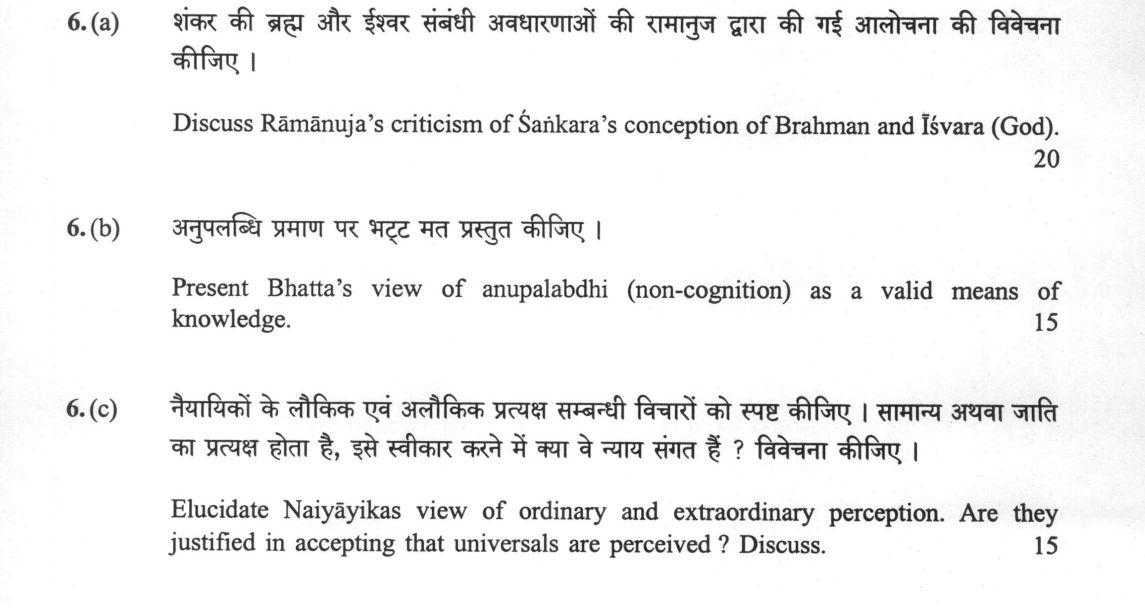
(a) Discuss Rāmānuja's criticism of Śaṅkara's conception of Brahman and Īśvara (God). (20 marks) (b) Present Bhatta's view of…
Discuss Rāmānuja's criticism of Śaṅkara's conception of Brahman and Īśvara (God). 20 marks
Present Bhatta's view of anupalabdhi (non-cognition) as a valid means of knowledge. 15 marks
Elucidate Naiyāyikas view of ordinary and extraordinary perception. Are they justified in accepting that universals are perceived ? Discuss. 15 marks
हिंदी में प्रश्न पढ़ें
शंकर की ब्रह्म और ईश्वर संबंधी अवधारणाओं की रामानुज द्वारा की गई आलोचना की विवेचना कीजिए । (20 अंक)
अनुपलब्धि प्रमाण पर भट्ट मत प्रस्तुत कीजिए । (15 अंक)
नैयायिकों के लौकिक एवं अलौकिक प्रत्यक्ष संबंधी विचारों को स्पष्ट कीजिए । सामान्य अथवा जाति का प्रत्यक्ष होता है, इसे स्वीकार करने में क्या वे न्याय संगत हैं ? विवेचना कीजिए । (15 अंक)
Model answer
Written by UPSC Answer Check against this question's marking rubric, to the expected length. UPSC does not publish answers for Mains — this is one way to score well, not an official key.
Rāmānuja on Brahman and Īśvara Rāmānuja’s critique begins with Śaṅkara’s distinction between nirguṇa Brahman and saguṇa Īśvara. For Śaṅkara, ultimate Brahman is nirviśeṣa, attributeless; Īśvara is Brahman under māyā/avidyā, the object of devotion but not the final reality. Rāmānuja rejects this as self-undermining. If Brahman is truly attributeless, it cannot be the conscious ground of the world, because consciousness itself implies a distinction between knower and known, and a real relation of qualification. A nirguṇa Brahman would be indeterminate, and an indeterminate cause cannot give rise to determinate effects; hence māyā cannot be said to originate from such a Brahman without making the cause unintelligible. Rāmānuja also attacks the locus of avidyā: ignorance cannot be located in an attributeless Brahman, because avidyā requires a conscious substrate that is also the object of its own limitation. In Viśiṣṭādvaita, Brahman is saguṇa; attributes are not external additions or illusory appearances but real internal qualifiers. The viśeṣaṇa-viśeṣya relation makes Brahman the qualified and guṇas, jīvas and jagat the qualifiers, so Īśvara is not a lower, māyā-qualified version of Brahman but Brahman himself as the conscious, attribute-bearing ground. The cit-jaḍa distinction further supports this: consciousness and matter are different, and Brahman as cit is the substrate of both, not identical with inert matter. Thus Rāmānuja preserves the reality of devotion, creation and moral agency while rejecting Advaita’s ultimate attributelessness.
Bhaṭṭa on anupalabdhi Kumārila Bhaṭṭa accepts anupalabdhi as a sixth pramāṇa, distinct from perception and inference. Its object is abhāva, a negative fact such as the absence of a pot on the floor, not a positive substance. The cognition has a svarūpa dimension: the absence itself is what is known; and a karaṇa dimension: the non-perception under appropriate conditions is the instrument or cause of that knowledge. The technical contrast sometimes drawn between vyatireka-anupalabdhi and anvaya-anupalabdhi must be handled carefully: it is not a standard Bhaṭṭa classification of anupalabdhi, and it must not be confused with the inference-formula of anvaya-vyatireka. Bhaṭṭa does not derive absence from a general concomitance of presence and absence; those terms properly belong to vyāpti. Where comparative discussions invoke vyatireka and anvaya, the Bhaṭṭa point is that anupalabdhi is a direct non-apprehension, not an inference from a relation of agreement. Prabhākara rejects anupalabdhi as an independent pramāṇa, reducing it to perception or inference, whereas Bhaṭṭa insists that negative facts are not adequately captured by those two.
Nyāya on perception and universals Nyāya divides perception into laukika and alaukika. Laukika perception is ordinary sense-perception, further divided into nirvikalpa, a pre-conceptual grasp, and savikalpa, a conceptual construction that identifies the object. Alaukika perception includes yogaja, sāmānyalakṣaṇa and jñānalakṣaṇa. Sāmānyalakṣaṇa is the extraordinary perception of the universal itself, not a single act that directly sees all individuals of a class. Nyāya argues that universals are real and inhere in particulars by samavāya; because they are real and present in the locus, they can be perceived, especially through this extraordinary mode. The Buddhist critique, associated with Dignāga’s apoha theory, denies real universals: what is perceived are particulars, and the concept “pot” functions by excluding non-pot. Nyāya replies that apoha cannot explain the positive content of recognition, the repeated application of a term, or the causal efficacy of universals in inference. Contemporary Nyāya responses refine this by distinguishing the universal from the mental concept and arguing that perception of a universal is not a direct perception of every individual but an apprehension of a real inhering property. Thus their acceptance is justified within Nyāya realism, but remains vulnerable to apoha unless the reality of inhering universals is independently defended. Together, they show Indian philosophy linking metaphysics, epistemology and soteriology as one integrated problem.
What "Discuss" is asking you to do
Lay the issue out from more than one side — how it arose, what is claimed for it, what is held against it, and where it now stands. UPSC attaches discuss to broad topics with several live dimensions, so coverage of the dimensions earns more than the strength of your opinion.
Structure that answers it
Set the issue up → the case as it is made → the case against → the dimension both sides leave out → where the balance now lies
Where marks are lost
Listing facts with no thread between them, or arguing one side throughout and calling it a discussion.
How this answer will be evaluated
Approach
Framework: State the position > Argument > Strongest objection > Evaluation. (a) discuss: intro > 3-4 dimensions > example > balanced close | (b) explain: definition/context > points in order > small example > short close | (c) critique: the claim > its strengths > its weaknesses > your judgment Full marks: Precise technical vocabulary, strong counter-arguments, exact Sanskrit terms
Key points expected
- Śaṅkara's nirguṇa Brahman and māyā
- Rāmānuja's viśiṣṭādvaita and saguṇa Brahman
- Critique of Īśvara as māyā-creator
- Bhakti and prapatti as valid means
- Definition of anupalabdhi (non-cognition)
- Bhaṭṭa's argument for its validity
- Distinction from Naiyāyika view
- Example of anupalabdhi (e.g., pot on mat)
Evaluation rubric
Each sub-part is marked on its own, against the marks and word limit printed on the paper.
- (a) Rāmānuja's critique of Śaṅkara's Brahman and Īśvara 20 marks
discuss— intro → 3-4 dimensions → example → balanced close
Must cover
- Śaṅkara's nirguṇa Brahman and māyā
- Rāmānuja's viśiṣṭādvaita and saguṇa Brahman
- Critique of Īśvara as māyā-creator
- Bhakti and prapatti as valid means
Loses marks
- Biographical details of Rāmānuja
- Vague paraphrase of Advaita
- Confusing Rāmānuja with Madhva
Earns more
- Distinction between svātantrya and māyā
- Role of upādhi in Rāmānuja's view
- Reference to Śrī Bhāṣya or Vedārtha Saṅgraha
Extra mark
- Specific Sanskrit terms like abhāsa-vāda
- Comparison with Madhva's dvaita
- (b) Bhaṭṭa view of anupalabdhi as pramāṇa 15 marks
explain— definition/context → points in order → small example → short close
Must cover
- Definition of anupalabdhi (non-cognition)
- Bhaṭṭa's argument for its validity
- Distinction from Naiyāyika view
- Example of anupalabdhi (e.g., pot on mat)
Loses marks
- Confusing anupalabdhi with anumāna
- Vague explanation of non-cognition
- Ignoring Bhaṭṭa's specific argument
Earns more
- Reference to Kumārila Bhaṭṭa
- Distinction between anupalabdhi and abhāva
- Role of anupalabdhi in negation
Extra mark
- Specific Sanskrit terms like abhāva-pramāṇa
- Comparison with Mīmāṃsā and Nyāya
- (c) Naiyāyika view of perception and universals 15 marks
critique— the claim → its strengths → its weaknesses → your judgment
Must cover
- Definition of ordinary and extraordinary perception
- Naiyāyika argument for perceiving universals
- Critique of universal perception
- Evaluation of Naiyāyika justification
Loses marks
- Confusing perception with inference
- Vague explanation of universals
- Ignoring the critique of universal perception
Earns more
- Distinction between nirvikalpaka and savikalpaka
- Reference to Uddyotakara or Vācaspati Miśra
- Comparison with Buddhist nominalism
Extra mark
- Specific Sanskrit terms like sāmānya and viśeṣa
- Reference to Nyāya Sūtra or Nyāya Bhāṣya
Practice this exact question
Write your answer and it is marked point by point against the model answer above — what you covered, what you missed, what you got wrong.
Evaluate my answer →More from Philosophy 2023 Paper I
- Q3 (a) Does the rejection of metaphysics as proposed by Logical Positivists relate to proble…
- Q4 (a) Why does Strawson consider person to be a primitive concept ? What implication does i…
- Q5 Write short answers to the following in about 150 words each: (a) "All human knowledge is…
- Q6 (a) Discuss Rāmānuja's criticism of Śaṅkara's conception of Brahman and Īśvara (God). (20…
- Q7 (a) Elucidate Naiyāyikas account of fallacies of the middle term in relation to five char…
- Q8 (a) "Ignorance of dependent origination is suffering while its knowledge is cessation of…