Paper I — Q8
(a) "Ignorance of dependent origination is suffering while its knowledge is cessation of suffering." Present an account of…
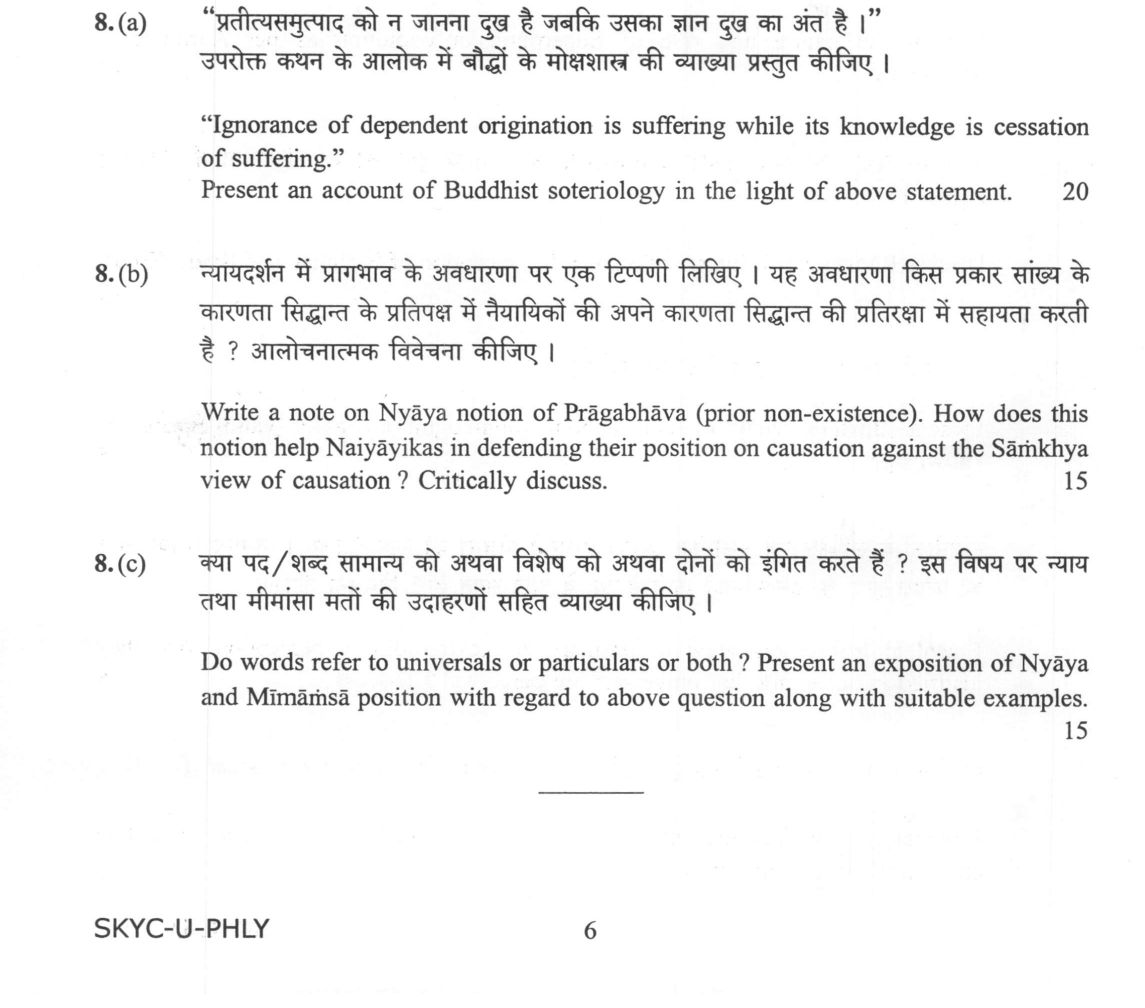
"Ignorance of dependent origination is suffering while its knowledge is cessation of suffering." Present an account of Buddhist soteriology in the light of above statement. 20 marks
Write a note on Nyāya notion of Prāgabhāva (prior non-existence). How does this notion help Naiyāyikas in defending their position on causation against the Sāṃkhya view of causation ? Critically discuss. 15 marks
Do words refer to universals or particulars or both ? Present an exposition of Nyāya and Mīmāṃsā position with regard to above question along with suitable examples. 15 marks
हिंदी में प्रश्न पढ़ें
"प्रतीत्यसमुत्पाद को न जानना दुःख है जबकि उसका ज्ञान दुःख का अंत है ।" उपरोक्त कथन के आलोक में बौद्धों के मोक्षशास्त्र की व्याख्या प्रस्तुत कीजिए । (20 अंक)
न्यायदर्शन में प्रागभाव के अवधारणा पर एक टिप्पणी लिखिए । यह अवधारणा किस प्रकार सांख्य के कारणता सिद्धांत के प्रतिपक्ष में नैयायिकों की अपने कारणता सिद्धांत की प्रतिरक्षा में सहायता करती है ? आलोचनात्मक विवेचना कीजिए । (15 अंक)
क्या पद/शब्द सामान्य को अथवा विशेष को अथवा दोनों को इंगित करते हैं ? इस विषय पर न्याय तथा मीमांसा मतों की उदाहरणों सहित व्याख्या कीजिए । (15 अंक)
Model answer
Written by UPSC Answer Check against this question's marking rubric, to the expected length. UPSC does not publish answers for Mains — this is one way to score well, not an official key.
Classical Indian philosophy systematically integrates metaphysics, semantics, and soteriology to address liberation, causation, and linguistic reference.
Buddhist Soteriology and Pratītyasamutpāda
In Buddhism, pratītyasamutpāda (dependent origination) functions as the ontological Middle Path between eternalism (śāśvatavāda) and annihilationism (ucchedavāda). It asserts that all phenomena arise dependently (asmin sati idam bhavati). Within the twelve links of causation (dvādaśa-nidāna), avidyā (primal ignorance of impermanence and non-self) is the root condition generating suffering (duḥkha). The Four Noble Truths articulate this causal nexus: diagnosing duḥkha, tracing its origin (samudaya) to craving rooted in avidyā, envisioning its cessation (nirodha) upon dispelling ignorance, and providing the praxis via the Noble Eightfold Path (mārga) to cultivate prajñā (transformative wisdom).
In Mādhyamika philosophy, Nāgārjuna develops this soteriology through the doctrine of Two Truths (satya-dvaya). Empirical existence operates under conventional truth (saṃvṛti-satya), governed by causal dependencies. However, ultimate truth (paramārtha-satya) reveals śūnyatā (emptiness of inherent existence, svabhāva). Equating pratītyasamutpāda with śūnyatā, Nāgārjuna demonstrates that realization of universal non-substantiality dissolves all mental proliferations (prapañca), culminating in liberation (nirvāṇa).
Nyāya Notion of Prāgabhāva and Causation
Nyāya defines prāgabhāva as prior non-existence—the absence of an effect in its material cause before its generation (such as curd before milk is curdled, or a jar before clay is fashioned). It is beginningless (anādi) but has an end (sānta), terminating precisely when the effect is produced. Nyāya distinguishes it from the three other forms of non-existence: dhvaṃsābhāva (posterior non-existence; having a beginning but endless), atyantābhāva (absolute non-existence, e.g., the son of a barren woman), and anyonyābhāva (mutual non-identity, e.g., a jar is not a cloth).
This concept is vital for Nyāya’s defense of asatkāryavāda (or ārambhavāda), which holds that the effect is an entirely new entity that did not exist prior to its production. Naiyāyikas deploy prāgabhāva against Sāṃkhya’s satkāryavāda (pre-existence of the effect in the cause). If the effect were already existent in the cause, causal agency (kārakavyāpāra) would be futile, leading to the objection of a "useless cause." By establishing prāgabhāva, Nyāya affirms the reality of causal transformation and genuine novelty without lapsing into absolute non-existence, as the effect emerges from a real, determinate material substratum.
Linguistic Reference in Nyāya and Mīmāṃsā
The semantic debate on whether a word denotes a universal (jāti), a particular (vyakti), or both reveals fundamental realistic commitments.
Gautama’s Nyāya-sūtra presents a composite doctrine: a word signifies the universal (jāti), the individual particular (vyakti), and the generic structure (ākṛti) simultaneously (vyakty-ākṛti-jātayastu padārthaḥ). When the word "cow" is uttered, it primarily denotes the universal gotva (cowness) as qualifying the concrete individual (vyakti) possessing the bovine configuration (ākṛti).
Mīmāṃsā approaches the problem through Vedic injunctions. The Bhāṭṭa school asserts that words denote only the universal (jāti) through primary expressive power (śakti); the particular (vyakti) is apprehended secondarily through implication (lakṣaṇā). In the directive "bring the cow" (gām ānaya), while action physically applies to an individual, the word strictly designates the universal gotva. Conversely, the Prābhākara school, advocating anvitābhidhāna-vāda, holds that words directly denote universal-qualified particulars (viśiṣṭa-vyakti) as connected in a sentence. Both schools uphold semantic realism, standing in sharp contrast to the Buddhist nominalist apoha theory, which conceives word-meaning purely as the exclusion of opposites (anyāpoha
What "Discuss" is asking you to do
Lay the issue out from more than one side — how it arose, what is claimed for it, what is held against it, and where it now stands. UPSC attaches discuss to broad topics with several live dimensions, so coverage of the dimensions earns more than the strength of your opinion.
Structure that answers it
Set the issue up → the case as it is made → the case against → the dimension both sides leave out → where the balance now lies
Where marks are lost
Listing facts with no thread between them, or arguing one side throughout and calling it a discussion.
How this answer will be evaluated
Approach
(a) account for: state the phenomenon > the causes in order of weight > conclusion | (b) critique: the claim > its strengths > its weaknesses > your judgment | (c) compare: paired headings or table > key differences > significance > conclusion Full marks: Precise technical vocabulary, clear reconstruction of arguments, strong counter-arguments, and critical evaluation with specific examples.
Key points expected
- Define pratītyasamutpāda (dependent origination) and its 12 links
- Identify avidyā (ignorance) as the root of duḥkha (suffering)
- Explain how knowledge of pratītyasamutpāda leads to the cessation of suffering
- Connect the statement to the Four Noble Truths
- Define Prāgabhāva (prior non-existence) in Nyāya philosophy
- Explain the Nyāya view of causation (kārya-vyavahāra)
- Contrast with the Sāṃkhya view of causation (satkāryavāda)
- Show how Prāgabhāva supports the Nyāya position against Sāṃkhya
Evaluation rubric
Each sub-part is marked on its own, against the marks and word limit printed on the paper.
- (a) Explain Buddhist soteriology by linking the cessation of suffering to the knowledge of dependent origination. 20 marks
account for— state the phenomenon → the causes in order of weight → conclusion
Must cover
- Define pratītyasamutpāda (dependent origination) and its 12 links
- Identify avidyā (ignorance) as the root of duḥkha (suffering)
- Explain how knowledge of pratītyasamutpāda leads to the cessation of suffering
- Connect the statement to the Four Noble Truths
Loses marks
- Vague paraphrase of the statement without philosophical analysis
- Biographical details of the Buddha instead of doctrinal explanation
- Failure to connect the specific statement to the broader soteriological framework
Earns more
- Mention the role of prajñā (wisdom) in breaking the cycle
- Discuss the relationship between anattā (no-self) and dependent origination
- Reference specific Buddhist texts or schools (e.g., Theravada, Madhyamaka)
- Explain the concept of nirvāṇa as the cessation of suffering
Extra mark
- Cite a specific sutra or passage supporting the statement
- Compare the Buddhist view with other Indian philosophical schools
- (b) Critically discuss the Nyāya notion of Prāgabhāva and its role in defending causation against Sāṃkhya. 15 marks
critique— the claim → its strengths → its weaknesses → your judgment
Must cover
- Define Prāgabhāva (prior non-existence) in Nyāya philosophy
- Explain the Nyāya view of causation (kārya-vyavahāra)
- Contrast with the Sāṃkhya view of causation (satkāryavāda)
- Show how Prāgabhāva supports the Nyāya position against Sāṃkhya
Loses marks
- Confusing Prāgabhāva with other types of non-existence (e.g., Āpūrva, Atyantika)
- Summarizing the Sāṃkhya view without critical engagement
- Lack of clear connection between Prāgabhāva and the defense of causation
Earns more
- Use precise technical vocabulary (e.g., kārya, hetu, satkāryavāda)
- Present the strongest counter-argument from Sāṃkhya
- Provide a clear example illustrating Prāgabhāva
- Evaluate the strength of the Nyāya argument
Extra mark
- Reference specific Nyāya texts (e.g., Nyāya Sūtra)
- Mention the role of perception (pratyakṣa) in establishing Prāgabhāva
- (c) Compare Nyāya and Mīmāṃsā positions on whether words refer to universals, particulars, or both, with examples. 15 marks
compare— paired headings or table → key differences → significance → conclusion
Must cover
- State the Nyāya position on word-reference (śabda-artha-sambandha)
- State the Mīmāṃsā position on word-reference
- Identify the key differences between the two positions
- Provide suitable examples for each position
Loses marks
- Vague description of the positions without clear distinction
- Failure to provide examples as requested
- Confusing the Nyāya and Mīmāṃsā positions
Earns more
- Use precise technical vocabulary (e.g., jāti, vyakti, śabda, artha)
- Explain the concept of 'sāmānya' (universal) and 'viśeṣa' (particular)
- Discuss the implications of each position for language and meaning
- Present a balanced judgment on the strengths of each view
Extra mark
- Reference specific Mīmāṃsā texts (e.g., Mīmāṃsā Sūtra)
- Mention the role of 'lakṣaṇā' (implication) in Mīmāṃsā semantics
Practice this exact question
Write your answer and it is marked point by point against the model answer above — what you covered, what you missed, what you got wrong.
Evaluate my answer →More from Philosophy 2023 Paper I
- Q5 Write short answers to the following in about 150 words each: (a) "All human knowledge is…
- Q6 (a) Discuss Rāmānuja's criticism of Śaṅkara's conception of Brahman and Īśvara (God). (20…
- Q7 (a) Elucidate Naiyāyikas account of fallacies of the middle term in relation to five char…
- Q8 (a) "Ignorance of dependent origination is suffering while its knowledge is cessation of…