Paper I — Q7
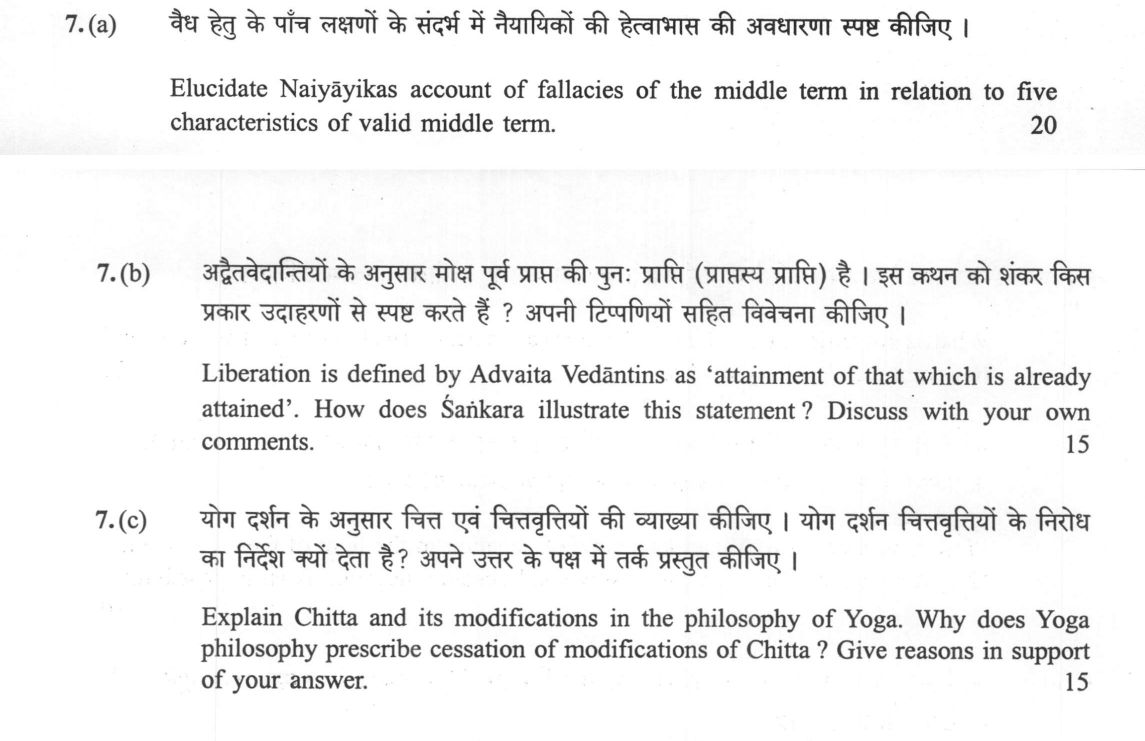
(a) Elucidate Naiyāyikas account of fallacies of the middle term in relation to five characteristics of valid middle term. (20…
Elucidate Naiyāyikas account of fallacies of the middle term in relation to five characteristics of valid middle term. 20 marks
Liberation is defined by Advaita Vedāntins as 'attainment of that which is already attained'. How does Śaṅkara illustrate this statement ? Discuss with your own comments. 15 marks
Explain Chitta and its modifications in the philosophy of Yoga. Why does Yoga philosophy prescribe cessation of modifications of Chitta ? Give reasons in support of your answer. 15 marks
हिंदी में प्रश्न पढ़ें
वैद्ध हेतु के पाँच लक्षणों के संदर्भ में नैयायिकों की हेत्वाभास की अवधारणा स्पष्ट कीजिए । (20 अंक)
अद्वैतवेदान्तियों के अनुसार मोक्ष पूर्व प्राप्त की पुनः प्राप्ति (प्राप्तस्य प्राप्ति) है । इस कथन को शंकर किस प्रकार उदाहरणों से स्पष्ट करते हैं ? अपनी टिप्पणियों सहित विवेचना कीजिए । (15 अंक)
योग दर्शन के अनुसार चित्त एवं चित्तवृत्तियों की व्याख्या कीजिए । योग दर्शन चित्तवृत्तियों के निरोध का निर्देश क्यों देता है ? अपने उत्तर के पक्ष में तर्क प्रस्तुत कीजिए । (15 अंक)
Model answer
Written by UPSC Answer Check against this question's marking rubric, to the expected length. UPSC does not publish answers for Mains — this is one way to score well, not an official key.
These three systems move from the validity of knowledge to the nature of reality and its cessation: Nyāya secures correct inference, Advaita identifies the already-real Self, and Yoga stills the mind that conceals it.
(a) Naiyāyikas make the middle term (hetu) the pivot of valid inference. A hetu is valid only when it satisfies five conditions: pakṣadharmatva, sapakṣasattva (sādharmya), vipakṣa-asattva (vaidharmya), asatpratipakṣatva and abādhitā; avyabhicāritva is the non-deviation secured by the second and third, and is distinct from asatpratipakṣatva. Avyabhicāritva thus means that the hetu never deviates from the sādhya; it is the invariable concomitance that makes inference reliable. Asiddha violates pakṣadharmatva: the hetu is absent from the pakṣa, as in ‘the horn of a rabbit is white because it is a horn’, where the subject or hetu is non-existent. Viruddha violates sapakṣasattva: the hetu occurs only in vipakṣa, not in sapakṣa, as in ‘sound is eternal because it is produced’; produced is absent from eternal sapakṣas and present in non-eternal vipakṣas. Savyabhicāra violates vipakṣa-asattva: the hetu occurs in both sapakṣa and vipakṣa, as in ‘the mountain is wet because it is a mountain’, since mountains can be wet or dry. Satpratipakṣa violates asatpratipakṣatva: a counter-hetu for the opposite conclusion is present, e.g. the claim that sound is eternal because produced is checked by the counter-claim that sound is non-eternal because produced. Bādhita violates abādhitā: a valid hetu is defeated by a stronger, established hetu to the opposite conclusion. Thus each fallacy is the negation of a specific condition: asiddha of pakṣadharmatva, viruddha of sapakṣasattva, savyabhicāra of vipakṣa-asattva, satpratipakṣa of asatpratipakṣatva, and bādhita of abādhitā.
(b) Śaṅkara illustrates ‘attainment of that which is already attained’ by showing that Brahman is never absent. In the nacre-silver analogy, silver is superimposed on nacre; when the error is removed, nacre is known as it is. In the rope-snake and mirage-water analogies, the snake and water are never real; their disappearance reveals the rope and the absence of water. The mechanism is adhyāsa: the self is mistaken for the not-self, and apavāda: the not-self is sublated by knowledge. Mokṣa is therefore not a new state but the removal of avidyā. The tenth-man story reinforces this: the man who searches for the tenth is told ‘thou art the tenth’ (tvam eva daśamaḥ), not the mahāvākya ‘tat tvam asi’; the sought Self is already the seeker. The apparent paradox dissolves: ‘attainment’ means recognition, not production. The difficulty that effort seems unnecessary if Brahman is already attained is answered by distinguishing the real from the apparent: effort removes ignorance, not Brahman.
(c) In Yoga, chitta is the inner organ (antaḥkaraṇa) that integrates buddhi, ahaṃkāra and manas. It bears vṛttis—modifications—of five types: pramāṇa, viparyaya, vikalpa, nidrā and smṛti. These are klisṭa when they reinforce afflictions and aklisṭa when they are non-afflicting, but all are fluctuations that veil puruṣa. The reasons are soteriological: vṛttis make puruṣa appear as doer and enjoyer, so their cessation is the means to freedom. Yoga prescribes citta-vṛtti-nirodha (YS I.2) because vṛttis bind puruṣa to prakṛti through identification (vṛtti-sārūpya, YS I.4). When the mind is identified with its modifications, puruṣa is mistaken for the changing mind; nirodha reveals puruṣa in its own svarūpa. Meditation destroys the vṛttis (dhyāna-heyās tad-vṛttayaḥ, YS II.11), and when vṛttis cease, there is no identification with them (YS IV.34). Aklisṭa vṛttis are useful in early stages but must also be stilled for kaivalya. Thus cessation is not mere quietism; it is the condition for kaivalya, the isolation of puruṣa.
Together they show that Indian philosophy treats liberation not as acquisition of a new object but as removal of error: valid knowledge, right recognition, and stillness of mind all disclose what is already real.
What "Elucidate" is asking you to do
Make a stated proposition plain and then prove it with instances. Elucidate stems almost always carry a claim or a named concept, and very often the words “with examples” or “with suitable diagrams” — the illustration is part of the directive, not decoration.
Structure that answers it
Plain-language statement of what the proposition means → the part that is obscure, resolved → first illustration → second illustration → why the proposition holds
Where marks are lost
Adding terminology; elucidate rewards removing it. The commoner loss is a clean explanation with no example, when the stem asked for examples.
How this answer will be evaluated
Approach
Framework: Naiyāyika Hetvābhāsa (Fallacies of the Middle Term). (a) explain: definition/context > points in order > small example > short close | (b) discuss: intro > 3-4 dimensions > example > balanced close | (c) explain: definition/context > points in order > small example > short close Full marks: Precise Sanskrit terminology, clear logical mapping of fallacies, and deep philosophical insight into Advaita/Yoga.
Key points expected
- Define the five characteristics of a valid Hetu (pakṣadharmatā, etc.)
- Identify the five fallacies (Savyabhicāra, Viruddha, Asādhāraṇa, Saṅghāta, Kalpita)
- Explicitly link each fallacy to the specific characteristic it violates
- Provide a standard example for at least two fallacies
- Define the Advaita concept of 'Pūrva-prāpta' (pre-existing) liberation
- Explain the role of Avidyā (ignorance) as the sole obstacle
- Provide Śaṅkara's specific illustrations (e.g., the rope-snake, the dream)
- Include a personal comment on the logical or practical implications
Evaluation rubric
Each sub-part is marked on its own, against the marks and word limit printed on the paper.
- (a) Map the five Hetvābhāsa to the five characteristics of a valid Hetu. 20 marks
explain— definition/context → points in order → small example → short close
Must cover
- Define the five characteristics of a valid Hetu (pakṣadharmatā, etc.)
- Identify the five fallacies (Savyabhicāra, Viruddha, Asādhāraṇa, Saṅghāta, Kalpita)
- Explicitly link each fallacy to the specific characteristic it violates
- Provide a standard example for at least two fallacies
Loses marks
- Listing fallacies without linking them to the five characteristics
- Confusing fallacies of the middle term with fallacies of the major term
Earns more
- Use of Sanskrit technical terms for the fallacies
- Distinction between Savyabhicāra and Viruddha
- Reference to the 'Pakṣa' and 'Sādhya' in the examples
Extra mark
- Mention of the 'Hetvābhāsa' classification in the Nyāya Sūtra
- (b) Explain Śaṅkara's illustration of 'attainment of the already attained' with comments. 15 marks
discuss— intro → 3-4 dimensions → example → balanced close
Must cover
- Define the Advaita concept of 'Pūrva-prāpta' (pre-existing) liberation
- Explain the role of Avidyā (ignorance) as the sole obstacle
- Provide Śaṅkara's specific illustrations (e.g., the rope-snake, the dream)
- Include a personal comment on the logical or practical implications
Loses marks
- Treating liberation as a future event or a new state of being
- Biographical details of Śaṅkara instead of philosophical analysis
Earns more
- Use of the term 'Ātman-Brahman identity'
- Reference to 'Jñāna' as the means of removal, not creation
- Distinction between 'Sādhya' (to be attained) and 'Pūrva-prāpta'
Extra mark
- Citation of a specific Bhashya passage
- (c) Define Chitta, its modifications, and the reason for their cessation. 15 marks
explain— definition/context → points in order → small example → short close
Must cover
- Define Chitta (mind-stuff) and its relationship to Puruṣa
- List the five types of Vṛttis (modifications) from Yoga Sūtra 1.5
- Explain the concept of 'Citta-vṛtti-nirodha' (cessation of modifications)
- Provide reasons: removal of 'Kliṣṭa' (painful) vṛttis and realization of Puruṣa
Loses marks
- Confusing Chitta with the ego (Ahaṃkāra) without distinction
- Failing to explain *why* cessation is necessary for liberation
Earns more
- Mention of 'Prakṛti' as the source of Chitta
- Distinction between 'Kliṣṭa' and 'Akliṣṭa' vṛttis
- Reference to 'Kaivalya' as the final state
Extra mark
- Mention of the eight limbs (Aṣṭāṅga) as the method of cessation
Practice this exact question
Write your answer and it is marked point by point against the model answer above — what you covered, what you missed, what you got wrong.
Evaluate my answer →More from Philosophy 2023 Paper I
- Q4 (a) Why does Strawson consider person to be a primitive concept ? What implication does i…
- Q5 Write short answers to the following in about 150 words each: (a) "All human knowledge is…
- Q6 (a) Discuss Rāmānuja's criticism of Śaṅkara's conception of Brahman and Īśvara (God). (20…
- Q7 (a) Elucidate Naiyāyikas account of fallacies of the middle term in relation to five char…
- Q8 (a) "Ignorance of dependent origination is suffering while its knowledge is cessation of…