Paper I — Q2
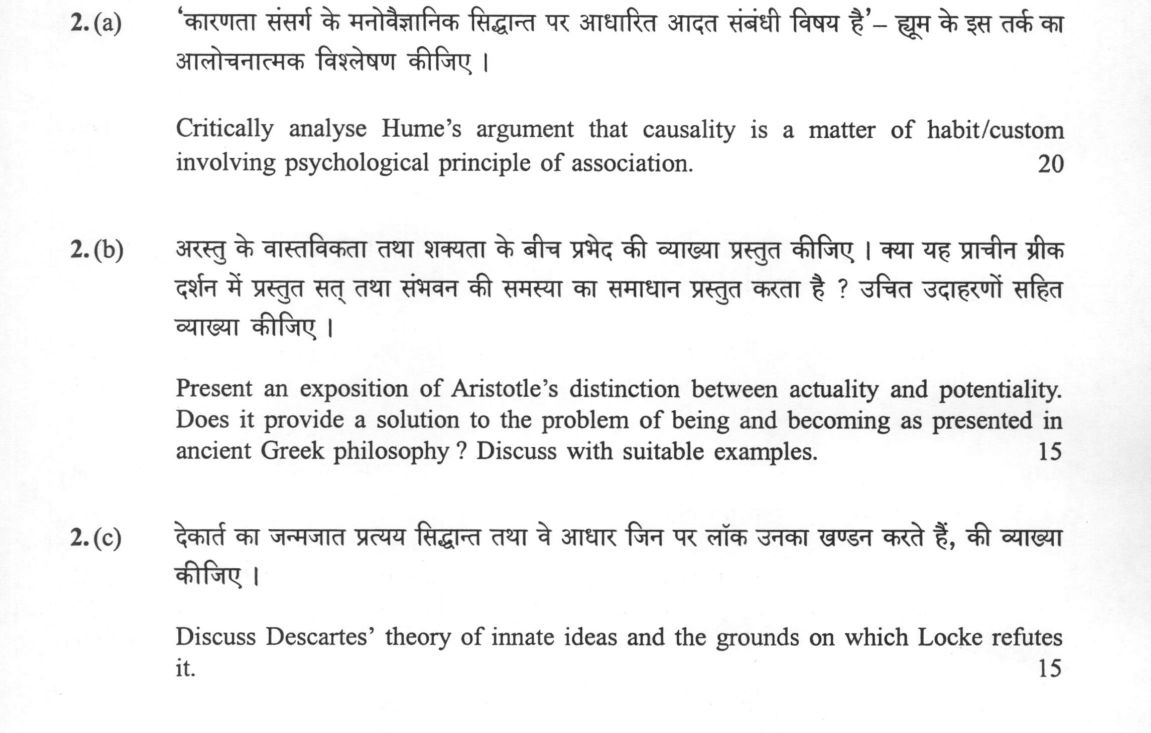
(a) Critically analyse Hume's argument that causality is a matter of habit/custom involving psychological principle of…
Critically analyse Hume's argument that causality is a matter of habit/custom involving psychological principle of association. 20 marks
Present an exposition of Aristotle's distinction between actuality and potentiality. Does it provide a solution to the problem of being and becoming as presented in ancient Greek philosophy ? Discuss with suitable examples. 15 marks
Discuss Descartes' theory of innate ideas and the grounds on which Locke refutes it. 15 marks
हिंदी में प्रश्न पढ़ें
'कारणता संसर्ग के मनोवैज्ञानिक सिद्धांत पर आधारित आदत संबंधी विषय है'— ह्यूम के इस तर्क का आलोचनात्मक विश्लेषण कीजिए । (20 अंक)
अरस्तु के वास्तविकता तथा शक्यता के बीच प्रभेद की व्याख्या प्रस्तुत कीजिए । क्या यह प्राचीन ग्रीक दर्शन में प्रस्तुत सत् तथा संभवन की समस्या का समाधान प्रस्तुत करता है ? उचित उदाहरणों सहित व्याख्या कीजिए । (15 अंक)
देकार्त का जन्मजात प्रत्यय सिद्धांत तथा वे आधार जिन पर लॉक उनका खंडन करते हैं, की व्याख्या कीजिए । (15 अंक)
Model answer
Written by UPSC Answer Check against this question's marking rubric, to the expected length. UPSC does not publish answers for Mains — this is one way to score well, not an official key.
Hume’s Scepticism on Causality and Critical Evaluation
David Hume bifurcates all objects of human inquiry into ‘Relations of Ideas’ (analytic, a priori) and ‘Matters of Fact’ (synthetic, a posteriori). Causality belongs strictly to matters of fact, grounded entirely in experience. However, Hume argues that sensory experience yields only the impression of spatial contiguity, temporal succession, and constant conjunction of events, but never any sensory impression of a "necessary connection" or productive power. Guided by the psychological principles of association—resemblance, contiguity, and cause-effect—the repeated observation of conjoined events generates an involuntary subjective expectation in the imagination. Causality, for Hume, is not an objective ontological reality or a rational necessity, but a psychological habit or custom. This underpins his problem of induction, demonstrating that the belief that the future will resemble the past lacks rational justification.
Critically, Hume’s radical reduction of causality to subjective habit overpsychologizes an indispensable rational principle. Immanuel Kant demonstrated that causality is not derived a posteriori from custom, but is a pure synthetic a priori category of the understanding, serving as a necessary condition for the possibility of objective experience. Karl Popper bypassed Hume's inductive habit altogether, showing that scientific progress relies on deductive falsification rather than inductive habituation. Furthermore, P. F. Strawson’s descriptive metaphysics establishes that a stable causal framework is a structural presupposition for individuating spatio-temporal particulars. Thus, while Hume successfully dismantled dogmatic rationalist assumptions of metaphysical necessity, his subjectivist account fails to explain the objective validity and predictive success of natural laws.
Aristotle: Potentiality, Actuality, and the Resolution of Being and Becoming
Aristotle resolves the ancient Greek metaphysical antinomy between Parmenides (who asserted immutable ‘Being’, declaring change illusory) and Heraclitus (who posited radical flux and ‘Becoming’) through his distinction between potentiality (dunamis) and actuality (energeia or entelecheia).
Change is neither the impossible generation of being from absolute non-being (against Parmenides) nor an unanchored, chaotic transition (against Heraclitus); rather, it is the actualization of an already existing potentiality. In Aristotle’s hylomorphic framework, matter represents potentiality, while form represents actuality. For example, an acorn is potentially an oak tree, and unshaped bronze is potentially a statue; change occurs when the latent potentiality of the material substrate is actualized into its determinate form. Aristotle establishes the absolute priority of actuality over potentiality logically, epistemologically, and temporally, since potentiality can only be defined in reference to an actualized end (telos). By demonstrating that becoming is the continuous realization of an enduring substance's inherent potential, Aristotle successfully synthesizes Being and Becoming.
Descartes’ Theory of Innate Ideas and Locke’s Refutation
René Descartes classifies human ideas into adventitious (sensory), fictitious (invented), and innate (inborn). Grasped through the criterion of clarity and distinctness, innate ideas include the eternal truths of geometry, the principles of logic, and the idea of an infinite, perfect God—stamped upon the human soul like the "mark of the maker" on his work. Descartes argues that such ideas cannot originate from finite human experience or arbitrary construction.
John Locke, in Book I of his Essay Concerning Human Understanding, systematically refutes innate ideas, establishing the mind as a tabula rasa (blank slate) upon which experience alone writes via sensation and reflection. Locke attacks the rationalist argument from universal assent, showing that children and idiots have no awareness of logical principles such as the principle of non-contradiction, nor do all cultures share the idea of God. He presents a fatal dilemma: if an "innate idea" merely signifies the innate capacity of the mind to understand, the claim is trivial, as all future knowledge would then be innate; if it requires actual conscious awareness, it is empirically false.
G. W. Leibniz subsequently defended the rationalist stance by clarifying that innate ideas exist not as explicit conscious knowledge, but as active dispositions or structural inclinations—likening the mind to a veined block of marble whose natural contours guide the sculptor, rather than Locke's passive wax.
Ultimately, these debates dismantled naive metaphysics, leading directly to the Kantian critical synthesis and laying the foundational frameworks for the modern cognitive and epistemological nature-nurture debate.
What "Critically analyse" is asking you to do
Break the subject into its working parts and show how they act on each other. The marks are in the interconnections — which factor drives which, and what the resulting structure explains — not in the inventory of factors. “Critically” is not a section added at the end: name the yardstick you are judging by — the evidence, the stated objective, a constitutional principle, a rival explanation — and let a verdict close each part of the body. Where the question quotes a claim, that verdict must land on the claim itself, accepted, qualified or rejected, and not on the theme in general.
Structure that answers it
Define the whole → separate it into its parts → show which part drives which → what that interaction produces → what the structure implies
Where marks are lost
Merits in one paragraph, demerits in the next, and a conclusion calling for a balanced and holistic approach. That is a survey with the judgement left out and it holds the answer in the middle band. The opposite error is reading “critically” as permission to attack — and with the odd pairings, critically describe or critically explain, the exposition still carries most of the marks, the judgement being a layer on it rather than a substitute for it.
How this answer will be evaluated
Approach
Framework: UPSC Philosophy Paper 1. (a) critique: the claim > its strengths > its weaknesses > your judgment | (b) discuss: intro > 3-4 dimensions > example > balanced close | (c) discuss: intro > 3-4 dimensions > example > balanced close Full marks: Precise technical vocabulary, strong counter-arguments, and clear reconstruction of philosophical positions.
Key points expected
- Define constant conjunction and uniformity of experience
- Explain the role of custom/habit in forming causal belief
- Identify the psychological principle of association (contiguity/succession)
- Present the strongest objection to the psychological account
- Define 'energeia' (actuality) and 'dynamis' (potentiality)
- Explain the distinction using the seed/tree example
- Address the problem of being and becoming (Parmenides vs Heraclitus)
- Provide a suitable example of the transition from potential to actual
Evaluation rubric
Each sub-part is marked on its own, against the marks and word limit printed on the paper.
- (a) Reconstruct Hume's argument for causality as habit and evaluate its psychological basis. 20 marks
critique— the claim → its strengths → its weaknesses → your judgment
Must cover
- Define constant conjunction and uniformity of experience
- Explain the role of custom/habit in forming causal belief
- Identify the psychological principle of association (contiguity/succession)
- Present the strongest objection to the psychological account
Loses marks
- Biographical details of Hume
- Vague paraphrase without technical terms
- Confusing Hume with Berkeley or Locke
Earns more
- Distinguish between 'necessary connection' and 'impression'
- Reference the 'is-ought' gap or problem of induction
- Mention the 'fork' of Hume's analysis (relations of ideas/matters of fact)
Extra mark
- Use Sanskrit term 'samsarga' for causality
- Reference Kant's 'Copernican revolution' as a response
- (b) Explain Aristotle's distinction between actuality and potentiality and its solution to being/becoming. 15 marks
discuss— intro → 3-4 dimensions → example → balanced close
Must cover
- Define 'energeia' (actuality) and 'dynamis' (potentiality)
- Explain the distinction using the seed/tree example
- Address the problem of being and becoming (Parmenides vs Heraclitus)
- Provide a suitable example of the transition from potential to actual
Loses marks
- Confusing potentiality with mere possibility
- Ignoring the 'becoming' aspect of the question
- Vague generalities without specific Aristotelian terms
Earns more
- Mention 'entelechy' as the highest form of actuality
- Reference the 'four causes' (material, formal, efficient, final)
- Discuss the 'unmoved mover' as pure actuality
Extra mark
- Use Greek terms 'energeia' and 'dynamis' explicitly
- Reference the 'Metaphysics' book (e.g., Book Theta)
- (c) Discuss Descartes' theory of innate ideas and Locke's refutation of it. 15 marks
discuss— intro → 3-4 dimensions → example → balanced close
Must cover
- Define 'innate ideas' in Descartes' framework
- Explain the 'cogito' and 'clear and distinct' ideas
- Present Locke's 'tabula rasa' argument
- Detail Locke's specific refutation of innate ideas (e.g., universal consent)
Loses marks
- Biographical details of Descartes or Locke
- Confusing innate ideas with a priori knowledge
- Failing to distinguish between 'innate' and 'inborn'
Earns more
- Mention the 'principle of non-contradiction' as an example of innate idea
- Reference Locke's 'Essay Concerning Human Understanding'
- Discuss the role of 'reflection' in Locke's epistemology
Extra mark
- Use Latin term 'tabula rasa'
- Reference the 'Meditations' for Descartes' argument
Practice this exact question
Write your answer and it is marked point by point against the model answer above — what you covered, what you missed, what you got wrong.
Evaluate my answer →More from Philosophy 2023 Paper I
- Q1 Write short answers to the following in about 150 words each: (a) "Precepts without conce…
- Q2 (a) Critically analyse Hume's argument that causality is a matter of habit/custom involvi…
- Q3 (a) Does the rejection of metaphysics as proposed by Logical Positivists relate to proble…
- Q4 (a) Why does Strawson consider person to be a primitive concept ? What implication does i…
- Q5 Write short answers to the following in about 150 words each: (a) "All human knowledge is…