Paper I — Q5
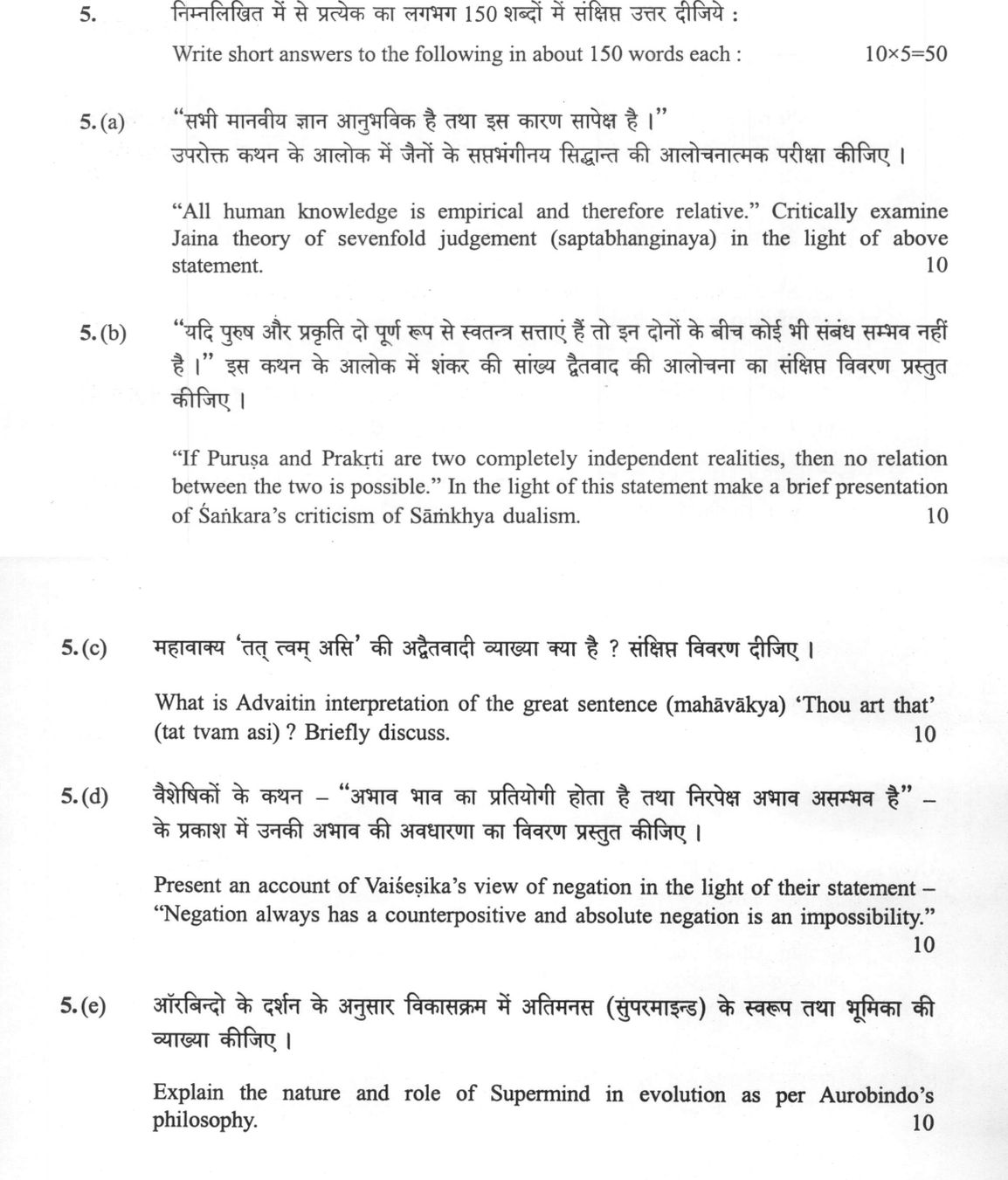
Write short answers to the following in about 150 words each: (a) "All human knowledge is empirical and therefore relative."…
Write short answers to the following in about 150 words each:
"All human knowledge is empirical and therefore relative." Critically examine Jaina theory of sevenfold judgement (saptabhanginaya) in the light of above statement. 10 marks
"If Purusa and Prakrti are two completely independent realities, then no relation between the two is possible." In the light of this statement make a brief presentation of Śaṅkara's criticism of Sāṃkhya dualism. 10 marks
What is Advaitin interpretation of the great sentence (mahāvākya) 'Thou art that' (tat tvam asi) ? Briefly discuss. 10 marks
Present an account of Vaiśeṣika's view of negation in the light of their statement — "Negation always has a counterpositive and absolute negation is an impossibility." 10 marks
Explain the nature and role of Supermind in evolution as per Aurobindo's philosophy. 10 marks
हिंदी में प्रश्न पढ़ें
निम्नलिखित में से प्रत्येक का लगभग 150 शब्दों में संक्षिप्त उत्तर दीजिए :
"सभी मानवीय ज्ञान आनुभविक है तथा इस कारण सापेक्ष है ।" उपरोक्त कथन के आलोक में जैनों के सप्तभंगीय सिद्धान्त की आलोचनात्मक परीक्षा कीजिए । (10 अंक)
"यदि पुरुष और प्रकृति दो पूर्ण रूप से स्वतन्त्र सत्ताएँ हैं तो इन दोनों के बीच कोई भी संबंध सम्भव नहीं है ।" इस कथन के आलोक में शंकर की सांख्य द्वैतवाद की आलोचना का संक्षिप्त विवरण प्रस्तुत कीजिए । (10 अंक)
महावाक्य 'तत् त्वम् असि' की अद्वैतवादी व्याख्या क्या है ? संक्षिप्त विवरण दीजिए । (10 अंक)
वैशेषिकों के कथन — "अभाव भाव का प्रतियोगी होता है तथा निरपेक्ष अभाव असंभव है" — के प्रकाश में उनकी अभाव की अवधारणा का विवरण प्रस्तुत कीजिए । (10 अंक)
श्रीअरबिंदो के दर्शन के अनुसार विकासक्रम में अतिमनस् (सुपरमाइन्ड) के स्वरूप तथा भूमिका की व्याख्या कीजिए । (10 अंक)
Model answer
Written by UPSC Answer Check against this question's marking rubric, to the 150-word length. UPSC does not publish answers for Mains — this is one way to score well, not an official key.
(a) Jaina saptabhaṅgī The statement has a partial truth: every naya is empirical and limited. But Jaina saptabhaṅgī does not accept its conclusion. It holds that an object possesses multiple aspects (aṇu) and any single empirical standpoint (naya) grasps only one aspect. Hence the seven predications—syād asti, syād nāsti, syād asti-nāsti, syād avaktavya, syād asti avaktavya, syād nāsti avaktavya, syād asti-nāsti avaktavya—are not seven contradictory opinions but seven conditioned affirmations. The third, syād asti-nāsti, means “in some respects it is and in some respects it is not,” not a temporal succession; the fourth, avaktavya, marks the inexpressibility of simultaneous affirmation and negation from one standpoint. Anekāntavāda thus transcends empirical relativism: it relativises each naya while preserving a comprehensive truth beyond any single empirical standpoint. Nayavāda limits every claim to its domain, so knowledge is neither merely empirical nor arbitrarily relative; it is multi-dimensional and conditionally valid.
(b) Śaṅkara’s criticism Śaṅkara’s objection is that Sāṃkhya cannot coherently maintain two independent realities. If Puruṣa and Prakṛti are wholly independent, no causal or purposive relation is possible; yet Sāṃkhya makes Prakṛti act for Puruṣa’s sake and Puruṣa witness Prakṛti’s evolution. If they are related, they are not independent; if independent, the world-process is inexplicable. Śaṅkara does not simply reject satkāryavāda; he accepts a form of it, that an effect must be grounded in its cause, but uses this to show that an unconscious Pradhana cannot be the efficient cause of conscious beings. An unconscious cause cannot produce intelligence, nor can it act for another’s sake without an intelligent agent. Moreover, Pradhana is only inferred from the world, whereas Brahman is directly revealed in the Upaniṣads as the sole cause. Hence Sāṃkhya dualism is a dependent hypothesis, not an independent reality.
(c) Advaitin mahāvākya For the Advaitin, tat tvam asi is not a statement that the individual body-mind is identical with the cosmic body. It is a mahāvākya whose function is to remove ignorance by revealing the identity of the innermost self with Brahman. The word tat denotes Brahman, infinite, attributeless, self-luminous; tvam denotes the jīva, apparently limited by body, mind and senses. The interpretation proceeds through jādajāhallakṣaṇa: the limiting adjuncts (upādhis) that are superimposed on Brahman and the jīva are removed, not the substratum itself. Thus the finite attributes of the jīva are negated as belonging to upādhis, while the infinite nature of Brahman is retained. What remains is the same consciousness, sat-cit-ānanda. The sentence therefore does not establish a new relation between two selves; it discloses that the jīvatman and paramātman are one in essence, the apparent difference being due to ignorance and limiting conditions.
(d) Vaiśeṣika negation Vaiśeṣika treats negation (abhāva) as a real but dependent category, always predicated of a counterpositive (pratiyogin). It is not a bare absence; it is the absence of a specific thing in a specific locus. Hence the four types: pragabhāva, prior non-existence, as the pot in the clay before production; pradhvamsabhāva, posterior non-existence, as the pot after destruction; atyantabhāva, absolute non-existence, as the pot in space where it never existed; and anyonyabhāva, mutual non-existence, as the pot in the cloth and the cloth in the pot. Each requires a pratiyogin: the pot, the clay, the space, the cloth. The statement that “negation always has a counterpositive” means that to say “x is absent” is to say “x is absent in y.” An absolute, counterpositive-less negation would be empty and self-contradictory, because negation is relational and cannot exist by itself. Thus Vaiśeṣika rejects a negation of all things as impossible; even universal absence must be located in some counterpositive.
(e) Aurobindo’s Supermind For Aurobindo, evolution is not merely biological ascent but the unfolding of Spirit in matter. The Supermind is the supramental consciousness, a truth-consciousness that is integral, self-aware and creative. It links Sachchidananda, the supreme reality, with matter, which is involution: Spirit descends into the lowest form while retaining its essential nature. Matter is not inert; it is Spirit in its densest expression, and evolution is the progressive revelation of higher consciousness through matter, life and mind. The Supermind is the goal and the transforming power of this process. It does not simply transcend nature but transforms it, bringing consciousness, life and body into harmony with supramental truth. Aurobindo’s triple transformation—psychic, spiritual and supramental—shows this: the psychic being awakens the inner self, spiritual practice purifies mind and life, and supramental transformation reorganises the whole nature so that the Supermind can manifest. Thus the Supermind is both the source and the fulfilment of evolution.
What "Critically examine" is asking you to do
Test the proposition the question puts to you and return a finding on how far it holds. Examine stems carry a claim, or ask whether something has happened, and expect evidence weighed both ways before the extent is stated — often with remedial measures attached. “Critically” is not a section added at the end: name the yardstick you are judging by — the evidence, the stated objective, a constitutional principle, a rival explanation — and let a verdict close each part of the body. Where the question quotes a claim, that verdict must land on the claim itself, accepted, qualified or rejected, and not on the theme in general.
Structure that answers it
Restate the claim as the question frames it → evidence that supports it → evidence that undercuts it → the conditions under which it holds → verdict on how far it stands
Where marks are lost
Merits in one paragraph, demerits in the next, and a conclusion calling for a balanced and holistic approach. That is a survey with the judgement left out and it holds the answer in the middle band. The opposite error is reading “critically” as permission to attack — and with the odd pairings, critically describe or critically explain, the exposition still carries most of the marks, the judgement being a layer on it rather than a substitute for it.
How this answer will be evaluated
Approach
Framework: State the position > Argument > Strongest objection > Evaluation. (a) examine: intro > how/why with reasoning > evidence > conclusion | (b) examine: intro > how/why with reasoning > evidence > conclusion | (c) discuss: intro > 3-4 dimensions > example > balanced close | (d) examine: intro > how/why with reasoning > evidence > conclusion | (e) explain: definition/context > points in order > small example > short close Full marks: Precise technical vocabulary, clear argument structure, strong counter-arguments, exact Sanskrit/Greek terms.
Key points expected
- Define Saptabhaṅginaya (seven-fold judgement)
- Explain the seven modes (syād-asti, etc.)
- Link modes to empirical/relative nature of knowledge
- Critically evaluate the theory's validity
- State the Sāṃkhya position on Puruṣa and Prakṛti
- Present Śaṅkara's argument on the impossibility of relation
- Explain the 'independent realities' problem
- Conclude with the Advaita critique
Evaluation rubric
Each sub-part is marked on its own, against the marks and word limit printed on the paper.
- (a) Critical analysis of Saptabhaṅginaya in light of the statement on empirical knowledge. 10 marks · 150 words
examine— intro → how/why with reasoning → evidence → conclusion
Must cover
- Define Saptabhaṅginaya (seven-fold judgement)
- Explain the seven modes (syād-asti, etc.)
- Link modes to empirical/relative nature of knowledge
- Critically evaluate the theory's validity
Loses marks
- Biographical details of Jain philosophers
- Vague paraphrase without technical terms
- Failing to address the 'empirical' aspect
Earns more
- Mention Anekāntavāda (many-sidedness)
- Use Sanskrit terms for the seven modes
- Contrast with absolute truth claims
Extra mark
- Reference to specific Jain texts (e.g., Tattvārtha Sūtra)
- (b) Presentation of Śaṅkara's criticism of Sāṃkhya dualism regarding Puruṣa-Prakṛti relation. 10 marks · 150 words
examine— intro → how/why with reasoning → evidence → conclusion
Must cover
- State the Sāṃkhya position on Puruṣa and Prakṛti
- Present Śaṅkara's argument on the impossibility of relation
- Explain the 'independent realities' problem
- Conclude with the Advaita critique
Loses marks
- Biographical details of Śaṅkara
- Vague paraphrase of dualism
- Failing to address the 'independence' issue
Earns more
- Use Sanskrit terms (Puruṣa, Prakṛti, Sāṃkhya)
- Mention the concept of 'Sambandha' (relation)
- Reference to specific Śaṅkara works (e.g., Brahma Sūtra Bhāṣya)
Extra mark
- Comparison with other dualist systems
- (c) Advaitin interpretation of the mahāvākya 'Tat tvam asi'. 10 marks · 150 words
discuss— intro → 3-4 dimensions → example → balanced close
Must cover
- Define 'Tat tvam asi' (Thou art that)
- Explain the Advaita interpretation (identity of Ātman and Brahman)
- Discuss the method of interpretation (e.g., Chāgata)
- Conclude with the significance of the mahāvākya
Loses marks
- Biographical details of Advaita philosophers
- Vague paraphrase without technical terms
- Failing to address the 'identity' aspect
Earns more
- Use Sanskrit terms (Ātman, Brahman, mahāvākya)
- Mention the concept of 'Adhyāsa' (superimposition)
- Reference to specific Upanishadic texts
Extra mark
- Comparison with other mahāvākyas
- (d) Account of Vaiśeṣika's view of negation based on the given statement. 10 marks · 150 words
examine— intro → how/why with reasoning → evidence → conclusion
Must cover
- Define negation (abhāva) in Vaiśeṣika
- Explain the concept of 'counterpositive' (pratiyogī)
- Discuss the impossibility of absolute negation
- Conclude with the Vaiśeṣika position on negation
Loses marks
- Biographical details of Vaiśeṣika philosophers
- Vague paraphrase without technical terms
- Failing to address the 'counterpositive' aspect
Earns more
- Use Sanskrit terms (abhāva, pratiyogī)
- Mention the four types of negation (e.g., Prāgabhāva)
- Reference to specific Vaiśeṣika texts
Extra mark
- Comparison with Nyāya's view on negation
- (e) Nature and role of Supermind in evolution as per Aurobindo's philosophy. 10 marks · 150 words
explain— definition/context → points in order → small example → short close
Must cover
- Define Supermind (Supramental consciousness)
- Explain its nature (truth-consciousness, etc.)
- Discuss its role in evolution (transformation of matter)
- Conclude with the significance of Supermind
Loses marks
- Biographical details of Aurobindo
- Vague paraphrase without technical terms
- Failing to address the 'evolution' aspect
Earns more
- Use Aurobindo's specific terminology (e.g., 'Supramental', 'Vital', 'Mental')
- Mention the concept of 'Integral Yoga'
- Reference to specific Aurobindo works (e.g., The Life Divine)
Extra mark
- Comparison with other evolutionary theories
Practice this exact question
Write your answer and it is marked point by point against the model answer above — what you covered, what you missed, what you got wrong.
Evaluate my answer →More from Philosophy 2023 Paper I
- Q2 (a) Critically analyse Hume's argument that causality is a matter of habit/custom involvi…
- Q3 (a) Does the rejection of metaphysics as proposed by Logical Positivists relate to proble…
- Q4 (a) Why does Strawson consider person to be a primitive concept ? What implication does i…
- Q5 Write short answers to the following in about 150 words each: (a) "All human knowledge is…
- Q6 (a) Discuss Rāmānuja's criticism of Śaṅkara's conception of Brahman and Īśvara (God). (20…
- Q7 (a) Elucidate Naiyāyikas account of fallacies of the middle term in relation to five char…
- Q8 (a) "Ignorance of dependent origination is suffering while its knowledge is cessation of…