Paper II — Q1
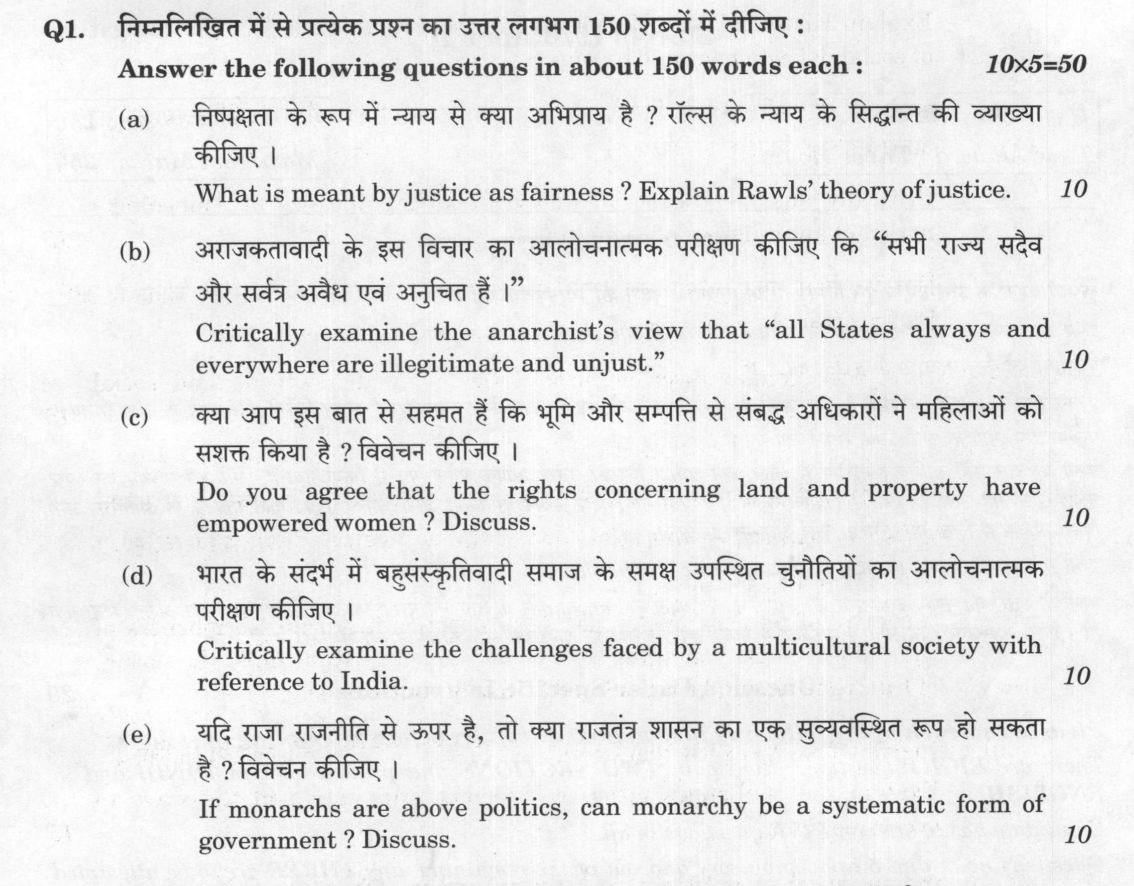
Answer the following questions in about 150 words each: (a) What is meant by justice as fairness? Explain Rawls' theory of…
Answer the following questions in about 150 words each:
What is meant by justice as fairness? Explain Rawls' theory of justice. 10 marks
Critically examine the anarchist's view that "all States always and everywhere are illegitimate and unjust." 10 marks
Do you agree that the rights concerning land and property have empowered women? Discuss. 10 marks
Critically examine the challenges faced by a multicultural society with reference to India. 10 marks
If monarchs are above politics, can monarchy be a systematic form of government? Discuss. 10 marks
हिंदी में प्रश्न पढ़ें
निम्नलिखित में से प्रत्येक प्रश्न का उत्तर लगभग 150 शब्दों में दीजिए :
निष्पक्षता के रूप में न्याय से क्या अभिप्राय है ? रॉल्स के न्याय के सिद्धांत की व्याख्या कीजिए । (10 अंक)
अराजकतावादी के इस विचार का आलोचनात्मक परीक्षण कीजिए कि "सभी राज्य सदैव और सर्वत्र अवैध एवं अनुचित हैं ।" (10 अंक)
क्या आप इस बात से सहमत हैं कि भूमि और सम्पत्ति से सम्बद्ध अधिकारों ने महिलाओं को सशक्त किया है ? विवेचन कीजिए । (10 अंक)
भारत के संदर्भ में बहुसंस्कृतिवादी समाज के समक्ष उपस्थित चुनौतियों का आलोचनात्मक परीक्षण कीजिए । (10 अंक)
यदि राजा राजनीति से ऊपर है, तो क्या राजतंत्र शासन का एक सुव्यवस्थित रूप हो सकता है ? विवेचन कीजिए । (10 अंक)
Model answer
Written by UPSC Answer Check against this question's marking rubric, to the 150-word length. UPSC does not publish answers for Mains — this is one way to score well, not an official key.
(a)
John Rawls conceives "justice as fairness" as a framework where principles of justice are agreed upon in an initial situation of fair equality. In this hypothetical original position, rational individuals deliberate behind a veil of ignorance, devoid of knowledge regarding their class, natural endowments, social status, or conception of the good. Rawls derives two fundamental principles of justice: First, the Equal Liberty Principle guarantees each person an equal right to the most extensive scheme of basic liberties compatible with a similar liberty for all. Second, social and economic inequalities must satisfy two conditions: they must be attached to offices open to all under fair equality of opportunity, and they must maximize the benefit of the least advantaged members of society (the Difference Principle). Rawls establishes the lexical priority of liberty over socio-economic redistribution. Thus, justice as fairness reconciles liberal autonomy with distributive justice through an impartial procedural mechanism.
(b)
Anarchists such as Mikhail Bakunin and Peter Kropotkin argue that the State is inherently illegitimate and unjust because it claims a monopoly on legitimate violence, relying upon coercion that negates individual autonomy and moral agency. They maintain that natural social harmony, mutual aid, and voluntary associations can replace centralized political hierarchy. However, this critique is excessively idealist. As political theorists and social contract philosophers demonstrate, the state serves as an indispensable framework for securing fundamental rights, adjudicating disputes, and providing collective public goods. Without a centralized authority, as Robert Nozick notes regarding the minimal state, society risks descending into factional oppression and insecurity. While the anarchist critique offers an essential safeguard against authoritarianism and state overreach, the claim of absolute illegitimacy fails; a constitutional state grounded in democratic accountability, the rule of law, and rights protection is essential for realizing justice.
(c)
Statutory reforms in land and property rights, prominently the Hindu Succession (Amendment) Act, 2005 and its judicial affirmation in Vineeta Sharma v. Rakesh Sharma, have meaningfully advanced women’s empowerment. Bestowing coparcenary rights and promoting joint property titling enhances women's economic autonomy, strengthens intra-household bargaining power, facilitates access to formal institutional credit, and provides a structural safety net against domestic violence and poverty. Nevertheless, legal formalization has not translated into universal substantive empowerment. Deep-seated patriarchal customs, practices like haq-tyag (coerced relinquishment of parental property rights), widespread rural landlessness, and institutional apathy in land revenue administration continue to obstruct actual ownership. Therefore, while property rights are an indispensable legislative baseline for gender justice, their transformative potential requires administrative enforcement, legal literacy, and the dismantling of customary patriarchal norms to ensure that formal title translates into de facto managerial control.
(d)
Multiculturalism in India faces complex structural challenges, including linguistic reorganization disputes, demands for religious personal laws versus uniform civil codes, and recurrent regional sub-nationalist aspirations. These fault lines test the balance between group-differentiated rights and national integration. The Indian Constitution addresses these challenges through a distinct model of constitutional secularism—based on principled distance and equal respect for all religions—alongside specific cultural and educational safeguards under Articles 29 and 30 to protect minority identities. Furthermore, the constitutional vision promotes a composite culture that integrates diversity without demanding forced assimilation. However, these mechanisms face growing friction from majoritarian tendencies and competitive identity politics. To sustain a stable multicultural democracy, India must continually calibrate group-specific cultural protections with individual fundamental rights, anchoring multicultural coexistence firmly within the framework of constitutional morality and deliberative democratic institutions.
(e)
The argument for monarchy as a systematic government posits that a hereditary monarch, detached from the vagaries of electoral contestation, embodies non-partisan stability, symbolic unity, and institutional continuity. By remaining above party politics, the monarch is presumed to act as an impartial constitutional arbiter. However, this model faces an inherent theoretical contradiction. If the monarch wields substantive political authority, the system suffers from an acute democratic deficit, arbitrary hereditary privilege, and a lack of institutional accountability to the governed. Conversely, if the monarch is stripped of actual power to preserve neutrality, governance is rendered systematic entirely by the surrounding constitutional and democratic machinery, reducing the crown to a ceremonial symbol. Therefore, monarchy itself cannot serve as an independent systematic form of government; its viability exists only when subordinated to constitutional supremacy and democratic governance.
What "Critically examine" is asking you to do
Test the proposition the question puts to you and return a finding on how far it holds. Examine stems carry a claim, or ask whether something has happened, and expect evidence weighed both ways before the extent is stated — often with remedial measures attached. “Critically” is not a section added at the end: name the yardstick you are judging by — the evidence, the stated objective, a constitutional principle, a rival explanation — and let a verdict close each part of the body. Where the question quotes a claim, that verdict must land on the claim itself, accepted, qualified or rejected, and not on the theme in general.
Structure that answers it
Restate the claim as the question frames it → evidence that supports it → evidence that undercuts it → the conditions under which it holds → verdict on how far it stands
Where marks are lost
Merits in one paragraph, demerits in the next, and a conclusion calling for a balanced and holistic approach. That is a survey with the judgement left out and it holds the answer in the middle band. The opposite error is reading “critically” as permission to attack — and with the odd pairings, critically describe or critically explain, the exposition still carries most of the marks, the judgement being a layer on it rather than a substitute for it.
How this answer will be evaluated
Approach
Framework: Rawlsian Justice as Fairness. (a) explain: definition/context > points in order > small example > short close | (b) critique: the claim > its strengths > its weaknesses > your judgment | (c) discuss: intro > 3-4 dimensions > example > balanced close | (d) examine: intro > how/why with reasoning > evidence > conclusion | (e) discuss: intro > 3-4 dimensions > example > balanced close Full marks: Precise technical vocabulary, strong counter-arguments, concrete examples, balanced evaluation.
Key points expected
- Define 'justice as fairness' as the core concept
- Explain the 'Original Position' and 'Veil of Ignorance'
- State the 'Difference Principle' (maximin)
- Mention the 'Liberty Principle' (lexical priority)
- State the anarchist argument (state as coercive)
- Present the 'Social Contract' or 'Consent' counter-argument
- Discuss the 'Monopoly on Violence' (Weber) as a necessity
- Evaluate the 'Order' vs 'Freedom' trade-off
Evaluation rubric
Each sub-part is marked on its own, against the marks and word limit printed on the paper.
- (a) Define justice as fairness and outline Rawls' two principles. 10 marks · 150 words
explain— definition/context → points in order → small example → short close
Must cover
- Define 'justice as fairness' as the core concept
- Explain the 'Original Position' and 'Veil of Ignorance'
- State the 'Difference Principle' (maximin)
- Mention the 'Liberty Principle' (lexical priority)
Loses marks
- Biographical details of Rawls
- Vague paraphrase of 'fairness' without technical terms
Earns more
- Contrast with Utilitarianism
- Mention 'Rationality' vs 'Reasonableness'
- Reference to 'A Theory of Justice'
Extra mark
- Mention 'Society as a fair system of cooperation'
- (b) Critically examine the anarchist claim that all states are illegitimate. 10 marks · 150 words
critique— the claim → its strengths → its weaknesses → your judgment
Must cover
- State the anarchist argument (state as coercive)
- Present the 'Social Contract' or 'Consent' counter-argument
- Discuss the 'Monopoly on Violence' (Weber) as a necessity
- Evaluate the 'Order' vs 'Freedom' trade-off
Loses marks
- Defining 'Anarchism' as mere chaos
- Ignoring the 'illegitimate' aspect of the prompt
Earns more
- Reference to Proudhon or Bakunin
- Mention 'Stateless society' feasibility
- Discuss 'Legitimacy' vs 'Illegitimacy' distinction
Extra mark
- Reference to 'Anarchism' as a political philosophy
- (c) Discuss whether land/property rights have empowered women. 10 marks · 150 words
discuss— intro → 3-4 dimensions → example → balanced close
Must cover
- Define 'Property Rights' in the context of women
- Argument for: Economic independence and bargaining power
- Argument against: Social/cultural barriers to ownership
- Balanced conclusion on 'Empowerment'
Loses marks
- Generalizing without specific examples
- Ignoring the 'rights' aspect of the prompt
Earns more
- Reference to 'Hindu Succession Act' (India context)
- Mention 'Land titling' programs
- Discuss 'Agency' vs 'Structure'
Extra mark
- Reference to specific legal reforms (e.g., 2005 Amendment)
- (d) Examine challenges of a multicultural society with reference to India. 10 marks · 150 words
examine— intro → how/why with reasoning → evidence → conclusion
Must cover
- Define 'Multiculturalism' in the Indian context
- Challenge 1: Communalism/Religious conflict
- Challenge 2: Linguistic/Regional diversity
- Challenge 3: Secularism vs. Majoritarianism
Loses marks
- Generic multiculturalism without Indian reference
- Ignoring the 'challenges' aspect
Earns more
- Reference to 'Unity in Diversity'
- Mention 'Constitutional Secularism'
- Discuss 'Cultural Hegemony' vs 'Pluralism'
Extra mark
- Reference to specific Indian events (e.g., Partition, riots)
- (e) Discuss if monarchy can be systematic if monarchs are above politics. 10 marks · 150 words
discuss— intro → 3-4 dimensions → example → balanced close
Must cover
- Define 'Monarchy' and 'Above Politics' (Constitutional Monarchy)
- Argument for: Stability, continuity, non-partisan role
- Argument against: Democratic deficit, lack of accountability
- Evaluate 'Systematic' nature of such a government
Loses marks
- Confusing 'Monarchy' with 'Dictatorship'
- Ignoring the 'above politics' condition
Earns more
- Reference to 'Constitutional Monarchy' (e.g., UK, Japan)
- Mention 'Crown' vs 'Parliament' distinction
- Discuss 'Head of State' vs 'Head of Government'
Extra mark
- Reference to 'Divine Right of Kings' (historical context)
Practice this exact question
Write your answer and it is marked point by point against the model answer above — what you covered, what you missed, what you got wrong.
Evaluate my answer →More from Philosophy 2023 Paper II
- Q1 Answer the following questions in about 150 words each: (a) What is meant by justice as f…
- Q2 (a) Elucidate why the absolute nature of sovereignty was rejected by Laski. (20 marks) (b…
- Q3 (a) Explain Historical Materialism and discuss its relevance in the context of social dev…
- Q4 (a) "Severity of punishment should be proportionate to the seriousness of the crime." — D…