Paper II — Q2
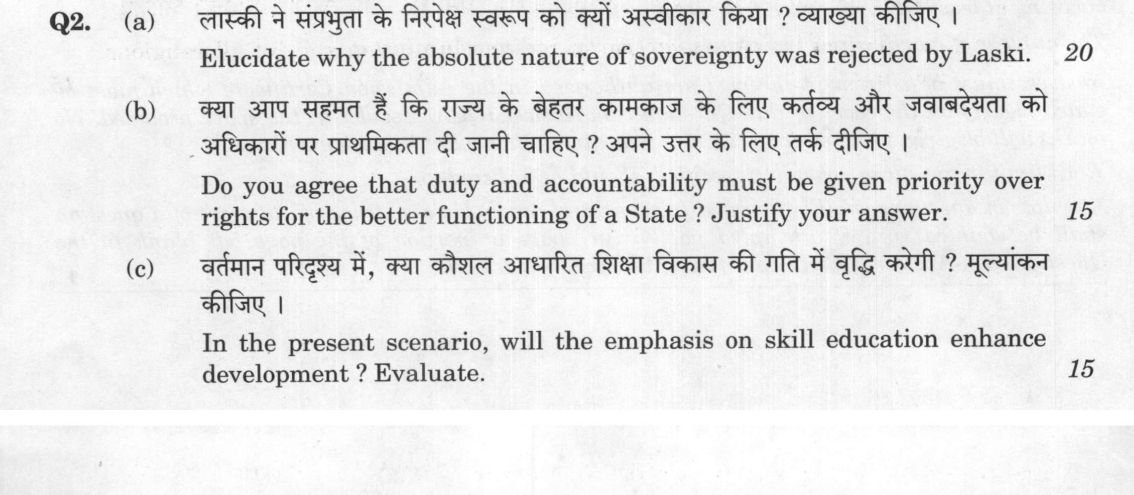
(a) Elucidate why the absolute nature of sovereignty was rejected by Laski. (20 marks) (b) Do you agree that duty and…
Elucidate why the absolute nature of sovereignty was rejected by Laski. 20 marks
Do you agree that duty and accountability must be given priority over rights for the better functioning of a State? Justify your answer. 15 marks
In the present scenario, will the emphasis on skill education enhance development? Evaluate. 15 marks
हिंदी में प्रश्न पढ़ें
लास्की ने सम्प्रभुता के निरपेक्ष स्वरूप को क्यों अस्वीकार किया ? व्याख्या कीजिए । (20 अंक)
क्या आप सहमत हैं कि राज्य के बेहतर कामकाज के लिए कर्तव्य और जवाबदेही को अधिकारों पर प्राथमिकता दी जानी चाहिए ? अपने उत्तर के लिए तर्क दीजिए । (15 अंक)
वर्तमान परिदृश्य में, क्या कौशल आधारित शिक्षा विकास की गति में वृद्धि करेगी ? मूल्यांकन कीजिए । (15 अंक)
Model answer
Written by UPSC Answer Check against this question's marking rubric, to the expected length. UPSC does not publish answers for Mains — this is one way to score well, not an official key.
Harold Laski rejected the classical monistic theory of sovereignty formulated by Jean Bodin, Thomas Hobbes, and John Austin, arguing that an absolute, unified, and legally omnipotent sovereign is both theoretically fallacious and practically dangerous.
Laski’s Pluralist Critique of Absolute Sovereignty
Laski elucidated that society is pluralistic and federal by nature, composed of numerous associations—such as trade unions, religious groups, cultural bodies, and educational institutions—each fulfilling distinct and vital human purposes. Consequently, the state cannot claim an absolute monopoly over sovereignty or individual allegiance; it is merely an association among associations, distinguished only by its coordinating function.
Laski argued for a functional distribution of power: authority must follow function, and because social functions are distributed across various autonomous groups, sovereignty itself must be decentralized. An individual’s personality is expressed through overlapping memberships in these autonomous associations, meaning political loyalty is necessarily federal and contingent. Absolute sovereignty reduces the individual to a passive subject, whereas a pluralist framework protects democratic freedom through economic pluralism and institutional decentralization. The state’s authority is morally conditional, justified only insofar as it secures rights and promotes the common welfare.
Priority of Duty and Accountability over Rights
The claim that duty and accountability should take priority over rights is fundamentally flawed because the two exist in a reciprocal, dialectical relationship. In modern democratic thought, rights are not concessions of the sovereign but essential prerequisites for human dignity and autonomy, as recognized in the social contract and liberal welfare traditions.
Prioritizing duty entirely over rights risks authoritarianism, while absolutizing rights without accountability leads to social fragmentation. B.R. Ambedkar’s conception of constitutional morality highlights that fundamental rights in Part III remain meaningful only when supported by democratic accountability and institutional checks. Simultaneously, Mahatma Gandhi’s philosophy of trusteeship emphasized that rights are inherently earned through the performance of duty.
In India, this interdependence is manifested through Fundamental Duties (Article 51A) and accountability instruments like the Right to Information (RTI) Act, 2005. During the COVID-19 pandemic, the state’s obligation to protect public health and citizens' duty of compliance had to be continually balanced against the protection of basic civil liberties and livelihoods. Therefore, rather than prioritizing duty over rights, a state functions optimally when accountability, duties, and rights operate in mutual equilibrium.
Evaluation of Skill Education and Development
The contemporary emphasis on skill education through frameworks like the National Education Policy (NEP) 2020 and the Skill India Mission is vital for leveraging India’s demographic dividend. By bridging the gap between industry requirements and academic curricula, vocational skilling enhances youth employability and productivity across the modern economy.
However, evaluating development solely through the prism of narrow vocational skilling reveals significant limitations. As Amartya Sen articulates in the Capability Approach, genuine development requires the expansion of substantive human freedoms and critical capabilities, rather than the mere creation of market-ready labour. Pure vocationalization detached from liberal education risks producing a workforce incapable of critical reflection and democratic engagement.
Furthermore, given the reality of jobless growth and an informal sector employing over eighty percent of the workforce, skill training cannot drive development unless supported by structural industrial policy, secure wages, and social security. While skill education is an indispensable economic instrument, it must be integrated with foundational learning and holistic human development to realize genuine socioeconomic transformation.
Contemporary governance therefore requires a synthesized approach: state authority must remain pluralist and decentralized as Laski envisioned, citizenship must balance rights with institutional accountability, and educational policy must expand holistic human capabilities alongside technical skills.
What "Elucidate" is asking you to do
Make a stated proposition plain and then prove it with instances. Elucidate stems almost always carry a claim or a named concept, and very often the words “with examples” or “with suitable diagrams” — the illustration is part of the directive, not decoration.
Structure that answers it
Plain-language statement of what the proposition means → the part that is obscure, resolved → first illustration → second illustration → why the proposition holds
Where marks are lost
Adding terminology; elucidate rewards removing it. The commoner loss is a clean explanation with no example, when the stem asked for examples.
How this answer will be evaluated
Approach
Framework: null. (a) explain: definition/context > points in order > small example > short close | (b) justify: claim > 3-4 reasons > evidence > conclusion | (c) evaluate: criteria > evidence > balanced judgment Full marks: Precise technical vocabulary, strong counter-arguments, concrete examples, and clear evaluation.
Key points expected
- Define absolute sovereignty (indivisible, unlimited, supreme).
- Explain Laski's critique: sovereignty is a social fact, not a legal fiction.
- Discuss the 'social contract' or 'consent of the governed' argument.
- Evaluate the practical implications of rejecting absolute sovereignty.
- Define the relationship between rights, duties, and accountability.
- Provide 3-4 reasons why duty/accountability is prioritized (e.g., social order, resource allocation).
- Provide evidence or examples of state functioning relying on duty.
- Conclude with a balanced judgment on the priority.
Evaluation rubric
Each sub-part is marked on its own, against the marks and word limit printed on the paper.
- (a) Reconstruct Laski's argument against absolute sovereignty and evaluate its validity. 20 marks
explain— definition/context → points in order → small example → short close
Must cover
- Define absolute sovereignty (indivisible, unlimited, supreme).
- Explain Laski's critique: sovereignty is a social fact, not a legal fiction.
- Discuss the 'social contract' or 'consent of the governed' argument.
- Evaluate the practical implications of rejecting absolute sovereignty.
Loses marks
- Biographical details of Harold Laski.
- Vague paraphrase without technical terms.
- Failing to distinguish between legal and political sovereignty.
Earns more
- Reference to 'The Life of the State' or specific works.
- Contrast with Hobbes or Austin's views.
- Mention the 'moral' vs 'legal' nature of sovereignty.
- Use of precise terms like 'indivisibility' or 'supremacy'.
Extra mark
- Reference to specific historical examples Laski used.
- Mention of the 'functional' theory of sovereignty.
- (b) Justify the claim that duty and accountability take priority over rights for state functioning. 15 marks
justify— claim → 3-4 reasons → evidence → conclusion
Must cover
- Define the relationship between rights, duties, and accountability.
- Provide 3-4 reasons why duty/accountability is prioritized (e.g., social order, resource allocation).
- Provide evidence or examples of state functioning relying on duty.
- Conclude with a balanced judgment on the priority.
Loses marks
- Ignoring the 'rights' side of the argument.
- Vague generalities without specific reasons.
- Failing to address the 'better functioning' aspect.
Earns more
- Reference to 'social contract' theory.
- Mention of 'negative' vs 'positive' rights.
- Discussion of 'accountability' mechanisms (judicial, legislative).
- Use of terms like 'reciprocity' or 'obligation'.
Extra mark
- Reference to specific constitutional provisions on duties (e.g., Art 51A in India).
- Mention of specific philosophers (e.g., Kant, Rawls).
- (c) Evaluate whether emphasis on skill education enhances development in the present scenario. 15 marks
evaluate— criteria → evidence → balanced judgment
Must cover
- Define 'skill education' and 'development' in the context.
- Present evidence/arguments for how skill education enhances development.
- Present limitations or negative aspects of the current emphasis.
- Provide a balanced judgment on the overall impact.
Loses marks
- Vague generalities without specific evidence.
- Ignoring the 'present scenario' aspect.
- Failing to provide a balanced judgment.
Earns more
- Reference to specific skill development programs (e.g., NSDC, Skill India).
- Discussion of 'employability' vs 'employers' needs.
- Mention of 'human capital' theory.
- Use of terms like 'vocational training' or 'technical education'.
Extra mark
- Reference to specific statistics on unemployment or skill gaps.
- Mention of specific international models (e.g., German dual system).
Practice this exact question
Write your answer and it is marked point by point against the model answer above — what you covered, what you missed, what you got wrong.
Evaluate my answer →More from Philosophy 2023 Paper II
- Q1 Answer the following questions in about 150 words each: (a) What is meant by justice as f…
- Q2 (a) Elucidate why the absolute nature of sovereignty was rejected by Laski. (20 marks) (b…
- Q3 (a) Explain Historical Materialism and discuss its relevance in the context of social dev…
- Q4 (a) "Severity of punishment should be proportionate to the seriousness of the crime." — D…
- Q5 Answer the following questions in about 150 words each: (a) Elucidate the personalistic a…