Paper II — Q8
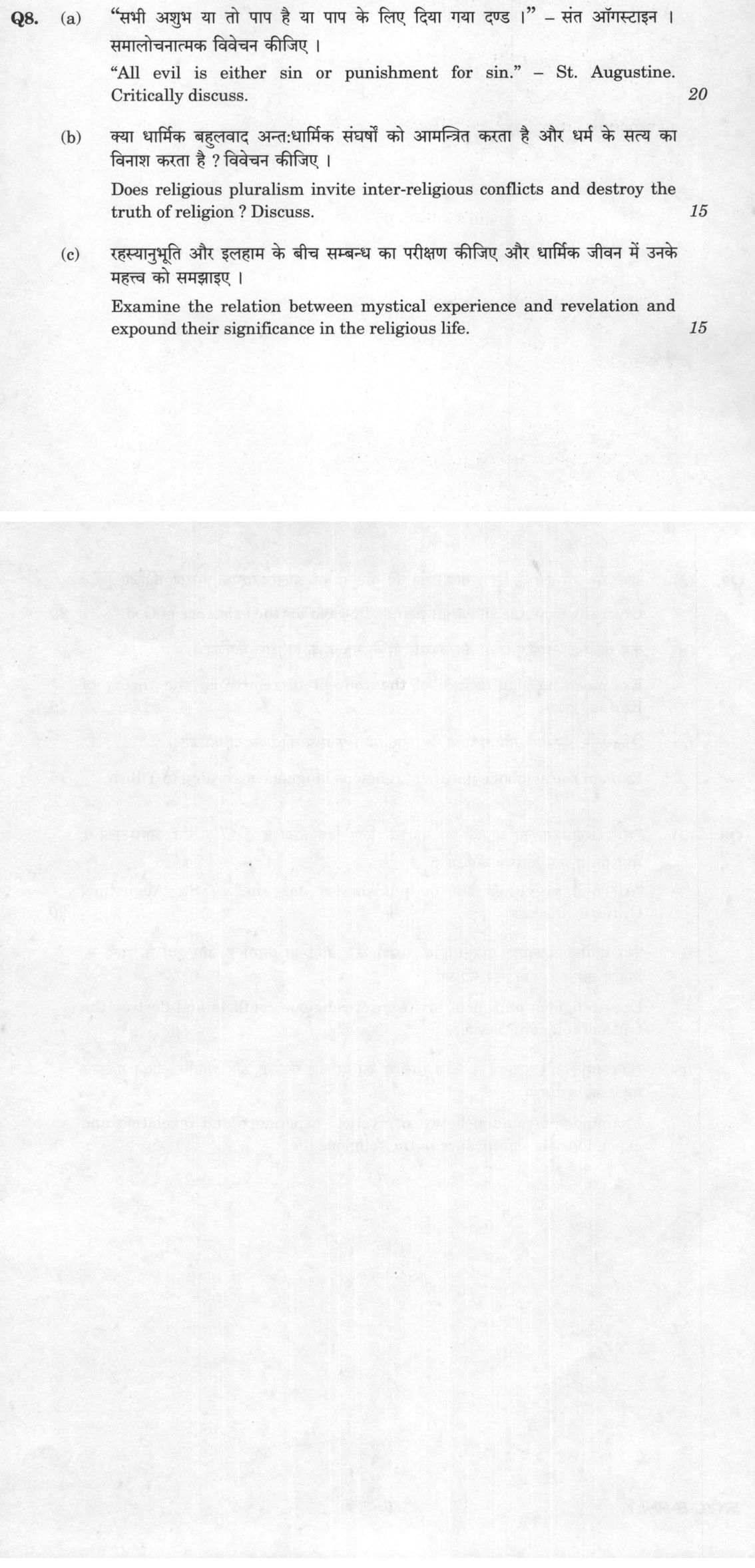
(a) "All evil is either sin or punishment for sin." – St. Augustine. Critically discuss. (20 marks) (b) Does religious pluralism…
"All evil is either sin or punishment for sin." – St. Augustine. Critically discuss. 20 marks
Does religious pluralism invite inter-religious conflicts and destroy the truth of religion? Discuss. 15 marks
Examine the relation between mystical experience and revelation and expound their significance in the religious life. 15 marks
हिंदी में प्रश्न पढ़ें
"सभी अशुभ या तो पाप है या पाप के लिए दिया गया दंड ।" – संत ऑगस्टाइन । समालोचनात्मक विवेचन कीजिए । (20 अंक)
क्या धार्मिक बहुलवाद अन्तःधार्मिक संघर्षों को आमंत्रित करता है और धर्म के सत्य का विनाश करता है ? विवेचन कीजिए । (15 अंक)
रहस्यानुभूति और इल्हाम के बीच सम्बन्ध का परीक्षण कीजिए और धार्मिक जीवन में उनके महत्व को समझाइए । (15 अंक)
Model answer
Written by UPSC Answer Check against this question's marking rubric, to the expected length. UPSC does not publish answers for Mains — this is one way to score well, not an official key.
Augustinian Theodicy and the Problem of Evil
Augustine reconciles God’s omnipotence and omnibenevolence through Neoplatonic metaphysics: evil possesses no positive ontological reality, existing only as privatio boni (a privation or corruption of the good). Within this framework, all evil is bipartite: moral evil arises from the perverse misuse of free will by rational creatures (aversio a Deo), while natural evil is interpreted as penal consequence—a cosmic disharmony justly inherited through the Fall. Thus, God is entirely exonerated, as evil is either the creature's sin or God's righteous punishment for sin.
Critically, Augustine’s free-will defense and retributive model face profound objections. Ascribing natural evils like tsunamis and pandemics to ancestral guilt violates basic moral proportionality and fails to account for dysteleological animal suffering occurring millions of years before humanity. Furthermore, as Dostoevsky’s Ivan Karamazov forcefully protests, the unmerited suffering of innocent children cannot be justified by any retributive scheme or higher cosmic balance. Modern philosophy therefore turns to alternative paradigms: John Hick’s Irenaean "soul-making" theodicy, which views the world not as a ruined paradise but as a challenging environment designed for spiritual maturation, and Process Theology, which resolves the dilemma by conceiving God as persuasive rather than coercively omnipotent. While Augustine successfully establishes human moral responsibility, his reduction of all suffering to sin and punishment remains morally and empirically unsustainable.
Religious Pluralism and Truth Claims
Religious pluralism, formulated notably in John Hick’s hypothesis, utilizes a Kantian distinction between the transcendent, ineffable "Real" (noumenon) and its culturally conditioned manifestations (phenomena). It directly confronts both exclusivism (salvation is restricted to one tradition) and inclusivism (one tradition holds the fullness of truth while others hold partial truths).
Pluralism does not inherently invite inter-religious conflict; rather, historical conflicts are primarily fueled by exclusivist absolutism. In the Indian tradition, this is demonstrated by Sri Ramakrishna’s experiential maxim jata mat tata path (as many faiths, so many paths) and Mahatma Gandhi’s principle of sarva dharma sambhava (equal reverence for all religions), which treat pluralism as the foundational prerequisite for communal peace.
Nor does pluralism destroy religious truth, provided truth is understood soteriologically rather than purely propositionally. Hick argues that religions are vehicles for transformation from self-centeredness to Reality-centeredness. Raimon Panikkar’s "diatopical hermeneutics" similarly reveals that inter-religious dialogue uncovers deeper dimensions of the transcendent without demanding homogenization. However, the pluralist position risks vulnerability if carried to an uncritical relativism that dilutes the existential urgency and distinctive normative commitments essential to religious life.
Mystical Experience, Revelation, and Religious Life
Mystical experience—characterized by William James through the marks of ineffability, noetic quality, transiency, and passivity, and by W.T. Stace as a "universal core" of unitive consciousness—represents direct, unmediated awareness of the Divine. Revelation, by contrast, denotes the public, historical self-disclosure of the Divine, structured either propositionally (doctrines and scriptures) or non-propositionally (existential divine-human encounters).
The relationship between the two is dialectical. While mystical experience acts as an intensified, internalized realization of revelation, tension often arises between the mystic's autonomous, unmediated insight and the institutional authority guarding propositional revelation. In religious life, their synthesis is indispensable: revelation serves as a necessary normative anchor protecting the community from idiosyncratic delusion, while mystical experience validates faith, infusing dry dogma with vital certitude, as seen in the interior life of St. Teresa of Ávila and Sri Aurobindo’s integral yoga. This epistemic harmony finds its clearest articulation in Indian philosophy, where external revelation (śruti) must ultimately be ratified and fulfilled by direct, personal realization (anubhava).
Collectively, contemporary philosophy of religion moves away from rigid retributive theodicies and dogmatic exclusivism toward dynamic frameworks that balance soteriological pluralism with experiential realization, grounding religious truth in living spiritual transformation.
What "Critically discuss" is asking you to do
Lay the issue out from more than one side — how it arose, what is claimed for it, what is held against it, and where it now stands. UPSC attaches discuss to broad topics with several live dimensions, so coverage of the dimensions earns more than the strength of your opinion. “Critically” is not a section added at the end: name the yardstick you are judging by — the evidence, the stated objective, a constitutional principle, a rival explanation — and let a verdict close each part of the body. Where the question quotes a claim, that verdict must land on the claim itself, accepted, qualified or rejected, and not on the theme in general.
Structure that answers it
Set the issue up → the case as it is made → the case against → the dimension both sides leave out → where the balance now lies
Where marks are lost
Merits in one paragraph, demerits in the next, and a conclusion calling for a balanced and holistic approach. That is a survey with the judgement left out and it holds the answer in the middle band. The opposite error is reading “critically” as permission to attack — and with the odd pairings, critically describe or critically explain, the exposition still carries most of the marks, the judgement being a layer on it rather than a substitute for it.
How this answer will be evaluated
Approach
(a) critique: the claim > its strengths > its weaknesses > your judgment | (b) discuss: intro > 3-4 dimensions > example > balanced close | (c) examine: intro > how/why with reasoning > evidence > conclusion Full marks: Precise reconstruction, strong counter-arguments, technical vocabulary, and clear judgment.
Key points expected
- Define sin as privation of good (privatio boni)
- Explain punishment as just retribution for sin
- Present the strongest objection to the dichotomy
- Provide a final judgment on the claim's validity
- Define religious pluralism clearly
- Analyze the link to inter-religious conflicts
- Discuss the impact on the concept of religious truth
- Provide a balanced conclusion
Evaluation rubric
Each sub-part is marked on its own, against the marks and word limit printed on the paper.
- (a) Reconstruct and evaluate Augustine's dichotomy of evil as sin or punishment. 20 marks
critique— the claim → its strengths → its weaknesses → your judgment
Must cover
- Define sin as privation of good (privatio boni)
- Explain punishment as just retribution for sin
- Present the strongest objection to the dichotomy
- Provide a final judgment on the claim's validity
Loses marks
- Biographical details of St. Augustine
- Vague paraphrase without technical terms
- Failure to address the 'punishment' aspect
Earns more
- Reference to theodicy or problem of evil
- Mention of free will defense
- Distinction between moral and natural evil
- Reference to specific Augustinian works
Extra mark
- Use of Latin term 'privatio boni'
- Reference to specific theological debates
- (b) Analyze the impact of religious pluralism on conflict and religious truth. 15 marks
discuss— intro → 3-4 dimensions → example → balanced close
Must cover
- Define religious pluralism clearly
- Analyze the link to inter-religious conflicts
- Discuss the impact on the concept of religious truth
- Provide a balanced conclusion
Loses marks
- One-sided argument without counter-view
- Vague generalizations about religion
- Failure to address the 'truth' aspect
Earns more
- Reference to specific inter-religious conflicts
- Discussion of relativism vs. absolutism
- Mention of dialogue and coexistence
- Reference to specific pluralist thinkers
Extra mark
- Reference to specific peace treaties or dialogues
- Use of Sanskrit term for tolerance (e.g., 'Sarva Dharma Sambhava')
- (c) Explore the relationship between mystical experience and revelation in religious life. 15 marks
examine— intro → how/why with reasoning → evidence → conclusion
Must cover
- Define mystical experience and revelation
- Explain the relationship between the two
- Elucidate their significance in religious life
- Provide a reasoned conclusion
Loses marks
- Confusing mystical experience with revelation
- Lack of specific examples or references
- Failure to address the 'significance' aspect
Earns more
- Reference to specific mystical traditions
- Discussion of subjective vs. objective truth
- Mention of specific mystics or prophets
- Analysis of the transformative power of these experiences
Extra mark
- Use of Sanskrit term for mystical experience (e.g., 'Anubhuti')
- Reference to specific mystical texts
Practice this exact question
Write your answer and it is marked point by point against the model answer above — what you covered, what you missed, what you got wrong.
Evaluate my answer →More from Philosophy 2023 Paper II
- Q5 Answer the following questions in about 150 words each: (a) Elucidate the personalistic a…
- Q6 (a) Critically examine Plato's apriori proofs for the immortality of the soul. (20 marks)…
- Q7 (a) Critically examine the arguments of Nyaya for the existence of God. (20 marks) (b) Ex…
- Q8 (a) "All evil is either sin or punishment for sin." – St. Augustine. Critically discuss.…