Paper II — Q6
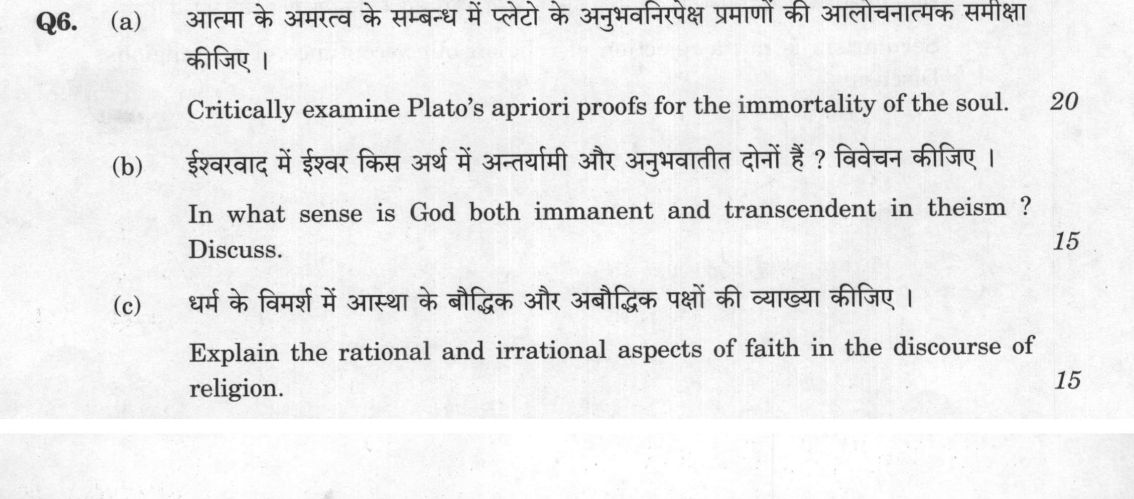
(a) Critically examine Plato's apriori proofs for the immortality of the soul. (20 marks) (b) In what sense is God both immanent…
Critically examine Plato's apriori proofs for the immortality of the soul. 20 marks
In what sense is God both immanent and transcendent in theism? Discuss. 15 marks
Explain the rational and irrational aspects of faith in the discourse of religion. 15 marks
हिंदी में प्रश्न पढ़ें
आत्मा के अमरत्व के संबंध में प्लेटो के अनुभवनिरपेक्ष प्रमाणों की आलोचनात्मक समीक्षा कीजिए । (20 अंक)
ईश्वरवाद में ईश्वर किस अर्थ में अंतर्यामी और अनुभवातीत दोनों हैं ? विवेचन कीजिए । (15 अंक)
धर्म के विमर्श में आस्था के बौद्धिक और अबौद्धिक पक्षों की व्याख्या कीजिए । (15 अंक)
Model answer
Written by UPSC Answer Check against this question's marking rubric, to the expected length. UPSC does not publish answers for Mains — this is one way to score well, not an official key.
Plato’s A Priori Proofs for the Immortality of the Soul
In the Phaedo and Meno, Plato offers four principal a priori demonstrations for the immortality of the soul (psyche), independent of empirical observation. First, the Argument from Opposites (Cyclical Argument) posits that all things in nature generate from their contraries; life must therefore arise from death, necessitating the cyclical survival and return of souls. Second, the Argument from Recollection (Anamnesis) asserts that our innate knowledge of absolute Forms (such as Equality or Beauty) cannot derive from sensory experience, proving the soul’s pre-existence in an intelligible realm. Third, the Argument from Affinity holds that while composite, material bodies decompose, the soul is simple, invisible, and indivisible, displaying affinity with the immutable Forms, thus rendering it indissoluble. Finally, the Argument from the Form of Life (Phaedo 102–107) establishes that the soul's essential nature participates in the Form of Life; because it fundamentally excludes its opposite (Death), the soul is intrinsically imperishable (athanaton).
Critically examined, Plato’s proofs provide a historically foundational architecture for Western dualism and rationalist psychology, yet they fail logically as definitive demonstrations. The Cyclical Argument commits a category mistake by treating biological death as symmetrical to natural alternation like waking and sleeping. The Argument from Recollection, at best, demonstrates pre-existence, not everlasting post-mortem survival. Furthermore, the Affinity Argument is undermined by Aristotle’s hylomorphism, which conceives the soul not as an independent substance, but as the form of the living organic body, perishing with it. Kant’s critique of Rational Psychology in the Paralogisms of Pure Reason decisively showed that inferring an immortal, substantial metaphysical soul from the transcendental unity of consciousness is logically fallacious. Hence, while Plato’s arguments exhibit rational coherence within his Idealism, they remain speculative metaphysical postulates rather than irrefutable deductive proofs.
Divine Immanence and Transcendence in Theism
Classical theism synthesizes two seemingly antithetical dimensions of God: transcendence and immanence, avoiding both the aloof detachment of deism and the pantheistic collapse of God into nature.
Transcendence denotes God’s ontological distinctness, aseity (self-existence), infinity, and qualitative otherness. God is not an entity among entities, but the unconditioned ground of reality, transcending temporal-spatial limitations and remaining ultimately incomprehensible (via negativa).
Immanence signifies God’s pervasive, sustaining presence (creatio continua) within the cosmos. God operates internally within every creature as primary causality without dissolving into the universe, distinguishing theism from pantheism and framing it closer to panentheism. Thomas Aquinas synthesized these by defining God as Ipsum Esse Subsistens (Subsistent Being Itself), where God is intimately present to all beings as the cause of their existence while infinitely surpassing them in essence, a balance mirrored in Moses Maimonides’ negative theology.
In Indian philosophy, this polarity is articulated within Vedanta. Advaita Vedanta frames Nirguna Brahman as absolute, unconditioned transcendence beyond empirical categories, while Saguna Brahman (Ishvara) serves as the immanent, governing principle of the phenomenal world (vyavahara). Ramanuja’s Visistadvaita provides an integrated mediating model through Sharira-Shariri Bhava (the universe as the body of God), affirming that God is wholly immanent as the indwelling soul of the cosmos (Antaryamin), while remaining transcendent in perfection, strictly rejecting crude anthropomorphism.
Rational and Irrational Dimensions of Faith
In religious philosophy, faith (fides) operates across a dialectic of rational foundation and non-rational commitment.
The rational aspects of faith position it as reasoned trust rather than blind adherence (fides quaerens intellectum). Richard Swinburne defends a cumulative case argument for theism, asserting that faith is supported by probabilistic rationality and explanatory coherence. Blaise Pascal’s Wager utilizes prudential rationality and decision theory under existential uncertainty, arguing that committing to faith is a rationally optimal choice given infinite expected utility.
Conversely, the irrational or supra-rational aspects emphasize that faith transcends discursive intellect. Tertullian’s famous dictum credo quia absurdum ("I believe because it is absurd") and Søren Kierkegaard’s formulation of the existential "leap of faith" locate the essence of religious conviction in the embrace of objective uncertainty and paradox, demanding a "teleological suspension of the ethical." Ludwig Wittgenstein advanced a non-rational view of faith as "groundless believing"—an affective, foundational framework embedded within a form of life rather than an empirical truth-claim subject to evidential verification.
Ultimately, genuine religious faith is trans-rational: if reduced entirely to discursive proof, it ceases to be faith; if reduced entirely to irrationality, it collapses into uncritical superstition.
What "Critically examine" is asking you to do
Test the proposition the question puts to you and return a finding on how far it holds. Examine stems carry a claim, or ask whether something has happened, and expect evidence weighed both ways before the extent is stated — often with remedial measures attached. “Critically” is not a section added at the end: name the yardstick you are judging by — the evidence, the stated objective, a constitutional principle, a rival explanation — and let a verdict close each part of the body. Where the question quotes a claim, that verdict must land on the claim itself, accepted, qualified or rejected, and not on the theme in general.
Structure that answers it
Restate the claim as the question frames it → evidence that supports it → evidence that undercuts it → the conditions under which it holds → verdict on how far it stands
Where marks are lost
Merits in one paragraph, demerits in the next, and a conclusion calling for a balanced and holistic approach. That is a survey with the judgement left out and it holds the answer in the middle band. The opposite error is reading “critically” as permission to attack — and with the odd pairings, critically describe or critically explain, the exposition still carries most of the marks, the judgement being a layer on it rather than a substitute for it.
How this answer will be evaluated
Approach
(a) critique: the claim > its strengths > its weaknesses > your judgment | (b) discuss: intro > 3-4 dimensions > example > balanced close | (c) explain: definition/context > points in order > small example > short close Full marks: Precise reconstruction of arguments, strong objections, and clear distinction between concepts.
Key points expected
- Reconstruct the Argument from Opposites (Phaedo 70c-72e)
- Reconstruct the Affinity Argument (Phaedo 78a-80d)
- Reconstruct the Argument from Recollection (Meno/Phaedo)
- Present the strongest objection to the Affinity Argument
- Define Immanence (God in the world)
- Define Transcendence (God above the world)
- Explain the theological necessity of both attributes
- Provide a concrete example of the tension
Evaluation rubric
Each sub-part is marked on its own, against the marks and word limit printed on the paper.
- (a) Reconstruct and evaluate Plato's a priori arguments for the soul's immortality. 20 marks
critique— the claim → its strengths → its weaknesses → your judgment
Must cover
- Reconstruct the Argument from Opposites (Phaedo 70c-72e)
- Reconstruct the Affinity Argument (Phaedo 78a-80d)
- Reconstruct the Argument from Recollection (Meno/Phaedo)
- Present the strongest objection to the Affinity Argument
Loses marks
- Biographical details of Plato
- Confusing a priori with empirical evidence
- Vague paraphrase without logical structure
Earns more
- Mention the Argument from the Final Cause (Phaedo 105e)
- Use Greek terms: eidos, aisthesis, psychē
- Distinguish a priori from a posteriori reasoning
- Reference the 'Soul as Form' concept
Extra mark
- Reference the 'Great Soul' (Magna Psychē) argument
- Mention the 'Soul as Simple' (Indivisible) argument
- (b) Explain the dual nature of God as immanent and transcendent in theism. 15 marks
discuss— intro → 3-4 dimensions → example → balanced close
Must cover
- Define Immanence (God in the world)
- Define Transcendence (God above the world)
- Explain the theological necessity of both attributes
- Provide a concrete example of the tension
Loses marks
- Treating Immanence and Transcendence as identical
- Vague definitions without theological context
- Ignoring the 'tension' between the two
Earns more
- Reference the 'Divine Attributes' debate
- Mention the 'Problem of Evil' in this context
- Use Sanskrit terms: Brahman, Ishvara
- Reference the 'Creator vs Sustainer' distinction
Extra mark
- Reference the 'Panentheism' vs 'Pantheism' distinction
- Mention the 'Divine Hiddenness' argument
- (c) Analyze the rational and irrational components of religious faith. 15 marks
explain— definition/context → points in order → small example → short close
Must cover
- Define 'Faith' in the religious context
- Identify rational aspects (e.g., logical consistency, evidence)
- Identify irrational aspects (e.g., blind belief, emotion)
- Provide a small example of each aspect
Loses marks
- Defining faith as only 'blind belief'
- Ignoring the 'rational' component entirely
- Vague examples without specific religious context
Earns more
- Reference the 'Leap of Faith' (Kierkegaard)
- Mention the 'Rationalism vs Fideism' debate
- Use Sanskrit terms: Shraddha, Bhakti
- Reference the 'Cognitive Dissonance' in faith
Extra mark
- Reference the 'Pascal's Wager' argument
- Mention the 'Existentialist' view of faith
Practice this exact question
Write your answer and it is marked point by point against the model answer above — what you covered, what you missed, what you got wrong.
Evaluate my answer →More from Philosophy 2023 Paper II
- Q3 (a) Explain Historical Materialism and discuss its relevance in the context of social dev…
- Q4 (a) "Severity of punishment should be proportionate to the seriousness of the crime." — D…
- Q5 Answer the following questions in about 150 words each: (a) Elucidate the personalistic a…
- Q6 (a) Critically examine Plato's apriori proofs for the immortality of the soul. (20 marks)…
- Q7 (a) Critically examine the arguments of Nyaya for the existence of God. (20 marks) (b) Ex…
- Q8 (a) "All evil is either sin or punishment for sin." – St. Augustine. Critically discuss.…