Paper II — Q5
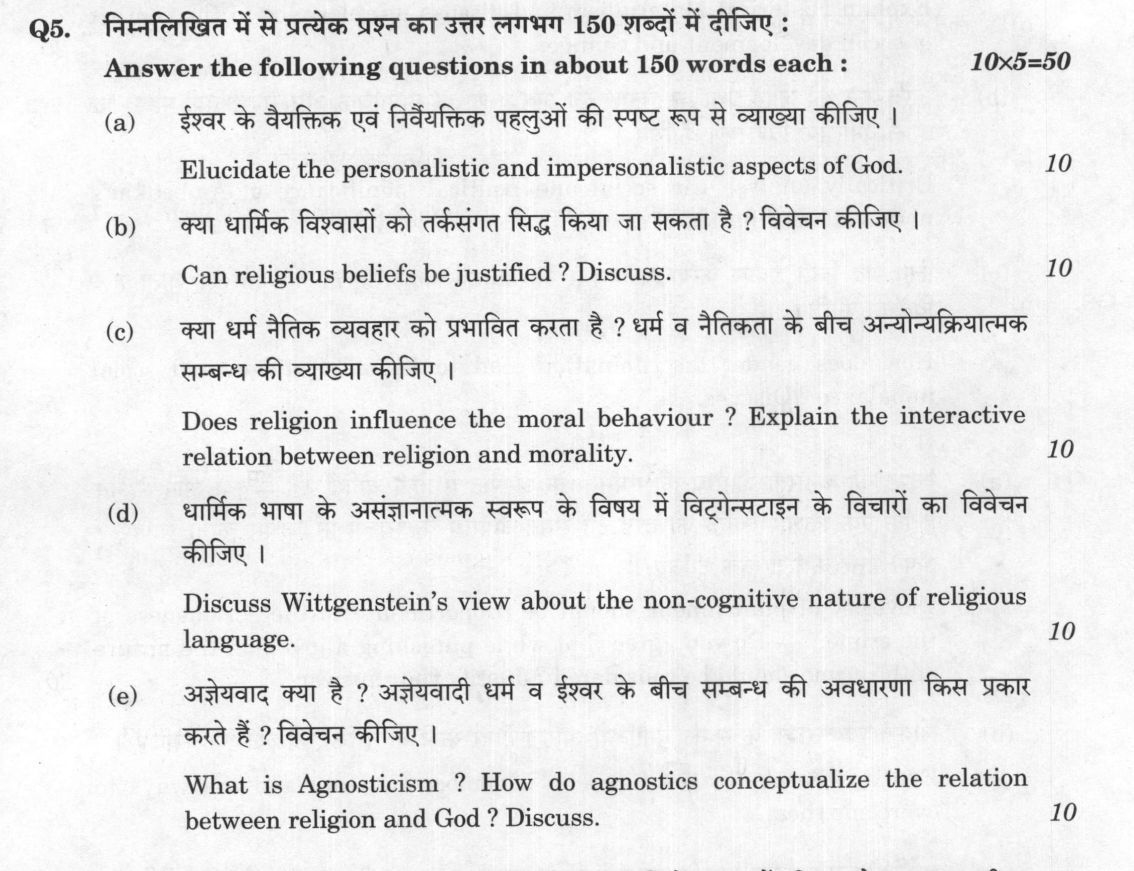
Answer the following questions in about 150 words each: (a) Elucidate the personalistic and impersonalistic aspects of God. (10…
Answer the following questions in about 150 words each:
Elucidate the personalistic and impersonalistic aspects of God. 10 marks
Can religious beliefs be justified? Discuss. 10 marks
Does religion influence the moral behaviour? Explain the interactive relation between religion and morality. 10 marks
Discuss Wittgenstein's view about the non-cognitive nature of religious language. 10 marks
What is Agnosticism? How do agnostics conceptualize the relation between religion and God? Discuss. 10 marks
हिंदी में प्रश्न पढ़ें
निम्नलिखित में से प्रत्येक प्रश्न का उत्तर लगभग 150 शब्दों में दीजिए :
ईश्वर के वैयक्तिक एवं निर्वैयक्तिक पहलुओं की स्पष्ट रूप से व्याख्या कीजिए । (10 अंक)
क्या धार्मिक विश्वासों को तर्कसंगत सिद्ध किया जा सकता है ? विवेचन कीजिए । (10 अंक)
क्या धर्म नैतिक व्यवहार को प्रभावित करता है ? धर्म व नैतिकता के बीच अन्योन्यक्रियात्मक संबंध की व्याख्या कीजिए । (10 अंक)
धार्मिक भाषा के असंज्ञानात्मक स्वरूप के विषय में विट्टगेन्स्टाइन के विचारों का विवेचन कीजिए । (10 अंक)
अज्ञेयवाद क्या है ? अज्ञेयवादी धर्म व ईश्वर के बीच संबंध की अवधारणा किस प्रकार करते हैं ? विवेचन कीजिए । (10 अंक)
Model answer
Written by UPSC Answer Check against this question's marking rubric, to the 150-word length. UPSC does not publish answers for Mains — this is one way to score well, not an official key.
(a) Personalistic and Impersonalistic Aspects of God
The concept of the divine in philosophy of religion oscillates between personalistic and impersonalistic conceptions. The personalistic aspect conceives God as an omnipotent, omniscient, and morally perfect person who relates dynamically to creation. This is exemplified in Western monotheism (Jehovah) and Indian theism (Ishvara or Saguna Brahman in Ramanuja’s Vishishtadvaita), where God possesses auspicious attributes (kalyana gunas), acts as cosmic creator, judge, and saviour, and responds to prayer and devotion (bhakti).
Conversely, the impersonalistic aspect conceptualizes ultimate reality as an unqualified, trans-personal ontological ground beyond anthropomorphic categories. This is manifested in Shankara’s *Nirguna Brahman*—pure consciousness (Saccidananda) devoid of predicates (nirupadhika)—as well as the Absolute of Hegel and F.H. Bradley, the Tao of Laozi, and the Ein Sof of Kabbalistic thought. While personalism emphasizes relational piety and moral governance, impersonalism asserts metaphysical transcendence, resolving the tension by viewing the personal God as the phenomenal manifestation of an unconditioned Absolute.
(b) Justification of Religious Beliefs
The epistemic status of religious beliefs is contested between evidentialist, rationalist, and fideist paradigms. W.K. Clifford’s evidentialist challenge posits that holding beliefs upon insufficient evidence is an ethical and epistemic failure. In response, Richard Swinburne constructs a cumulative case, utilizing Bayesian probability to argue that the cosmological, teleological, and experiential evidence collectively renders the theistic hypothesis rational.
Departing from classical evidentialism, Alvin Plantinga’s Reformed Epistemology argues that belief in God is "properly basic," grounded in immediate experiential cognitive faculties (sensus divinitatis) without needing inferential proof. Complementing this, William James provides a pragmatic justification in The Will to Believe, asserting that on genuine, forced, and living options, passionate non-rational choice is epistemically licit. Conversely, Søren Kierkegaard’s fideism rejects rational justification altogether, framing faith as an objective uncertainty embraced through an absolute "leap of faith." Ultimately, religious justification depends on whether rationality is defined exclusively by empirical verification or broadened to include basic cognitive, existential, and pragmatic warrants.
(c) Religion and Moral Behaviour
The interactive relationship between religion and morality spans foundational dependence, sociological reinforcement, and rational autonomy. In classical Indian philosophy, dharma integrates religion and morality into an indivisible cosmic-ethical order, where moral duties (sadharana and varna-ashrama dharma) are intrinsically bound to metaphysical liberation (moksha). Sociologically, Émile Durkheim demonstrated that religious rituals generate "collective effervescence," translating sacred beliefs into binding social morality that stabilizes communal cohesion.
However, Immanuel Kant challenged this dependence by establishing autonomous ethics: morality does not rely on divine commands (Categorical Imperative), but rather leads to religion, wherein God and immortality are necessary postulates of practical reason to harmonize virtue and happiness (the Highest Good). In contemporary Indian constitutional democracy, this interactive relation manifests as ethical pluralism, where an overarching secular morality (enshrined in fundamental duties and human dignity) derives motivational force from shared religious-philosophical values while remaining legally autonomous from sectarian dogma.
(d) Wittgenstein’s View of the Non-Cognitive Nature of Religious Language
In his later philosophy, Ludwig Wittgenstein rejected the verificationist doctrine of the Logical Positivists (such as A.J. Ayer), who dismissed religious language as meaningless because it lacks empirical verification. Wittgenstein reconceptualized language through the doctrines of "language-games" (Sprachspiele) and "forms of life" (Lebensformen), proposing that meaning is determined by usage within a specific communal context rather than by empirical reference.
Consequently, Wittgenstein characterized religious language as non-cognitive and expressive rather than fact-stating or scientific. Utterances such as "God exists" or "The Last Judgment will come" are not empirical hypotheses subjected to scientific falsification; rather, they regulate a believer’s entire cognitive framework, manifesting a profound existential commitment and emotional attitude. By demonstrating that religious statements operate under an entirely distinct grammar from scientific assertions, Wittgenstein preserved the distinct meaningfulness of religious life while divesting it of cognitive-descriptive claims.
(e) Agnosticism and the Conception of Religion and God
Agnosticism, coined by T.H. Huxley in 1869, is an epistemological stance rooted in cognitive humility, asserting that the ultimate nature of reality, metaphysical entities, and God is unknown and inherently unknowable given the limitations of human reason and empirical evidence. Unlike atheism, which positively denies the existence of God, and negative theology (via negativa or neti-neti), which admits trans-rational mystical union with the divine, agnosticism strictly suspends theoretical judgment on metaphysical claims.
Agnostics conceptualize religion primarily as an existential, ethical, and cultural enterprise rather than a dogmatic cosmological system. By severing religion from theological certitude, agnosticism permits functional and ethical participation in religious forms—such as communal solidarity, ritual practice, and ethical action—without requiring metaphysical allegiance to a supernatural deity. Agnosticism thus redirects the religious impulse away from speculative orthodoxy toward humanistic, this-worldly ethical commitment and rigorous intellectual integrity.
What "Elucidate" is asking you to do
Make a stated proposition plain and then prove it with instances. Elucidate stems almost always carry a claim or a named concept, and very often the words “with examples” or “with suitable diagrams” — the illustration is part of the directive, not decoration.
Structure that answers it
Plain-language statement of what the proposition means → the part that is obscure, resolved → first illustration → second illustration → why the proposition holds
Where marks are lost
Adding terminology; elucidate rewards removing it. The commoner loss is a clean explanation with no example, when the stem asked for examples.
How this answer will be evaluated
Approach
Framework: Philosophy Paper II: Reconstruct argument, strongest objection, evaluation. (a) explain: definition/context > points in order > small example > short close | (b) discuss: intro > 3-4 dimensions > example > balanced close | (c) explain: definition/context > points in order > small example > short close | (d) discuss: intro > 3-4 dimensions > example > balanced close | (e) discuss: intro > 3-4 dimensions > example > balanced close Full marks: Precise reconstruction of arguments, strongest objections, and clear evaluation with technical vocabulary.
Key points expected
- Define personalistic God (Saguna) with attributes
- Define impersonalistic God (Nirguna) as attributeless
- Contrast the two aspects clearly
- Provide examples of traditions for each
- State the problem of justification
- Present one major argument (e.g., Proper Function)
- Present the strongest objection (e.g., Reformed Epistemology critique)
- Conclude with a balanced evaluation
Evaluation rubric
Each sub-part is marked on its own, against the marks and word limit printed on the paper.
- (a) Distinguish personalistic (Saguna) and impersonalistic (Nirguna) conceptions of God. 10 marks · 150 words
explain— definition/context → points in order → small example → short close
Must cover
- Define personalistic God (Saguna) with attributes
- Define impersonalistic God (Nirguna) as attributeless
- Contrast the two aspects clearly
- Provide examples of traditions for each
Loses marks
- Confusing the two concepts
- Vague definitions without attributes
- Biographical details of philosophers
Earns more
- Mention Vedanta (Advaita vs Dvaita)
- Use Sanskrit terms Saguna/Nirguna
- Reference specific philosophers (Ramanuja, Shankara)
Extra mark
- Cite specific Upanishadic verses
- Mention specific theological debates
- (b) Examine epistemic justifications for religious beliefs (e.g., Plantinga, Swinburne). 10 marks · 150 words
discuss— intro → 3-4 dimensions → example → balanced close
Must cover
- State the problem of justification
- Present one major argument (e.g., Proper Function)
- Present the strongest objection (e.g., Reformed Epistemology critique)
- Conclude with a balanced evaluation
Loses marks
- Summarizing philosophers instead of reconstructing arguments
- Ignoring the objection
- Vague generalities about 'faith'
Earns more
- Mention Alvin Plantinga
- Reference 'Proper Function' or 'Warrant'
- Mention Richard Swinburne's Bayesian approach
Extra mark
- Cite specific philosophical works
- Mention specific logical fallacies
- (c) Analyze the interactive relationship between religion and moral behavior. 10 marks · 150 words
explain— definition/context → points in order → small example → short close
Must cover
- Define the relationship (causal or constitutive)
- Explain how religion influences morality
- Explain how morality influences religion
- Provide a concrete example
Loses marks
- One-sided view (only religion -> morality)
- Vague examples
- Ignoring the 'interactive' aspect
Earns more
- Mention 'Divine Command Theory'
- Reference specific moral codes (e.g., Ten Commandments)
- Discuss secular vs religious morality
Extra mark
- Cite specific sociological studies
- Mention specific ethical dilemmas
- (d) Explain Wittgenstein's view on the non-cognitive nature of religious language. 10 marks · 150 words
discuss— intro → 3-4 dimensions → example → balanced close
Must cover
- Define 'non-cognitive' in this context
- Explain Wittgenstein's 'language game' concept
- Apply to religious language (e.g., 'God exists')
- Contrast with cognitive/empirical claims
Loses marks
- Confusing with logical positivism
- Vague explanation of 'language game'
- Biographical details of Wittgenstein
Earns more
- Mention 'Philosophical Investigations'
- Use term 'language game'
- Reference 'forms of life'
Extra mark
- Cite specific passages from Wittgenstein
- Mention specific religious phrases analyzed
- (e) Define Agnosticism and explain its view on the relation between religion and God. 10 marks · 150 words
discuss— intro → 3-4 dimensions → example → balanced close
Must cover
- Define Agnosticism (agnostic vs agnostic)
- Explain the epistemic stance (unknowability)
- Describe the relation to religion (suspension of judgment)
- Contrast with atheism and theism
Loses marks
- Confusing agnosticism with atheism
- Vague definition
- Ignoring the 'relation' aspect
Earns more
- Mention Thomas Huxley
- Use term 'agnosticism' etymology
- Reference specific agnostic arguments
Extra mark
- Cite specific agnostic philosophers
- Mention specific religious contexts
Practice this exact question
Write your answer and it is marked point by point against the model answer above — what you covered, what you missed, what you got wrong.
Evaluate my answer →More from Philosophy 2023 Paper II
- Q2 (a) Elucidate why the absolute nature of sovereignty was rejected by Laski. (20 marks) (b…
- Q3 (a) Explain Historical Materialism and discuss its relevance in the context of social dev…
- Q4 (a) "Severity of punishment should be proportionate to the seriousness of the crime." — D…
- Q5 Answer the following questions in about 150 words each: (a) Elucidate the personalistic a…
- Q6 (a) Critically examine Plato's apriori proofs for the immortality of the soul. (20 marks)…
- Q7 (a) Critically examine the arguments of Nyaya for the existence of God. (20 marks) (b) Ex…
- Q8 (a) "All evil is either sin or punishment for sin." – St. Augustine. Critically discuss.…