Paper II — Q3
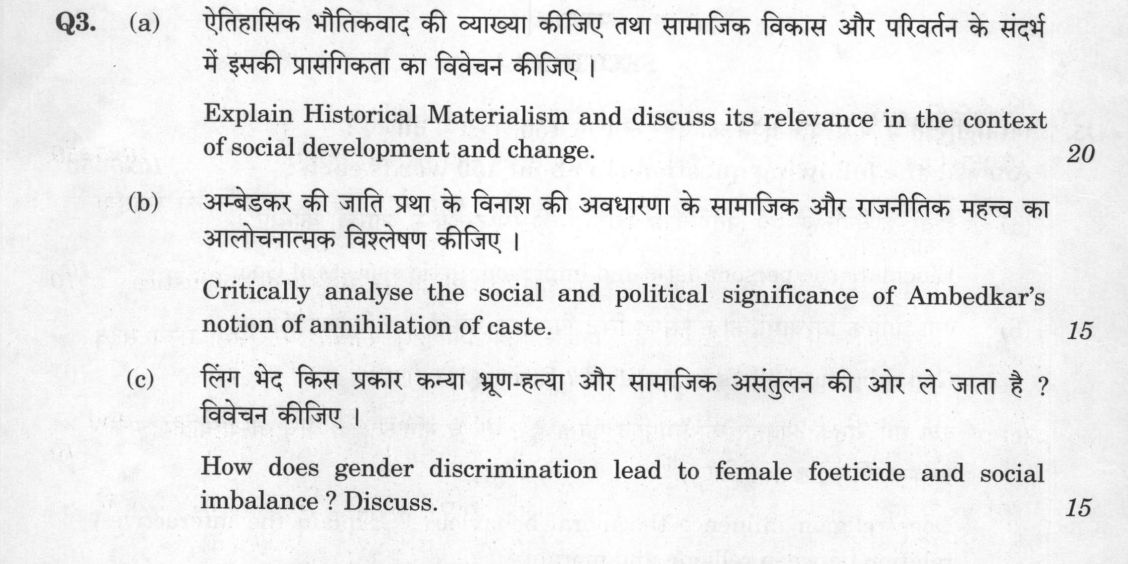
(a) Explain Historical Materialism and discuss its relevance in the context of social development and change. (20 marks) (b)…
Explain Historical Materialism and discuss its relevance in the context of social development and change. 20 marks
Critically analyse the social and political significance of Ambedkar's notion of annihilation of caste. 15 marks
How does gender discrimination lead to female foeticide and social imbalance? Discuss. 15 marks
हिंदी में प्रश्न पढ़ें
ऐतिहासिक भौतिकवाद की व्याख्या कीजिए तथा सामाजिक विकास और परिवर्तन के संदर्भ में इसकी प्रासंगिकता का विवेचन कीजिए । (20 अंक)
अम्बेडकर की जाति प्रथा के विनाश की अवधारणा के सामाजिक और राजनीतिक महत्व का आलोचनात्मक विश्लेषण कीजिए । (15 अंक)
लिंग भेद किस प्रकार कन्या भ्रूण-हत्या और सामाजिक असंतुलन की ओर ले जाता है ? विवेचन कीजिए । (15 अंक)
Model answer
Written by UPSC Answer Check against this question's marking rubric, to the expected length. UPSC does not publish answers for Mains — this is one way to score well, not an official key.
Historical Materialism and Social Change
Karl Marx’s Historical Materialism posits that the economic base—comprising the forces and relations of production—conditions the juridical, political, and ideological superstructure. Social development is driven dialectically: as productive forces expand, they come into conflict with existing relations of production, generating class antagonisms that propel society through progressive epochs: primitive communism, slavery, feudalism, capitalism, and ultimately socialism.
In understanding social change, this framework illuminates post-colonial Indian agrarian transitions, where technological shifts like the Green Revolution transformed semi-feudal agrarian structures into rural capitalist relations, polarizing rich farmers and landless labour. Similarly, in the modern digital economy, the concentration of algorithmic capital creates a new urban precariat (gig workers), restructuring class dynamics. However, the model suffers from economic determinism. By reducing social reality to material substructures, it underplays non-economic variables—particularly caste hierarchies, religious consciousness, and autonomous political agency—as independent drivers of historical transformation.
Ambedkar’s Annihilation of Caste
B.R. Ambedkar’s Annihilation of Caste (1936) provides an ontological and structural critique of the Hindu social order. He distinguished caste from Marxian class: while class exhibits ungraded, horizontal exploitation, caste operates on "graded inequality", characterized by ascending reverence and descending contempt, which prevents unified collective resistance. For Ambedkar, caste is not merely a division of labour, but a division of labourers.
Socially, Ambedkar argued that genuine annihilation requires destroying the religious authority of the shastras that sanctify chaturvarnya. He identified inter-caste marriage (roti-beti vyavahar) as the definitive real remedy, as it fuses blood and dissolves alienation. Politically, his advocacy traversed from demanding separate electorates at the Round Table Conferences to the compromise of the Poona Pact (1932), which substituted separate electorates with reserved seats. This culminated in constitutional safeguards: Articles 15 and 17 (abolition of discrimination and untouchability) and Articles 330–342 (political and administrative reservations). Convinced that Hinduism could not reform internally, his 1956 conversion to Navayana Buddhism marked a final socio-spiritual departure toward equality and fraternity.
Gender Discrimination, Female Foeticide, and Social Imbalance
Female foeticide is the violent manifestation of structural gender discrimination. Rooted in patriarchal patriliny and property relations, sons are perceived as economic and ritual assets who inherit property and perform ancestral rites, while daughters are rendered financial liabilities due to the exploitative dowry system. This son preference, especially prevalent among land-owning and asset-holding classes, intersects with the misuse of medical technology. Affordable ultrasonography facilitates sex-selective abortions in violation of the Pre-Conception and Pre-Natal Diagnostic Techniques (PCPNDT) Act, 1994, and the Medical Termination of Pregnancy (MTP) Act, 1971.
This elimination of female foetuses results in acutely skewed sex ratios, historically visible in states like Haryana and Punjab. The resulting demographic deficit causes a profound "marriage squeeze", driving the cross-regional trafficking and commodification of brides (such as paro practices in north India). It accelerates gender-based violence, hyper-masculinizes public spaces, and compromises India’s demographic dividend by marginalizing female workforce participation. Remedying this requires rigorous enforcement of the PCPNDT Act alongside transformative state interventions like Beti Bachao Beti Padhao and equal inheritance rights under the Hindu Succession (Amendment) Act, 2005.
Comprehensive social progress requires an integrated approach: dismantling material inequalities as identified by Historical Materialism, eradicating caste-based graded hierarchies through Ambedkarite constitutionalism and social fusion, and deconstructing patriarchal norms to secure gender justice.
What "Explain" is asking you to do
Make the working of something clear — what sets it off, what follows from what, and what it produces. Explain is the Commission's mechanism word: it dominates the technical papers and the “explain why” stems, where the marks sit in the causal chain and not in the label.
Structure that answers it
State what it is → the initiating condition → the chain of cause, step by step → an instance where it plays out → what the chain produces
Where marks are lost
Describing what something looks like instead of why it works that way. Naming the stages without linking them reads as description too.
How this answer will be evaluated
Approach
(a) explain: definition/context > points in order > small example > short close | (b) critique: the claim > its strengths > its weaknesses > your judgment | (c) discuss: intro > 3-4 dimensions > example > balanced close Full marks: Precise technical vocabulary, strong counter-arguments, concrete application to moral/political problems.
Key points expected
- Define base and superstructure relationship
- Explain mode of production as driver of change
- Link class struggle to social transformation
- Apply theory to concrete social development
- Define 'annihilation' vs 'abolition' distinction
- Analyse social significance (inter-dining, inter-caste marriage)
- Analyse political significance (constitutional rights, representation)
- Present strongest counter-argument or limitation
Evaluation rubric
Each sub-part is marked on its own, against the marks and word limit printed on the paper.
- (a) Define Historical Materialism and discuss its relevance to social development and change. 20 marks
explain— definition/context → points in order → small example → short close
Must cover
- Define base and superstructure relationship
- Explain mode of production as driver of change
- Link class struggle to social transformation
- Apply theory to concrete social development
Loses marks
- Biographical details of Marx
- Vague paraphrase without technical terms
- Ignoring the 'relevance' aspect
Earns more
- Reference to Marx's 'Preface to A Contribution'
- Mention dialectical materialism as method
- Discuss historical stages (feudal to capitalist)
- Critique of idealist history
Extra mark
- Reference to 'German Ideology'
- Mention 'Capital' as application
- (b) Critically analyse the social and political significance of Ambedkar's annihilation of caste. 15 marks
critique— the claim → its strengths → its weaknesses → your judgment
Must cover
- Define 'annihilation' vs 'abolition' distinction
- Analyse social significance (inter-dining, inter-caste marriage)
- Analyse political significance (constitutional rights, representation)
- Present strongest counter-argument or limitation
Loses marks
- Biography of Ambedkar
- Confusing 'abolition' with 'annihilation'
- Ignoring the 'critical' analysis requirement
Earns more
- Reference to 'Annihilation of Caste' text
- Link to 'Jugaad' or 'Jugaad' (if applicable)
- Mention 'Poorna Swaraj' (if applicable)
- Discuss 'Depressed Classes' political mobilization
Extra mark
- Reference to 'Castes in India' (1916)
- Mention 'Bahishudt Hindu Mahasabha'
- (c) Discuss how gender discrimination leads to female foeticide and social imbalance. 15 marks
discuss— intro → 3-4 dimensions → example → balanced close
Must cover
- Link son preference to dowry and inheritance
- Explain mechanism of sex-selective abortion
- Discuss demographic consequences (sex ratio)
- Analyze social imbalance (bride shortage, trafficking)
Loses marks
- Vague generalities without specific mechanisms
- Ignoring the 'social imbalance' aspect
- Biographical details of activists
Earns more
- Reference to 'PCPNDT Act 1994'
- Mention 'Dowry Prohibition Act'
- Cite 'Census' data on sex ratio
- Discuss 'Son Preference' in rural India
Extra mark
- Reference to 'National Family Health Survey'
- Mention 'Child Marriage Prohibition Act'
Practice this exact question
Write your answer and it is marked point by point against the model answer above — what you covered, what you missed, what you got wrong.
Evaluate my answer →More from Philosophy 2023 Paper II
- Q1 Answer the following questions in about 150 words each: (a) What is meant by justice as f…
- Q2 (a) Elucidate why the absolute nature of sovereignty was rejected by Laski. (20 marks) (b…
- Q3 (a) Explain Historical Materialism and discuss its relevance in the context of social dev…
- Q4 (a) "Severity of punishment should be proportionate to the seriousness of the crime." — D…
- Q5 Answer the following questions in about 150 words each: (a) Elucidate the personalistic a…
- Q6 (a) Critically examine Plato's apriori proofs for the immortality of the soul. (20 marks)…