Paper II — Q7
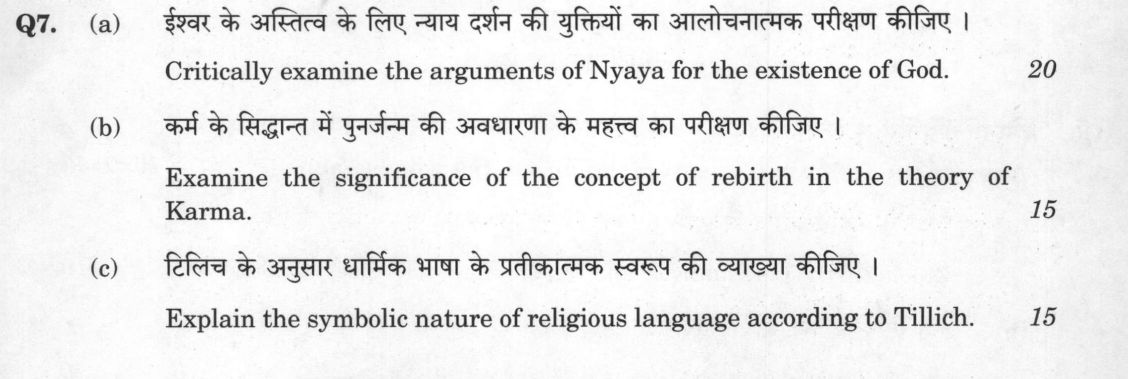
(a) Critically examine the arguments of Nyaya for the existence of God. (20 marks) (b) Examine the significance of the concept…
Critically examine the arguments of Nyaya for the existence of God. 20 marks
Examine the significance of the concept of rebirth in the theory of Karma. 15 marks
Explain the symbolic nature of religious language according to Tillich. 15 marks
हिंदी में प्रश्न पढ़ें
ईश्वर के अस्तित्व के लिए न्याय दर्शन की युक्तियों का आलोचनात्मक परीक्षण कीजिए । (20 अंक)
कर्म के सिद्धांत में पुनर्जन्म की अवधारणा के महत्व का परीक्षण कीजिए । (15 अंक)
टिलिच के अनुसार धार्मिक भाषा के प्रतीकात्मक स्वरूप की व्याख्या कीजिए । (15 अंक)
Model answer
Written by UPSC Answer Check against this question's marking rubric, to the expected length. UPSC does not publish answers for Mains — this is one way to score well, not an official key.
Nyāya’s proofs for Īśvara. Nyāya, especially in Udayana’s Nyāyakusumāñjali and later refined by Gaṅgeśa, argues that the world is not self-caused but requires an intelligent cause. The design argument observes the order, fitness and purpose in nature; the argument from adṛṣṭa/adrṣṭa holds that unseen moral forces produced by past actions need a conscious regulator; the authority of the Vedas presupposes a reliable divine source; cosmological order requires an intelligent governor; and moral experience needs a dispenser who rewards and punishes. Nyāya thus identifies Īśvara as omniscient, omnipotent and morally perfect.
Critically, these proofs are not conclusive. Buddhist thinkers such as Dharmakīrti, and Cārvāka materialists, object that a creator causes a regression: if the world needs a cause, why does Īśvara not need one? They also challenge the inference from order to intelligence, since natural causation can explain regularity without a designer. The adṛṣṭa argument is circular if it assumes unseen moral forces already dependent on a divine agent, and the Veda argument is vulnerable to the objection that scriptural authority cannot prove itself. Moreover, Nyāya’s proof of omniscience is difficult: finite observation cannot establish infinite knowledge, and a morally perfect God does not automatically explain evil. A fair verdict is that Nyāya gives a coherent theistic epistemology, but its arguments remain probabilistic and contested rather than demonstrative.
Rebirth in the theory of Karma. Rebirth (punarbhava/punarjanma) is significant because karma requires a subject who can experience the fruits of actions across time. If life ended with death, many actions would remain unfructified, and apparent injustice would be inexplicable. Rebirth supplies the continuity needed for karmic fruition. The distinction between sancita (stored karma), prārabdha (karma already bearing fruit in the present life) and āgāmi (new karma created by present action) shows how past, present and future moral responsibility interlock. In Sāṅkhya-Yoga, rebirth is tied to the soul’s bondage and liberation; in Vedānta, it is the arena in which ignorance is removed and mokṣa attained; in Jainism, it is governed by subtle karmic particles and ethical discipline. Mīmāṃsā’s early position was ambiguous, while Cārvāka rejected rebirth as unverifiable. Ethically, rebirth makes action serious: present conduct shapes future existence, so mokṣa-oriented action must be disciplined, non-attached and morally responsible.
Tillich’s symbolic religious language. Tillich distinguishes symbols from signs. A sign points to something else but does not participate in it; a symbol opens the symbolizer to the symbolized and participates in the reality it represents. Religious language is therefore non-literal yet non-arbitrary: it does not make factual claims in the same way as science, but it expresses ultimate concern. For Tillich, “God” is the symbol of ultimate concern, not a being among beings. This approach overcomes literalistic atheism, because the atheist who denies a literal creator may still be confronted with the reality of ultimate concern. It also differs from Braithwaite’s non-cognitivism, which treats religious statements as expressions of commitment, and from Wittgenstein’s language games, which stresses rule-governed use within forms of life. Tillich preserves the cognitive depth of religious symbols while avoiding naïve literalism.
Conclusion. Taken together, these positions show three solutions to religious epistemology and language. Nyāya offers literal theism supported by inference and scriptural authority; karma-rebirth provides a metaphysical framework for moral causation and justice; Tillich reinterprets religious assertions symbolically. The critical finding is that Nyāya’s arguments are philosophically respectable but not decisive, rebirth is indispensable to karma’s moral coherence, and Tillich’s symbolism offers a more defensible account of religious language in a pluralistic age.
What "Critically examine" is asking you to do
Test the proposition the question puts to you and return a finding on how far it holds. Examine stems carry a claim, or ask whether something has happened, and expect evidence weighed both ways before the extent is stated — often with remedial measures attached. “Critically” is not a section added at the end: name the yardstick you are judging by — the evidence, the stated objective, a constitutional principle, a rival explanation — and let a verdict close each part of the body. Where the question quotes a claim, that verdict must land on the claim itself, accepted, qualified or rejected, and not on the theme in general.
Structure that answers it
Restate the claim as the question frames it → evidence that supports it → evidence that undercuts it → the conditions under which it holds → verdict on how far it stands
Where marks are lost
Merits in one paragraph, demerits in the next, and a conclusion calling for a balanced and holistic approach. That is a survey with the judgement left out and it holds the answer in the middle band. The opposite error is reading “critically” as permission to attack — and with the odd pairings, critically describe or critically explain, the exposition still carries most of the marks, the judgement being a layer on it rather than a substitute for it.
How this answer will be evaluated
Approach
Framework: UPSC Philosophy Paper II. (a) critique: the claim > its strengths > its weaknesses > your judgment | (b) examine: intro > how/why with reasoning > evidence > conclusion | (c) explain: definition/context > points in order > small example > short close Full marks: Clear, logical, and well-structured answer with precise terminology and strong counter-arguments.
Key points expected
- Reconstruct the Nyaya argument for God (Ishvara) as a creator
- Identify the specific Nyaya sutras or logical steps used
- Present the strongest counter-argument (e.g., from Samkhya or Buddhist logic)
- Provide a final judgment on the argument's validity
- Define the concept of rebirth (punarjanma) in the context of Karma
- Explain how rebirth is necessary for the theory of Karma to function
- Discuss the relationship between past actions and present circumstances
- Provide a conclusion on the significance of rebirth in Karma theory
Evaluation rubric
Each sub-part is marked on its own, against the marks and word limit printed on the paper.
- (a) Reconstruct Nyaya's arguments for God's existence and evaluate their logical validity. 20 marks
critique— the claim → its strengths → its weaknesses → your judgment
Must cover
- Reconstruct the Nyaya argument for God (Ishvara) as a creator
- Identify the specific Nyaya sutras or logical steps used
- Present the strongest counter-argument (e.g., from Samkhya or Buddhist logic)
- Provide a final judgment on the argument's validity
Loses marks
- Biographical details of the Nyaya founder
- Vague paraphrase of the argument without logical structure
- Confusing Nyaya with other schools of Indian philosophy
Earns more
- Mention the 'Nyaya Sutra' or 'Vaisesika' context
- Reference the 'Saptapada' (seven steps) of the Nyaya argument
- Distinguish between God as creator and God as sustainer
- Use precise Sanskrit terms like 'Ishvara' or 'Kartri'
Extra mark
- Cite a specific verse from the Nyaya Sutras
- Reference a specific modern scholar's critique of Nyaya
- (b) Analyze the role of rebirth (punarjanma) in the theory of Karma. 15 marks
examine— intro → how/why with reasoning → evidence → conclusion
Must cover
- Define the concept of rebirth (punarjanma) in the context of Karma
- Explain how rebirth is necessary for the theory of Karma to function
- Discuss the relationship between past actions and present circumstances
- Provide a conclusion on the significance of rebirth in Karma theory
Loses marks
- Biographical details of the Buddha or other religious figures
- Vague paraphrase of the concept without logical structure
- Confusing Karma with other concepts like 'Dharma' or 'Moksha'
Earns more
- Mention the concept of 'Samsara' (cycle of birth and death)
- Reference the 'Karma Phala' (fruit of action) concept
- Distinguish between 'Sanchita', 'Prarabdha', and 'Agami' karma
- Use precise Sanskrit terms like 'Punarjanma' or 'Karma'
Extra mark
- Cite a specific verse from the Bhagavad Gita on Karma and rebirth
- Reference a specific modern scholar's interpretation of Karma and rebirth
- (c) Explain the symbolic nature of religious language according to Tillich. 15 marks
explain— definition/context → points in order → small example → short close
Must cover
- Define the concept of 'symbolic language' in Tillich's philosophy
- Explain how religious language is symbolic rather than literal
- Discuss the function of symbols in religious experience
- Provide a conclusion on the significance of symbolic language in religion
Loses marks
- Biographical details of Tillich
- Vague paraphrase of the concept without logical structure
- Confusing Tillich's symbolic language with other philosophical concepts
Earns more
- Mention the concept of 'Ultimate Concern' in Tillich's philosophy
- Reference the 'New Being' concept in Tillich's theology
- Distinguish between 'symbolic' and 'literal' language in religion
- Use precise terms like 'Symbol' or 'Ultimate Concern'
Extra mark
- Cite a specific verse from Tillich's 'Systematic Theology'
- Reference a specific modern scholar's interpretation of Tillich's symbolic language
Practice this exact question
Write your answer and it is marked point by point against the model answer above — what you covered, what you missed, what you got wrong.
Evaluate my answer →More from Philosophy 2023 Paper II
- Q4 (a) "Severity of punishment should be proportionate to the seriousness of the crime." — D…
- Q5 Answer the following questions in about 150 words each: (a) Elucidate the personalistic a…
- Q6 (a) Critically examine Plato's apriori proofs for the immortality of the soul. (20 marks)…
- Q7 (a) Critically examine the arguments of Nyaya for the existence of God. (20 marks) (b) Ex…
- Q8 (a) "All evil is either sin or punishment for sin." – St. Augustine. Critically discuss.…