Paper II — Q4
(a) "Severity of punishment should be proportionate to the seriousness of the crime." — Do you agree that while punishing a…
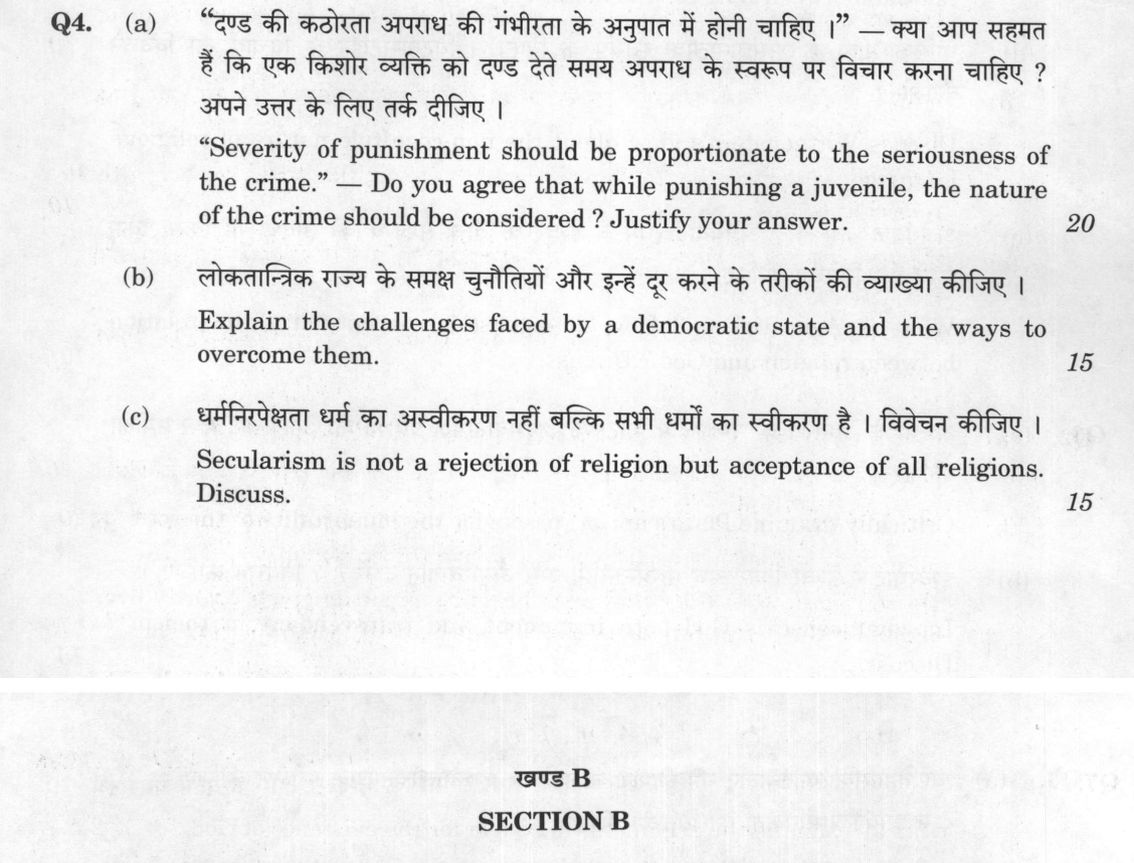
"Severity of punishment should be proportionate to the seriousness of the crime." — Do you agree that while punishing a juvenile, the nature of the crime should be considered? Justify your answer. 20 marks
Explain the challenges faced by a democratic state and the ways to overcome them. 15 marks
Secularism is not a rejection of religion but acceptance of all religions. Discuss. 15 marks
हिंदी में प्रश्न पढ़ें
"दण्ड की कठोरता अपराध की गंभीरता के अनुपात में होनी चाहिए ।" — क्या आप सहमत हैं कि एक किशोर व्यक्ति को दण्ड देते समय अपराध के स्वरूप पर विचार करना चाहिए ? अपने उत्तर के लिए तर्क दीजिए । (20 अंक)
लोकतांत्रिक राज्य के समक्ष चुनौतियों और इन्हें दूर करने के तरीकों की व्याख्या कीजिए । (15 अंक)
धर्मनिरपेक्षता धर्म का अस्वीकरण नहीं बल्कि सभी धर्मों का स्वीकरण है । विवेचन कीजिए । (15 अंक)
Model answer
Written by UPSC Answer Check against this question's marking rubric, to the expected length. UPSC does not publish answers for Mains — this is one way to score well, not an official key.
Justice, democratic governance, and secular coexistence form the tripartite foundation of a modern constitutional order, each confronting the fundamental philosophical challenge of harmonizing individual rights with collective welfare and moral equity.
Proportionality and Juvenile Justice
The classical penal doctrine of proportionality—rooted in lex talionis and retributive justice—demands that punishment mirror the gravity of the offense. However, in juvenile jurisprudence, this retributive calculus must be reconciled with reformative theory. While the nature of the crime cannot be wholly ignored, culpability must be viewed through the lens of developmental psychology. Neuroscience demonstrates that the adolescent prefrontal cortex is not fully developed, diminishing impulse control and moral culpability, an empirical reality recognized by the US Supreme Court in Roper v. Simmons (2005).
In India, the post-Nirbhaya discourse led to the Juvenile Justice (Care and Protection of Children) Act, 2015, which created an exception allowing children aged 16 to 18 accused of "heinous crimes" to be tried as adults following a preliminary assessment. The obvious objection to this mechanism is that judging a juvenile based on the crime's brutality risks collapsing the rehabilitative ethos into pure retribution. Nevertheless, considering the nature of the crime is justified when it functions not as an automatic adult transfer, but as an inquiry into individualized cognitive maturity (mens rea) and moral agency, as reinforced by the Indian Supreme Court in Barun Chandra Thakur v. Master Bholu (2022). Factoring in the seriousness of the act allows the legal system to uphold proportional deterrence while preserving rehabilitative pathways for reformable adolescents.
Challenges Faced by a Democratic State and Remedies
Contemporary democratic states confront profound structural strains: majoritarianism that sidelines minority voices, populist appeals that bypass institutional norms, and the erosion of deliberative parliamentary culture. The money-power nexus, highlighted by controversies around electoral bonds, skews political representation, while dilemmas surrounding the Tenth Schedule (anti-defection law) curb intra-party dissent. Furthermore, digital misinformation and algorithmic polarization degrade reasoned public discourse.
Overcoming these challenges requires institutional and normative regeneration. First, cultivating B.R. Ambedkar’s concept of "constitutional morality" is vital to ensure self-restraint, respect for pluralism, and fidelity to institutional processes. Second, deliberative democracy must be revived by strengthening parliamentary standing committees and citizen consultation mechanisms. Third, robust electoral reforms—such as state funding of elections and regulating political donations—must decouple capital from political influence. Finally, institutionalizing digital media literacy and safeguarding an independent civil society are essential to ensure constant public accountability between election cycles.
Secularism: Acceptance of All Religions
Unlike the Western Enlightenment model that establishes a strict "wall of separation" between Church and State, Indian secularism is rooted in Sarva Dharma Sambhava (equal respect for all faiths). As reflected in Mahatma Gandhi’s conception of *Ram Rajya*—an ethical, pluralistic public sphere rather than a theocratic state—and Dharampal’s documentation of pre-colonial communitarian coexistence, Indian secularism does not banish religion from the public realm. Instead, it practices principled, non-discriminatory engagement with all faiths.
Under this framework, the Indian Supreme Court utilizes the "essential religious practices" doctrine to permit state-led social reform while protecting genuine religious freedoms. However, this equal-respect model generates operational tensions between theological deference and universal rights. Landmark flashpoints—such as the Shah Bano case regarding uniform civil rights, the Ayodhya title dispute, and the Hijab controversy regarding secular institutional spaces—illustrate the delicate challenge of maintaining state neutrality without permitting internal group hierarchies to override individual constitutional liberties.
Ultimately, proportionate juvenile justice, deliberative democratic institutions, and an inclusive secular fabric converge to sustain a humane, rights-respecting constitutional democracy dedicated to moral progress and social harmony.
What "Justify" is asking you to do
Defend a position with reasons that carry evidence, and show why the contrary view does not hold. Where the stem runs as a question and asks you to justify your answer, the position is yours to choose and the marks lie wholly in the defence.
Structure that answers it
Position stated plainly → reason 1 with evidence → reason 2 with evidence → strongest objection, met → position restated as qualified
Where marks are lost
Reasons stated and none of them evidenced. The other standard loss is fence-sitting — an answer that finds merit on both sides and commits to neither has justified nothing.
How this answer will be evaluated
Approach
Framework: Philosophy, Paper 2 (Political Philosophy & Ethics). (a) justify: claim > 3-4 reasons > evidence > conclusion | (b) challenges: 3-4 challenges > solutions mapped to them > conclusion | (c) discuss: intro > 3-4 dimensions > example > balanced close Full marks: Precise, well-structured arguments with specific examples and clear conclusions.
Key points expected
- State a clear position on the proportionality of punishment for juveniles.
- Provide 3-4 distinct reasons supporting the chosen position.
- Apply the argument to the specific context of juvenile justice.
- Conclude with a definitive judgment.
- Identify 3-4 specific challenges faced by democratic states.
- Map specific solutions to each identified challenge.
- Provide a clear conclusion on the viability of these solutions.
- Maintain a logical flow from problem to solution.
Evaluation rubric
Each sub-part is marked on its own, against the marks and word limit printed on the paper.
- (a) Justify the position on whether the nature of the crime should be considered when punishing a juvenile. 20 marks
justify— claim → 3-4 reasons → evidence → conclusion
Must cover
- State a clear position on the proportionality of punishment for juveniles.
- Provide 3-4 distinct reasons supporting the chosen position.
- Apply the argument to the specific context of juvenile justice.
- Conclude with a definitive judgment.
Loses marks
- Failing to address the specific 'juvenile' context.
- Vague generalities without specific reasons.
- Ignoring the 'nature of the crime' aspect.
Earns more
- Reference to the 'best interest of the child' principle.
- Distinction between retributive and restorative justice.
- Mention of the Juvenile Justice (JJ) Act.
- Discussion of the 'doli incapax' doctrine.
Extra mark
- Citation of a specific Supreme Court judgment on juvenile crime.
- Reference to the UN Convention on the Rights of the Child (UNCRC).
- (b) Explain the challenges faced by a democratic state and the ways to overcome them. 15 marks
challenges— 3-4 challenges → solutions mapped to them → conclusion
Must cover
- Identify 3-4 specific challenges faced by democratic states.
- Map specific solutions to each identified challenge.
- Provide a clear conclusion on the viability of these solutions.
- Maintain a logical flow from problem to solution.
Loses marks
- Listing challenges without corresponding solutions.
- Vague or generic statements about 'democracy'.
- Failing to distinguish between 'democratic state' and 'democratic government'.
Earns more
- Mention of 'populism' or 'majoritarianism' as a challenge.
- Reference to 'judicial activism' or 'legislative gridlock'.
- Discussion of 'electoral reform' as a solution.
- Mention of 'civic education' or 'media literacy'.
Extra mark
- Reference to a specific democratic crisis (e.g., Weimar Republic).
- Citation of a specific constitutional mechanism for overcoming a challenge.
- (c) Discuss the statement that secularism is not a rejection of religion but acceptance of all religions. 15 marks
discuss— intro → 3-4 dimensions → example → balanced close
Must cover
- Define secularism in the context of the Indian Constitution.
- Analyze 3-4 dimensions of the relationship between the state and religion.
- Provide a concrete example of state neutrality or accommodation.
- Conclude with a balanced view on the nature of secularism.
Loses marks
- Confusing secularism with atheism or anti-religion.
- Failing to address the 'acceptance of all religions' part of the statement.
- Vague or general statements without specific examples.
Earns more
- Distinction between 'Western secularism' and 'Indian secularism'.
- Reference to 'Article 25' to 'Article 28' of the Constitution.
- Mention of 'equal respect' or 'equal distance' from all religions.
- Discussion of 'religious freedom' vs. 'state atheism'.
Extra mark
- Citation of a specific Supreme Court case on secularism (e.g., S.R. Bommai).
- Reference to the 'Preamble' of the Constitution.
Practice this exact question
Write your answer and it is marked point by point against the model answer above — what you covered, what you missed, what you got wrong.
Evaluate my answer →More from Philosophy 2023 Paper II
- Q1 Answer the following questions in about 150 words each: (a) What is meant by justice as f…
- Q2 (a) Elucidate why the absolute nature of sovereignty was rejected by Laski. (20 marks) (b…
- Q3 (a) Explain Historical Materialism and discuss its relevance in the context of social dev…
- Q4 (a) "Severity of punishment should be proportionate to the seriousness of the crime." — D…
- Q5 Answer the following questions in about 150 words each: (a) Elucidate the personalistic a…
- Q6 (a) Critically examine Plato's apriori proofs for the immortality of the soul. (20 marks)…
- Q7 (a) Critically examine the arguments of Nyaya for the existence of God. (20 marks) (b) Ex…