Paper I — Q1
Answer the following questions in about 150 words each: (a) Differentiate between Plato's and Aristotle's conceptions of form…
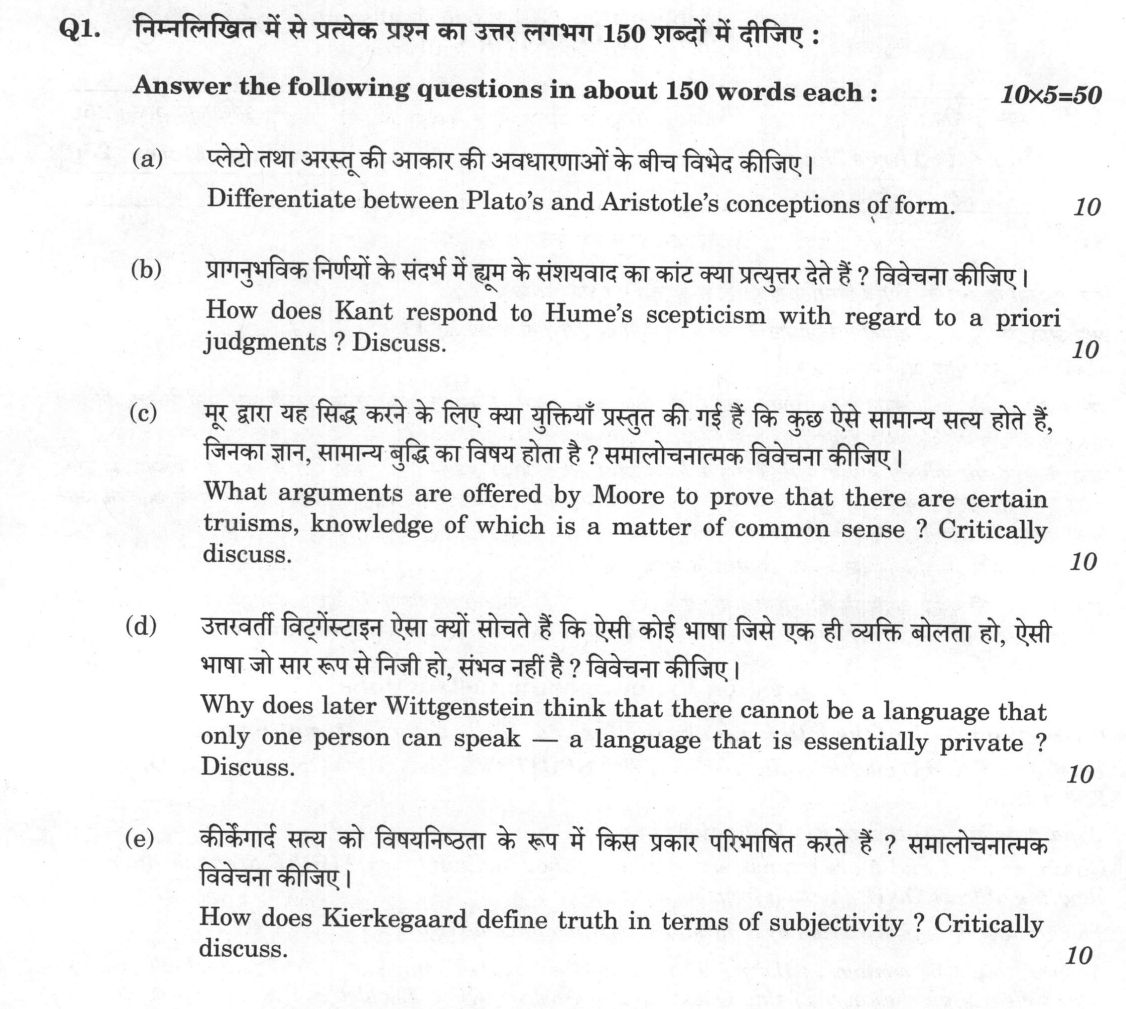
Answer the following questions in about 150 words each:
Differentiate between Plato's and Aristotle's conceptions of form. 10 marks
How does Kant respond to Hume's scepticism with regard to a priori judgments ? Discuss. 10 marks
What arguments are offered by Moore to prove that there are certain truisms, knowledge of which is a matter of common sense ? Critically discuss. 10 marks
Why does later Wittgenstein think that there cannot be a language that only one person can speak — a language that is essentially private ? Discuss. 10 marks
How does Kierkegaard define truth in terms of subjectivity ? Critically discuss. 10 marks
हिंदी में प्रश्न पढ़ें
निम्नलिखित में से प्रत्येक प्रश्न का उत्तर लगभग 150 शब्दों में दीजिए :
प्लेटो तथा अरस्तु की आकार की अवधारणाओं के बीच विभेद कीजिए। 10 अंक
प्रागनुभविक निर्णयों के संदर्भ में ह्यूम के संशयवाद का कांट क्या प्रत्युत्तर देते हैं ? विवेचना कीजिए। 10 अंक
मूर द्वारा यह सिद्ध करने के लिए क्या युक्तियाँ प्रस्तुत की गई हैं कि कुछ ऐसे सामान्य सत्य होते हैं, जिनका ज्ञान, सामान्य बुद्धि का विषय होता है ? समालोचनात्मक विवेचना कीजिए। 10 अंक
उत्तरवर्ती विट्टगेंस्टाइन ऐसा क्यों सोचते हैं कि ऐसी कोई भाषा जिसे एक ही व्यक्ति बोलता हो, ऐसी भाषा जो सार रूप से निजी हो, संभव नहीं है ? विवेचना कीजिए। 10 अंक
कीर्केगार्ड सत्य को विषयनिष्ठता के रूप में किस प्रकार परिभाषित करते हैं ? समालोचनात्मक विवेचना कीजिए। 10 अंक
Model answer
Written by UPSC Answer Check against this question's marking rubric, to the 150-word length. UPSC does not publish answers for Mains — this is one way to score well, not an official key.
(a) Plato's and Aristotle's Conceptions of Form
Plato conceives Forms (Eide) as transcendent, eternal, and immutable archetypes residing in a separate intelligible realm, independent of spatiotemporal particulars. Sensible objects are mere imperfect copies that exist by participating in (methexis) or imitating (mimesis) these Forms. Consequently, genuine knowledge (episteme) is attained not through sense experience, but through intellectual recollection (anamnesis).
Conversely, Aristotle rejects this transcendent dualism through his doctrine of hylomorphism, arguing that forms are immanent principles inseparable from primary substances (ousia). Form constitutes the actualizing principle (entelecheia) of prime matter (dynamis), determining an object's essence, function, and telos. Except for the pure actuality of the Prime Mover, form never exists independently of matter. Epistemologically, Aristotle substitutes Platonic recollection with empirical abstraction (epagoge), deriving universal forms directly from sensory particulars. While Plato’s transcendent model explains objective moral ideals, Aristotle’s immanent formulation provides a more coherent metaphysical grounding for change, natural sciences, and the physical world.
(b) Kant's Response to Hume on A Priori Judgments
David Hume's radical empiricism divided knowledge into relations of ideas (analytic a priori) and matters of fact (synthetic a posteriori), asserting that necessary connections like causation are mere psychological habits derived from constant conjunction, thereby undermining metaphysical and scientific certainty.
Immanuel Kant responds by executing a "Copernican Revolution" in epistemology, establishing the possibility of synthetic a priori judgments. Rather than the mind passively conforming to external objects, objects must conform to the cognitive apparatus of the subject. Kant demonstrates that while all knowledge begins with experience, it does not originate from experience. Pure forms of sensible intuition (space and time) and twelve pure categories of the understanding (including causality and substance) function as necessary, universal a priori conditions for the very possibility of coherent experience (transcendental deduction).
Kant successfully rescues Newtonian science and mathematical certainty from Humean scepticism, though at the critical cost of limiting genuine knowledge to the phenomenal realm while declaring the noumenal thing-in-itself strictly unknowable.
(c) Moore's Defence of Common Sense Truisms
G. E. Moore, in A Defence of Common Sense and Proof of an External World, defends direct realism against absolute idealism and Cartesian scepticism by enumerating a list of mundane "truisms." These include the propositions that he possesses a living human body, that this body existed in the past, and that an external world of material objects and other minds exists independently of perception.
Moore argues through ordinary language analysis that the certainty of these common-sense truisms is far greater than the plausibility of any abstract metaphysical premises used to deny them. He famously provides an ostensive proof of an external world by holding up his two hands.
Critically, while Moore effectively exposes the unlivable artificiality of radical scepticism, his argument borders on dogmatism by confusing subjective psychological certainty with rigorous philosophical justification. As Ludwig Wittgenstein noted in On Certainty, Moore’s truisms are not empirical propositions awaiting proof, but rather ungrounded, non-epistemic "hinges" that form the scaffolding of all inquiry.
(d) Later Wittgenstein on Private Language
In Philosophical Investigations, Ludwig Wittgenstein rejects the possibility of an essentially private language—one whose words refer to sensations accessible solely to the solitary speaker, such that another person cannot understand it.
Wittgenstein’s critique rests on rule-following and the need for normative correctness. Using language requires following rules; however, to follow a rule requires a meaningful distinction between being right and merely thinking one is right. In a purely private realm, the speaker has no independent, objective criterion or standard of verification to validate whether a sign is applied consistently over time, collapsing the distinction between correctness and the illusion of correctness.
Using the "beetle-in-the-box" analogy, Wittgenstein demonstrates that if an inner sensation has no public behavioral manifestation, it drops out of consideration as semantically irrelevant. Meaning is not an act of private mental ostension, but a socially scaffolded enterprise grounded in public criteria, shared human forms of life (Lebensformen), and interactive language-games.
(e) Kierkegaard on Truth as Subjectivity
In Concluding Unscientific Postscript, Søren Kierkegaard defines truth not as objective, propositional accuracy, but as "an objective uncertainty, held fast through appropriation with the most passionate inwardness." He launches a trenchant critique against Hegelian speculative idealism, arguing that comprehensive objective systems reduce the concrete, existing individual to an abstract spectator, neutralizing personal ethical responsibility.
For Kierkegaard, existential and religious truths cannot be settled by detached rational inquiry or empirical proofs. Truth emerges dynamically through the subject's mode of relation to the object: the how of belief supersedes the what. Navigating existence through the aesthetic and ethical stages culminates in the religious stage, which requires an existential "leap of faith" across the abyss of rational paradox, exemplified by Abraham.
Critically, Kierkegaard's formulation risks collapsing into radical fideism, unbridled irrationalism, and ethical relativism. Nevertheless, it remains a profound corrective to systemic dogmatism, restoring personal authenticity, lived commitment, and passionate inward decision as the core constituents of human existence.
What "Critically discuss" is asking you to do
Lay the issue out from more than one side — how it arose, what is claimed for it, what is held against it, and where it now stands. UPSC attaches discuss to broad topics with several live dimensions, so coverage of the dimensions earns more than the strength of your opinion. “Critically” is not a section added at the end: name the yardstick you are judging by — the evidence, the stated objective, a constitutional principle, a rival explanation — and let a verdict close each part of the body. Where the question quotes a claim, that verdict must land on the claim itself, accepted, qualified or rejected, and not on the theme in general.
Structure that answers it
Set the issue up → the case as it is made → the case against → the dimension both sides leave out → where the balance now lies
Where marks are lost
Merits in one paragraph, demerits in the next, and a conclusion calling for a balanced and holistic approach. That is a survey with the judgement left out and it holds the answer in the middle band. The opposite error is reading “critically” as permission to attack — and with the odd pairings, critically describe or critically explain, the exposition still carries most of the marks, the judgement being a layer on it rather than a substitute for it.
How this answer will be evaluated
Approach
Framework: UPSC Philosophy Paper I Rubric. (a) compare: paired headings or table > key differences > significance > conclusion | (b) discuss: intro > 3-4 dimensions > example > balanced close | (c) critique: the claim > its strengths > its weaknesses > your judgment | (d) discuss: intro > 3-4 dimensions > example > balanced close | (e) critique: the claim > its strengths > its weaknesses > your judgment Full marks: Precise technical vocabulary, clear argument reconstruction, strong counter-arguments, and exact references to primary texts.
Key points expected
- Plato's Forms as transcendent and separate (choris)
- Aristotle's Forms as immanent in matter (hyle)
- Distinction between 'what it is to be' and 'what it is'
- Reference to the 'Third Man' argument or critique of separation
- Hume's distinction between analytic and synthetic judgments
- Hume's skepticism regarding causality and induction
- Kant's 'Copernican Revolution' or transcendental idealism
- Role of a priori intuitions (space/time) and categories
Evaluation rubric
Each sub-part is marked on its own, against the marks and word limit printed on the paper.
- (a) Contrast the ontological status and location of Form in both philosophers. 10 marks · 150 words
compare— paired headings or table → key differences → significance → conclusion
Must cover
- Plato's Forms as transcendent and separate (choris)
- Aristotle's Forms as immanent in matter (hyle)
- Distinction between 'what it is to be' and 'what it is'
- Reference to the 'Third Man' argument or critique of separation
Loses marks
- Biographical details of Plato or Aristotle
- Vague paraphrase without technical terms
- Confusing 'Form' with 'Idea' in a non-technical sense
Earns more
- Use of Greek terms: eidos, ousia, hyle
- Mention of the 'Parasite' or 'Homunculus' objection
- Reference to the 'Matter-Form' composite (synolon)
Extra mark
- Citation of specific Metaphysics book (e.g., Book I or VII)
- (b) Explain Kant's solution to the problem of synthetic a priori knowledge. 10 marks · 150 words
discuss— intro → 3-4 dimensions → example → balanced close
Must cover
- Hume's distinction between analytic and synthetic judgments
- Hume's skepticism regarding causality and induction
- Kant's 'Copernican Revolution' or transcendental idealism
- Role of a priori intuitions (space/time) and categories
Loses marks
- Confusing Kant with Hume's empiricism
- Failing to define 'a priori' and 'synthetic'
- Biographical details of the 'Enlightenment' context
Earns more
- Reference to the 'Transcendental Deduction'
- Mention of the 'Schematism' of the categories
- Use of the term 'synthetic a priori'
Extra mark
- Reference to the 'Critique of Pure Reason' (A/B editions)
- (c) Evaluate Moore's 'common sense' defense against philosophical skepticism. 10 marks · 150 words
critique— the claim → its strengths → its weaknesses → your judgment
Must cover
- Moore's 'Proof of an External World' (hand example)
- The 'Open Question' or 'Truisms' (e.g., 'I am here')
- The 'Preposterousness' of the skeptic's premises
- Distinction between 'knowledge' and 'certainty'
Loses marks
- Confusing Moore with Russell or Wittgenstein
- Failing to explain the 'truisms' concept
- Biographical details of Moore's life
Earns more
- Reference to 'A Refutation of Idealism'
- Mention of the 'Moorean Shift' or 'Moorean Method'
- Critique of the 'Cartesian Circle'
Extra mark
- Reference to the 'Common Sense' essay (1925)
- (d) Explain Wittgenstein's argument against the possibility of a private language. 10 marks · 150 words
discuss— intro → 3-4 dimensions → example → balanced close
Must cover
- The 'Private Language Argument' (PLA) from the 'Philosophical Investigations'
- The 'Beetle in a Box' analogy
- The 'Rule-following' and 'Convention' argument
- The 'Sceptical Argument' about meaning
Loses marks
- Confusing 'Private Language' with 'Inner Sense'
- Failing to explain the 'Rule-following' aspect
- Biographical details of Wittgenstein's life
Earns more
- Reference to 'Philosophical Investigations' (PI) §243-315
- Mention of 'Language Games' (Sprachspiel)
- Use of the term 'Private Language'
Extra mark
- Reference to the 'Beetle' (Käfer) in German
- (e) Evaluate Kierkegaard's definition of truth as 'subjectivity' and its implications. 10 marks · 150 words
critique— the claim → its strengths → its weaknesses → your judgment
Must cover
- Kierkegaard's 'Subjectivity is Truth' (from 'Concluding Unscientific Postscript')
- The 'Infinite Passion' and 'Inwardness' (Indre)
- The 'Leap of Faith' and 'Existential Choice'
- Critique of 'Objective' or 'Systematic' truth (Hegel)
Loses marks
- Confusing Kierkegaard with Nietzsche or Heidegger
- Failing to explain the 'Subjectivity' concept
- Biographical details of Kierkegaard's life
Earns more
- Reference to 'Concluding Unscientific Postscript' (1846)
- Mention of 'The Sickness unto Death'
- Use of the term 'Subjectivity' (Subjektivitet)
Extra mark
- Reference to the 'Aesthetic', 'Ethical', and 'Religious' stages
Practice this exact question
Write your answer and it is marked point by point against the model answer above — what you covered, what you missed, what you got wrong.
Evaluate my answer →More from Philosophy 2024 Paper I
- Q1 Answer the following questions in about 150 words each: (a) Differentiate between Plato's…
- Q2 (a) Is rejection of Locke's notion of primary qualities instrumental in Berkeley's leanin…
- Q3 (a) Explain Russell's notion of incomplete symbols. Also explain how this notion leads to…
- Q4 (a) What do the existentialist thinkers mean by the slogan "existence precedes essence" ?…