Paper I — Q3
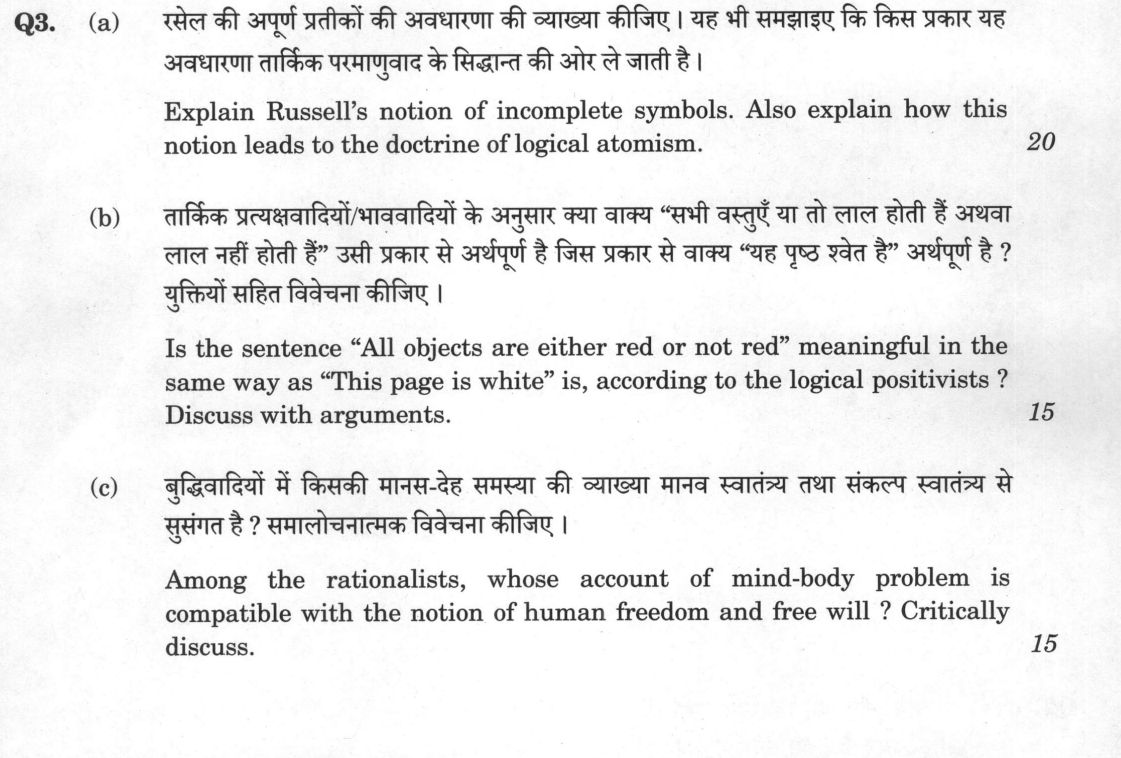
(a) Explain Russell's notion of incomplete symbols. Also explain how this notion leads to the doctrine of logical atomism. 20…
Explain Russell's notion of incomplete symbols. Also explain how this notion leads to the doctrine of logical atomism. 20 marks
Is the sentence "All objects are either red or not red" meaningful in the same way as "This page is white" is, according to the logical positivists ? Discuss with arguments. 15 marks
Among the rationalists, whose account of mind-body problem is compatible with the notion of human freedom and free will ? Critically discuss. 15 marks
हिंदी में प्रश्न पढ़ें
रसेल की अपूर्ण प्रतीकों की अवधारणा की व्याख्या कीजिए। यह भी समझाइए कि किस प्रकार यह अवधारणा तार्किक परमाणुवाद के सिद्धांत की ओर ले जाती है। 20 अंक
तार्किक प्रत्यक्षवादियों/भाववादियों के अनुसार क्या वाक्य "सभी वस्तुएं या तो लाल होती हैं अथवा लाल नहीं होती हैं" उसी प्रकार से अर्थपूर्ण है जिस प्रकार से वाक्य "यह पृष्ठ श्वेत है" अर्थपूर्ण है ? युक्तियों सहित विवेचना कीजिए। 15 अंक
बुद्धिवादियों में किसकी मानस-देह समस्या की व्याख्या मानव स्वातंत्र्य तथा संकल्प स्वातंत्र्य से सुसंगत है ? समालोचनात्मक विवेचना कीजिए। 15 अंक
Model answer
Written by UPSC Answer Check against this question's marking rubric, to the expected length. UPSC does not publish answers for Mains — this is one way to score well, not an official key.
Russell’s Incomplete Symbols and Logical Atomism
In Russell’s philosophy, an incomplete symbol is an expression that has no meaning in isolation but contributes to the meaning of the proposition in which it occurs. In Introduction to Mathematical Philosophy, Russell illustrates this through definite descriptions, such as "the present King of France," as well as class symbols. When analyzing "The present King of France is bald," Russell shows that ordinary grammar misleads us into treating the descriptive phrase as a genuine proper name pointing to an entity. Logically translated, the phrase unpacks into three distinct assertions: an existential claim, a uniqueness claim, and a property attribution. By demonstrating that the description disappears upon formal analysis, Russell avoids Alexius Meinong’s bloated ontology of non-existent objects.
This method directly generates Russell’s doctrine of Logical Atomism. Guided by his supreme maxim—"wherever possible, substitute constructions out of known entities for inferences to unknown entities"—philosophical analysis systematically eliminates grammatical illusions until it reaches ultimate, unanalyzable constituents. These basic elements are logical simples: particulars (apprehended by immediate acquaintance and denoted by logically proper names) and universals (predicates and relations). Simples combine to form atomic facts, which are mirrored by logically independent atomic propositions. Thus, the theory of incomplete symbols serves as the functional mechanism that strips away linguistic confusions to reveal the isomorphic correspondence between logical structure and metaphysical reality.
Meaningfulness in Logical Positivism
According to logical positivists like A.J. Ayer (Language, Truth and Logic), the sentences "All objects are either red or not red" and "This page is white" are both cognitively meaningful, but they are not meaningful in the same way. The verification principle divides all significant assertions into two distinct classes: analytic (tautological) and synthetic (empirical).
The sentence "All objects are either red or not red" is an analytic proposition grounded in the logical law of excluded middle (P ∨ ¬ P). It is logically true (L-true) solely in virtue of the definitions of its constituent terms and logical form. Its validity is independent of empirical experience; it is known a priori and cannot be refuted by observation, though it yields zero factual information about the empirical world.
Conversely, "This page is white" is a synthetic proposition. Its truth or falsity cannot be deduced from the meanings of the terms alone; rather, it depends on empirical facts. It is meaningful because sense-experience can verify or falsify it a posteriori. Thus, while both statements avoid the positivist charge of metaphysical meaninglessness, the former derives its meaning from formal-linguistic conventions, whereas the latter derives its meaning from experiential verification.
The Rationalist Mind-Body Problem and Free Will
Among the rationalists, Gottfried Wilhelm Leibniz provides the account of the mind-body relation most compatible with human freedom and free will.
René Descartes’ interactionist dualism locates mind-body contact in the pineal gland, but fails to reconcile how an immaterial soul (res cogitans) can freely exert causal force upon a mechanically determined physical body (res extensa) without violating physical conservation laws. Baruch Spinoza resolves dualism through substance monism and psycho-physical parallelism, where mind and body are attributes of one infinite Substance (God or Nature). However, Spinoza completely rejects free will as an illusion born of ignorance of causes; human freedom is reduced strictly to the intellectual recognition and acceptance of necessity (amor Dei intellectualis).
Leibniz’s doctrine of pre-established harmony best preserves human freedom through rational self-determination. For Leibniz, reality consists of non-physical, "windowless monads" that do not causally interact with one another. Because a human mind-monad is unaffected by external mechanical pushes, all its actions arise from its own internal principle of development—its perceptions and appetitions. Free actions are those where the agent acts spontaneously with reason and deliberation, guided by clear and distinct perceptions rather than confused passions.
Critically, Leibniz faces the objection that his doctrine of the "complete individual concept"—which holds that every predicate true of an individual is contained in its concept from eternity—leads to fatalism. Leibniz resolves this by distinguishing between absolute (geometrical) necessity, where the contrary involves a logical contradiction, and hypothetical or moral necessity, where an individual acts according to what seems best. Because human choices do not involve logical contradiction in their opposites, they incline the will without necessitating it, thereby safeguarding genuine moral responsibility and compatibilist free will.
What "Explain" is asking you to do
Make the working of something clear — what sets it off, what follows from what, and what it produces. Explain is the Commission's mechanism word: it dominates the technical papers and the “explain why” stems, where the marks sit in the causal chain and not in the label.
Structure that answers it
State what it is → the initiating condition → the chain of cause, step by step → an instance where it plays out → what the chain produces
Where marks are lost
Describing what something looks like instead of why it works that way. Naming the stages without linking them reads as description too.
How this answer will be evaluated
Approach
Framework: UPSC Philosophy Paper 1. (a) explain: definition/context > points in order > small example > short close | (b) discuss: intro > 3-4 dimensions > example > balanced close | (c) critique: the claim > its strengths > its weaknesses > your judgment Full marks: Precise technical vocabulary, clear logical reconstruction, strong counter-arguments, and Sanskrit/Greek terms where apt.
Key points expected
- Define 'incomplete symbol' (e.g., definite descriptions, quantifiers).
- Explain the 'context principle' (meaning only in context).
- Link to 'logical analysis' of ordinary language.
- Connect to 'logical atomism' (propositions as logical constructions).
- Define 'tautology' (analytic) vs. 'empirical' (synthetic).
- Apply 'verification principle' to both sentences.
- Distinguish 'logical sense' from 'empirical content'.
- Conclude on the difference in 'meaningfulness'.
Evaluation rubric
Each sub-part is marked on its own, against the marks and word limit printed on the paper.
- (a) Define incomplete symbols and trace the logical derivation to logical atomism. 20 marks
explain— definition/context → points in order → small example → short close
Must cover
- Define 'incomplete symbol' (e.g., definite descriptions, quantifiers).
- Explain the 'context principle' (meaning only in context).
- Link to 'logical analysis' of ordinary language.
- Connect to 'logical atomism' (propositions as logical constructions).
Loses marks
- Confusing 'incomplete symbols' with 'incomplete propositions'.
- Biographical details of Russell instead of logical analysis.
- Failing to explicitly link the two concepts.
Earns more
- Mention 'Theory of Descriptions' (1905).
- Reference 'On Denoting' or 'Principles of Mathematics'.
- Contrast with Frege's 'senses' and 'references'.
Extra mark
- Use Sanskrit term 'anupapatti' for logical inconsistency.
- Cite specific example: 'The present King of France is bald'.
- (b) Compare the meaningfulness of a tautology vs. an empirical statement. 15 marks
discuss— intro → 3-4 dimensions → example → balanced close
Must cover
- Define 'tautology' (analytic) vs. 'empirical' (synthetic).
- Apply 'verification principle' to both sentences.
- Distinguish 'logical sense' from 'empirical content'.
- Conclude on the difference in 'meaningfulness'.
Loses marks
- Treating tautologies as 'meaningless' without nuance.
- Ignoring the 'verification principle' entirely.
- Vague paraphrase of 'meaning' without technical definition.
Earns more
- Reference Carnap or Ayer's 'Language, Truth and Logic'.
- Mention 'cognitive significance' vs. 'logical form'.
- Discuss the 'demarcation criterion' of science.
Extra mark
- Use Sanskrit term 'svatah-siddha' for self-evident truth.
- Reference Wittgenstein's 'Tractatus' on tautologies.
- (c) Identify the rationalist whose mind-body view allows for free will. 15 marks
critique— the claim → its strengths → its weaknesses → your judgment
Must cover
- Identify the specific rationalist (e.g., Spinoza or Leibniz).
- Explain their 'mind-body' account (e.g., parallelism).
- Analyze compatibility with 'human freedom'.
- Provide a critical evaluation of this compatibility.
Loses marks
- Confusing 'rationalist' with 'empiricist' (e.g., Hume).
- Failing to define 'free will' in the context.
- Biographical summary instead of critical analysis.
Earns more
- Contrast with Descartes' 'interactionism'.
- Discuss 'pre-established harmony' (Leibniz).
- Reference 'conatus' (Spinoza) as a form of freedom.
Extra mark
- Use Sanskrit term 'svatantrya' for autonomy/freedom.
- Reference 'Monadology' or 'Ethics' specifically.
Practice this exact question
Write your answer and it is marked point by point against the model answer above — what you covered, what you missed, what you got wrong.
Evaluate my answer →More from Philosophy 2024 Paper I
- Q1 Answer the following questions in about 150 words each: (a) Differentiate between Plato's…
- Q2 (a) Is rejection of Locke's notion of primary qualities instrumental in Berkeley's leanin…
- Q3 (a) Explain Russell's notion of incomplete symbols. Also explain how this notion leads to…
- Q4 (a) What do the existentialist thinkers mean by the slogan "existence precedes essence" ?…
- Q5 Answer the following questions in about 150 words each: (a) Do you think Cārvāka's philos…
- Q6 (a) Differentiate between the Cārvākas' refutation of self as a transcendental category a…