Paper I — Q2
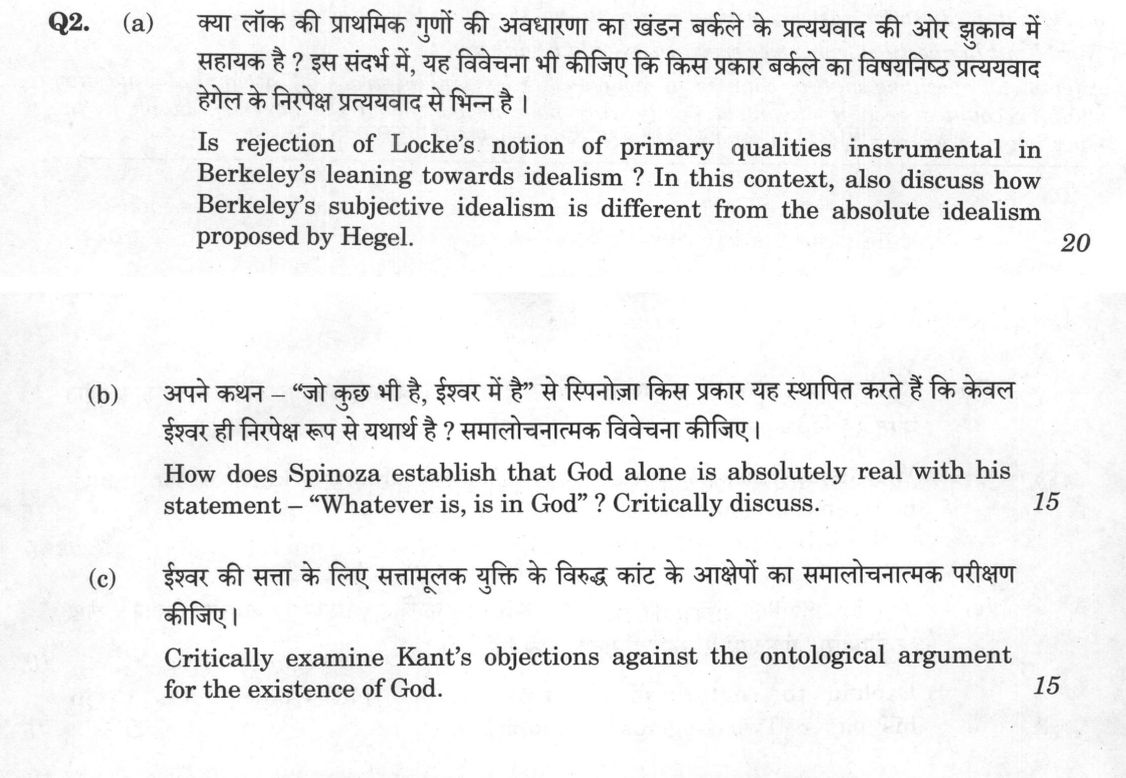
(a) Is rejection of Locke's notion of primary qualities instrumental in Berkeley's leaning towards idealism ? In this context…
Is rejection of Locke's notion of primary qualities instrumental in Berkeley's leaning towards idealism ? In this context, also discuss how Berkeley's subjective idealism is different from the absolute idealism proposed by Hegel. 20 marks
How does Spinoza establish that God alone is absolutely real with his statement – "Whatever is, is in God" ? Critically discuss. 15 marks
Critically examine Kant's objections against the ontological argument for the existence of God. 15 marks
हिंदी में प्रश्न पढ़ें
क्या लॉक की प्राथमिक गुणों की अवधारणा का खण्डन बर्कले के प्रत्ययवाद की ओर झुकाव में सहायक है ? इस संदर्भ में, यह विवेचना भी कीजिए किस प्रकार बर्कले का विषयनिष्ठ प्रत्ययवाद हेगेल के निरपेक्ष प्रत्ययवाद से भिन्न है। 20 अंक
अपने कथन – "जो कुछ भी है, ईश्वर में है" से स्पिनोजा किस प्रकार यह स्थापित करते हैं कि केवल ईश्वर ही निरपेक्ष रूप से यथार्थ है ? समालोचनात्मक विवेचना कीजिए। 15 अंक
ईश्वर की सत्ता के लिए सत्तामूलक युक्ति के विरुद्ध कांट के आक्षेपों का समालोचनात्मक परीक्षण कीजिए। 15 अंक
Model answer
Written by UPSC Answer Check against this question's marking rubric, to the expected length. UPSC does not publish answers for Mains — this is one way to score well, not an official key.
Idealism denies mind-independent matter as ultimate reality, ranging from Berkeley’s subjective idealism, where objects depend on perception and God, to Hegel’s absolute idealism, where reality is the self-developing rational structure of Spirit.
Berkeley and Locke Locke distinguishes primary qualities—extension, solidity, motion—from secondary qualities such as colour and taste. Primary qualities are mind-independent; secondary qualities are mind-dependent sensations. Berkeley’s immaterialism is instrumental in rejecting this distinction because he argues that even primary qualities cannot be conceived apart from perception. His master argument holds that one cannot think of an object as unperceived, since thinking of it is already perceiving it. If extension and solidity are inseparable from perceived ideas, there is no material substratum. Hence esse est percipi: finite objects exist only in being perceived, and their continued existence is secured by God. Thus perception becomes the ontological condition of existence.
Berkeley’s subjective idealism differs from Hegel’s absolute idealism. Berkeley’s world depends on finite perceivers and ultimately on God; reality is grounded in a personal divine mind. Hegel does not reduce reality to finite subjects. His absolute idealism understands reality as the dialectical unfolding of Geist through history, logic, nature and spirit. For Hegel, the absolute is not a perceiver of ideas but the rational whole coming to self-consciousness; subject and object are moments in its development, not opposed as mind and matter.
Spinoza Spinoza establishes that God alone is absolutely real by defining substance as causa sui, infinite in its kind. Since two substances cannot share the same attribute, and God has infinite attributes, no finite substance can exist independently. Thought and extension are attributes of one infinite substance, not separate substances, thereby rejecting Cartesian dualism. “Whatever is, is in God” means that all finite things are modes, i.e. modifications of God’s attributes, not independent beings. Natura naturans is God as the active causal ground; natura naturata is the system of modes following from God’s nature, not God as an effect. This yields a reading often called pantheistic, Deus sive Natura, though critics debate whether it is deistic or deterministic; in any case God is immanent, not a transcendent personal creator.
Kant Kant objects to the ontological argument by distinguishing analytic from synthetic judgments. A real predicate adds something to the concept of a subject; existence, however, is not a real predicate. To say “God exists” does not add a further property to the concept of God; it posits the object as actually given. His thalers example shows that one hundred real thalers contain no more predicates than one hundred possible thalers. He also distinguishes the “is” of predication from the “is” of existence, arguing that the argument confuses logical with real possibility: consistency does not imply reality.
Yet Kant’s critique must be examined critically. His thalers example concerns contingent objects, whose existence is merely posited; it may not apply to a necessary being, whose essence includes existence. If necessary existence differs from contingent existence, the argument may target a different kind of being. Hegelian responses reject the separation of concept and existence by treating existence as a moment of the absolute idea; Plantinga-style modal arguments reformulate it: if maximal greatness includes necessary existence in some possible world, then God exists in all worlds. Kant’s objection is powerful against the traditional move from concept to fact, but it does not refute every ontological reconstruction.
Thus Berkeley’s rejection of primary qualities supports idealism by eliminating matter, while Hegel’s idealism is absolute rather than subjective. Spinoza’s monism makes God the only substance, and Kant’s critique exposes a real weakness in the ontological argument, though counterarguments keep it contested.
What "Critically examine" is asking you to do
Test the proposition the question puts to you and return a finding on how far it holds. Examine stems carry a claim, or ask whether something has happened, and expect evidence weighed both ways before the extent is stated — often with remedial measures attached. “Critically” is not a section added at the end: name the yardstick you are judging by — the evidence, the stated objective, a constitutional principle, a rival explanation — and let a verdict close each part of the body. Where the question quotes a claim, that verdict must land on the claim itself, accepted, qualified or rejected, and not on the theme in general.
Structure that answers it
Restate the claim as the question frames it → evidence that supports it → evidence that undercuts it → the conditions under which it holds → verdict on how far it stands
Where marks are lost
Merits in one paragraph, demerits in the next, and a conclusion calling for a balanced and holistic approach. That is a survey with the judgement left out and it holds the answer in the middle band. The opposite error is reading “critically” as permission to attack — and with the odd pairings, critically describe or critically explain, the exposition still carries most of the marks, the judgement being a layer on it rather than a substitute for it.
How this answer will be evaluated
Approach
(a) discuss: intro > 3-4 dimensions > example > balanced close | (b) critique: the claim > its strengths > its weaknesses > your judgment | (c) critique: the claim > its strengths > its weaknesses > your judgment Full marks: Precise reconstruction, technical vocabulary, strong counter-arguments, clear distinctions.
Key points expected
- Reconstruct Locke's primary/secondary quality distinction
- Explain Berkeley's rejection of material substratum
- Define Berkeley's subjective idealism (esse est percipi)
- Contrast with Hegel's absolute idealism (Spirit/Geist)
- Define Spinoza's God as Nature (Deus sive Natura)
- Explain 'in God' as immanent causality
- Discuss monism and rejection of dualism
- Critically evaluate the claim's logical coherence
Evaluation rubric
Each sub-part is marked on its own, against the marks and word limit printed on the paper.
- (a) Link Locke's primary qualities to Berkeley's idealism and contrast with Hegel. 20 marks
discuss— intro → 3-4 dimensions → example → balanced close
Must cover
- Reconstruct Locke's primary/secondary quality distinction
- Explain Berkeley's rejection of material substratum
- Define Berkeley's subjective idealism (esse est percipi)
- Contrast with Hegel's absolute idealism (Spirit/Geist)
Loses marks
- Biographical details of Berkeley or Hegel
- Vague paraphrase without technical terms
- Confusing subjective and objective idealism
Earns more
- Mention 'esse est percipi' or 'to be is to be perceived'
- Reference to 'Treatise Concerning Human Knowledge'
- Distinguish subjective vs objective idealism
- Mention Hegel's 'Phenomenology of Spirit'
Extra mark
- Reference to 'Treatise Concerning Human Knowledge'
- Reference to 'Phenomenology of Spirit'
- (b) Analyze Spinoza's 'in God' claim and its implications for reality. 15 marks
critique— the claim → its strengths → its weaknesses → your judgment
Must cover
- Define Spinoza's God as Nature (Deus sive Natura)
- Explain 'in God' as immanent causality
- Discuss monism and rejection of dualism
- Critically evaluate the claim's logical coherence
Loses marks
- Treating Spinoza's God as personal deity
- Confusing immanent with transcendent causality
- Lack of critical evaluation
Earns more
- Use term 'Deus sive Natura'
- Mention 'Ethics' as source text
- Distinguish immanent vs transcendent causality
- Reference to 'substance' and 'modes'
Extra mark
- Reference to 'Ethics' Part I
- Mention 'Deus sive Natura' explicitly
- (c) Examine Kant's specific objections to the ontological argument. 15 marks
critique— the claim → its strengths → its weaknesses → your judgment
Must cover
- State the ontological argument's core premise
- Explain Kant's 'existence is not a predicate' claim
- Analyze the distinction between analytic and synthetic judgments
- Evaluate the strength of Kant's objection
Loses marks
- Misrepresenting the ontological argument
- Confusing Kant's objection with Hume's
- Lack of critical evaluation
Earns more
- Reference to 'Critique of Pure Reason'
- Mention 'hundred thalers' example
- Distinguish analytic vs synthetic judgments
- Reference to 'transcendental' vs 'logical' concept
Extra mark
- Reference to 'Critique of Pure Reason'
- Mention 'hundred thalers' example
Practice this exact question
Write your answer and it is marked point by point against the model answer above — what you covered, what you missed, what you got wrong.
Evaluate my answer →More from Philosophy 2024 Paper I
- Q1 Answer the following questions in about 150 words each: (a) Differentiate between Plato's…
- Q2 (a) Is rejection of Locke's notion of primary qualities instrumental in Berkeley's leanin…
- Q3 (a) Explain Russell's notion of incomplete symbols. Also explain how this notion leads to…
- Q4 (a) What do the existentialist thinkers mean by the slogan "existence precedes essence" ?…
- Q5 Answer the following questions in about 150 words each: (a) Do you think Cārvāka's philos…