Paper I — Q4
(a) What do the existentialist thinkers mean by the slogan "existence precedes essence" ? How is human existence related to human…
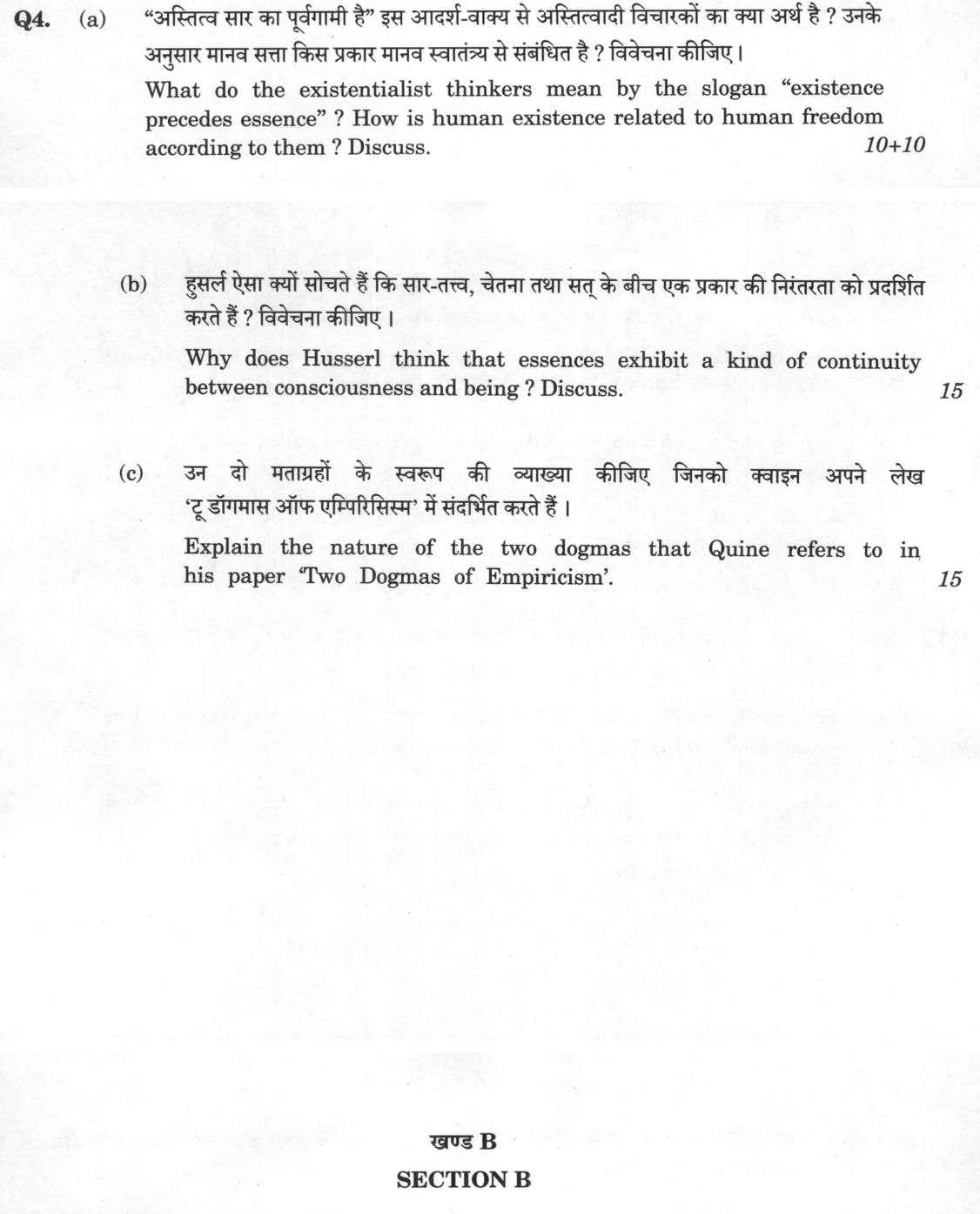
What do the existentialist thinkers mean by the slogan "existence precedes essence" ? How is human existence related to human freedom according to them ? Discuss. 10+10 marks
Why does Husserl think that essences exhibit a kind of continuity between consciousness and being ? Discuss. 15 marks
Explain the nature of the two dogmas that Quine refers to in his paper 'Two Dogmas of Empiricism'. 15 marks
हिंदी में प्रश्न पढ़ें
"अस्तित्व सार का पूर्वगामी है" इस आदर्श-वाक्य से अस्तित्ववादी विचारकों का क्या अर्थ है ? उनके अनुसार मानव सत्ता किस प्रकार मानव स्वातंत्र्य से संबंधित है ? विवेचना कीजिए। 10+10 अंक
हुसर्ल ऐसा क्यों सोचते हैं कि सार-तत्त्व, चेतना तथा सत्तु के बीच एक प्रकार की निरंतरता को प्रदर्शित करते हैं ? विवेचना कीजिए । 15 अंक
उन दो मतार्थों के स्वरूप की व्याख्या कीजिए जिनको क्वाइन अपने लेख 'टू डॉगमास ऑफ एम्पिरिसिज्म' में संदर्भित करते हैं । 15 अंक
Model answer
Written by UPSC Answer Check against this question's marking rubric, to the expected length. UPSC does not publish answers for Mains — this is one way to score well, not an official key.
Twentieth-century philosophy witnessed a profound re-examination of foundational categories, progressing from existential investigations of lived subjectivity to phenomenological structures of consciousness and analytic critiques of empirical dogma.
Existence, Essence, and Human Freedom
Jean-Paul Sartre’s maxim "existence precedes essence" radically overturns traditional metaphysical essentialism, which held that human nature is predefined by a creator or a fixed teleological form. For existentialists, human beings first exist, encounter themselves in the world, and only through subsequent choices, actions, and projects define who they become. While Martin Heidegger emphasizes "thrownness" (Geworfenheit) and Sartre underscores *facticity*—the concrete, unchosen socio-historical constraints of one's birth—these conditions do not determine human essence. Instead, they constitute the situated horizon against which self-creation occurs.
Consequently, freedom is not merely an attribute that humans possess; it is the ontological structure of human reality itself (being-for-itself). As Sartre famously declared, "Man is condemned to be free." Because human existence lacks an inherent blueprint, individuals bear total responsibility for their lives. Evading this terrifying burden of radical freedom results in "bad faith" (mauvaise foi)—the inauthentic adoption of deterministic roles or external dogma. Authentic existence requires confronting existential angst, acknowledging one's non-fixity, and forging meaning through committed, self-directed action.
Husserl: Essences as Continuity between Consciousness and Being
Edmund Husserl bridges the traditional Cartesian dualism between the subjective mind and objective reality by demonstrating that essences (eidos) exhibit an intrinsic continuity between consciousness and being. Through the phenomenological reduction (epoché), which brackets the "natural attitude" and assumptions about the independent existence of the external world, consciousness is revealed as essentially intentional: consciousness is always "consciousness-of" something.
Through eidetic reduction and the intuition of essences (Wesensschau), Husserl demonstrates that essences are neither mind-independent Platonic forms nor mere subjective psychological impressions. Instead, they are the invariant, constitutive structures of phenomena realized in the intentional correlation between noesis (the act of consciousness) and noema (the objective meaning experienced). Because an object can only show itself through these invariant structural possibilities of experience, essence serves as the necessary medium through which consciousness and being are harmoniously joined, eliminating the gulf between the experiencing subject and the phenomenon known.
Quine’s Critique of the Two Dogmas
In Two Dogmas of Empiricism, W.V.O. Quine challenges logical positivism by dismantling two deeply entrenched assumptions:
The first dogma is the analytic-synthetic distinction—the belief in a fundamental cleavage between truths grounded solely in meaning (analytic, like "no bachelor is married") and truths grounded in empirical fact (synthetic). Quine argues that attempts to define analyticity rely on a circular network of inter-definable notions such as synonymy, necessity, and definition, none of which can be empirically verified without presupposing analyticity itself.
The second dogma is reductionism—the view that every meaningful empirical statement can be translated into an equivalent construct of immediate sensory experiences.
In place of these dogmas, Quine proposes confirmation holism: our knowledge constitutes a dynamic "web of belief" that faces the tribunal of experience as an integrated whole, rather than sentence by sentence. Due to the underdetermination of theory by evidence and the indeterminacy of translation, any statement at the periphery can be revised, and even logical truths at the core are not entirely immune to empirical recalibration. Consequently, Quine dissolves the rigid boundary between speculative philosophy and empirical science, advocating for an epistemology naturalized within scientific inquiry.
Together, these traditions reconfigured modern philosophy: existentialism situated freedom as the inescapable ground of human existence, phenomenology illuminated the intentional structures binding consciousness to the world, and Quinean holism dismantled foundationalism to integrate epistemology with natural inquiry.
What "Discuss" is asking you to do
Lay the issue out from more than one side — how it arose, what is claimed for it, what is held against it, and where it now stands. UPSC attaches discuss to broad topics with several live dimensions, so coverage of the dimensions earns more than the strength of your opinion.
Structure that answers it
Set the issue up → the case as it is made → the case against → the dimension both sides leave out → where the balance now lies
Where marks are lost
Listing facts with no thread between them, or arguing one side throughout and calling it a discussion.
How this answer will be evaluated
Approach
Framework: UPSC Philosophy Paper 1. (a) discuss: intro > 3-4 dimensions > example > balanced close | (b) discuss: intro > 3-4 dimensions > example > balanced close | (c) explain: definition/context > points in order > small example > short close Full marks: Precise technical vocabulary, clear argument reconstruction, strong counter-arguments, and balanced evaluation.
Key points expected
- Define 'existence precedes essence' (Dasein)
- Contrast with traditional 'essence precedes existence'
- Explain 'existence' as pre-reflective being-in-the-world
- Link freedom to the 'project' of self-creation
- Define 'essence' (Eidos) in Husserlian context
- Explain 'intentionality' as the bridge
- Discuss 'noema' and 'noesis' correlation
- Explain 'phenomenological reduction' (epoché)
Evaluation rubric
Each sub-part is marked on its own, against the marks and word limit printed on the paper.
- (a) Define 'existence precedes essence' and link it to human freedom. 20 marks
discuss— intro → 3-4 dimensions → example → balanced close
Must cover
- Define 'existence precedes essence' (Dasein)
- Contrast with traditional 'essence precedes existence'
- Explain 'existence' as pre-reflective being-in-the-world
- Link freedom to the 'project' of self-creation
Loses marks
- Biographical details of Heidegger or Sartre
- Vague paraphrase of 'existence' without technical terms
- Ignoring the link to freedom
Earns more
- Mention 'thrownness' (Geworfenheit) and 'facticity'
- Reference Heidegger's 'Being and Time' or Sartre
- Discuss 'bad faith' as denial of freedom
- Use Sanskrit term 'Satta' for existence
Extra mark
- Reference 'Being and Time' (Sein und Zeit)
- Reference 'Being and Nothingness'
- (b) Explain Husserl's view on the continuity between consciousness and being. 15 marks
discuss— intro → 3-4 dimensions → example → balanced close
Must cover
- Define 'essence' (Eidos) in Husserlian context
- Explain 'intentionality' as the bridge
- Discuss 'noema' and 'noesis' correlation
- Explain 'phenomenological reduction' (epoché)
Loses marks
- Confusing Husserl with Heidegger
- Ignoring the role of intentionality
- Vague description of 'continuity'
Earns more
- Mention 'transcendental ego'
- Reference 'Ideas I' or 'Logical Investigations'
- Discuss 'lifeworld' (Lebenswelt)
- Use Sanskrit term 'Chetana' for consciousness
Extra mark
- Reference 'Ideas I'
- Reference 'Logical Investigations'
- (c) Explain the nature of the two dogmas in Quine's paper. 15 marks
explain— definition/context → points in order → small example → short close
Must cover
- Identify Dogma 1: Analytic-Synthetic Distinction
- Identify Dogma 2: Reductionism (Verificationism)
- Explain Quine's critique of the analytic concept
- Explain Quine's critique of reductionism
Loses marks
- Confusing Quine with Carnap
- Failing to define the two dogmas clearly
- Vague description of Quine's critique
Earns more
- Mention 'web of belief' metaphor
- Reference 'Two Dogmas of Empiricism' (1951)
- Discuss 'confirmation holism'
- Use Sanskrit term 'Matra' for dogma
Extra mark
- Reference 'Two Dogmas of Empiricism' (1951)
- Reference 'Word and Object'
Practice this exact question
Write your answer and it is marked point by point against the model answer above — what you covered, what you missed, what you got wrong.
Evaluate my answer →More from Philosophy 2024 Paper I
- Q1 Answer the following questions in about 150 words each: (a) Differentiate between Plato's…
- Q2 (a) Is rejection of Locke's notion of primary qualities instrumental in Berkeley's leanin…
- Q3 (a) Explain Russell's notion of incomplete symbols. Also explain how this notion leads to…
- Q4 (a) What do the existentialist thinkers mean by the slogan "existence precedes essence" ?…
- Q5 Answer the following questions in about 150 words each: (a) Do you think Cārvāka's philos…
- Q6 (a) Differentiate between the Cārvākas' refutation of self as a transcendental category a…
- Q7 (a) Present an account of evolution of Prakṛti as propounded in Sāṃkhyakārikā. In this co…