Paper I — Q6
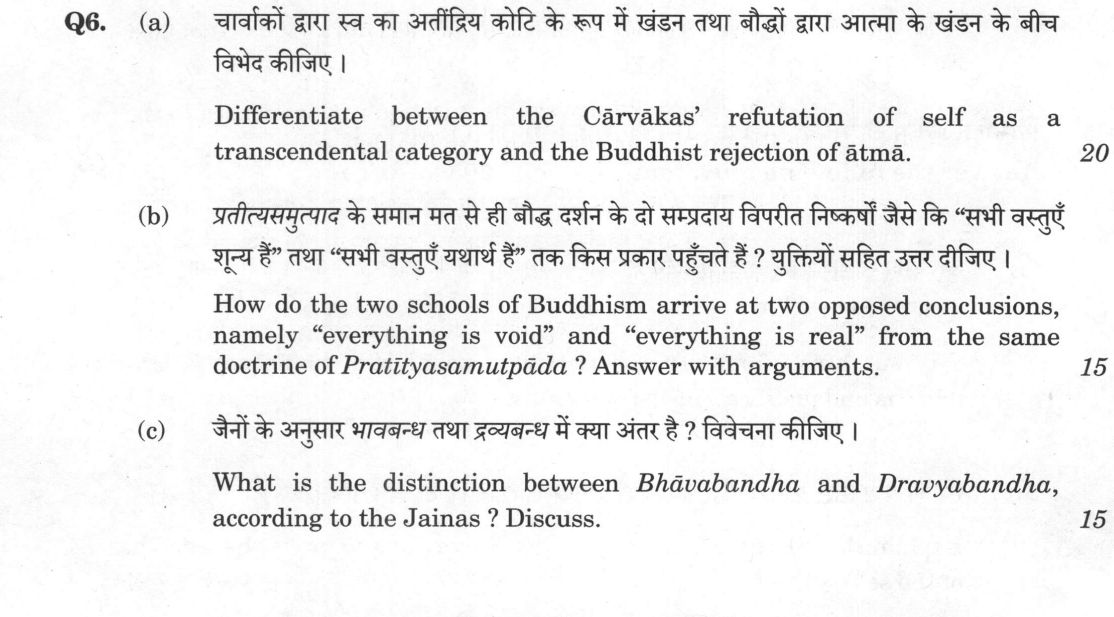
(a) Differentiate between the Cārvākas' refutation of self as a transcendental category and the Buddhist rejection of ātmā. 20…
Differentiate between the Cārvākas' refutation of self as a transcendental category and the Buddhist rejection of ātmā. 20 marks
How do the two schools of Buddhism arrive at two opposed conclusions, namely "everything is void" and "everything is real" from the same doctrine of Pratītyasamutpāda? Answer with arguments. 15 marks
What is the distinction between Bhāvabandha and Dravyabandha, according to the Jainas? Discuss. 15 marks
हिंदी में प्रश्न पढ़ें
चार्वाकों द्वारा स्व का अतांत्रिक कोटि के रूप में खंडन तथा बौद्धों द्वारा आत्मा के खंडन के बीच विभेद कीजिए। 20 अंक
प्रतीत्यसमुत्पाद के समान मत से ही बौद्ध दर्शन के दो सम्प्रदाय विपरीत निष्कर्षों जैसे कि "सभी वस्तुएँ शून्य हैं" तथा "सभी वस्तुएँ यथार्थ हैं" तक किस प्रकार पहुँचते हैं? युक्तियों सहित उत्तर दीजिए। 15 अंक
जैनों के अनुसार भावबन्ध तथा द्रव्यबन्ध में क्या अंतर है? विवेचना कीजिए। 15 अंक
Model answer
Written by UPSC Answer Check against this question's marking rubric, to the expected length. UPSC does not publish answers for Mains — this is one way to score well, not an official key.
Cārvāka and Buddhist anātman The Cārvākas, in the Bṛhaspati/Barhaspatya tradition, reject ātmā as a transcendental category because it is not perceivable. For them pratyakṣa is the only valid means of knowledge, and what is called self is the living body (deha). Hence dehātmavāda: the body is the self, and consciousness is an emergent product of the four bhūtas in the right combination. There is no unperceivable soul, no afterlife, and no transmigrating entity. Cārvāka does not deny the experience of self; it locates it in the body and denies any eternal, independent self beyond it. Buddhism also denies ātmā, but not by reducing self to matter. Through pratītyasamutpāda and anitya, it denies a permanent, independent self; the person is only a conventional designation over the five skandhas. Nāgārjuna’s Mūlamadhyamakakārikā argues that a self cannot be found in the skandhas nor apart from them. Yet Buddhism accepts rebirth as causal continuity without a transmigrating soul, unlike Cārvāka materialism. Thus Cārvāka rejects the self epistemically as unverifiable and identifies it with body; Buddhism rejects it ontologically as empty of svabhāva while retaining a dependently arisen, conventional person. The contrast is not merely verbal: Cārvāka’s self is perishable and material, while the Buddhist conventional self is a process of skandhas, and the Buddhist rejection leaves room for karma and liberation.
Mādhyamika and Sarvāstivāda From the same pratītyasamutpāda, Mādhyamika and Sarvāstivāda draw opposite conclusions. Nāgārjuna argues that if things are dependently originated, they cannot possess svabhāva; dependence proves emptiness. His formula that śūnyatā is pratītyasamutpāda shows that “everything is void” is not a separate metaphysical void but the very mode of arising: all dharmas, and even dependent origination itself, lack intrinsic existence. Sarvāstivāda/Vaibhāṣika, by contrast, reads dependence as real causal efficacy. For past karma, memory and continuity to work, past dharmas must exist; otherwise a non-existent cause cannot produce a present effect. Their argument from causal power (sakti) leads to sarvam asti: all dharmas in past, present and future are real, though conditioned. The same doctrine is read as refutation of svabhāva by Mādhyamika and as proof of real dharmas by Sarvāstivāda. Thus the divergence is interpretive: Mādhyamika takes dependence as the negation of inherent existence, while Sarvāstivāda takes it as the operation of real dharmas across time. Yogācāra (Asaṅga/Vasubandhu) is not the source of “everything is real”; its vijñapti-mātratā denies external objects and treats vijñāna as the basis of appearance, but its dependent flow is not intrinsically real.
Jaina bandha Jaina bandha has two aspects. Dravyabandha is the ontological attachment of karmic matter (pudgala) to the soul-substance (jīva-dravya); karmic particles actually cling to the soul and limit its infinite knowledge, bliss and power. Bhāvabandha is the bondage of the soul’s states or modes (bhāvas) produced by delusion, passions and activity; it is the psychological-spiritual conditioning that draws karma in. The Tattvārtha Sūtra of Umasvāti treats bandha as influx of karma due to moha, rāga, dveṣa, pramāda and activity. In Jain terms, dravya is the substratum, bhāva its modification; bandha is both the attachment of karma-dravya and the soul’s bound bhāva. The distinction is therefore between substance-level entanglement and mode-level conditioning: dravyabandha is karma as real pudgala attached to jīva-dravya, while bhāvabandha is the soul’s deluded, passion-bound state that sustains the influx. Liberation requires both samvara, stopping new influx, and nirjarā, shedding existing karma, so that both material and modal bondage cease and the soul’s infinite qualities are unobstructed.
Conclusion The three heterodox positions differ sharply: Cārvāka materialism makes the body the self and denies transcendence; Buddhism’s middle path denies permanent self through dependence; Jaina pluralistic realism distinguishes real karmic matter from real soul-modes, making bondage both ontological and psychological.
What "Differentiate" is asking you to do
Fix the criteria on which the two differ and apply each criterion to both, so the pair can no longer be mixed up. Differentiate stems usually carry a further task attached — describe the mechanism, set out the principles, discuss the applications — and that task carries its own marks.
Structure that answers it
Criterion 1 applied to both → criterion 2 → criterion 3 → summary line or table → the attached second demand answered in full
Where marks are lost
Two standalone definitions placed side by side, leaving the reader to extract the difference. The second common loss is running out of space before the attached task, which is often worth as much as the differentiation.
How this answer will be evaluated
Approach
Framework: UPSC Philosophy Paper 1. (a) compare: paired headings or table > key differences > significance > conclusion | (b) explain: definition/context > points in order > small example > short close | (c) discuss: intro > 3-4 dimensions > example > balanced close Full marks: Precise technical vocabulary, clear differentiation, strong arguments, and accurate examples.
Key points expected
- Cārvāka: self is merely a property of the body (sattva)
- Buddhist: self is a false superimposition on aggregates (skandhas)
- Cārvāka: consciousness is a product of material elements
- Buddhist: consciousness is a momentary process (citta-santāna)
- Madhyamaka: Pratītyasamutpāda implies Śūnyatā (emptiness)
- Yogācāra: Pratītyasamutpāda implies Vijñapti-mātratā (consciousness-only)
- Madhyamaka: negation of svabhāva (intrinsic nature)
- Yogācāra: reality of the mind-stream (citta-santāna)
Evaluation rubric
Each sub-part is marked on its own, against the marks and word limit printed on the paper.
- (a) Differentiate Cārvāka's materialist refutation of self from Buddhist anātman. 20 marks
compare— paired headings or table → key differences → significance → conclusion
Must cover
- Cārvāka: self is merely a property of the body (sattva)
- Buddhist: self is a false superimposition on aggregates (skandhas)
- Cārvāka: consciousness is a product of material elements
- Buddhist: consciousness is a momentary process (citta-santāna)
Loses marks
- Confusing Cārvāka with other materialist schools
- Failing to distinguish 'refutation' from 'rejection'
- Vague paraphrase without technical terms
Earns more
- Cārvāka: rejection of inference (anumāna) as a source of knowledge
- Buddhist: use of logic to prove the non-existence of self
- Cārvāka: survival of self is impossible after death
- Buddhist: rebirth without a transmigrating self
Extra mark
- Reference to specific Cārvāka sutras (e.g., Lokāyata Sūtra)
- Reference to specific Buddhist texts (e.g., Milindapañha)
- (b) Explain how Madhyamaka and Yogācāra derive opposite conclusions from Pratītyasamutpāda. 15 marks
explain— definition/context → points in order → small example → short close
Must cover
- Madhyamaka: Pratītyasamutpāda implies Śūnyatā (emptiness)
- Yogācāra: Pratītyasamutpāda implies Vijñapti-mātratā (consciousness-only)
- Madhyamaka: negation of svabhāva (intrinsic nature)
- Yogācāra: reality of the mind-stream (citta-santāna)
Loses marks
- Confusing Madhyamaka with Yogācāra
- Failing to link the conclusions to Pratītyasamutpāda
- Vague paraphrase without technical terms
Earns more
- Madhyamaka: Nāgārjuna's argument against svabhāva
- Yogācāra: Asaṅga's theory of the storehouse consciousness (ālaya-vijñāna)
- Madhyamaka: the two truths (conventional and ultimate)
- Yogācāra: the three natures (trisvabhāva)
Extra mark
- Reference to specific Madhyamaka texts (e.g., Mūlamadhyamakakārikā)
- Reference to specific Yogācāra texts (e.g., Vijñaptimātratā-siddhi)
- (c) Discuss the distinction between Bhāvabandha and Dravyabandha in Jain philosophy. 15 marks
discuss— intro → 3-4 dimensions → example → balanced close
Must cover
- Bhāvabandha: relation between a substance and its modes (paryāya)
- Dravyabandha: relation between two distinct substances
- Bhāvabandha: e.g., the relation between a pot and its shape
- Dravyabandha: e.g., the relation between a soul and a body
Loses marks
- Confusing Bhāvabandha with Dravyabandha
- Failing to provide examples
- Vague paraphrase without technical terms
Earns more
- Bhāvabandha: modes are not independent of the substance
- Dravyabandha: substances are independent of each other
- Bhāvabandha: the substance is the substratum of the modes
- Dravyabandha: the substances are distinct and separate
Extra mark
- Reference to specific Jain texts (e.g., Tattvārtha Sūtra)
- Reference to specific Jain philosophers (e.g., Umāsvāti)
Practice this exact question
Write your answer and it is marked point by point against the model answer above — what you covered, what you missed, what you got wrong.
Evaluate my answer →More from Philosophy 2024 Paper I
- Q3 (a) Explain Russell's notion of incomplete symbols. Also explain how this notion leads to…
- Q4 (a) What do the existentialist thinkers mean by the slogan "existence precedes essence" ?…
- Q5 Answer the following questions in about 150 words each: (a) Do you think Cārvāka's philos…
- Q6 (a) Differentiate between the Cārvākas' refutation of self as a transcendental category a…
- Q7 (a) Present an account of evolution of Prakṛti as propounded in Sāṃkhyakārikā. In this co…
- Q8 (a) How do I know that I know ? Answer this question with reference to the Naiyāyikas, th…