Paper I — Q8
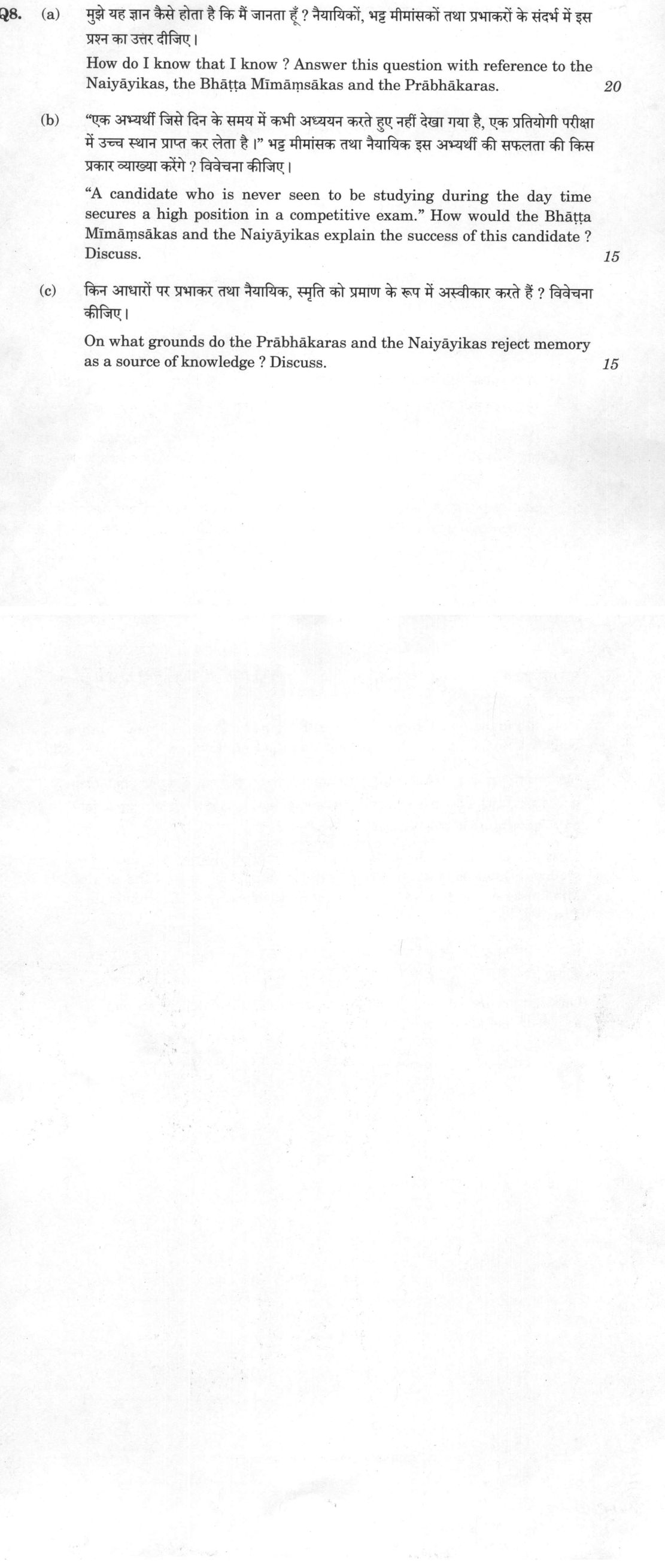
(a) How do I know that I know ? Answer this question with reference to the Naiyāyikas, the Bhāṭṭa Mīmāṃsākas and the Prābhākaras…
How do I know that I know ? Answer this question with reference to the Naiyāyikas, the Bhāṭṭa Mīmāṃsākas and the Prābhākaras. 20 marks
"A candidate who is never seen to be studying during the day time secures a high position in a competitive exam." How would the Bhāṭṭa Mīmāṃsākas and the Naiyāyikas explain the success of this candidate ? Discuss. 15 marks
On what grounds do the Prābhākaras and the Naiyāyikas reject memory as a source of knowledge ? Discuss. 15 marks
हिंदी में प्रश्न पढ़ें
मुझे यह ज्ञान कैसे होता है कि मैं जानता हूँ ? नैयायिकों, भट्ट मीमांसकों तथा प्रभाकरों के संदर्भ में इस प्रश्न का उत्तर दीजिए। 20 अंक
"एक अभ्यर्थी जिसे दिन के समय में कभी अध्ययन करते हुए नहीं देखा गया है, एक प्रतियोगी परीक्षा में उच्च स्थान प्राप्त कर लेता है।" भट्ट मीमांसक तथा नैयायिक इस अभ्यर्थी की सफलता की किस प्रकार व्याख्या करेंगे ? विवेचना कीजिए। 15 अंक
किन आधारों पर प्रभाकर तथा नैयायिक, स्मृति को प्रमाण के रूप में अस्वीकार करते हैं ? विवेचना कीजिए। 15 अंक
Model answer
Written by UPSC Answer Check against this question's marking rubric, to the expected length. UPSC does not publish answers for Mains — this is one way to score well, not an official key.
How Do I Know That I Know?
The question of meta-cognition and epistemic justification reveals fundamental divergences in classical Indian epistemology regarding whether knowledge is self-luminous (svaprakāśa) or known through another cognition (paraprakāśa), and whether its validity is intrinsic (svataḥ) or extrinsic (parataḥ).
The Naiyāyikas advocate paraprakāśa and parataḥ-pramāṇyavāda. A primary cognition (vyavasāya, e.g., "This is a pot") reveals only its external object, not itself. I know that I know through a subsequent, distinct introspective perception termed anuvyavasāya ("I perceive this pot"). This second-order cognition takes the first cognition as its object through mental perception (mānasa-pratyakṣa). Furthermore, the epistemic truth of this cognition is not self-certified; its validity (prāmāṇya) is established extrinsically through successful pragmatic action (saṃvādi-pravṛtti-sāmarthya).
The Bhāṭṭa Mīmāṃsākas reject both anuvyavasāya and self-luminosity. Knowledge is an act (kriyā) that is imperceptible (atīndriya). When an object is known, an epistemic property called "cognizedness" or "manifestedness" (jñātatā or prākaṭya) is produced in the object. I know that I know through an inference from this result (phala): "The object has the property of knownness; this knownness must have a cause; therefore, I have a cognition of the object." For Bhāṭṭas, while the apprehension of knowledge is inferential (vedanā-jñāna), its validity is intrinsic (svataḥ-pramāṇya), held to be valid unless vitiated by defeaters (bādhaka-jñāna).
The Prābhākara Mīmāṃsākas propose the doctrine of tripuṭī-saṃvit-vāda (triune perception). Knowledge is self-luminous (svaprakāśa). In every act of knowing, three factors are simultaneously revealed: the knower (mātā), the known object (meya), and the knowledge itself (māna). There is no need for a subsequent anuvyavasāya or an inferential jñātatā. In knowing the pot, I immediately know that I know it. Prābhākaras also uphold svataḥ-pramāṇyavāda, asserting that all apprehensions (anubhūti) are intrinsically valid; what is called error is merely a practical failure of non-discrimination (akhyāti).
Explaining the Non-Studying Ranker: Bhāṭṭa versus Nyāya
The case of a candidate never observed studying by day yet securing a high rank illustrates the epistemological clash between postulation (arthāpatti) and inference (anumāna).
The Bhāṭṭa Mīmāṃsākas explain this success through arthāpatti (presumption/postulation), as articulated by Kumārila Bhaṭṭa in the Ślokavārttika. There is an apparent contradiction (virodha) between two established facts: the observed daytime leisure and the exceptional examination success. To resolve this conflict and render the facts coherent, the mind posits the unobserved fact: "The candidate studies secretly at night." For Bhāṭṭas, arthāpatti is an independent pramāṇa rooted in dṛṣṭa-arthāpatti or śruta-artha-smaraṇa, operating to eliminate an epistemic impasse rather than deriving conclusions from a universal rule.
The Naiyāyikas, represented by Gaṅgeśa in the Tattvacintāmaṇi, reject arthāpatti as an independent source of knowledge, reducing it to anumāna (inference). The success is explained through a standard five-membered syllogism (pañcāvayava) grounded in invariable concomitance (vyāpti) between the effect (high rank) and the cause (diligent study): The candidate possesses night-study (pratijñā); because of exceptional exam success despite daytime leisure (hetu); whoever achieves exam success without daytime study engages in night-study, like other past successful candidates (dṛṣṭānta). Since effect cannot arise without cause (kāraṇa-kārya-sambandha), daytime absence logically restricts the locus of study to the night via contrapositive inference (vyatireki-anumāna).
Rejection of Memory as a Pramāṇa
Both Prābhākaras and Naiyāyikas exclude memory (smṛti) from the status of valid knowledge (pramā), but on distinct technical grounds.
The Prābhākaras define pramā strictly as anubhūti (fresh apprehension). Memory (smaraṇa) is rejected because it is entirely caused by the revival of past residual impressions (saṃskāra-mātra-janya). It lacks novelty, merely reproducing what was already apprehended. Furthermore, memory introduces subjective ideation (kalpanā), superimposing past temporal-spatial determinations onto the present, thereby failing to grasp present, unmediated reality. Because memory depends upon a previous cognition, it lacks epistemic autonomy.
The Naiyāyikas define pramā as yathārtha-anubhava (veridical present apprehension). Memory is classified as smṛti-jñāna rather than pramāṇa-janya jñāna. It lacks the requisite causal apparatus (pratyakṣa-lakṣaṇa) of a valid source: it operates without present sense-object contact (indriyārtha-sannikarṣa) in perception and lacks a present middle term (liṅga) in inference. The object in memory is past and absent, whereas a pramāṇa must reveal an object in its authentic, present causal framework.
These debates mirror deeper philosophical commitments: Nyāya realism demands external verification (parataḥ) and strict causal chains for valid apprehension, while Mīmāṃsā asserts the self-validating nature of cognition (svataḥ) to secure the unquestionable authority of Vedic injunctions without falling into infinite regress.
What "Discuss" is asking you to do
Lay the issue out from more than one side — how it arose, what is claimed for it, what is held against it, and where it now stands. UPSC attaches discuss to broad topics with several live dimensions, so coverage of the dimensions earns more than the strength of your opinion.
Structure that answers it
Set the issue up → the case as it is made → the case against → the dimension both sides leave out → where the balance now lies
Where marks are lost
Listing facts with no thread between them, or arguing one side throughout and calling it a discussion.
How this answer will be evaluated
Approach
Framework: Indian Philosophy (Nyaya, Mimamsa). (a) explain: definition/context > points in order > small example > short close | (b) explain: definition/context > points in order > small example > short close | (c) explain: definition/context > points in order > small example > short close Full marks: Precise technical vocabulary, clear distinction between schools, strong logical reconstruction.
Key points expected
- Naiyāyika: Sasaṃvitti-vāda (simultaneous self-awareness)
- Bhāṭṭa: Anuśaya-vāda (latent impression)
- Prābhākara: Sākṣāt-karaṇa (direct illumination)
- Distinguish the three positions clearly
- Bhāṭṭa: Success due to past karma (puruṣārtha)
- Naiyāyika: Success due to present effort (puruṣārtha)
- Contrast the two views on causality
- Prābhākara: Memory is a form of perception (pratyakṣa)
Evaluation rubric
Each sub-part is marked on its own, against the marks and word limit printed on the paper.
- (a) Explain the epistemological mechanism of self-awareness (svasaṃvitti) across three schools. 20 marks
explain— definition/context → points in order → small example → short close
Must cover
- Naiyāyika: Sasaṃvitti-vāda (simultaneous self-awareness)
- Bhāṭṭa: Anuśaya-vāda (latent impression)
- Prābhākara: Sākṣāt-karaṇa (direct illumination)
- Distinguish the three positions clearly
Loses marks
- Confusing Bhāṭṭa and Prābhākara positions
- Vague paraphrase without technical terms
Earns more
- Use of Sanskrit technical terms
- Mention of specific arguments (e.g., infinite regress)
Extra mark
- Reference to specific texts (e.g., Tattvakaumudī)
- (b) Explain the metaphysical basis of the candidate's success (past karma vs. present effort). 15 marks
explain— definition/context → points in order → small example → short close
Must cover
- Bhāṭṭa: Success due to past karma (puruṣārtha)
- Naiyāyika: Success due to present effort (puruṣārtha)
- Contrast the two views on causality
Loses marks
- Failing to distinguish the two schools
- Biographical details of the schools
Earns more
- Use of term 'puruṣārtha'
- Clear distinction between past and present agency
Extra mark
- Reference to specific Mimamsa or Nyaya texts
- (c) Explain the specific logical grounds for rejecting memory (smṛti) as a pramāṇa. 15 marks
explain— definition/context → points in order → small example → short close
Must cover
- Prābhākara: Memory is a form of perception (pratyakṣa)
- Naiyāyika: Memory is a form of inference (anumāna)
- State the specific objection to memory as independent pramāṇa
Loses marks
- Confusing the two schools' positions
- Vague statement without logical grounds
Earns more
- Use of term 'pramāṇa'
- Clear logical reasoning for rejection
Extra mark
- Reference to specific arguments (e.g., circularity)
Practice this exact question
Write your answer and it is marked point by point against the model answer above — what you covered, what you missed, what you got wrong.
Evaluate my answer →More from Philosophy 2024 Paper I
- Q5 Answer the following questions in about 150 words each: (a) Do you think Cārvāka's philos…
- Q6 (a) Differentiate between the Cārvākas' refutation of self as a transcendental category a…
- Q7 (a) Present an account of evolution of Prakṛti as propounded in Sāṃkhyakārikā. In this co…
- Q8 (a) How do I know that I know ? Answer this question with reference to the Naiyāyikas, th…