Paper I — Q7
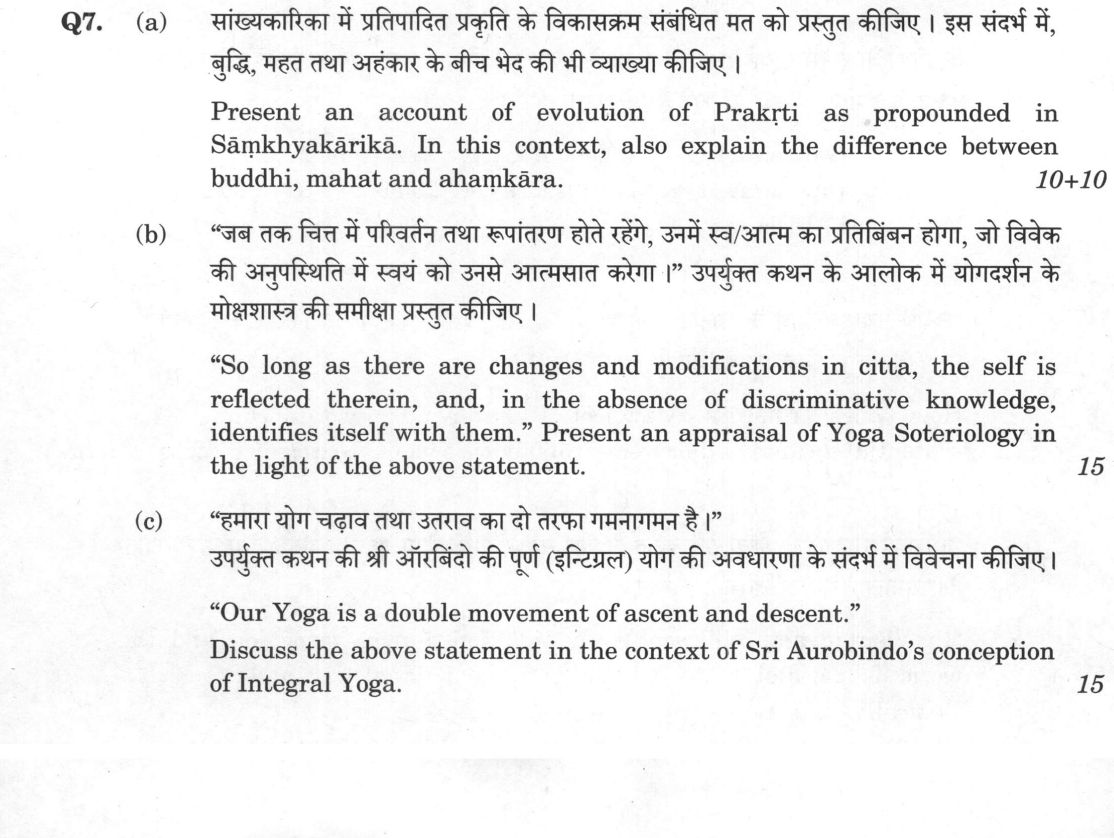
(a) Present an account of evolution of Prakṛti as propounded in Sāṃkhyakārikā. In this context, also explain the difference…
Present an account of evolution of Prakṛti as propounded in Sāṃkhyakārikā. In this context, also explain the difference between buddhi, mahat and ahaṃkāra. 10+10 marks
"So long as there are changes and modifications in citta, the self is reflected therein, and, in the absence of discriminative knowledge, identifies itself with them." Present an appraisal of Yoga Soteriology in the light of the above statement. 15 marks
"Our Yoga is a double movement of ascent and descent." Discuss the above statement in the context of Sri Aurobindo's conception of Integral Yoga. 15 marks
हिंदी में प्रश्न पढ़ें
सांख्यकारिका में प्रतिपादित प्रकृति के विकासक्रम संबंधित मत को प्रस्तुत कीजिए। इस संदर्भ में, बुद्धि, महत् तथा अहंकार के बीच भेद की भी व्याख्या कीजिए। 10+10 अंक
"जब तक चित्त में परिवर्तन तथा रूपान्तरण होते रहेंगे, उनमें स्व/आत्म का प्रतिबिंबन होगा, जो विवेक की अनुपस्थिति में स्वयं को उनसे आत्मसात करेगा।" उपर्युक्त कथन के आलोक में योगदर्शन के मोक्षशास्त्र की समीक्षा प्रस्तुत कीजिए। 15 अंक
"हमारा योग चढ़ाव तथा उतराव का दो तरफा गमनागमन है।" उपर्युक्त कथन की श्री अरविंदो की पूर्ण (इंटीग्रल) योग की अवधारणा के संदर्भ में विवेचना कीजिए। 15 अंक
Model answer
Written by UPSC Answer Check against this question's marking rubric, to the expected length. UPSC does not publish answers for Mains — this is one way to score well, not an official key.
Evolution of Prakṛti. In the Sāṃkhyakārikā, prakṛti is the unconditioned material cause, triguṇa, and source of the twenty-three evolutes. Its evolution is sāṭkāryavāda: the effect pre-exists in the cause, and the manifold is a modification of prakṛti. The first evolute is mahat/buddhi, the cosmic intelligence that reflects puruṣa and initiates differentiation. Buddhi is niścayātmikā, the determinative faculty that decides “this is so”; as mahat it is the vast cosmic principle of intelligence; as individual buddhi it is the same faculty in the embodied self. From mahat arises ahaṃkāra, the principle of self-reference or abhimāna, which appropriates experience as “mine.” Ahaṃkāra has three aspects: vaikarika/sāttvika, taijasa/rājasa and bhūtādi/tāmasa. The sāttvika aspect gives rise to the eleven organs—manas and the five jñānendriyas and karmendriyas; the tāmasa aspect gives rise to the five tanmātras, which produce the five mahabhūtas; rajas assists both by providing dynamic activity. Thus the avyakta becomes vyakta through a graded unfolding from intelligence to ego, sense and matter. The distinction is functional: mahat knows, buddhi decides, ahaṃkāra appropriates; together they explain how one prakṛti yields subtle and gross worlds while remaining distinct from puruṣa.
Yoga’s soteriology. The quoted statement captures Yoga’s diagnosis of bondage. In the Yoga Sūtra, yoga is citta-vṛtti-nirodha (I.2–4): the stilling of mental modifications. Citta is not the self but a subtle instrument of prakṛti. When vṛttis are active, puruṣa is reflected in citta (cittabimba); in the absence of viveka-khyāti, the self identifies with the reflected modifications—thoughts, ego, pleasure, pain. This adhyāsa produces saṃyoga, the entanglement of puruṣa with prakṛti, and is the root of the klesas (II.3–9). Yoga’s soteriology therefore aims at kaivalya, the isolation of puruṣa in its own nature, not annihilation but cessation of false identification. The path uses abhyāsa and vairāgya, the limbs of aṣṭāṅga yoga, and discriminative insight that the witness is distinct from the witnessed. The appraisal is mixed. The model is powerful because it explains bondage without making puruṣa responsible for karma, and gives a practical method for self-knowledge. Yet it remains theoretically delicate: if puruṣa is pure consciousness and prakṛti inert, how does reflection occur, and how does citta-vṛtti-nirodha produce new knowledge rather than mere quiescence? Yoga answers that the reflection is a functional relation, not ontological identity, and that viveka-khyāti is decisive. Still, the dualism leaves the relation between consciousness and matter under-explained.
Integral Yoga’s double movement. Sri Aurobindo’s statement that “Our Yoga is a double movement of ascent and descent” reinterprets this soteriology as a cosmic process. Ascent is the evolution of consciousness from matter through life, mind and beyond toward Supermind, a dynamic integral intelligence. Descent is involution and the self-limitation of the higher: the Supermind or Spirit descends into matter, and Integral Yoga seeks to draw that higher consciousness back into the human being and the world. In The Life Divine and The Synthesis of Yoga, this is not escape from the world but transformation of it. The triple transformation—psychic, spiritual and supramental—means that the individual first turns to the inner psychic being, then purifies and widens through spiritual experience, and finally opens to the supramental consciousness that can transform body, life and mind. This double movement resolves the Sāṃkhya-Yoga dualism by integrating Brahman and Śakti: the absolute is not a passive puruṣa separate from prakṛti, but a dynamic unity of consciousness and power. It avoids ascetic withdrawal by making the world the field of transformation, while retaining Yoga’s discipline of self-knowledge. The way forward, therefore, is not merely to isolate the self from prakṛti, but to recognise prakṛti as the dynamic expression of the one Spirit and to transform it through the descent of the higher into the lower.
What "Discuss" is asking you to do
Lay the issue out from more than one side — how it arose, what is claimed for it, what is held against it, and where it now stands. UPSC attaches discuss to broad topics with several live dimensions, so coverage of the dimensions earns more than the strength of your opinion.
Structure that answers it
Set the issue up → the case as it is made → the case against → the dimension both sides leave out → where the balance now lies
Where marks are lost
Listing facts with no thread between them, or arguing one side throughout and calling it a discussion.
How this answer will be evaluated
Approach
Framework: UPSC Philosophy Paper 1. (a) explain: definition/context > points in order > small example > short close | (b) critique: the claim > its strengths > its weaknesses > your judgment | (c) discuss: intro > 3-4 dimensions > example > balanced close Full marks: Precise technical vocabulary, clear distinctions, strong analytical structure.
Key points expected
- Prakṛti's evolution from unmanifest to manifest
- Mahat as first evolute (Buddhi)
- Ahaṃkāra as second evolute
- Distinction between Mahat and Ahaṃkāra
- Explanation of citta vṛtti (modifications)
- Mechanism of self-identification (adhyāsa)
- Role of Viveka (discriminative knowledge)
- Soteriological goal (Kaivalya/Mokṣa)
Evaluation rubric
Each sub-part is marked on its own, against the marks and word limit printed on the paper.
- (a) Sequential account of Sāṃkhya evolution and distinction of three guṇas. 20 marks
explain— definition/context → points in order → small example → short close
Must cover
- Prakṛti's evolution from unmanifest to manifest
- Mahat as first evolute (Buddhi)
- Ahaṃkāra as second evolute
- Distinction between Mahat and Ahaṃkāra
Loses marks
- Confusing Mahat with Ahaṃkāra
- Omitting the role of Guṇas
- Vague paraphrase without technical terms
Earns more
- Role of Guṇas (Sattva, Rajas, Tamas)
- Sāṃkhyakārikā verse references
- Causal relationship between evolute stages
Extra mark
- Sanskrit terms for evolute stages
- Diagram of Sāṃkhya cosmogony
- (b) Appraisal of Yoga Soteriology based on citta modification and self-identification. 15 marks
critique— the claim → its strengths → its weaknesses → your judgment
Must cover
- Explanation of citta vṛtti (modifications)
- Mechanism of self-identification (adhyāsa)
- Role of Viveka (discriminative knowledge)
- Soteriological goal (Kaivalya/Mokṣa)
Loses marks
- Ignoring the 'absence of discriminative knowledge' clause
- Confusing Puruṣa with Citta
- Biographical details of Patañjali
Earns more
- Reference to Yoga Sūtra (e.g., 1.2, 1.3)
- Distinction between Puruṣa and Prakṛti
- Process of Citta-sthairyam
Extra mark
- Comparison with Vedānta Soteriology
- Specific Sūtra citations
- (c) Analysis of Sri Aurobindo's Integral Yoga as a double movement. 15 marks
discuss— intro → 3-4 dimensions → example → balanced close
Must cover
- Definition of 'ascent' (spiritualisation)
- Definition of 'descent' (divinisation)
- Integration of both movements
- Context of Integral Yoga
Loses marks
- Treating ascent and descent as separate
- Ignoring the 'Integral' aspect
- Vague spiritualism without philosophical grounding
Earns more
- Transformation of matter
- Role of Supermind
- Distinction from traditional Yoga
Extra mark
- Reference to 'The Life Divine'
- Specific terminology (e.g., Chit-Shakti)
Practice this exact question
Write your answer and it is marked point by point against the model answer above — what you covered, what you missed, what you got wrong.
Evaluate my answer →More from Philosophy 2024 Paper I
- Q4 (a) What do the existentialist thinkers mean by the slogan "existence precedes essence" ?…
- Q5 Answer the following questions in about 150 words each: (a) Do you think Cārvāka's philos…
- Q6 (a) Differentiate between the Cārvākas' refutation of self as a transcendental category a…
- Q7 (a) Present an account of evolution of Prakṛti as propounded in Sāṃkhyakārikā. In this co…
- Q8 (a) How do I know that I know ? Answer this question with reference to the Naiyāyikas, th…