Paper I — Q5
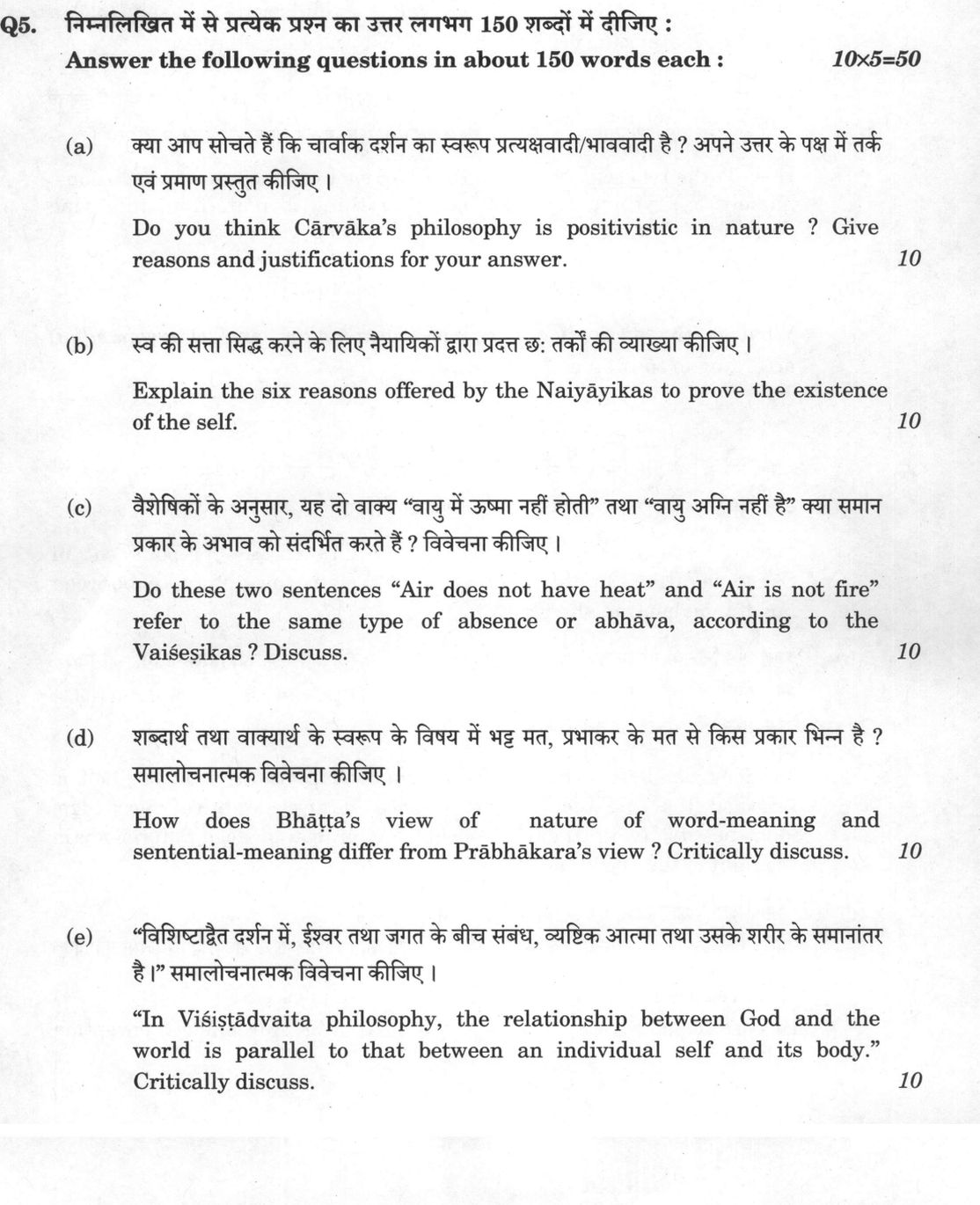
Answer the following questions in about 150 words each: (a) Do you think Cārvāka's philosophy is positivistic in nature ? Give…
Answer the following questions in about 150 words each:
Do you think Cārvāka's philosophy is positivistic in nature ? Give reasons and justifications for your answer. 10 marks
Explain the six reasons offered by the Naiyāyikas to prove the existence of the self. 10 marks
Do these two sentences "Air does not have heat" and "Air is not fire" refer to the same type of absence or abhāva, according to the Vaiśeṣikas ? Discuss. 10 marks
How does Bhāṭṭa's view of nature of word-meaning and sentential-meaning differ from Prābhākara's view ? Critically discuss. 10 marks
"In Viśiṣṭādvaita philosophy, the relationship between God and the world is parallel to that between an individual self and its body." Critically discuss. 10 marks
हिंदी में प्रश्न पढ़ें
निम्नलिखित में से प्रत्येक प्रश्न का उत्तर लगभग 150 शब्दों में दीजिए :
क्या आप सोचते हैं कि चार्वाक दर्शन का स्वरूप प्रत्यक्षवादी/भाववादी है ? अपने उत्तर के पक्ष में तर्क एवं प्रमाण प्रस्तुत कीजिए । 10 अंक
स्व की सत्ता सिद्ध करने के लिए नैयायिकों द्वारा प्रदत्त छः तर्कों की व्याख्या कीजिए । 10 अंक
वैशेषिकों के अनुसार, यह दो वाक्य "वायु में उष्णा नहीं होती" तथा "वायु अग्नि नहीं है" क्या समान प्रकार के अभाव को संदर्भित करते हैं ? विवेचना कीजिए । 10 अंक
शब्दार्थ तथा वाक्यार्थ के स्वरूप के विषय में भट्ट मत, प्रभाकर के मत से किस प्रकार भिन्न है ? समालोचनात्मक विवेचना कीजिए । 10 अंक
"विशिष्टाद्वैत दर्शन में, ईश्वर तथा जगत के बीच संबंध, व्यष्टिक आत्मा तथा उसके शरीर के समानांतर है।" समालोचनात्मक विवेचना कीजिए । 10 अंक
Model answer
Written by UPSC Answer Check against this question's marking rubric, to the 150-word length. UPSC does not publish answers for Mains — this is one way to score well, not an official key.
Cārvāka and positivism. Cārvāka, or Lokāyata, is positivistic only in a limited, methodological sense. Its fragments, including those attributed to the Bṛhaspati Sūtra, accept pratyakṣa as the sole pramāṇa and reject anumāna and śabda as independent sources of knowledge; they also deny ātmā, heaven, karma and dharma as metaphysical realities. This resembles Comtean positivism in restricting valid knowledge to what is observable or empirically accessible and rejecting transcendent metaphysics. However, the resemblance is not exact. Comtean positivism is a doctrine of the development of science and society, whereas Cārvāka is a materialist naturalism with an ethical aim of pleasure and avoidance of pain. Cārvāka does not merely adopt a method; it asserts a metaphysical naturalism, holding that only matter and its combinations exist. Thus it is anti-metaphysical in its rejection of the unseen, but not identical to modern positivism; it is better described as empiricist, materialist and hedonistic rather than strictly positivistic.
Naiyāyika proofs of the self. Naiyāyikas prove the self through six arguments in Nyāya Sūtra 3.1.18–23. First, āyuṣaḥ saṃyogāt: life is a quality of the self, so life in a body implies a self as substratum. Second, indriyārthasaṃyogaḥ: sense-object contact produces perception, which requires a conscious self as subject. Third, pratibandhāyogāt: memory occurs only when there is no obstruction to the self’s recollection, so memory implies a self. Fourth, hṛdayapradeśa: the heart-region is the seat of consciousness, indicating the self’s location. Fifth, prāṇāyāma: voluntary breath control shows an agent distinct from the body, namely the self. Sixth, mṛtyukāla: at death the self leaves the body, proving its reality. The self is the permanent substratum of these changing bodily and mental events. Thus the self is inferred from life, perception, memory, heart, breath and death, not from revelation. These arguments are meant to establish the self as a real, conscious substance.
Vaiśeṣika absence. According to the Vaiśeṣikas, the two sentences do not denote the same type of abhāva. Praśastapāda’s Bhāṣya treats absence as a sixth padārtha and distinguishes its forms. ‘Air does not have heat’ expresses dharmābhāva, the absence of a quality in a substrate: heat, a property, is not present in air. ‘Air is not fire’ expresses a mutual or numerical absence, anyonyābhāva, also described as saṃsargābhāva in the sense of absence of identity or contact: air and fire are different substances. The first is a negative predication about a quality; the second is a distinction between two entities. This distinction matters because Vaiśeṣika realism makes abhāva ontologically real, not merely a mental negation. However, a critic may argue that both are simply negative judgments. Still, for Vaiśeṣika, the difference between absence of a dharma and mutual absence of substances is essential.
Bhāṭṭa and Prābhākara. Bhāṭṭa and Prābhākara differ on how word-meaning yields sentential meaning. Bhāṭṭa’s abhihitānvayavāda holds that words have nominative, denotative meanings of individual entities, and their syntactic connection is understood only after the whole sentence is heard. The verb denotes action, and in injunctions its meaning is bhāvanā, a causative or injunctive force that prompts the agent to perform the action. Lakṣaṇā is not needed ordinarily; it is a separate secondary function only when the primary meaning fails. Prābhākara’s anvitābhidhānavāda holds that words denote already syntactically connected entities, so sentence meaning is immediate, not a post-verbal construction. For him the verb denotes the action itself, and the sentence’s meaning is the prescribed action (vidhi). Bhāṭṭa’s view preserves the simplicity of word-meaning but adds a mental operation; Prābhākara’s view is more linguistically economical because comprehension is direct, though it makes word-meaning more complex by embedding syntactic relations. Thus the issue is whether grammar is post-semantic or lexical.
Viśiṣṭādvaita. Rāmānuja’s Viśiṣṭādvaita compares God and the world to an individual self and its body. Brahman is the antaryāmin, the inner controller; jīvas and matter are his body. This śarīra-śarīri-bhāva is inseparable (apr̥thak-siddhi), not identity. God is distinct from the world, yet the world cannot exist apart from him. God’s body includes nitya-vibhūti, the eternal spiritual realm, and liṅga-śarīra, the material body; nitya-vibhūti is not God’s form, the divya-maṅgala-vigraha. The analogy resembles Fichte’s absolute ego or Spinoza’s modes in making the world dependent on an absolute, but differs because Rāmānuja’s God is personal and conscious, not an impersonal substance. Critics may say that if the world is God’s body, the distinction becomes too thin and the view approaches pantheism. Rāmānuja would reply that it is panentheism: God is in the world, but the world is not all of God. Thus it preserves immanence and transcendence, but needs defence against pantheism.
What "Critically discuss" is asking you to do
Lay the issue out from more than one side — how it arose, what is claimed for it, what is held against it, and where it now stands. UPSC attaches discuss to broad topics with several live dimensions, so coverage of the dimensions earns more than the strength of your opinion. “Critically” is not a section added at the end: name the yardstick you are judging by — the evidence, the stated objective, a constitutional principle, a rival explanation — and let a verdict close each part of the body. Where the question quotes a claim, that verdict must land on the claim itself, accepted, qualified or rejected, and not on the theme in general.
Structure that answers it
Set the issue up → the case as it is made → the case against → the dimension both sides leave out → where the balance now lies
Where marks are lost
Merits in one paragraph, demerits in the next, and a conclusion calling for a balanced and holistic approach. That is a survey with the judgement left out and it holds the answer in the middle band. The opposite error is reading “critically” as permission to attack — and with the odd pairings, critically describe or critically explain, the exposition still carries most of the marks, the judgement being a layer on it rather than a substitute for it.
How this answer will be evaluated
Approach
Framework: Indian Philosophy (Darshana) - Epistemology, Metaphysics, and Linguistics. (a) discuss: Position statement > Arguments for positivism > Arguments against/nuance > Evaluation | (b) explain: Context of Naiyāyika self > List of six reasons > Brief elaboration of each > Conclusion | (c) discuss: Definition of Abhāva types > Analysis of 'Air/Heat' sentence > Analysis of 'Air/Fire' sentence > Comparison and conclusion | (d) discuss: Bhāṭṭa's view (Padārtha-vyāpāra) > Prābhākara's view (Saktya-vyāpāra) > Comparison of word vs sentence meaning > Critical evaluation | (e) discuss: Viśiṣṭādvaita core tenet > Analogy of God-World as Self-Body > Implications of this analogy > Critical evaluation Full marks: Precise technical vocabulary, clear argument reconstruction, strong counter-arguments, and accurate Sanskrit terms.
Key points expected
- Cārvāka: Pratyakṣa only, materialism, rejection of inference
- Naiyāyika: Six reasons for Ātman (Smṛti, Icchā, Prayatna, Sukha/Duḥkha, etc.)
- Vaiśeṣika: Svātantrya vs Pratiyogitā abhāva
- Mīmāṃsā: Padārtha-vyāpāra (Bhāṭṭa) vs Saktya-vyāpāra (Prābhākara)
- Viśiṣṭādvaita: God as Ātman, World as Śarīra
Evaluation rubric
Each sub-part is marked on its own, against the marks and word limit printed on the paper.
- (a) Evaluate Cārvāka's epistemology against the criteria of logical positivism. 10 marks · 150 words
discuss— Position statement → Arguments for positivism → Arguments against/nuance → Evaluation
Must cover
- Limitation of pramāṇa to pratyakṣa (perception)
- Rejection of anumāna (inference) and śabda (scripture)
- Materialism (Svabhāvavāda) and Lokāyata
- Comparison with verification principle
Loses marks
- Confusing Cārvāka with Buddhist Cūḍāla
- Vague generalities without technical terms
Earns more
- Mention of 'Cārvāka Sūtra' or 'Bṛhaspatya'
- Distinction between 'positive' and 'positivist'
Extra mark
- Reference to specific Cārvāka arguments against inference
- (b) Enumerate and explain the six specific arguments for Ātman's existence. 10 marks · 150 words
explain— Context of Naiyāyika self → List of six reasons → Brief elaboration of each → Conclusion
Must cover
- Recollection (Smṛti) and its object
- Desire (Icchā) and its subject
- Effort (Prayatna) and its agent
- Pleasure/Pain (Sukha/Duḥkha) and its experiencer
Loses marks
- Confusing Naiyāyika self with Vedāntic Brahman
- Missing more than two of the six reasons
Earns more
- Mention of 'Sākṣī' (witness) consciousness
- Distinction between self and mind (manas)
Extra mark
- Reference to specific Naiyāyika Sūtra numbers
- (c) Distinguish the specific types of Abhāva in the two given examples. 10 marks · 150 words
discuss— Definition of Abhāva types → Analysis of 'Air/Heat' sentence → Analysis of 'Air/Fire' sentence → Comparison and conclusion
Must cover
- Identification of 'Svātantrya' (independence) in first
- Identification of 'Pratiyogitā' (counterpositivity) in second
- Explanation of 'Svātantrya-abhāva' (absence of property)
- Explanation of 'Pratiyogitā-abhāva' (absence of object)
Loses marks
- Confusing 'absence' with 'negation' in general
- Failing to identify the specific type for each sentence
Earns more
- Use of Sanskrit terms for the specific abhāvas
- Clear logical distinction between property and object
Extra mark
- Reference to Vaiśeṣika Sūtra on Abhāva
- (d) Contrast the Mīmāṃsaka theories of word and sentence meaning. 10 marks · 150 words
discuss— Bhāṭṭa's view (Padārtha-vyāpāra) → Prābhākara's view (Saktya-vyāpāra) → Comparison of word vs sentence meaning → Critical evaluation
Must cover
- Bhāṭṭa: Word meaning is independent (Padārtha-vyāpāra)
- Prābhākara: Word meaning is dependent (Saktya-vyāpāra)
- Bhāṭṭa: Sentence meaning is synthetic (Sphoṭa)
- Prābhākara: Sentence meaning is atomic (Ekasphoṭa)
Loses marks
- Confusing Bhāṭṭa with Prābhākara
- Vague description of 'meaning' without technical precision
Earns more
- Use of terms 'Padārtha-vyāpāra' and 'Saktya-vyāpāra'
- Example illustrating the difference
Extra mark
- Reference to specific Mīmāṃsā Sūtra
- (e) Analyze the specific analogy of God-World relation in Viśiṣṭādvaita. 10 marks · 150 words
discuss— Viśiṣṭādvaita core tenet → Analogy of God-World as Self-Body → Implications of this analogy → Critical evaluation
Must cover
- God as Ātman (Self) and World as Śarīra (Body)
- Distinction between God and World (Bheda)
- Inseparability of God and World (Abheda)
- Role of God as controller (Niyanta) of the body
Loses marks
- Confusing Viśiṣṭādvaita with Dvaita
- Failing to explain the 'body' analogy specifically
Earns more
- Use of terms 'Śarīra' and 'Śarīrin'
- Reference to Rāmānuja's specific arguments
Extra mark
- Comparison with Advaita's view of the world
Practice this exact question
Write your answer and it is marked point by point against the model answer above — what you covered, what you missed, what you got wrong.
Evaluate my answer →More from Philosophy 2024 Paper I
- Q2 (a) Is rejection of Locke's notion of primary qualities instrumental in Berkeley's leanin…
- Q3 (a) Explain Russell's notion of incomplete symbols. Also explain how this notion leads to…
- Q4 (a) What do the existentialist thinkers mean by the slogan "existence precedes essence" ?…
- Q5 Answer the following questions in about 150 words each: (a) Do you think Cārvāka's philos…
- Q6 (a) Differentiate between the Cārvākas' refutation of self as a transcendental category a…
- Q7 (a) Present an account of evolution of Prakṛti as propounded in Sāṃkhyakārikā. In this co…
- Q8 (a) How do I know that I know ? Answer this question with reference to the Naiyāyikas, th…