Paper II — Q1
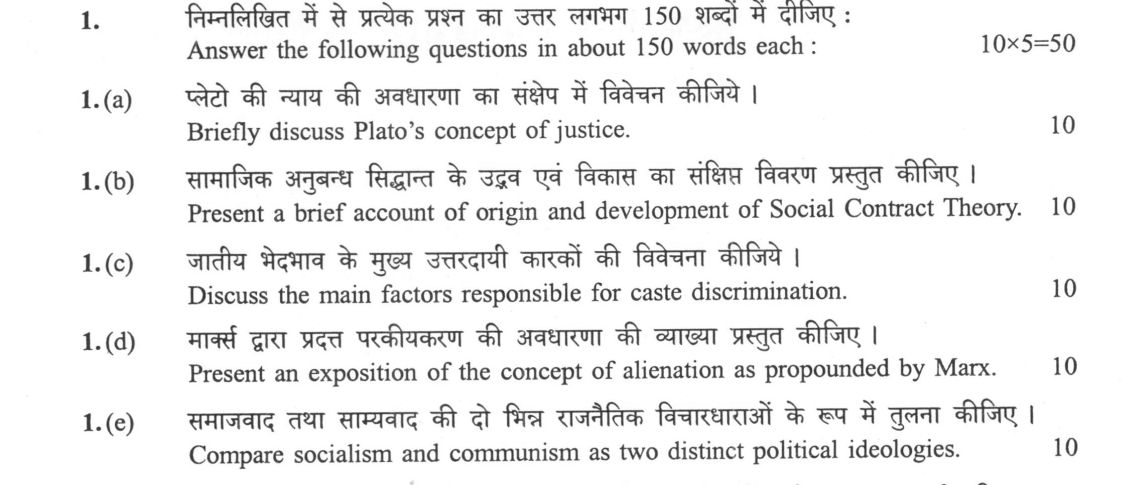
Answer the following questions in about 150 words each: (a) Briefly discuss Plato's concept of justice. (10 marks) (b) Present a…
Answer the following questions in about 150 words each: Briefly discuss Plato's concept of justice. 10 marks
Present a brief account of origin and development of Social Contract Theory. 10 marks
Discuss the main factors responsible for caste discrimination. 10 marks
Present an exposition of the concept of alienation as propounded by Marx. 10 marks
Compare socialism and communism as two distinct political ideologies. 10 marks
हिंदी में प्रश्न पढ़ें
निम्नलिखित में से प्रत्येक प्रश्न का उत्तर लगभग 150 शब्दों में दीजिए : प्लेटो की न्याय की अवधारणा का संक्षेप में विवेचन कीजिए । (10 अंक)
सामाजिक अनुबंध सिद्धांत के उद्भव एवं विकास का संक्षिप्त विवरण प्रस्तुत कीजिए । (10 अंक)
जातीय भेदभाव के मुख्य उत्तरदायी कारकों की विवेचना कीजिए । (10 अंक)
मार्क्स द्वारा प्रदत्त परकीयकरण की अवधारणा की व्याख्या प्रस्तुत कीजिए । (10 अंक)
समाजवाद तथा साम्यवाद की दो भिन्न राजनीतिक विचारधाराओं के रूप में तुलना कीजिए । (10 अंक)
Model answer
Written by UPSC Answer Check against this question's marking rubric, to the 150-word length. UPSC does not publish answers for Mains — this is one way to score well, not an official key.
(a) Plato's Concept of Justice
In the Republic, Plato conceptualizes justice (dikaiosyne) not as a mere legalistic convention, but as the fundamental structural virtue of both the human soul and the political community. Rejecting the Sophistic challenge posed by Thrasymachus in Book I—who asserted that justice is merely the "interest of the stronger"—Plato defines justice intrinsically as functional specialization, or "doing one's own work" (ta heautou prattein) without encroaching upon the domain of others.
Plato posits an isomorphism between the individual and the state (polis). The human soul consists of three elements: Reason, Spirit, and Appetite. Correspondingly, the ideal state comprises three classes: Philosopher-Kings (governed by Reason), Auxiliaries or Guardians (governed by Spirit), and Producers or Artisans (governed by Appetite). Justice is realized as psychic harmony when each part performs its distinct function under the guidance of Reason, producing social and moral order through a balanced hierarchy of virtues.
(b) Origin and Development of Social Contract Theory
Social Contract Theory emerged in early modern political philosophy to ground political legitimacy and obligation in rational human consent rather than divine right.
Thomas Hobbes initiated the modern tradition in Leviathan, positing a prepolitical "state of nature" characterized by a "war of all against all," where life is solitary, poor, nasty, brutish, and short. To secure survival, individuals surrender all natural rights to an absolute sovereign. John Locke modified this construct in his Second Treatise, describing the state of nature as governed by the Law of Nature. For Locke, individuals retain natural rights to life, liberty, and estate, establishing a limited, constitutional government based on fiduciary trust.
Jean-Jacques Rousseau advanced the theory by identifying private property as the source of inequality. In The Social Contract, he argued that individuals surrender particular wills to the sovereign "General Will," realizing moral freedom and popular sovereignty. In contemporary philosophy, John Rawls revived the contractarian tradition in A Theory of Justice through the heuristic device of the "original position" behind a "veil of ignorance" to deduce fair principles of distributive justice.
(c) Factors Responsible for Caste Discrimination
Caste discrimination is a systemic phenomenon sustained by an interplay of socio-cultural, economic, and political factors.
The religious-ritual foundation of caste derives from the traditional varna hierarchy, sanctified through rigid concepts of ritual purity and pollution (asoucha). Sociologically, as B.R. Ambedkar observed, caste is maintained primarily through compulsory endogamy, which prevents social assimilation and perpetuates practices of untouchability.
Economically, caste operates through hereditary occupational segregation, resulting in the structural landlessness of marginalized communities, unequal asset distribution, and forced reliance on unfree or precarious labour. Educationally, centuries of historical exclusion from literacy have created intergenerational educational deficits, currently manifested in the modern digital divide and under-representation in higher education.
Politically, despite constitutional protections under Articles 15, 16, and 17, deep-seated caste discrimination persists due to the hegemony of dominant agrarian castes and opportunistic vote-bank mobilization. Dismantling this systemic hierarchy demands radical land redistribution, strict enforcement of the Protection of Civil Rights Act, and active promotion of inter-caste social integration.
(d) Marx's Concept of Alienation
Karl Marx propounded his theory of alienation (Entfremdung) in the Economic and Philosophic Manuscripts of 1844, analyzing the estrangement of the working class under capitalist modes of production. Rooted in private ownership of the means of production and the commodification of wage-labour, alienation manifests across four interconnected dimensions.
First, the worker is alienated from the product of labour; the object produced is appropriated by the capitalist and confronts the worker as an alien, hostile power. Second, the worker experiences alienation from the act of production itself, transforming creative work into repetitive, forced, and physically exhausting toil. Third, this estrangement separates humans from their "species-being" (Gattungswesen)—the conscious, purposeful, and creative essence distinctive to humanity. Fourth, it induces alienation of humans from fellow humans, reducing social relationships to competitive market exchanges.
For Marx, alienation is not an inescapable existential condition but a historically contingent consequence of capitalism, overcome only through the revolutionary abolition of private property and the establishment of unalienated, communist production.
(e) Comparison of Socialism and Communism
Socialism and communism represent distinct ideological models and developmental phases within Marxist political theory, as formulated in Marx's Critique of the Gotha Programme.
Regarding economic distribution, socialism operates on the principle "from each according to their ability, to each according to their work," linking compensation directly to labour contribution. In contrast, communism functions on the higher principle "from each according to their ability, to each according to their needs," decoupling material provision from individual output.
In property relations, socialism establishes state ownership and public management of major means of production, whereas communism achieves common social ownership characterized by the complete absence of private property and social classes.
Concerning the state, socialism relies on a centralized proletarian state ("dictatorship of the proletariat") to suppress capitalist resistance and reorganize production. In contrast, communism anticipates the complete "withering away of the state," replacing political governance with administrative self-regulation.
Thus, while socialism serves as a transitional phase marked by bourgeois remnants, communism constitutes the stateless, classless culmination of human emancipation.
What "Discuss" is asking you to do
Lay the issue out from more than one side — how it arose, what is claimed for it, what is held against it, and where it now stands. UPSC attaches discuss to broad topics with several live dimensions, so coverage of the dimensions earns more than the strength of your opinion.
Structure that answers it
Set the issue up → the case as it is made → the case against → the dimension both sides leave out → where the balance now lies
Where marks are lost
Listing facts with no thread between them, or arguing one side throughout and calling it a discussion.
How this answer will be evaluated
Approach
Framework: UPSC Mains Philosophy Paper II. (a) discuss: intro > 3-4 dimensions > example > balanced close | (b) account for: state the phenomenon > the causes in order of weight > conclusion | (c) discuss: intro > 3-4 dimensions > example > balanced close | (d) explain: definition/context > points in order > small example > short close | (e) compare: paired headings or table > key differences > significance > conclusion Full marks: Precise technical vocabulary, clear reconstruction of arguments, and strong analytical depth.
Key points expected
- Define justice as 'doing one's own work' (ta heautou ergon)
- Link tripartite soul to tripartite state structure
- Identify the four cardinal virtues (wisdom, courage, moderation, justice)
- Explain the 'Great Analogy' between individual and city
- Identify Thomas Hobbes as the originator (Leviathan)
- Contrast Hobbes' 'state of nature' with Locke's
- Explain Rousseau's 'General Will' as a development
- Mention the shift from 'natural rights' to 'social will'
Evaluation rubric
Each sub-part is marked on its own, against the marks and word limit printed on the paper.
- (a) Reconstruct the argument for justice as harmony in the Republic. 10 marks · 150 words
discuss— intro → 3-4 dimensions → example → balanced close
Must cover
- Define justice as 'doing one's own work' (ta heautou ergon)
- Link tripartite soul to tripartite state structure
- Identify the four cardinal virtues (wisdom, courage, moderation, justice)
- Explain the 'Great Analogy' between individual and city
Loses marks
- Biographical details of Plato's life
- Confusing Plato's justice with modern legal justice
- Vague paraphrase without technical terms
Earns more
- Mention the 'noble lie' (myth of the metals)
- Reference the 'Philosopher King' as the ideal ruler
- Use Greek terms like 'dikaiosyne' or 'armonia'
Extra mark
- Cite specific Book numbers from the Republic
- Mention the 'Ring of Gyges' thought experiment
- (b) Trace the historical evolution of the social contract theory. 10 marks · 150 words
account for— state the phenomenon → the causes in order of weight → conclusion
Must cover
- Identify Thomas Hobbes as the originator (Leviathan)
- Contrast Hobbes' 'state of nature' with Locke's
- Explain Rousseau's 'General Will' as a development
- Mention the shift from 'natural rights' to 'social will'
Loses marks
- Listing thinkers without explaining their specific contribution
- Confusing the theory with modern constitutionalism
- Ignoring the 'state of nature' premise
Earns more
- Reference the 'state of nature' as a hypothetical construct
- Mention the 'right of revolution' in Locke
- Use the term 'consent of the governed'
Extra mark
- Mention the influence of Grotius or Pufendorf
- Reference the 'social compact' vs 'social contract' distinction
- (c) Analyze the sociological and religious roots of caste discrimination. 10 marks · 150 words
discuss— intro → 3-4 dimensions → example → balanced close
Must cover
- Identify 'Purity and Pollution' as the primary factor
- Explain the role of 'Varna' and 'Jati' in social stratification
- Mention the 'hereditary nature' of occupation and status
- Discuss the 'endogamy' (marriage within the group) aspect
Loses marks
- Focusing only on modern legal remedies
- Ignoring the religious/ideological basis
- Vague generalizations about 'discrimination'
Earns more
- Reference the 'Dharma' or religious sanction of the system
- Mention the 'untouchability' as the extreme form
- Use the term 'social closure' or 'hierarchy'
Extra mark
- Cite specific texts like the Manusmriti
- Mention the 'Brahminical' ideology
- (d) Explain the four dimensions of alienation in Marx's critique. 10 marks · 150 words
explain— definition/context → points in order → small example → short close
Must cover
- Define alienation from the 'product of labor'
- Define alienation from the 'act of production' (labor)
- Define alienation from 'species-being' (Gattungswesen)
- Define alienation from 'other human beings'
Loses marks
- Confusing alienation with mere 'loneliness' or 'isolation'
- Ignoring the economic/material basis of the concept
- Biographical details of Marx
Earns more
- Link alienation to the 'commodity fetishism'
- Mention the 'wage labor' system as the cause
- Use the term 'Entfremdung' (German for alienation)
Extra mark
- Reference the 'Economic and Philosophic Manuscripts of 1844'
- Mention the 'reification' of labor
- (e) Distinguish between socialism and communism as political ideologies. 10 marks · 150 words
compare— paired headings or table → key differences → significance → conclusion
Must cover
- Contrast 'state ownership' (socialism) vs 'common ownership' (communism)
- Explain the 'transitional stage' of socialism
- Mention the 'withering away of the state' in communism
- Contrast 'distribution according to work' vs 'according to need'
Loses marks
- Treating them as synonyms
- Focusing on historical regimes (USSR, China) rather than theory
- Vague generalizations about 'equality'
Earns more
- Reference the 'dictatorship of the proletariat'
- Mention the 'classless society' as the communist goal
- Use the term 'proletariat' and 'bourgeoisie'
Extra mark
- Cite 'Critique of the Gotha Programme' for the distinction
- Mention 'democratic centralism'
Practice this exact question
Write your answer and it is marked point by point against the model answer above — what you covered, what you missed, what you got wrong.
Evaluate my answer →More from Philosophy 2024 Paper II
- Q1 Answer the following questions in about 150 words each: (a) Briefly discuss Plato's conce…
- Q2 (a) Delineate the central tenets of Humanism. How does advent of enlightenment in Europe…
- Q3 (a) Do you agree with the view that Aristotle was more successful than Plato in steering…
- Q4 (a) Discuss gender equality as a necessary condition to achieve empowerment of women. Als…