Paper II — Q2
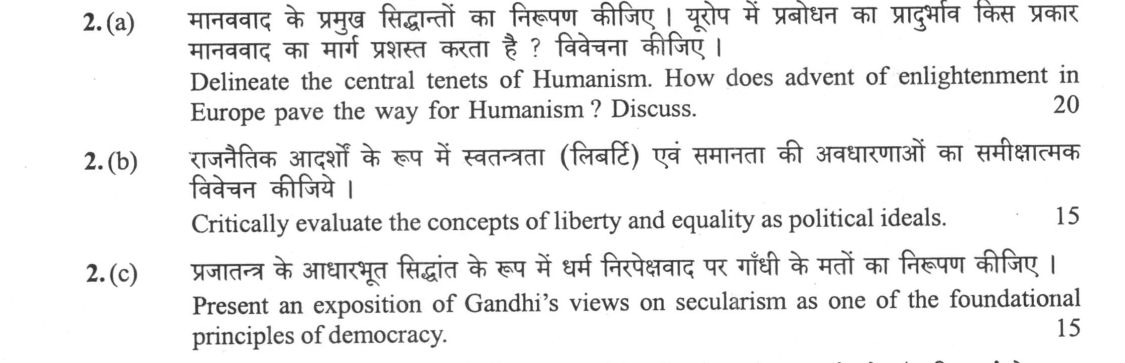
(a) Delineate the central tenets of Humanism. How does advent of enlightenment in Europe pave the way for Humanism? Discuss. (20…
Delineate the central tenets of Humanism. How does advent of enlightenment in Europe pave the way for Humanism? Discuss. 20 marks
Critically evaluate the concepts of liberty and equality as political ideals. 15 marks
Present an exposition of Gandhi's views on secularism as one of the foundational principles of democracy. 15 marks
हिंदी में प्रश्न पढ़ें
मानववाद के प्रमुख सिद्धांतों का निरूपण कीजिए । यूरोप में प्रबोधन का प्रादुर्भाव किस प्रकार मानववाद का मार्ग प्रशस्त करता है ? विवेचना कीजिए । (20 अंक)
राजनीतिक आदर्शों के रूप में स्वतंत्रता (लिबर्टी) एवं समानता की अवधारणाओं का समीक्षात्मक विवेचन कीजिए । (15 अंक)
प्रजातंत्र के आधारभूत सिद्धांत के रूप में धर्म निरपेक्षवाद पर गांधी के मतों का निरूपण कीजिए । (15 अंक)
Model answer
Written by UPSC Answer Check against this question's marking rubric, to the expected length. UPSC does not publish answers for Mains — this is one way to score well, not an official key.
Modern political philosophy centers on human agency, negotiating the dialectic between individual freedom, collective justice, and the moral architecture of the state.
Tenets of Humanism and the Enlightenment
Humanism asserts the intrinsic dignity, moral agency, and capacity of human beings to understand and shape their world through reason rather than divine revelation. Its central tenets include anthropocentrism, the primacy of critical inquiry over dogma, and the pursuit of flourishing in the temporal world.
Renaissance humanism, articulated in Pico della Mirandola’s Oration on the Dignity of Man and the Christian humanism of Erasmus, initiated this shift by celebrating human potential within a broad theological frame. The European Enlightenment transformed this into secular humanism through a radical epistemic revolution.
The scientific breakthroughs of Galileo and Newton dismantled scholastic teleology, replacing it with an empirical, mechanistic view of nature that elevated human intellect. Immanuel Kant crystallized this shift with his motto Sapere aude (dare to know), defining Enlightenment as humanity’s release from self-incurred immaturity. John Locke’s doctrine of inalienable natural rights grounded political legitimacy in human consent; David Hume’s empiricism undermined metaphysical orthodoxies; and Denis Diderot’s Encyclopédie secularized and democratized knowledge. Together, they established an anthropocentric framework where human welfare became the sole measure of social institutions. In India, this trajectory found resonance in Rabindranath Tagore’s spiritual humanism, which prioritized universal human fellowship, and Jawaharlal Nehru’s scientific humanism, which championed rational planning and secular progress.
Critical Evaluation of Liberty and Equality
Liberty and equality represent intertwined yet conflicting political ideals. Isaiah Berlin bifurcated liberty into negative liberty (absence of external obstacles) and positive liberty (capacity for self-mastery and autonomous flourishing). Equality similarly operates at multiple levels: formal legal equality, equality of opportunity, and substantive equality of outcome.
The tension between these ideals is profound. Absolute negative liberty inevitably generates stark socioeconomic disparities, whereas enforced equality of outcome risks state paternalism and tyranny. This friction is evident in the contrast between J.S. Mill’s harm principle, which fiercely guards individual autonomy against majoritarian overreach, and Jean-Jacques Rousseau’s concept of the 'general will', which subordinates particular liberties to collective sovereign equality.
Contemporary political philosophy attempts to reconcile them. John Rawls proposes a lexical ordering where basic equal liberties are inviolable, but social inequalities are permitted only if they maximize the advantage of the least-advantaged (Difference Principle). Ronald Dworkin advances this through 'equality of resources', arguing that justice must be ambition-sensitive yet endowment-insensitive. In the Indian constitutional framework, this synthesis is institutionalized by harmonizing Fundamental Rights (Articles 14, 19, 21) with the egalitarian directives of the DPSPs (Articles 38, 39). However, as B.R. Ambedkar critically observed, formal political equality remains a contradictory facade unless underwritten by radical social and economic equality.
Gandhi’s Secularism as a Democratic Foundation
Mahatma Gandhi conceived secularism not as the Western 'wall of separation' between Church and State, nor as irreligious materialism, but as *Sarva Dharma Sambhava*—equal reverence for all religious traditions. For Gandhi, all religions are partial, imperfect paths toward the singular, ultimate Truth (Satya), bound together by non-violence (Ahimsa).
Gandhi argued that true democracy cannot exist in an ethical vacuum. In Hind Swaraj, he critiqued modern Western democracies as atomized and majoritarian. Instead, he envisioned a decentralized democracy of village republics (Panchayati Raj), grounded in Swaraj (moral self-rule). Secularism was the prerequisite for this vision: by spiritualizing politics through inclusive ethics rather than sectarian dogma, it guaranteed that minoritarian voices retained equal moral standing.
Gandhi demonstrated this praxis through daily interfaith prayer meetings and his direct interventions during communal violence in Noakhali, insisting that active fraternal engagement, rather than state-enforced indifference, is the lifeblood of a pluralistic democracy.
Conclusion
A robust democratic polity requires a continuous synthesis of these ideals: the Enlightenment's commitment to individual reason and rights, the constitutional balancing of liberty and substantive equality, and the Gandhian ethos of interfaith fraternity. Sustaining this balance offers the most viable path toward an inclusive, humanist democratic order.
What "Discuss" is asking you to do
Lay the issue out from more than one side — how it arose, what is claimed for it, what is held against it, and where it now stands. UPSC attaches discuss to broad topics with several live dimensions, so coverage of the dimensions earns more than the strength of your opinion.
Structure that answers it
Set the issue up → the case as it is made → the case against → the dimension both sides leave out → where the balance now lies
Where marks are lost
Listing facts with no thread between them, or arguing one side throughout and calling it a discussion.
How this answer will be evaluated
Approach
Framework: null. (a) discuss: intro > 3-4 dimensions > example > balanced close | (b) critically evaluate: positives > negatives/limits > conditions/safeguards > conclusion | (c) explain: definition/context > points in order > small example > short close Full marks: Precise reconstruction of arguments, strong counter-arguments, and concrete application.
Key points expected
- Define Humanism's central tenets (anthropocentrism, reason, dignity)
- Explain the shift from medieval theocentrism to humanism
- Link Enlightenment rationalism to the maturation of Humanist thought
- Provide a balanced conclusion on the relationship
- Define liberty and equality as political ideals
- Present the positive aspects of both concepts
- Identify the negatives, limits, or tensions between them
- Offer a conclusion on their co-existence
Evaluation rubric
Each sub-part is marked on its own, against the marks and word limit printed on the paper.
- (a) Delineate Humanism's tenets and discuss the Enlightenment's role in its development. 20 marks
discuss— intro → 3-4 dimensions → example → balanced close
Must cover
- Define Humanism's central tenets (anthropocentrism, reason, dignity)
- Explain the shift from medieval theocentrism to humanism
- Link Enlightenment rationalism to the maturation of Humanist thought
- Provide a balanced conclusion on the relationship
Loses marks
- Biographical details of philosophers
- Vague paraphrase of ideas
- Ignoring the 'Enlightenment' part of the question
Earns more
- Mention specific thinkers (Pico, Erasmus, Kant, Voltaire)
- Reference the Renaissance context
- Distinguish between Renaissance and Enlightenment Humanism
- Use precise technical vocabulary
Extra mark
- Cite specific works (e.g., 'Oration on the Dignity of Man')
- Reference specific philosophical concepts (e.g., 'Aufklärung')
- (b) Critically evaluate liberty and equality as political ideals. 15 marks
critically evaluate— positives → negatives/limits → conditions/safeguards → conclusion
Must cover
- Define liberty and equality as political ideals
- Present the positive aspects of both concepts
- Identify the negatives, limits, or tensions between them
- Offer a conclusion on their co-existence
Loses marks
- Defining terms without evaluation
- Treating liberty and equality as identical
- Ignoring the 'critical' aspect (only listing pros)
Earns more
- Distinguish between negative and positive liberty
- Distinguish between formal and substantive equality
- Discuss the 'liberty-equality' tension (e.g., Rawls)
- Apply to concrete political problems
Extra mark
- Reference specific political theorists (e.g., Isaiah Berlin, John Rawls)
- Cite specific constitutional provisions
- (c) Explain Gandhi's views on secularism as a foundational principle of democracy. 15 marks
explain— definition/context → points in order → small example → short close
Must cover
- Define Gandhi's concept of secularism (Sarvodaya)
- Explain the link between secularism and democracy
- Present the argument for religious tolerance
- Conclude on its foundational role
Loses marks
- Biography of Gandhi
- Confusing Gandhi's secularism with state secularism
- Vague paraphrase of 'tolerance'
Earns more
- Use the term 'Sarvodaya' or 'Vasudhaiva Kutumbakam'
- Distinguish Gandhi's view from Western secularism
- Reference the 'Hindutva' debate
- Apply to concrete moral problems
Extra mark
- Cite specific writings (e.g., 'Hind Swaraj')
- Reference specific historical events (e.g., communal riots)
Practice this exact question
Write your answer and it is marked point by point against the model answer above — what you covered, what you missed, what you got wrong.
Evaluate my answer →More from Philosophy 2024 Paper II
- Q1 Answer the following questions in about 150 words each: (a) Briefly discuss Plato's conce…
- Q2 (a) Delineate the central tenets of Humanism. How does advent of enlightenment in Europe…
- Q3 (a) Do you agree with the view that Aristotle was more successful than Plato in steering…
- Q4 (a) Discuss gender equality as a necessary condition to achieve empowerment of women. Als…
- Q5 Answer the following questions in about 150 words each: (a) Can there be a religion witho…