Paper II — Q3
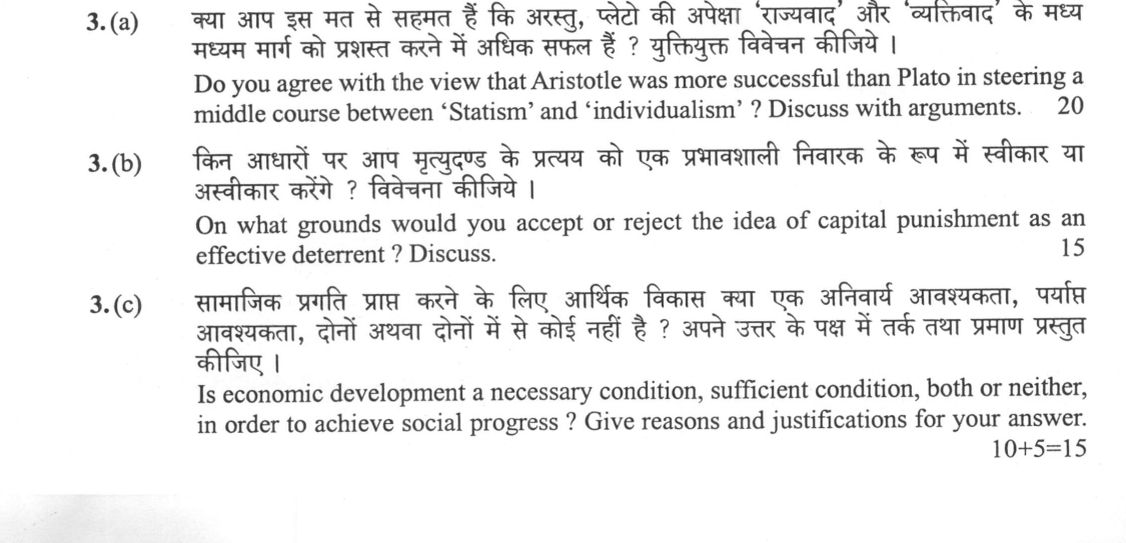
(a) Do you agree with the view that Aristotle was more successful than Plato in steering a middle course between 'Statism' and…
Do you agree with the view that Aristotle was more successful than Plato in steering a middle course between 'Statism' and 'individualism'? Discuss with arguments. 20 marks
On what grounds would you accept or reject the idea of capital punishment as an effective deterrent? Discuss. 15 marks
Is economic development a necessary condition, sufficient condition, both or neither, in order to achieve social progress? Give reasons and justifications for your answer. (10+5=15 marks)
हिंदी में प्रश्न पढ़ें
क्या आप इस मत से सहमत हैं कि अरस्तू, प्लेटो की अपेक्षा 'राज्यवाद' और 'व्यक्तिवाद' के मध्य मध्यम मार्ग को प्रशस्त करने में अधिक सफल है ? युक्तियुक्त विवेचन कीजिए । (20 अंक)
किन आधारों पर आप मृत्युदंड के प्रत्यय को एक प्रभावशाली निवारक के रूप में स्वीकार या अस्वीकार करेंगे ? विवेचना कीजिए । (15 अंक)
सामाजिक प्रगति प्राप्त करने के लिए आर्थिक विकास क्या एक अनिवार्य आवश्यकता, पर्याप्त आवश्यकता, दोनों अथवा दोनों में से कोई नहीं है ? अपने उत्तर के पक्ष में तर्क तथा प्रमाण प्रस्तुत कीजिए । (10+5=15 अंक)
Model answer
Written by UPSC Answer Check against this question's marking rubric, to the expected length. UPSC does not publish answers for Mains — this is one way to score well, not an official key.
Political philosophy, punishment and development all turn on balancing collective order with individual flourishing. Aristotle’s politics, capital punishment and economic progress can be examined as attempts to locate that balance.
Aristotle’s middle course Plato’s Republic is often read as statism: the city is organised around the philosopher-king, guardians are separated from private family and property, and the common good is pursued through class discipline. Aristotle criticises this excessive unity in Politics, arguing that a household is not a city and that a state should not dissolve the family or private ownership. He defends private property because it encourages care, reduces disputes and supports household management, while still subordinating it to civic virtue. His preferred polity is a mixed constitution, blending oligarchic and democratic elements, which moderates extremes. Yet Aristotle is not an atomistic individualist. For him the individual is teleological: human beings achieve eudaimonia only in the polis, through friendship, law and participation. Thus he steers a golden mean between Plato’s absorption of the individual in the state and modern individualism that treats the person as prior to the community.
Capital punishment as deterrence Deterrence arguments for capital punishment rest on the idea that the most severe penalty prevents murder by creating fear. Bentham’s utilitarian calculus supports punishment if it prevents greater harm; Beccaria, though a founder of deterrence theory, opposed the death penalty and argued that certainty, not severity, deters. Abolitionists counter that empirical evidence does not show a clear deterrent effect; Amnesty International has repeatedly found no reliable evidence that the death penalty deters murder more than life imprisonment. There are also wrongful execution risks, which make deterrence morally dangerous. Retributive arguments, associated with Lord Stephen, justify punishment as deserved moral response rather than mere utility. In India, the 35th Law Commission Report (1967) recommended abolition except in the case of waging war, while Bachan Singh v. State of Punjab (1980) retained it under the “rarest of rare” doctrine. Delay in execution has been debated in Supreme Court cases such as V. Singanallur v. Union of India (2015) as raising torture concerns. Comparative abolition appears in Council of Europe Protocol No. 13 to the European Convention on Human Rights, a Council of Europe treaty; the EU is not a party to the ECHR, though its member states have abolished capital punishment.
Economic development and social progress Logically, a necessary condition must be present for social progress, while a sufficient condition guarantees it. Economic development is often treated as necessary because it expands education, health, infrastructure and opportunity, as reflected in HDI beyond GDP. But it is not sufficient: growth can coexist with inequality, environmental damage and social fragmentation. The Kerala model shows high social indicators with lower per capita income, while the Gujarat model shows growth with debates over distribution and social costs. Bhutan’s Gross National Happiness adds well-being and ecology to economic measures. Counter-examples include Nigeria’s resource curse, where oil wealth has not translated into broad social progress. Amartya Sen’s capability approach argues that development must expand real freedoms, not merely income. Rawlsian distribution of primary goods suggests that social progress requires fair basic liberties, opportunities and social bases of self-respect. Gandhian critique warns that development without ethics, self-reliance and non-violence may deepen exploitation. Thus economic development is a necessary but not sufficient condition for social progress.
Conclusion Aristotle’s mixed polity, the limits of capital punishment and the insufficiency of GDP together show that neither pure statism nor pure individualism, nor mere severity or mere growth, can secure human flourishing. The way forward is institutional moderation: rights-protecting states, evidence-based criminal justice, and development measured by capabilities, equality and dignity.
What "Discuss" is asking you to do
Lay the issue out from more than one side — how it arose, what is claimed for it, what is held against it, and where it now stands. UPSC attaches discuss to broad topics with several live dimensions, so coverage of the dimensions earns more than the strength of your opinion.
Structure that answers it
Set the issue up → the case as it is made → the case against → the dimension both sides leave out → where the balance now lies
Where marks are lost
Listing facts with no thread between them, or arguing one side throughout and calling it a discussion.
How this answer will be evaluated
Approach
Framework: UPSC Mains Philosophy Paper II. (a) discuss: intro > 3-4 dimensions > example > balanced close | (b) discuss: intro > 3-4 dimensions > example > balanced close | (c) justify: claim > 3-4 reasons > evidence > conclusion Full marks: Precise technical vocabulary, strong counter-arguments, and clear logical structure.
Key points expected
- Define 'Statism' in context of Plato's Republic
- Define 'Individualism' in context of modern political thought
- Reconstruct Aristotle's 'Golden Mean' (mesotes) in politics
- Provide a balanced judgment on the validity of the comparison
- Define 'deterrent' in the context of criminal law
- Present arguments for capital punishment as a deterrent
- Present arguments against its effectiveness (e.g., rational choice theory)
- Conclude with a reasoned judgment on its efficacy
Evaluation rubric
Each sub-part is marked on its own, against the marks and word limit printed on the paper.
- (a) Evaluate the claim that Aristotle's political thought is a 'middle course' between Plato's statism and individualism. 20 marks
discuss— intro → 3-4 dimensions → example → balanced close
Must cover
- Define 'Statism' in context of Plato's Republic
- Define 'Individualism' in context of modern political thought
- Reconstruct Aristotle's 'Golden Mean' (mesotes) in politics
- Provide a balanced judgment on the validity of the comparison
Loses marks
- Biographical details of Aristotle or Plato
- Vague paraphrase without technical terms
- Ignoring the 'individualism' side of the argument
Earns more
- Reference to 'Politics' Book I or II
- Mention of 'Zoon politikon' (political animal)
- Contrast with Plato's 'Philosopher King' concept
- Use of Sanskrit/Greek terms like 'mesotes' or 'eudaimonia'
Extra mark
- Reference to specific chapters in 'Politics'
- Mention of 'Nicomachean Ethics' for the Golden Mean
- (b) Critically evaluate the efficacy of capital punishment as a deterrent to crime. 15 marks
discuss— intro → 3-4 dimensions → example → balanced close
Must cover
- Define 'deterrent' in the context of criminal law
- Present arguments for capital punishment as a deterrent
- Present arguments against its effectiveness (e.g., rational choice theory)
- Conclude with a reasoned judgment on its efficacy
Loses marks
- Emotional or moralizing language without logical argument
- Ignoring the 'deterrent' aspect and focusing only on 'retribution'
- Factual errors regarding legal provisions
Earns more
- Reference to 'retributive justice' vs 'utilitarianism'
- Mention of 'irreversibility' of the punishment
- Reference to specific legal cases or statutes (e.g., Indian Constitution Art 21)
- Use of terms like 'deterrence' and 'retribution'
Extra mark
- Reference to specific Supreme Court judgments (e.g., Bachan Singh case)
- Mention of 'rarest of rare' doctrine
- (c) Justify whether economic development is a necessary, sufficient, or both condition for social progress. 15 marks
justify— claim → 3-4 reasons → evidence → conclusion
Must cover
- Define 'economic development' and 'social progress'
- Analyze the 'necessary condition' aspect (e.g., poverty alleviation)
- Analyze the 'sufficient condition' aspect (e.g., HDI, inequality)
- Provide a clear conclusion on the relationship
Loses marks
- Confusing 'economic growth' with 'economic development'
- Ignoring the 'social' aspect of progress
- Vague generalizations without specific examples
Earns more
- Reference to 'HDI' (Human Development Index)
- Mention of 'Gini coefficient' for inequality
- Use of terms like 'correlation' vs 'causation'
- Reference to specific economic theories (e.g., Amartya Sen's capabilities)
Extra mark
- Reference to specific data or reports (e.g., UNDP reports)
- Mention of 'sustainable development' goals
Practice this exact question
Write your answer and it is marked point by point against the model answer above — what you covered, what you missed, what you got wrong.
Evaluate my answer →More from Philosophy 2024 Paper II
- Q1 Answer the following questions in about 150 words each: (a) Briefly discuss Plato's conce…
- Q2 (a) Delineate the central tenets of Humanism. How does advent of enlightenment in Europe…
- Q3 (a) Do you agree with the view that Aristotle was more successful than Plato in steering…
- Q4 (a) Discuss gender equality as a necessary condition to achieve empowerment of women. Als…
- Q5 Answer the following questions in about 150 words each: (a) Can there be a religion witho…
- Q6 (a) Is it necessary to adhere to the notions of immortality of soul and rebirth in order…