Paper II — Q4
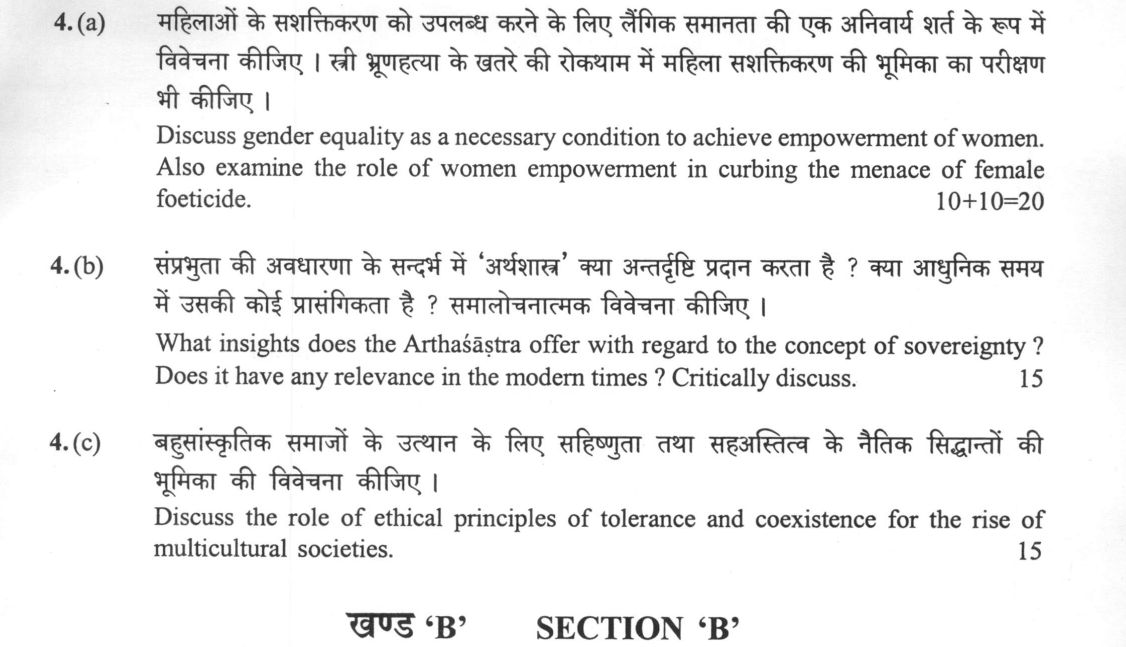
(a) Discuss gender equality as a necessary condition to achieve empowerment of women. Also examine the role of women empowerment…
Discuss gender equality as a necessary condition to achieve empowerment of women. Also examine the role of women empowerment in curbing the menace of female foeticide. (10+10=20 marks)
What insights does the Arthaśāstra offer with regard to the concept of sovereignty? Does it have any relevance in the modern times? Critically discuss. 15 marks
Discuss the role of ethical principles of tolerance and coexistence for the rise of multicultural societies. 15 marks
हिंदी में प्रश्न पढ़ें
महिलाओं के सशक्तिकरण को उपलब्ध करने के लिए लैंगिक समानता की एक अनिवार्य शर्त के रूप में विवेचना कीजिए । स्त्री भ्रूणहत्या के खतरे की रोकथाम में महिला सशक्तिकरण की भूमिका का परीक्षण भी कीजिए । (10+10=20 अंक)
संप्रभुता की अवधारणा के संदर्भ में 'अर्थशास्त्र' क्या अंतर्दृष्टि प्रदान करता है ? क्या आधुनिक समय में उसकी कोई प्रासंगिकता है ? समालोचनात्मक विवेचना कीजिए । (15 अंक)
बहुसांस्कृतिक समाजों के उत्थान के लिए सहिष्णुता तथा सहअस्तित्व के नैतिक सिद्धांतों की भूमिका की विवेचना कीजिए । (15 अंक)
Model answer
Written by UPSC Answer Check against this question's marking rubric, to the expected length. UPSC does not publish answers for Mains — this is one way to score well, not an official key.
Gender Equality, Empowerment, and Female Foeticide
Gender equality is the necessary ontological and practical condition for women's empowerment. True empowerment demands moving beyond formal equality (equal rights guaranteed under the law) to substantive equality (equal real opportunities, socio-economic agency, and distribution of power). As articulated in Amartya Sen’s and Martha Nussbaum’s Capability Approach, empowerment requires enabling central human capabilities—bodily health, political participation, and economic agency—so that women possess the substantive freedom to choose lives they value. Without substantive gender equality in property rights, education, and social norms, empowerment remains purely rhetorical.
Women's empowerment is pivotal in eradicating the structural menace of female foeticide. Entrenched son preference stems from patrilineal socio-economic arrangements where daughters are perceived as liabilities and sons as social insurance. When women achieve educational and economic autonomy, their bargaining power within the household expands, directly dismantling patriarchal utility calculations. While legislative measures like the Pre-Conception and Pre-Natal Diagnostic Techniques (PC-PNDT) Act are essential, their limitations in curbing underground diagnostic misuse highlight that legal deterrence alone is insufficient. Holistic interventions like Beti Bachao Beti Padhao, combined with rising female literacy and workforce participation, show a direct positive impact. In historically skewed states such as Haryana and Punjab, rising female education and socio-economic agency have generated an inverse correlation with son preference, progressively improving the Child Sex Ratio.
Sovereignty in the Arthaśāstra and Modern Relevance
Kauṭilya’s Arthaśāstra conceptualizes sovereignty through the Saptāṅga theory, which views the state as an organic whole comprising seven prakṛtis (constituent elements): Svāmin (the ruler), Amātya (ministers/bureaucracy), Janapada (territory and population), Durga (fortified city), Kośa (treasury), Daṇḍa (military power), and Mitra (allies). Sovereignty is concentrated in the Svāmin, whose authority is legitimized through *rāja-dharma*—subordinated to the collective welfare (yogakṣema) of the people. Kauṭilya advances an instrumental view of dharma, treating ethical and moral norms as pragmatic instruments for state security, political stability, and consolidation of de facto executive control alongside de jure sovereignty.
In modern times, Kauṭilyan sovereignty retains remarkable relevance for realpolitik in international relations, strategic autonomy, and administrative statecraft geared toward socio-economic welfare. His insistence on an uncompromised treasury (kośa) and strong national defense (daṇḍa) mirrors modern state priorities. However, critically, Kauṭilya’s model conflicts with contemporary constitutional sovereignty. In modern constitutional democracies, sovereignty rests with the people rather than an executive monarch. Furthermore, Kauṭilya's reliance on pervasive surveillance, realpolitik unrestrained by moral universals, and centralized authority runs contrary to institutional checks and balances, democratic legitimacy, and universal human rights.
Ethical Principles of Tolerance and Coexistence in Multicultural Societies
Multicultural societies depend on moving beyond negative tolerance (passive forbearance or mere coexistence without engagement) to positive coexistence grounded in mutual respect and active recognition. As Charles Taylor observes in his politics of recognition and Bhikhu Parekh notes in his theory of multiculturalism, cultural identity is integral to human self-realization; hence, a vibrant pluralist society must actively validate diverse cultural frameworks. This aligns with Mahatma Gandhi’s ideal of sarvodaya and religious harmony (sarva dharma sambhava), which insists on mutual enrichment rather than majoritarian assimilation.
In India, constitutional morality institutionalizes these ethical principles through the ideals of fraternity and composite culture under Article 51A(e) and (f), alongside minority cultural and educational safeguards under Articles 29 and 30. This ethos manifests in the everyday syncretism of Kerala’s multi-religious landscape and the preserved distinctiveness of the Northeastern ethnic communities. Nonetheless, the rise of majoritarian tendencies and identity chauvinism poses continuous challenges to this fabric.
The way forward lies in fostering substantive capabilities for vulnerable groups, anchoring executive power strictly within constitutional limits, and revitalizing dialogical fraternity to ensure that pluralism and human dignity thrive in unison.
What "Discuss" is asking you to do
Lay the issue out from more than one side — how it arose, what is claimed for it, what is held against it, and where it now stands. UPSC attaches discuss to broad topics with several live dimensions, so coverage of the dimensions earns more than the strength of your opinion.
Structure that answers it
Set the issue up → the case as it is made → the case against → the dimension both sides leave out → where the balance now lies
Where marks are lost
Listing facts with no thread between them, or arguing one side throughout and calling it a discussion.
How this answer will be evaluated
Approach
Framework: UPSC Mains Philosophy Paper II. (a) discuss: intro > 3-4 dimensions > example > balanced close | (b) critically evaluate: positives > negatives/limits > conditions/safeguards > conclusion | (c) discuss: intro > 3-4 dimensions > example > balanced close Full marks: Precise definitions, strong arguments, concrete examples, and critical evaluation.
Key points expected
- Define gender equality as a necessary condition for empowerment
- Examine the link between women's empowerment and curbing female foeticide
- Provide concrete examples or evidence for the arguments
- Present a balanced conclusion on the relationship
- Explain the Arthaśāstra's concept of sovereignty (e.g., 'Svatantrya')
- Identify the strengths of this concept
- Identify the weaknesses or limitations of this concept
- Assess its relevance in modern political contexts
Evaluation rubric
Each sub-part is marked on its own, against the marks and word limit printed on the paper.
- (a) Analyze gender equality as a prerequisite for empowerment and its role in curbing female foeticide. 20 marks
discuss— intro → 3-4 dimensions → example → balanced close
Must cover
- Define gender equality as a necessary condition for empowerment
- Examine the link between women's empowerment and curbing female foeticide
- Provide concrete examples or evidence for the arguments
- Present a balanced conclusion on the relationship
Loses marks
- Vague paraphrase of 'empowerment' without definition
- Failure to link empowerment directly to the reduction of foeticide
- Biographical details of a feminist thinker instead of argument
Earns more
- Reference to specific laws or policies (e.g., MTP Act)
- Use of precise technical vocabulary (e.g., 'agency', 'autonomy')
- Mention of specific social or economic indicators
- Discussion of the 'menace' of female foeticide in a broader context
Extra mark
- Citation of a specific Supreme Court judgment on gender equality
- Reference to a specific government scheme for women's empowerment
- (b) Critically evaluate the Arthaśāstra's concept of sovereignty and its modern relevance. 15 marks
critically evaluate— positives → negatives/limits → conditions/safeguards → conclusion
Must cover
- Explain the Arthaśāstra's concept of sovereignty (e.g., 'Svatantrya')
- Identify the strengths of this concept
- Identify the weaknesses or limitations of this concept
- Assess its relevance in modern political contexts
Loses marks
- Summarizing the Arthaśāstra without critical evaluation
- Failing to address the 'modern relevance' aspect
- Biographical details of Kautilya instead of his political theory
Earns more
- Use of Sanskrit terms like 'Svatantrya' or 'Svabhava'
- Comparison with modern theories of sovereignty (e.g., Westphalian)
- Discussion of the 'Mandala' theory in relation to sovereignty
- Reference to specific chapters of the Arthaśāstra
Extra mark
- Citation of a specific verse from the Arthaśāstra
- Reference to a modern political scientist who has commented on Kautilya
- (c) Discuss the role of tolerance and coexistence in the rise of multicultural societies. 15 marks
discuss— intro → 3-4 dimensions → example → balanced close
Must cover
- Define the ethical principles of tolerance and coexistence
- Explain how these principles facilitate the rise of multicultural societies
- Provide examples of multicultural societies where these principles are evident
- Present a balanced view on the challenges of implementing these principles
Loses marks
- Vague definition of 'tolerance' without ethical grounding
- Failure to link tolerance/coexistence to the 'rise' of multiculturalism
- General statements without specific examples or philosophical backing
Earns more
- Reference to specific philosophers (e.g., Kant, Rawls) on tolerance
- Discussion of the 'paradox of tolerance'
- Mention of specific multicultural policies or models
- Use of precise terms like 'cultural relativism' or 'universalism'
Extra mark
- Citation of a specific international declaration on cultural rights
- Reference to a specific case study of a multicultural society
Practice this exact question
Write your answer and it is marked point by point against the model answer above — what you covered, what you missed, what you got wrong.
Evaluate my answer →More from Philosophy 2024 Paper II
- Q1 Answer the following questions in about 150 words each: (a) Briefly discuss Plato's conce…
- Q2 (a) Delineate the central tenets of Humanism. How does advent of enlightenment in Europe…
- Q3 (a) Do you agree with the view that Aristotle was more successful than Plato in steering…
- Q4 (a) Discuss gender equality as a necessary condition to achieve empowerment of women. Als…
- Q5 Answer the following questions in about 150 words each: (a) Can there be a religion witho…
- Q6 (a) Is it necessary to adhere to the notions of immortality of soul and rebirth in order…
- Q7 (a) State and evaluate Buddhism as a religion without God. (20 marks) (b) What kind of ep…