Paper II — Q5
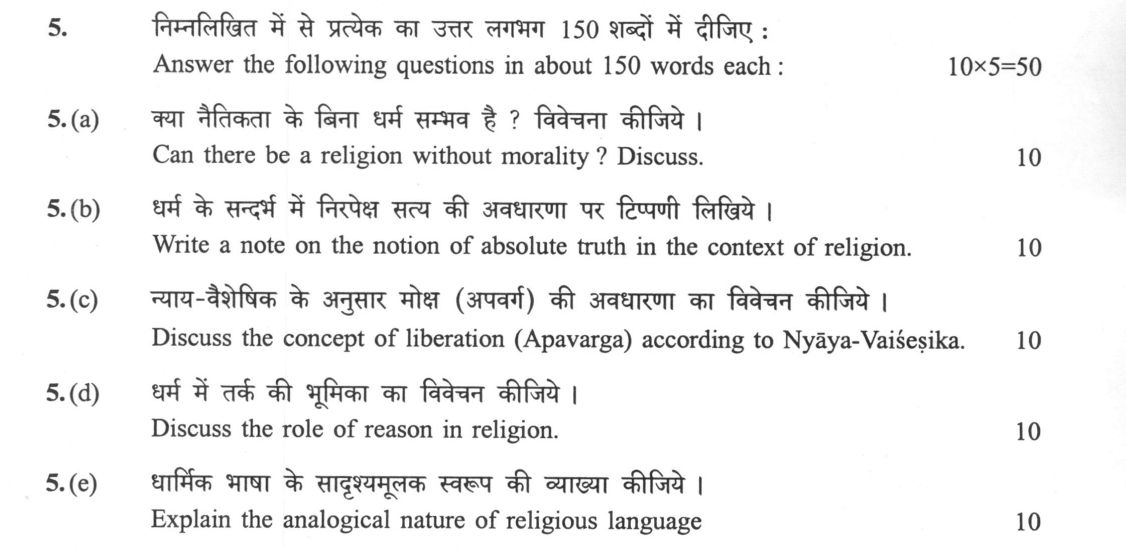
Answer the following questions in about 150 words each: (a) Can there be a religion without morality? Discuss. (10 marks) (b)…
Answer the following questions in about 150 words each: Can there be a religion without morality? Discuss. 10 marks
Write a note on the notion of absolute truth in the context of religion. 10 marks
Discuss the concept of liberation (Apavarga) according to Nyāya-Vaiśeṣika. 10 marks
Discuss the role of reason in religion. 10 marks
Explain the analogical nature of religious language. 10 marks
हिंदी में प्रश्न पढ़ें
निम्नलिखित में से प्रत्येक का उत्तर लगभग 150 शब्दों में दीजिए : क्या नैतिकता के बिना धर्म संभव है ? विवेचना कीजिए । (10 अंक)
धर्म के संदर्भ में निरपेक्ष सत्य की अवधारणा पर टिप्पणी लिखिए । (10 अंक)
न्याय-वैशेषिक के अनुसार मोक्ष (अपवर्ग) की अवधारणा का विवेचन कीजिए । (10 अंक)
धर्म में तर्क की भूमिका का विवेचन कीजिए । (10 अंक)
धार्मिक भाषा के सादृश्यमूलक स्वरूप की व्याख्या कीजिए । (10 अंक)
Model answer
Written by UPSC Answer Check against this question's marking rubric, to the 150-word length. UPSC does not publish answers for Mains — this is one way to score well, not an official key.
(a) Religion and Morality
The relationship between religion and morality spans from total identification to functional independence. One view holds that religion can exist without morality. In early animistic cults and certain antinomian Tantric traditions, the central concern is metaphysical power, ritual propitiation, or transcending dualities, often deliberately violating conventional ethics. Sociologically, Émile Durkheim showed that religion primarily generates social cohesion through the sacred-profane dichotomy, where moral rules are secondary derivations.
Conversely, Immanuel Kant argued that morality is autonomous and leads inevitably to religion ("religion within the bounds of mere reason"), reducing authentic faith to the recognition of moral duties as divine commands. In Indian thought, Sarvepalli Radhakrishnan maintained that religion is fundamentally anchored in *dharma*—the moral and cosmic order—rendering an amoral religion a contradiction in terms. Thus, while ritualism can operate amoralistically, religion as a holistic soteriological framework necessarily integrates moral values.
(b) Absolute Truth in Religion
The concept of absolute truth in religion posits an ultimate, universally valid metaphysical reality. In Western theology, this generates three distinct paradigms. Religious exclusivism asserts unique, uncompromised access to saving truth, reflecting Pope Benedict XVI’s critique of the modern "dictatorship of relativism." Inclusivism, articulated in Vatican II's Nostra Aetate, acknowledges salvific elements in other traditions while maintaining fulfillment in a single revelation. Religious pluralism, formulated by John Hick, treats absolute truth ("the Real") as transcendent and noumenal, with historical religions being culturally conditioned, phenomenal responses.
In contrast, Indian philosophical systems offer non-absolutist paradigms. Jaina Anekāntavāda and Syādvāda argue that reality is multi-faceted, making every doctrinal claim relative and perspectival. Similarly, Buddhist Śūnyatā deconstructs all claims to self-existent, absolute essences (svabhāva). A constructive approach treats absolute truth not as an exclusive dogma, but as a regulative ideal guiding spiritual inquiry.
(c) Liberation (Apavarga) in Nyāya-Vaiśeṣika
In Nyāya-Vaiśeṣika, Apavarga is defined as the absolute and irreversible cessation of all twenty-one kinds of pain (duḥkha-atyanta-vimokṣa). The root cause of bondage is mithyājñāna (false knowledge), which generates defects (doṣa: attachment, aversion), driving rebirth (janma) and suffering.
Liberation is attained through *tattvajñāna*—the discriminative knowledge of reality structured into the seven categories (padārthas) in Vaiśeṣika, or the sixteen philosophical topics in Nyāya. Central to this is realizing that the self (ātmā) is an independent substance wholly distinct from the body, senses, and mind (manas). Because consciousness (caitanya) is an accidental quality (āgantuka-guṇa) produced only when ātmā contacts manas, the liberated state is completely devoid of cognition, feeling, and bliss. Navya-Nyāya, particularly Gaṅgeśa, refined apavarga as the absolute destruction of specific qualities (viśeṣa-guṇa-uccheda), sharply distinguishing it from Sāṅkhya’s kaivalya, which preserves consciousness as an eternal, self-luminous essence.
(d) Role of Reason in Religion
Reason in religion operates dialectically between rational justification and transcendent revelation. Thomas Aquinas proposed a harmonious synthesis (fides quaerens intellectum), wherein natural reason establishes the "preambles of faith" (e.g., God’s existence), while supernatural mysteries require revelation. In sharp contrast, Søren Kierkegaard rejected rational mediation, contending that religious commitment demands a passionate, supra-rational "leap of faith" into the absurd.
In Indian philosophy, Advaita Vedānta assigns reason (yukti) a critical role: Śaṅkara accepts śruti as the primary pramāṇa for transcendent reality, yet uses rigorous reasoning to eliminate contradictions until scriptural truth is directly realized in intuitive experience (anubhava). In modern epistemology, W.K. Clifford’s evidentialism asserts that belief without sufficient evidence is irrational and immoral, whereas Alvin Plantinga’s Reformed epistemology argues that theistic belief is "properly basic," requiring no propositional proof. Reason thus serves as an indispensable critical corrective against dogmatism without exhausting the transcendent.
(e) Analogical Nature of Religious Language
Religious language faces the dilemma of describing an infinite, transcendent reality using finite empirical terms. Thomas Aquinas resolved this through the doctrine of analogy, avoiding both univocity (which reduces God to creaturely limits) and equivocation (which renders theological statements meaningless). He distinguished the analogy of attribution (divine perfections belong primarily to God and secondarily to creatures) from the analogy of proportion (attributes exist in God in proportion to the divine infinite essence).
Ian Ramsey advanced this by showing that empirical "models" combined with logical "qualifiers" (e.g., "infinitely good") trigger "disclosure situations." Paul Tillich similarly distinguished symbolic language, which participates in the reality it points to, from literal assertion. Critics like Duns Scotus argued that analogy secretly depends on a univocal core to maintain coherence, while logical positivists dismissed it as non-cognitive. Nonetheless, analogical language remains vital: it marks the boundary where discursive reason acknowledges its limits while communicating absolute metaphysical claims.
What "Discuss" is asking you to do
Lay the issue out from more than one side — how it arose, what is claimed for it, what is held against it, and where it now stands. UPSC attaches discuss to broad topics with several live dimensions, so coverage of the dimensions earns more than the strength of your opinion.
Structure that answers it
Set the issue up → the case as it is made → the case against → the dimension both sides leave out → where the balance now lies
Where marks are lost
Listing facts with no thread between them, or arguing one side throughout and calling it a discussion.
How this answer will be evaluated
Approach
Framework: Philosophy Paper II: State position > Argument > Strongest objection > Evaluation. (a) discuss: intro > 3-4 dimensions > example > balanced close | (b) write short notes: define > 3-4 key features > one example > one-line significance | (c) discuss: intro > 3-4 dimensions > example > balanced close | (d) discuss: intro > 3-4 dimensions > example > balanced close | (e) explain: definition/context > points in order > small example > short close Full marks: Precise reconstruction of arguments, strong counter-arguments, and balanced evaluation.
Key points expected
- State the position on the relationship
- Present the argument for the necessity of morality
- Present the strongest counter-argument (e.g., ritualism)
- Provide a balanced evaluation
- Define absolute truth in this context
- Identify 3-4 key features of the notion
- Provide one example
- State one-line significance
Evaluation rubric
Each sub-part is marked on its own, against the marks and word limit printed on the paper.
- (a) Evaluate the logical and functional relationship between religion and morality. 10 marks · 150 words
discuss— intro → 3-4 dimensions → example → balanced close
Must cover
- State the position on the relationship
- Present the argument for the necessity of morality
- Present the strongest counter-argument (e.g., ritualism)
- Provide a balanced evaluation
Loses marks
- Biography of the philosopher
- Vague paraphrase of concepts
- Failure to present a counter-argument
Earns more
- Reference to specific religious traditions
- Distinction between ritual and ethics
- Use of precise technical vocabulary
Extra mark
- Exact term in Sanskrit or Greek
- Reference to a specific philosopher
- (b) Define and contextualize the notion of absolute truth in religion. 10 marks · 150 words
write short notes— define → 3-4 key features → one example → one-line significance
Must cover
- Define absolute truth in this context
- Identify 3-4 key features of the notion
- Provide one example
- State one-line significance
Loses marks
- Biography of the philosopher
- Vague paraphrase of concepts
- Failure to provide an example
Earns more
- Distinction between relative and absolute truth
- Reference to specific religious texts
- Use of precise technical vocabulary
Extra mark
- Exact term in Sanskrit or Greek
- Reference to a specific philosopher
- (c) Explain the concept of liberation (Apavarga) in Nyāya-Vaiśeṣika. 10 marks · 150 words
discuss— intro → 3-4 dimensions → example → balanced close
Must cover
- State the position on Apavarga
- Present the argument for its nature
- Present the strongest counter-argument
- Provide a balanced evaluation
Loses marks
- Biography of the philosopher
- Vague paraphrase of concepts
- Failure to present a counter-argument
Earns more
- Reference to Nyāya-Vaiśeṣika texts
- Distinction between Apavarga and other states
- Use of precise technical vocabulary
Extra mark
- Exact term in Sanskrit or Greek
- Reference to a specific philosopher
- (d) Evaluate the role of reason in religion. 10 marks · 150 words
discuss— intro → 3-4 dimensions → example → balanced close
Must cover
- State the position on reason's role
- Present the argument for reason's importance
- Present the strongest counter-argument (e.g., faith)
- Provide a balanced evaluation
Loses marks
- Biography of the philosopher
- Vague paraphrase of concepts
- Failure to present a counter-argument
Earns more
- Reference to specific religious traditions
- Distinction between reason and faith
- Use of precise technical vocabulary
Extra mark
- Exact term in Sanskrit or Greek
- Reference to a specific philosopher
- (e) Explain the analogical nature of religious language. 10 marks · 150 words
explain— definition/context → points in order → small example → short close
Must cover
- Define analogical nature of religious language
- Present points in order
- Provide a small example
- Provide a short close
Loses marks
- Biography of the philosopher
- Vague paraphrase of concepts
- Failure to provide an example
Earns more
- Reference to specific religious texts
- Distinction between literal and analogical language
- Use of precise technical vocabulary
Extra mark
- Exact term in Sanskrit or Greek
- Reference to a specific philosopher
Practice this exact question
Write your answer and it is marked point by point against the model answer above — what you covered, what you missed, what you got wrong.
Evaluate my answer →More from Philosophy 2024 Paper II
- Q2 (a) Delineate the central tenets of Humanism. How does advent of enlightenment in Europe…
- Q3 (a) Do you agree with the view that Aristotle was more successful than Plato in steering…
- Q4 (a) Discuss gender equality as a necessary condition to achieve empowerment of women. Als…
- Q5 Answer the following questions in about 150 words each: (a) Can there be a religion witho…
- Q6 (a) Is it necessary to adhere to the notions of immortality of soul and rebirth in order…
- Q7 (a) State and evaluate Buddhism as a religion without God. (20 marks) (b) What kind of ep…
- Q8 (a) Distinguish between cognitivist and non-cognitivist account of religious language. Do…