Paper II — Q7
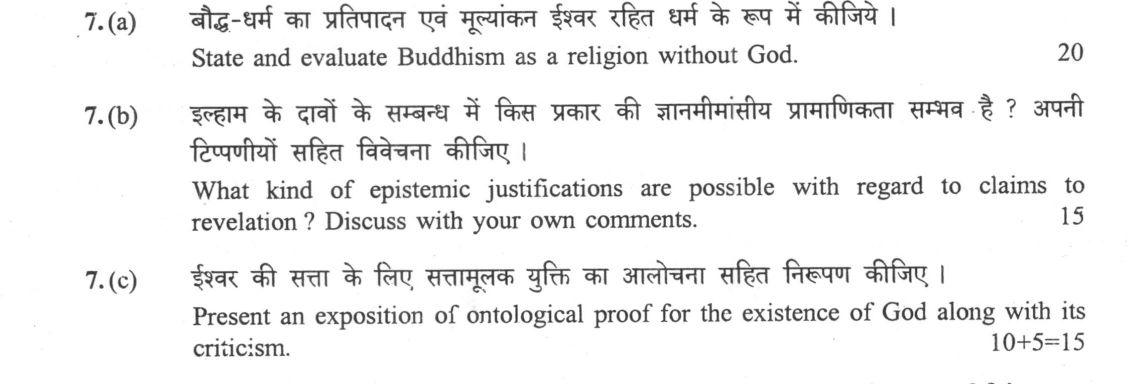
(a) State and evaluate Buddhism as a religion without God. (20 marks) (b) What kind of epistemic justifications are possible with…
State and evaluate Buddhism as a religion without God. 20 marks
What kind of epistemic justifications are possible with regard to claims to revelation? Discuss with your own comments. 15 marks
Present an exposition of ontological proof for the existence of God along with its criticism. (10+5=15 marks)
हिंदी में प्रश्न पढ़ें
बौद्ध-धर्म का प्रतिपादन एवं मूल्यांकन ईश्वर रहित धर्म के रूप में कीजिये । (20 अंक)
इल्हाम के दावों के सम्बन्ध में किस प्रकार की ज्ञानमीमांसीय प्रामाणिकता सम्भव है ? अपनी टिप्पणियों सहित विवेचना कीजिए । (15 अंक)
ईश्वर की सत्ता के लिए सत्तामूलक युक्ति का आलोचना सहित निरूपण कीजिए । (10+5=15 अंक)
Model answer
Written by UPSC Answer Check against this question's marking rubric, to the expected length. UPSC does not publish answers for Mains — this is one way to score well, not an official key.
Buddhism as a Religion without God
Buddhism challenges classical Western and orthodox Indian definitions of religion by rejecting a personal creator (Ishvara), an absolute first cause, and an eternal soul (atman). The architecture of Buddhist soteriology rests upon the tri-lakshana: anicca (universal impermanence), dukkha (suffering), and anatta (non-self), governed by the natural causal law of pratityasamutpada (dependent origination). Liberation (nirvana) is achieved through personal ethical discipline (sila), meditative absorption (samadhi), and discriminative wisdom (prajna), rather than divine grace.
Evaluating its non-theistic character reveals an ontological divergence between traditions. Theravada strictly preserves an empirical, psychological non-theism where the historical Buddha is an enlightened guide (marga-data), not a savior (moksha-data). Conversely, Mahayana introduces cosmic Bodhisattvas and the Trikaya doctrine. Concepts like Tathagatagarbha (innate Buddha-nature) and Dharmakaya (the ultimate reality) function structurally as transpersonal absolutes. This led S. Radhakrishnan to argue that Mahayana covertly reintroduces the Upanishadic Brahman under a negative dialectic. Max Weber similarly classified early Buddhism as an exemplary soteriology for monk-elites, noting that popular religion inevitably seeks devotional objects. In modern India, B.R. Ambedkar formulated Navayana Buddhism, explicitly divesting the Dhamma of all supernaturalism and theism, evaluating it as a rational, social religion of liberty, equality, and fraternity.
Evaluated against the standard of whether religion requires a transcendent deity to provide moral order and ultimate salvation, Buddhism demonstrates that God is not an indispensable category for religion; it functions as a complete spiritual system, even though its devotional developments emulate functional theism.
Epistemic Justifications of Revelation
Claims to revelation (shruti or divine self-disclosure) seek epistemic justification through three primary frameworks:
Evidentialist justification models treat revelation as valid testimony grounded in direct superconscious experience. Swami Vivekananda defended Vedic revelation by asserting that shruti is not dogmatic decree but the recorded spiritual data of ancient rishis, verifiable through repeatable personal realization (anubhuti).
Coherentist justification, exemplified in Sri Aurobindo’s integral epistemology, posits that revelation is validated when intuitive, supramental illumination harmonizes with rational coherence and empirical evolution, resolving antinomies that discursive reason cannot bridge.
Reformed Epistemology, articulated by Alvin Plantinga, argues for the proper basicality of revelation. Bypassing propositional evidence, Plantinga contends that beliefs grounded in divine testimony are properly basic with respect to warrant, produced by an innate sensus divinitatis functioning in an appropriate epistemic environment.
In critical assessment, Plantinga’s proper basicality risks subjective fideism and epistemic relativism, as it cannot adjudicate between conflicting sectarian revelations. Vivekananda’s experiential model remains epistemologically superior, as it subjects subjective revelation to universal empirical-experiential verification.
Ontological Proof for the Existence of God and its Criticism
St. Anselm formulated the a priori ontological argument in Proslogion II, defining God as aliquid quo nihil maius cogitari possit (that than which nothing greater can be conceived). Since existing in reality (in re) is greater than existing merely in the intellect (in intellectu), this greatest conceivable being must exist in reality, lest a contradiction arise. In Proslogion III, Anselm advanced the modal version: a being whose non-existence is impossible is greater than one whose non-existence is possible; therefore, necessary existence belongs intrinsically to the concept of God. Modern thinkers like Norman Malcolm and Alvin Plantinga reformulated this via S5 modal logic: if the existence of a Maximally Great Being is logically possible, it must exist in all possible worlds, and hence in the actual world.
Major criticisms dismantle this logical transition: Gaunilo of Marmoutiers raised the Lost Island objection, demonstrating that Anselm's logic commits an illicit parity: one could define a "perfect island" into actual existence. Immanuel Kant demonstrated that "existence is not a real predicate." Saying "God exists" adds no new descriptive property to the concept of God; it merely posits the subject with all its predicates. Bertrand Russell formalized this critique using the Theory of Definite Descriptions, arguing that Anselm commits a category mistake by treating existence as an individual attribute rather than a second-order quantifier (∃ x).
Modal reformulations preserve internal logical validity but fail to establish the initial premise—that the actual existence of a Maximally Great Being is uniquely possible in the real world. Thus, the proof remains a brilliant conceptual analysis that cannot bridge the gap between logical necessity and ontological reality.
Conclusion
These three philosophical inquiries demonstrate that ultimate reality and religious meaning do not depend exclusively on rational theistic deduction or uncritical scripture. While Anselmian ontology remains trapped in conceptual circularity and revelation requires rigorous experiential testing, Buddhism proves that religion can sustain profound ethical and soteriological efficacy through empirical non-theism.
What "Evaluate" is asking you to do
Judge how well something has performed against the standard it set for itself — its stated aim, mandate or promise — and commit to a verdict. Name the yardstick before you judge; an unanchored judgement reads as opinion.
Structure that answers it
Name the yardstick — stated aim, mandate or benchmark → performance against it → shortfall against it → why the gap exists → verdict
Where marks are lost
Presenting both sides and then declining to decide, or delivering a verdict against a standard you never stated, which makes it look arbitrary.
How this answer will be evaluated
Approach
(a) evaluate: criteria > evidence > balanced judgment | (b) discuss: intro > 3-4 dimensions > example > balanced close | (c) critique: the claim > its strengths > its weaknesses > your judgment Full marks: Precise reconstruction of arguments, strong counter-arguments, and balanced evaluation.
Key points expected
- Define 'atheistic' (anattā) and 'non-theistic' (anātmavāda) positions
- Reconstruct the argument from the Four Noble Truths
- Address the 'God' vs 'Supreme Reality' distinction
- Evaluate the 'religion without God' characterization
- Define 'epistemic justification' in this context
- Present at least two distinct justifications (e.g., experiential, coherence)
- Present the strongest counter-argument (e.g., problem of evil, private nature)
- Provide a balanced conclusion
Evaluation rubric
Each sub-part is marked on its own, against the marks and word limit printed on the paper.
- (a) State and evaluate Buddhism as a religion without God. 20 marks
evaluate— criteria → evidence → balanced judgment
Must cover
- Define 'atheistic' (anattā) and 'non-theistic' (anātmavāda) positions
- Reconstruct the argument from the Four Noble Truths
- Address the 'God' vs 'Supreme Reality' distinction
- Evaluate the 'religion without God' characterization
Loses marks
- Biographical details of the Buddha
- Confusing 'anattā' with 'nihilism'
- Vague generalities about 'peace' or 'love'
Earns more
- Mention of 'Tathāgata' or 'Nirvāṇa' as non-theistic concepts
- Comparison with Jainism or other Indian traditions
- Reference to specific sutras (e.g., Kaccānagotta Sutta)
Extra mark
- Citation of specific Pali terms for 'God' (e.g., deva, brahma)
- Reference to modern scholars (e.g., Paul Williams, Richard Gombrich)
- (b) Discuss epistemic justifications for claims to revelation. 15 marks
discuss— intro → 3-4 dimensions → example → balanced close
Must cover
- Define 'epistemic justification' in this context
- Present at least two distinct justifications (e.g., experiential, coherence)
- Present the strongest counter-argument (e.g., problem of evil, private nature)
- Provide a balanced conclusion
Loses marks
- Treating revelation as a scientific fact
- Ignoring the 'private' nature of religious experience
- Vague assertions about 'faith' without analysis
Earns more
- Reference to specific philosophers (e.g., Alvin Plantinga, William James)
- Distinction between 'revelation' and 'inspiration'
- Discussion of 'properly basic beliefs'
Extra mark
- Reference to specific religious texts (e.g., Quran, Bible)
- Mention of 'cognitive science of religion' perspectives
- (c) Exposition of ontological proof and its criticism. 15 marks
critique— the claim → its strengths → its weaknesses → your judgment
Must cover
- State the ontological argument (Anselm or Descartes)
- Define 'perfect being' or 'greatest conceivable being'
- Present the strongest criticism (e.g., Kant's 'existence is not a predicate')
- Evaluate the validity of the argument
Loses marks
- Confusing ontological with cosmological arguments
- Vague paraphrase of the argument
- Ignoring the 'predicate' objection
Earns more
- Reference to specific philosophers (e.g., Anselm, Descartes, Kant, Gaunilo)
- Distinction between 'a priori' and 'a posteriori' arguments
- Mention of 'modal ontological argument' (Plantinga)
Extra mark
- Reference to specific logical formalizations
- Mention of 'ontological' vs 'cosmological' arguments
Practice this exact question
Write your answer and it is marked point by point against the model answer above — what you covered, what you missed, what you got wrong.
Evaluate my answer →More from Philosophy 2024 Paper II
- Q4 (a) Discuss gender equality as a necessary condition to achieve empowerment of women. Als…
- Q5 Answer the following questions in about 150 words each: (a) Can there be a religion witho…
- Q6 (a) Is it necessary to adhere to the notions of immortality of soul and rebirth in order…
- Q7 (a) State and evaluate Buddhism as a religion without God. (20 marks) (b) What kind of ep…
- Q8 (a) Distinguish between cognitivist and non-cognitivist account of religious language. Do…