Paper II — Q6
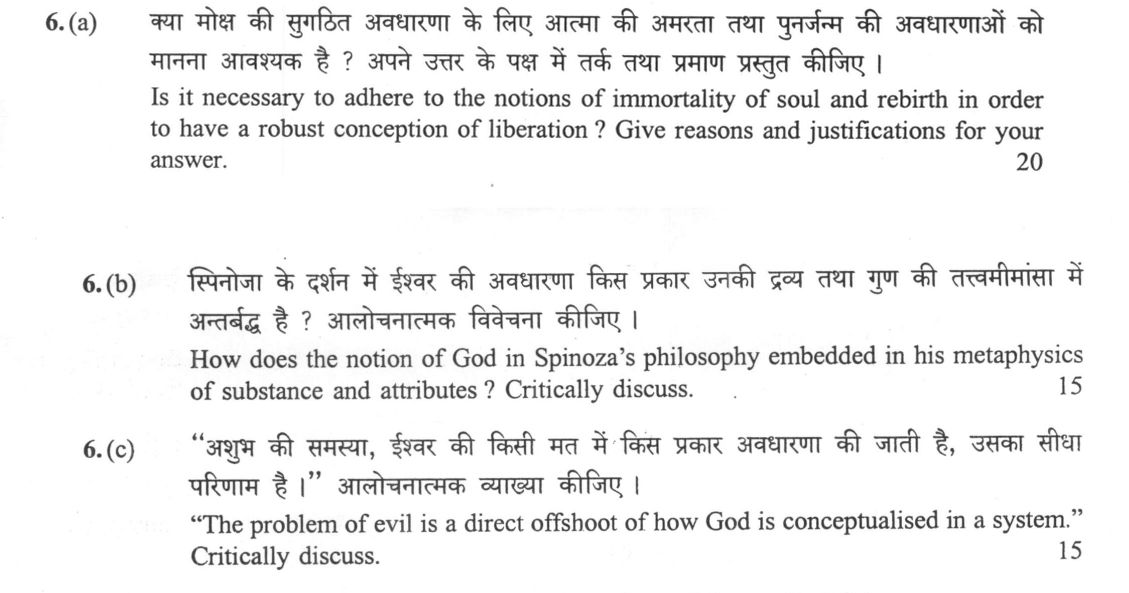
(a) Is it necessary to adhere to the notions of immortality of soul and rebirth in order to have a robust conception of…
Is it necessary to adhere to the notions of immortality of soul and rebirth in order to have a robust conception of liberation? Give reasons and justifications for your answer. 20 marks
How does the notion of God in Spinoza's philosophy embedded in his metaphysics of substance and attributes? Critically discuss. 15 marks
"The problem of evil is a direct offshoot of how God is conceptualised in a system." Critically discuss. 15 marks
हिंदी में प्रश्न पढ़ें
क्या मोक्ष की सुगठित अवधारणा के लिए आत्मा की अमरता तथा पुनर्जन्म की अवधारणाओं को मानना आवश्यक है ? अपने उत्तर के पक्ष में तर्क तथा प्रमाण प्रस्तुत कीजिए । (20 अंक)
स्पिनोजा के दर्शन में ईश्वर की अवधारणा किस प्रकार उनकी द्रव्य तथा गुण की तत्त्वमीमांसा में अन्तर्बद्ध है ? आलोचनात्मक विवेचना कीजिए । (15 अंक)
"अशुभ की समस्या, ईश्वर की किसी मत में किस प्रकार अवधारणा की जाती है, उसका सीधा परिणाम है ।" आलोचनात्मक व्याख्या कीजिए । (15 अंक)
Model answer
Written by UPSC Answer Check against this question's marking rubric, to the expected length. UPSC does not publish answers for Mains — this is one way to score well, not an official key.
Metaphysical commitments regarding the soul, divine reality, and the nature of being fundamentally dictate the architecture of liberation, divine ontology, and theodicy across philosophical traditions.
Soul, Rebirth, and the Conception of Liberation
In classical Indian philosophy, the necessity of an immortal soul and rebirth depends on whether liberation is conceived ontologically or phenomenologically. In Advaita Vedanta, the immortality of the soul (Atman) and its non-dual identity with Brahman is foundational; liberation (moksha) is the realization of this eternal, uncreated reality, terminating the cycle of samsara. Similarly, Nyaya-Vaisheshika posits apavarga as the complete cessation of pain, attainable only when the eternal individual soul exhausts its accumulated karma across transmigratory cycles. Early Purva-Mimamsa prioritized ritual action (dharma) to attain heavenly states (svarga), treating liberation as secondary yet sustaining post-mortem continuity.
Conversely, Buddhism deconstructs this substantialist framework through the doctrine of anatta (non-self) and anicca (impermanence). It demonstrates that a robust conception of liberation (nirvana)—the extinguishing of craving and ignorance—does not require an enduring, immortal soul, interpreting rebirth instead as a continuum of psychophysical processes via dependent origination (pratityasamutpada). Carvaka materialism rejects both immortality and rebirth entirely, dismissing transcendent liberation and identifying death (maranam eva apavargah) as the only cessation. In contemporary thought, Sri Aurobindo’s Integral Yoga reconstructs liberation not as an escape from rebirth, but as the progressive divinization of terrestrial life and consciousness, while modern naturalist ethics locates freedom in psychological integration and ethical autonomy within a single empirical lifespan.
Critically, while notions of an immortal soul and rebirth provide a coherent metaphysical scaffold for retributive cosmic justice, they are not strictly necessary: liberation can be robustly formulated as existential and psychological transformation (jivanmukti) without eternalist presuppositions.
Spinoza’s God: Substance, Attributes, and Immanence
Spinoza grounds his philosophy in substance monism, defining God as the sole, absolutely infinite, and self-caused (causa sui) substance (Deus sive Natura). By definition, substance is that which exists in itself and is conceived through itself. God possesses infinite attributes, each expressing eternal and infinite essence, of which the human intellect perceives only two: Thought and Extension. Individual finite entities, including human minds and bodies, are not independent substances but modes—transient modifications of God’s attributes.
Critically, Spinoza’s pantheism rejects the traditional theological model of an anthropomorphic, transcendent creator operating with purpose or free will. He distinguishes between Natura naturans (God as dynamic, self-originating substance) and Natura naturata (the modal world necessarily following from divine nature). By eliminating teleology, Spinoza establishes strict metaphysical determinism: everything unfolds by geometric necessity, rendering contingency and free will human illusions born of inadequate ideas. While this brilliantly resolves Cartesian mind-body dualism through parallel attributes, it invites the critical charge of fatalism, effectively replacing personal theism with an impersonal cosmos where religious piety becomes the intellectual love of God (amor intellectualis Dei).
The Problem of Evil as a Doctrinal Offshoot
The problem of evil is primarily an artifact of classical monotheism, which defines God through the rigid triad of omnipotence, omniscience, and omnibenevolence. When God is conceptualized as an all-powerful, all-knowing, and wholly good creator ex nihilo, the reality of moral and natural suffering generates an irreconcilable logical and evidential paradox.
Where this divine framework is altered, the problem dissolves or transforms. Process theology (Alfred North Whitehead, Charles Hartshorne) avoids the dilemma by reconceptualizing God as dipolar and non-coercive, possessing persuasive rather than absolute power; evil arises from the creative freedom of worldly entities, not divine failure.
In Indian philosophy, non-theistic frameworks bypass the problem altogether. Sankhya dualism attributes suffering to the intrinsic disequilibrium of prakriti’s three gunas, leaving the pure consciousness (purusha) untouched without invoking a creator God. Buddhism locates evil and suffering squarely in avidya (ignorance) and dependent origination (pratityasamutpada), rendering theistic theodicies redundant. Even within theistic traditions like Ramanuja’s Visishtadvaita, evil is explained through beginningless karma, where individual souls act as free modes within God’s organic body (sarira-sariri-bhava).
Ultimately, the problem of evil is not an intrinsic feature of reality, but a direct consequence of monarchical theism; decentralizing classical omnipotence effectively eliminates the theodical contradiction.
What "Critically discuss" is asking you to do
Lay the issue out from more than one side — how it arose, what is claimed for it, what is held against it, and where it now stands. UPSC attaches discuss to broad topics with several live dimensions, so coverage of the dimensions earns more than the strength of your opinion. “Critically” is not a section added at the end: name the yardstick you are judging by — the evidence, the stated objective, a constitutional principle, a rival explanation — and let a verdict close each part of the body. Where the question quotes a claim, that verdict must land on the claim itself, accepted, qualified or rejected, and not on the theme in general.
Structure that answers it
Set the issue up → the case as it is made → the case against → the dimension both sides leave out → where the balance now lies
Where marks are lost
Merits in one paragraph, demerits in the next, and a conclusion calling for a balanced and holistic approach. That is a survey with the judgement left out and it holds the answer in the middle band. The opposite error is reading “critically” as permission to attack — and with the odd pairings, critically describe or critically explain, the exposition still carries most of the marks, the judgement being a layer on it rather than a substitute for it.
How this answer will be evaluated
Approach
Framework: UPSC Philosophy Paper II. (a) justify: claim > 3-4 reasons > evidence > conclusion | (b) critique: the claim > its strengths > its weaknesses > your judgment | (c) critique: the claim > its strengths > its weaknesses > your judgment Full marks: Precise technical vocabulary, strong reconstruction of arguments, clear critical evaluation, and specific examples.
Key points expected
- Define 'liberation' (Moksha) in Indian philosophical context
- Reconstruct the argument linking Atman immortality to Moksha
- Reconstruct the argument linking Punarjanma (rebirth) to Karma
- Present a counter-argument (e.g., Buddhist Anatta or Advaita)
- Define Spinoza's 'Substance' (Deus sive Natura)
- Explain the role of 'Attributes' (Thought and Extension)
- Analyze the relationship between God and Nature
- Provide a critical evaluation of this pantheistic view
Evaluation rubric
Each sub-part is marked on its own, against the marks and word limit printed on the paper.
- (a) Evaluate the necessity of immortality/rebirth for a robust conception of liberation (Moksha). 20 marks
justify— claim → 3-4 reasons → evidence → conclusion
Must cover
- Define 'liberation' (Moksha) in Indian philosophical context
- Reconstruct the argument linking Atman immortality to Moksha
- Reconstruct the argument linking Punarjanma (rebirth) to Karma
- Present a counter-argument (e.g., Buddhist Anatta or Advaita)
Loses marks
- Biographical details of philosophers
- Vague paraphrase of concepts without technical terms
- Failure to address the 'necessity' aspect
Earns more
- Use precise Sanskrit terms (Atman, Punarjanma, Moksha)
- Distinguish between different schools (e.g., Nyaya vs. Advaita)
- Provide a clear, reasoned conclusion on necessity
Extra mark
- Reference specific Upanishadic verses
- Mention specific philosophers (e.g., Shankara, Ramanuja)
- (b) Critically discuss the notion of God in Spinoza's metaphysics of substance and attributes. 15 marks
critique— the claim → its strengths → its weaknesses → your judgment
Must cover
- Define Spinoza's 'Substance' (Deus sive Natura)
- Explain the role of 'Attributes' (Thought and Extension)
- Analyze the relationship between God and Nature
- Provide a critical evaluation of this pantheistic view
Loses marks
- Biography of Spinoza
- Vague paraphrase of 'God is Nature'
- Failure to connect God to substance/attributes
Earns more
- Use precise technical vocabulary (Substance, Attribute, Mode)
- Distinguish Spinoza's God from the traditional theistic God
- Present a strong counter-argument or limitation
Extra mark
- Reference specific propositions from the Ethics
- Compare with other rationalist metaphysics (e.g., Descartes)
- (c) Critically discuss the link between the problem of evil and the conceptualization of God. 15 marks
critique— the claim → its strengths → its weaknesses → your judgment
Must cover
- Define the 'Problem of Evil' (logical vs. evidential)
- Explain how God's attributes (omnipotence, omniscience, omnibenevolence) create the problem
- Present a standard theodicy or defense (e.g., free will)
- Critically evaluate the strength of the link
Loses marks
- Vague description of 'evil' without philosophical context
- Failure to link evil to God's specific attributes
- Biographical details of philosophers
Earns more
- Use precise technical vocabulary (Theodicy, Omnipotence, Omnibenevolence)
- Distinguish between logical and evidential problem of evil
- Present a strong counter-argument to the theodicy
Extra mark
- Reference specific philosophers (e.g., Epicurus, Hume, Plantinga)
- Mention specific types of evil (moral vs. natural)
Practice this exact question
Write your answer and it is marked point by point against the model answer above — what you covered, what you missed, what you got wrong.
Evaluate my answer →More from Philosophy 2024 Paper II
- Q3 (a) Do you agree with the view that Aristotle was more successful than Plato in steering…
- Q4 (a) Discuss gender equality as a necessary condition to achieve empowerment of women. Als…
- Q5 Answer the following questions in about 150 words each: (a) Can there be a religion witho…
- Q6 (a) Is it necessary to adhere to the notions of immortality of soul and rebirth in order…
- Q7 (a) State and evaluate Buddhism as a religion without God. (20 marks) (b) What kind of ep…
- Q8 (a) Distinguish between cognitivist and non-cognitivist account of religious language. Do…