Paper II — Q8
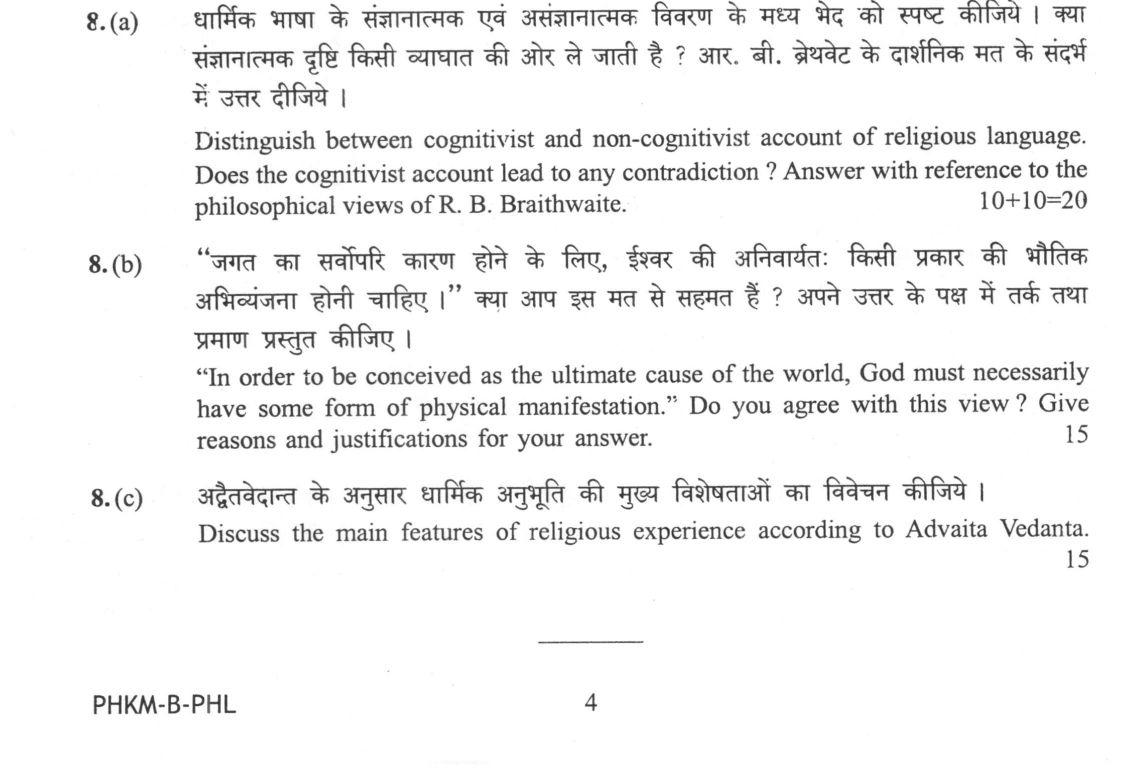
(a) Distinguish between cognitivist and non-cognitivist account of religious language. Does the cognitivist account lead to any…
Distinguish between cognitivist and non-cognitivist account of religious language. Does the cognitivist account lead to any contradiction? Answer with reference to the philosophical views of R. B. Braithwaite. (10+10=20 marks)
"In order to be conceived as the ultimate cause of the world, God must necessarily have some form of physical manifestation." Do you agree with this view? Give reasons and justifications for your answer. 15 marks
Discuss the main features of religious experience according to Advaita Vedanta. 15 marks
हिंदी में प्रश्न पढ़ें
धार्मिक भाषा के संज्ञानात्मक एवं असंज्ञानात्मक विवरण के मध्य भेद को स्पष्ट कीजिये । क्या संज्ञानात्मक दृष्टि किसी व्याघात की ओर ले जाती है ? आर. बी. ब्रेथवेट के दार्शनिक मत के संदर्भ में उत्तर दीजिये । (10+10=20 अंक)
"जगत का सर्वोपरि कारण होने के लिए, ईश्वर की अनिवार्यतः किसी प्रकार की भौतिक अभिव्यंजना होनी चाहिए ।" क्या आप इस मत से सहमत हैं ? अपने उत्तर के पक्ष में तर्क तथा प्रमाण प्रस्तुत कीजिए । (15 अंक)
अद्वैतवेदान्त के अनुसार धार्मिक अनुभूति की मुख्य विशेषताओं का विवेचन कीजिये । (15 अंक)
Model answer
Written by UPSC Answer Check against this question's marking rubric, to the expected length. UPSC does not publish answers for Mains — this is one way to score well, not an official key.
Religious language The debate over religious language turns on truth-aptness. Cognitivism treats statements such as “God exists” as propositions with truth conditions: they can be true or false and represent facts. Non-cognitivism denies this property; it treats them as expressive, practical or functional, committing speakers to a way of life rather than asserting facts.
R. B. Braithwaite, an empiricist influenced by Wittgenstein rather than a logical positivist, develops a non-cognitivist account. For him, religious language is not metaphysical assertion but “stories” expressing commitment to an agapeistic life. It shapes moral and spiritual practice rather than describing entities. His critique presses a verificationist point: if religious claims are factual, they must be empirically testable; unverifiable metaphysical claims cannot masquerade as factual without becoming meaningless or reduced to empirical claims, losing distinctive content. This is a self-undermining contradiction: cognitivism wants religious language to be meaningful as factual, but the empiricist standard it must meet empties it. Yet his reductionism may understate religious commitment, since believers often make truth-claims about God, even if they resist ordinary verification.
Physical manifestation I do not agree that an ultimate cause must have physical manifestation. The thesis confuses the mode of causation with the nature of the cause. In creation theologies, God causes the world without being a physical agent. In Aristotle, hylomorphism explains physical change through matter and form, but the Prime Mover is pure form, immaterial and unmoved; ultimate causation does not require embodiment. Incarnation theologies in Christianity and Vaishnavism give God physical or quasi-physical manifestation to mediate grace, revelation or devotion, not because causation demands matter. Ramanuja’s Vishishtadvaita affirms divine attributes and avatars, yet treats Brahman as inner controller and cause, not merely a physical body.
The stronger case is that ultimate causation may be pure spirit or non-dual reality. Plotinus’s One is beyond being and form; Shankara’s nirguna Brahman is attributeless, beyond space, time and physicality. Shankara distinguishes saguna Brahman, the personal God with attributes, from nirguna Brahman, the absolute ground. Saguna manifestation is useful for devotion and moral practice, but not metaphysically necessary for ultimate causation. To require physical manifestation would limit God to the created order and collapse cause and effect.
Advaita experience Advaita Vedanta understands religious experience as direct realization of Brahman as sole reality. The world is not ultimately real in the same sense; it is the effect of maya, the power of superimposition that makes the one appear as many. The goal is moksha, liberation through identity-realization: “Aham Brahmasmi,” the self is Brahman. It is cultivated through sravana, manana and nididhyasana—listening, reflection and meditation—culminating in samadhi. Savikalpa samadhi retains a subtle object or distinction, while nirvikalpa samadhi is wordless, non-dual absorption in which subject-object duality disappears.
Advaita also distinguishes jivanmukti, liberation while living, from post-mortem release. The jivanmukta remains in the world but sees action as Brahman’s play, free from egoic bondage. This differs from Dvaita, where the soul remains eternally distinct from God, and from Vishishtadvaita, where the soul is a real part of God’s body. Classical expositions by Shankara and Mandana Mishra, and modern interpretations by Radhakrishnan and Malkani, stress that Advaita experience is not merely emotional ecstasy but knowledge of non-duality. Ramana Maharshi and Vivekananda’s reinterpretation show how this insight can be lived ethically and socially.
In conclusion, the cognitivist/non-cognitivist divide is a limit of propositional language. Braithwaite’s non-cognitivism rescues religious practice from false factualism, but Advaita goes further: religious experience transcends the claim/non-claim distinction. Likewise, ultimate causation need not be physical; it can be understood as non-dual Brahman, whose saguna manifestations are pedagogical rather than necessary. Thus religion combines practical commitment, non-dual realization and causation that does not reduce the infinite to the physical.
What "Distinguish" is asking you to do
Name the property that separates the items and say which side holds it. Distinguish is marked exactly as differentiate is, with no difference in expectation, but its stems more often line up three terms rather than two — gender equality, gender equity and empowerment — and every pair in the set has to be separated.
Structure that answers it
The category they all sit in → the property dividing the first pair → the second pair → the third → why the boundary matters in practice
Where marks are lost
Separating the two obviously different items and leaving the middle term unplaced. A description of each side from which the line must be inferred is marked as description, not as a distinction.
How this answer will be evaluated
Approach
Framework: Analytic Philosophy of Religion. (a) compare: Paired headings: Cognitivist vs Non-cognitivist > Key differences in truth-value and reference > Braithwaite's specific application > Evaluation of the contradiction | (b) discuss: Intro: Define 'ultimate cause' and 'physical manifestation' > Arguments for agreement (e.g., Incarnation, Avatars) > Arguments against (e.g., Transcendence, Pure Spirit) > Balanced close with justification | (c) discuss: Intro: Define Advaita Vedanta's view of reality > Feature 1: Non-duality (Advaita) of Atman and Brahman > Feature 2: Illusion (Maya) and the nature of the world > Feature 3: Liberation (Moksha) as realization, not attainment > Balanced close Full marks: Precise technical vocabulary; strong counter-arguments; clear distinction between views.
Key points expected
- Cognitivism vs Non-cognitivism in religious language
- Braithwaite's 'rules of conduct' argument
- Nirguna vs Saguna Brahman
- Advaita Vedanta's non-dualism
- Maya and Avidya
- Moksha as realization
Evaluation rubric
Each sub-part is marked on its own, against the marks and word limit printed on the paper.
- (a) Contrast truth-apt claims vs. rules of conduct; identify the 'contradiction' in the cognitivist view. 20 marks
compare— Paired headings: Cognitivist vs Non-cognitivist → Key differences in truth-value and reference → Braithwaite's specific application → Evaluation of the contradiction
Must cover
- Cognitivism: Religious language as truth-apt propositions
- Non-cognitivism: Language as rules of conduct (Braithwaite)
- Contradiction: The problem of verification or falsification
- Braithwaite's view: 'God exists' as a rule for living
Loses marks
- Biography of Braithwaite instead of his argument
- Vague paraphrase of 'rules of conduct' without examples
Earns more
- Reference to the 'verification principle' (Logical Positivism)
- Distinction between 'factual' and 'prescriptive' statements
- Mention of 'emotive' or 'expressive' function of language
Extra mark
- Reference to A.J. Ayer's 'Language, Truth and Logic'
- Mention of 'cognitive content' vs 'non-cognitive content'
- (b) Evaluate the necessity of physical manifestation for God as the ultimate cause. 15 marks
discuss— Intro: Define 'ultimate cause' and 'physical manifestation' → Arguments for agreement (e.g., Incarnation, Avatars) → Arguments against (e.g., Transcendence, Pure Spirit) → Balanced close with justification
Must cover
- Definition of 'ultimate cause' (Nirguna vs Saguna)
- Argument for: Incarnation/Avatar as necessary for interaction
- Argument against: God as pure spirit (Nirguna) transcending matter
- Justification: Why physical form is or isn't required for causality
Loses marks
- Ignoring the 'ultimate cause' part of the prompt
- Vague generalities about God without specific philosophical terms
Earns more
- Reference to 'Nirguna Brahman' vs 'Saguna Brahman'
- Mention of 'Avatara' concept in Hinduism
- Reference to 'Incarnation' in Christianity
Extra mark
- Reference to 'Maya' as the power of manifestation
- Mention of 'Lila' (divine play) as a reason for manifestation
- (c) Outline the key characteristics of religious experience in Advaita Vedanta. 15 marks
discuss— Intro: Define Advaita Vedanta's view of reality → Feature 1: Non-duality (Advaita) of Atman and Brahman → Feature 2: Illusion (Maya) and the nature of the world → Feature 3: Liberation (Moksha) as realization, not attainment → Balanced close
Must cover
- Non-duality (Advaita): Atman is Brahman
- Maya: The world as appearance, not absolute reality
- Moksha: Liberation as realization of identity, not going somewhere
- Jnana: Knowledge as the means to liberation
Loses marks
- Confusing Advaita with Dvaita (dualism)
- Vague description of 'peace' without philosophical grounding
Earns more
- Reference to 'Tat Tvam Asi' (Thou art That)
- Mention of 'Avidya' (ignorance) as the cause of bondage
- Distinction between 'Vyavaharika' (empirical) and 'Paramarthika' (absolute) reality
Extra mark
- Reference to 'Sakshi' (witness) consciousness
- Mention of 'Nirguna' (attribute-less) Brahman
Practice this exact question
Write your answer and it is marked point by point against the model answer above — what you covered, what you missed, what you got wrong.
Evaluate my answer →More from Philosophy 2024 Paper II
- Q5 Answer the following questions in about 150 words each: (a) Can there be a religion witho…
- Q6 (a) Is it necessary to adhere to the notions of immortality of soul and rebirth in order…
- Q7 (a) State and evaluate Buddhism as a religion without God. (20 marks) (b) What kind of ep…
- Q8 (a) Distinguish between cognitivist and non-cognitivist account of religious language. Do…