Paper I — Q1
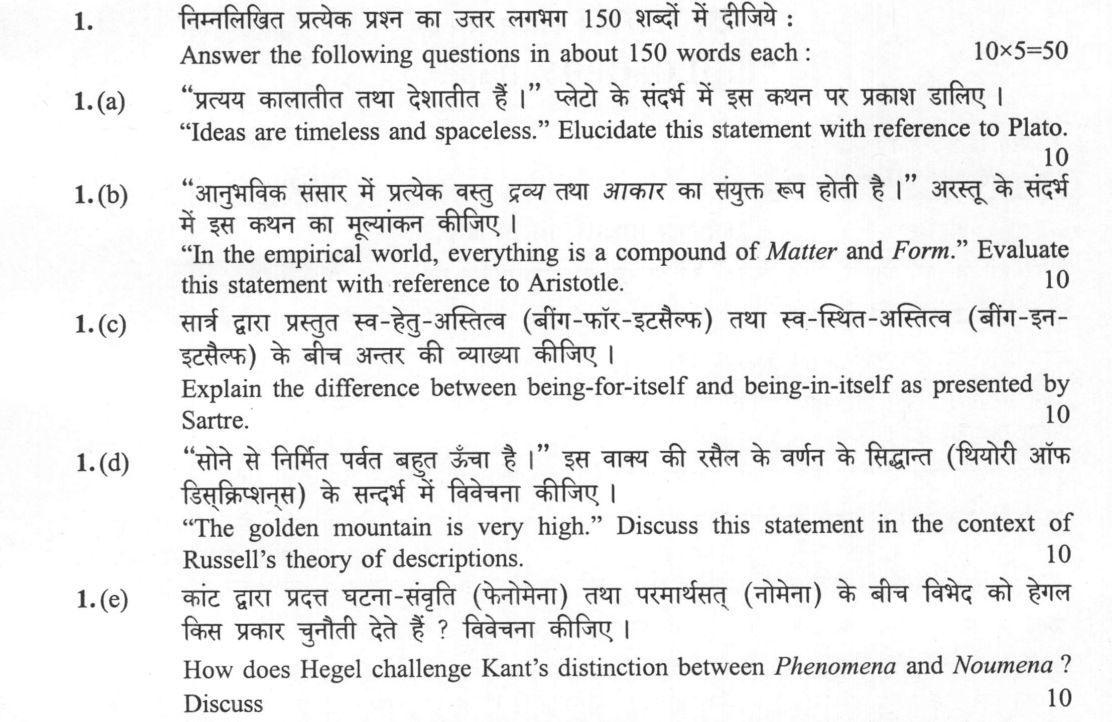
Answer the following questions in about 150 words each : 10×5=50 (a) "Ideas are timeless and spaceless." Elucidate this…
Answer the following questions in about 150 words each : 10×5=50
"Ideas are timeless and spaceless." Elucidate this statement with reference to Plato. 10 marks
"In the empirical world, everything is a compound of Matter and Form." Evaluate this statement with reference to Aristotle. 10 marks
Explain the difference between being-for-itself and being-in-itself as presented by Sartre. 10 marks
"The golden mountain is very high." Discuss this statement in the context of Russell's theory of descriptions. 10 marks
How does Hegel challenge Kant's distinction between Phenomena and Noumena ? Discuss 10
हिंदी में प्रश्न पढ़ें
निम्नलिखित प्रत्येक प्रश्न का उत्तर लगभग 150 शब्दों में दीजिए :
"प्रत्यय कालातीत तथा देशातीत है।" प्लेटो के संदर्भ में इस कथन पर प्रकाश डालिए। 10
"आनुभविक संसार में प्रत्येक वस्तु द्रव्य तथा आकार का संयुक्त रूप होती है।" अरस्तु के संदर्भ में इस कथन का मूल्यांकन कीजिए। 10
सार्त्र द्वारा प्रस्तुत स्व-हेतु-अस्तित्व (बीइंग-फॉर-इटसेल्फ) तथा स्व-स्थित-अस्तित्व (बीइंग-इन-इटसेल्फ) के बीच अंतर की व्याख्या कीजिए। 10
"सोने से निर्मित पर्वत बहुत ऊँचा है।" इस वाक्य की रसेल के वर्णन के सिद्धांत (थियोरी ऑफ डिस्क्रिप्शन्स) के संदर्भ में विवेचना कीजिए। 10
कांट द्वारा प्रदत्त घटना-संबुति (फेनोमेना) तथा परमार्थसत् (नोमेना) के बीच विभेद को हेगेल किस प्रकार चुनौती देते हैं ? विवेचना कीजिए। 10
Model answer
Written by UPSC Answer Check against this question's marking rubric, to the 150-word length. UPSC does not publish answers for Mains — this is one way to score well, not an official key.
(a) For Plato, Ideas or Forms are timeless and spaceless because they belong to the Realm of Being, not to the sensible world of change. Particular beautiful things, just acts, or good deeds are in the Realm of Becoming: they appear, decay, and are located in space and time. The Forms—Beauty, Justice, Good—are eternal, immutable, non-spatial, and intelligible rather than visible. They do not exist “here” or “now”; they are grasped by reason through recollection and dialectic. Sensible particulars participate (methexis) in Forms, so a beautiful object is beautiful by sharing in the Form of Beauty, but it is never identical with it. The Form of Good is the highest Idea, illuminating all others. Thus the statement means that Ideas are not material objects, not generated or destroyed, and not subject to spatial separation; they are stable objects of knowledge, unlike appearances.
(b) Aristotle rejects Plato’s separation (chorismos) and argues that in the empirical world every substance is a compound of matter (hyle) and form (morphe/eidos). Matter is the substratum, while form is the principle making a thing what it is. Prime matter is pure potentiality, without determinate qualities; substantial form is actuality, the principle realizing potential. A bronze statue is a compound of bronze matter and the shape of a statue; a human is a compound of body and soul, the soul being the form of the body. Form is not a separate Platonic entity existing apart from things; it is immanent in the substance. Thus the statement is true for Aristotle: empirical things are neither bare matter nor pure form, but hylomorphic unities. Matter provides possibility, form provides identity, function, and intelligibility. This explains change as the acquisition or loss of form by matter, not as participation in a transcendent realm.
(c) Sartre distinguishes being-in-itself (en-soi) from being-for-itself (pour-soi). Being-in-itself is the mode of inanimate objects: it is opaque, full, self-identical, massive, and inert. A stone simply is; it does not question itself, lack itself, or project itself toward possibilities. Being-for-itself is consciousness: it is not a thing but a self-negating, temporal, free activity that is what it is not and is not what it is. Consciousness is always consciousness of something, and it introduces nothingness into the world through doubt, negation, and anticipation. Nothingness is constitutive of the for-itself, because consciousness can distance itself from facts and choose. Bad faith arises when consciousness tries to flee this distinction, pretending to be a fixed in-itself or denying its freedom. The in-itself is therefore the background against which consciousness appears as lack and freedom. Thus the for-itself is the source of meaning, value, and responsibility, while the in-itself is the given, undifferentiated fullness of being.
(d) Russell treats “the golden mountain” not as a proper name but as a definite description. Grammatically it looks like a subject-predicate sentence, but logically it does not refer to an existent object. The analysis is a single existentially quantified conjunction: ∃x[(Gx ∧ Mx) ∧ ∀y((Gy ∧ My) → y = x) ∧ Hx], where Gx means x is golden, Mx means x is a mountain, and Hx means x is very high. This asserts that there is one and only one golden mountain and that it is very high. If no golden mountain exists, the proposition is false, and no non-existent object need be posited. This avoids Meinongian objects. In primary occurrence, the description is analyzed existentially; in secondary occurrence, as under “I believe that the golden mountain is high,” it is not eliminated in the same way, preserving sense. Thus Russell shows apparent reference can be logical structure without ontological commitment.
(e) Hegel challenges Kant’s distinction between phenomena and noumena by arguing that the thing-in-itself is not an unknowable limit beyond experience but a product of reason’s dialectical movement. In the Phenomenology of Spirit, consciousness progresses from sense-certainty through perception, understanding, self-consciousness, reason, spirit, and religion to Absolute Knowing. At each stage, the subject’s claim to know an immediate object is shown to contain its own negation, so the noumenon is not a static barrier but a moment in the development of self-knowledge. Hegel’s Aufhebung preserves Kant’s insight that knowledge is mediated while transcending his dualism: the distinction is sublated into a system in which reason realizes itself in history, nature, and spirit. For Hegel, Kant’s split reflects an abstract understanding that freezes the living process of thought. Thus Absolute Spirit is not a hidden thing beyond phenomena; it is the rational self-unfolding of reality, and phenomena are the necessary manifestation of the noumenal.
What "Elucidate" is asking you to do
Make a stated proposition plain and then prove it with instances. Elucidate stems almost always carry a claim or a named concept, and very often the words “with examples” or “with suitable diagrams” — the illustration is part of the directive, not decoration.
Structure that answers it
Plain-language statement of what the proposition means → the part that is obscure, resolved → first illustration → second illustration → why the proposition holds
Where marks are lost
Adding terminology; elucidate rewards removing it. The commoner loss is a clean explanation with no example, when the stem asked for examples.
How this answer will be evaluated
Approach
Framework: State the position > Argument > Strongest objection > Evaluation. (a) explain: definition/context > points in order > small example > short close | (b) evaluate: criteria > evidence > balanced judgment | (c) explain: definition/context > points in order > small example > short close | (d) discuss: intro > 3-4 dimensions > example > balanced close | (e) discuss: intro > 3-4 dimensions > example > balanced close Full marks: Precise technical vocabulary, clear argument structure, strong counter-arguments, exact Greek/Sanskrit terms.
Key points expected
- Define Idea (Idea/eidos) as eternal and unchanging
- Contrast Idea with sensible particulars (time/space)
- Explain the 'timeless' aspect (eternal existence)
- Explain the 'spaceless' aspect (non-spatial realm)
- Define Matter (hyle) as potentiality (dynamis)
- Define Form (morphe) as actuality (energeia)
- Explain the concept of 'compound' (synolon)
- Distinguish empirical world from pure Form
Evaluation rubric
Each sub-part is marked on its own, against the marks and word limit printed on the paper.
- (a) Explain the ontological status of Ideas as timeless and spaceless in Plato's metaphysics. 10 marks · 150 words
explain— definition/context → points in order → small example → short close
Must cover
- Define Idea (Idea/eidos) as eternal and unchanging
- Contrast Idea with sensible particulars (time/space)
- Explain the 'timeless' aspect (eternal existence)
- Explain the 'spaceless' aspect (non-spatial realm)
Loses marks
- Confusing 'Idea' with modern 'concept' or 'thought'
- Biographical details of Plato
- Vague paraphrase without technical terms
Earns more
- Reference to the 'Divided Line' or 'World of Forms'
- Mention of 'participation' (methexis) or 'imitation' (mimesis)
- Use of Greek term 'aion' for timelessness
Extra mark
- Reference to the 'Sun' or 'Cave' allegory
- Mention of 'anamnesis' as proof of pre-existence
- (b) Assess the validity of the claim that empirical things are compounds of Matter and Form. 10 marks · 150 words
evaluate— criteria → evidence → balanced judgment
Must cover
- Define Matter (hyle) as potentiality (dynamis)
- Define Form (morphe) as actuality (energeia)
- Explain the concept of 'compound' (synolon)
- Distinguish empirical world from pure Form
Loses marks
- Confusing 'Matter' with physical atoms
- Ignoring the 'empirical' qualifier (applying to God/Unmoved Mover)
- Biographical details of Aristotle
Earns more
- Use of Greek terms 'hyle' and 'morphe'
- Reference to 'substance' (ousia) as the compound
- Mention of 'Prime Matter' (prote hyle)
Extra mark
- Reference to the 'Four Causes' (material, formal, efficient, final)
- Mention of 'act' and 'potency' (energeia/dynamis)
- (c) Differentiate between being-for-itself (consciousness) and being-in-itself (objects) in Sartre. 10 marks · 150 words
explain— definition/context → points in order → small example → short close
Must cover
- Define being-in-itself (en-soi) as fullness/object
- Define being-for-itself (pour-soi) as consciousness/negation
- Explain the 'lack' (manque) in for-itself
- Contrast the two modes of being
Loses marks
- Confusing 'for-itself' with 'for-others'
- Vague description without technical terms
- Biographical details of Sartre
Earns more
- Use of French terms 'en-soi' and 'pour-soi'
- Reference to 'transcendence' of consciousness
- Mention of 'facticity' vs 'possibility'
Extra mark
- Reference to the 'Café' example
- Mention of 'bad faith' (mauvaise foi)
- (d) Analyze the truth conditions of 'The golden mountain is very high' using Russell's theory. 10 marks · 150 words
discuss— intro → 3-4 dimensions → example → balanced close
Must cover
- Identify the statement as a definite description
- Apply the three conditions (existence, uniqueness, property)
- Determine the truth value (false due to non-existence)
- Explain the 'scope' of the description
Loses marks
- Treating 'golden mountain' as a proper name
- Ignoring the 'uniqueness' condition
- Biographical details of Russell
Earns more
- Use of logical notation (existential quantifier)
- Reference to 'incomplete symbol'
- Mention of 'contextual definition'
Extra mark
- Reference to the 'King of France' example
- Mention of 'Russell's Paradox'
- (e) Explain how Hegel's dialectic challenges Kant's separation of Phenomena and Noumena. 10 marks · 150 words
discuss— intro → 3-4 dimensions → example → balanced close
Must cover
- State Kant's distinction (Phenomena vs Noumena)
- Explain Hegel's critique of the 'thing-in-itself'
- Describe the 'dialectical' movement (thesis-antithesis-synthesis)
- Show how 'appearance' is not separate from 'reality'
Loses marks
- Confusing 'Phenomena' with 'illusion'
- Biographical details of Hegel or Kant
- Vague paraphrase without technical terms
Earns more
- Use of German terms 'Erscheinung' and 'Ding an sich'
- Reference to 'Absolute Idealism'
- Mention of 'mediation' (Vermittlung)
Extra mark
- Reference to the 'Phenomenology of Spirit'
- Mention of 'Aufhebung' (sublation)
Practice this exact question
Write your answer and it is marked point by point against the model answer above — what you covered, what you missed, what you got wrong.
Evaluate my answer →More from Philosophy 2025 Paper I
- Q1 Answer the following questions in about 150 words each : 10×5=50 (a) "Ideas are timeless…
- Q2 (a) What are the basic tenets of Rationalism ? How does Descartes build a system of Philo…
- Q3 (a) "We should look not to an ideal language which derives its meaning from facts and has…
- Q4 (a) How is Husserl's account of "I think" different from that of Descartes ? Critically d…