Paper I — Q8
(a) Discuss the idea of Bimba-pratibimbavāda as presented in Vedanta philosophy along with its soteriological significance…
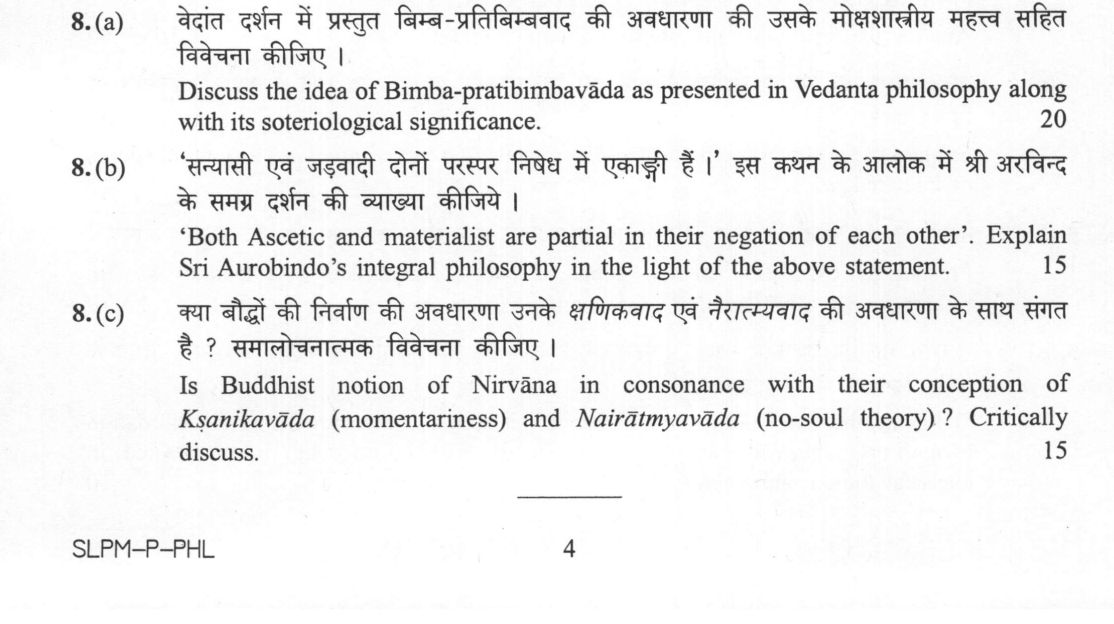
Discuss the idea of Bimba-pratibimbavāda as presented in Vedanta philosophy along with its soteriological significance. 20 marks
'Both Ascetic and materialist are partial in their negation of each other'. Explain Sri Aurobindo's integral philosophy in the light of the above statement. 15 marks
Is Buddhist notion of Nirvāṇa in consonance with their conception of Kṣaṇikavāda (momentariness) and Nairātmyavāda (no-soul theory) ? Critically discuss. 15 marks
हिंदी में प्रश्न पढ़ें
वेदान्त दर्शन में प्रस्तुत बिम्ब-प्रतिबिम्बवाद की अवधारणा की उसके मोक्षशास्त्रीय महत्व सहित विवेचना कीजिए । 20
'संन्यासी एवं जड़वादी दोनों परस्पर निषेध में एकांगी हैं ।' इस कथन के आलोक में श्री अरविन्द के समग्र दर्शन की व्याख्या कीजिए । 15
क्या बौद्धों की निर्वाण की अवधारणा उनके क्षणिकवाद एवं नैरात्म्यवाद की अवधारणा के साथ संगत है ? समालोचनात्मक विवेचना कीजिए । 15
Model answer
Written by UPSC Answer Check against this question's marking rubric, to the expected length. UPSC does not publish answers for Mains — this is one way to score well, not an official key.
Bimba-pratibimbavāda and its Soteriological Significance
Bimba-pratibimbavāda (reflection theory), formulated within the Vivaraṇa school of Advaita Vedānta (Padmapāda, Prakāśātman) and the Pratyabhijñā system of Kashmir Shaivism (Utpaladeva, Abhinavagupta), explains the ontological relation between the Absolute and the empirical individual. It differs fundamentally from Avacchedavāda (limitation theory of the Bhāmatī school, where the Jīva is conditioned like space in a jar) and Ābhāsavāda (where the reflection is an illusory semblance). Reflectionism posits that the Jīva is a real reflection (pratibimba) of Pure Consciousness (bimba, Brahman) cast upon the adjunct (upādhi) of avidyā or the internal organ (antaḥkaraṇa).
The soteriological import is immediate: the reflection is non-different in essence from the prototype. Just as removing a mirror does not annihilate the face but restores its unreflected status, the sublation of upādhis through knowledge dissolves the apparent duality of Jīva and Brahman. In Kashmir Shaivism, liberation is attained via pratyabhijñā (recognition)—the individual soul recognizes that its dynamic consciousness is identical with the cosmic mirror of Paramashiva. Liberation is thus not the production of a new state, but the cessation of false alienation through the direct recognition of one’s identity as the Bimba.
Sri Aurobindo's Critique and Integral Philosophy
In The Life Divine, Sri Aurobindo observes that human thought oscillates between two extremes: the "Denial of the Materialist," which accepts Matter as the sole reality and negates Spirit, and the "Refusal of the Ascetic," which affirms Spirit while dismissing the world as an illusory or transient falsehood (māyā). Aurobindo considers both partial truths. Materialism grasps the necessity of physical manifestation but misses the transcendent source; asceticism grasps the transcendent Absolute but fails to perceive the divine purpose in terrestrial life.
To reconcile this dichotomy, Aurobindo offers his Integral Advaita (Pūrṇādvaita), asserting that Matter is Spirit involved, and evolution is the progressive self-unveiling of the Divine (Sachchidānanda). Hence, "All life is Yoga." The ontological link between the unmanifest Absolute and cosmic multiplicity is the Supermind (Vijñāna)—the active creative consciousness. Soteriologically, Aurobindo rejects world-negating escapism in favor of terrestrial transformation via the Triple Transformation: the psychic transformation (conversion of the inner being around the psychic center), the spiritual transformation (descent of higher light, power, and peace into the nature), and the supramental transformation (the complete divinization of mind, life, and physical matter).
Nirvāṇa, Kṣaṇikavāda, and Nairātmyavāda
The compatibility of Nirvāṇa with Kṣaṇikavāda (radical momentariness) and Nairātmyavāda (no-soul theory) hinges on whether Nirvāṇa is conceived as an entity or as a state of cessation. In early Buddhism and Theravāda, consonance is maintained by defining Nirvāṇa strictly as *duḥkha-nirodha*—the unconditioned (asaṃskṛta) cessation of defilements and the karmic causal series (santāna). Because there is no enduring self (anātman), liberation is not the absorption of a soul, but the extinguishing of the flame of craving (taṇhā).
However, a philosophical tension arises: if every mental state is strictly momentary (kṣaṇika), who attains Nirvāṇa, and how does ethical cultivation persist across transient moments? Classical critics argued that momentariness reduces Nirvāṇa to mere annihilation (ucchedavāda).
Mahāyāna traditions bridge this tension dynamically. Yogācāra scholars like Vasubandhu explain continuity via the storehouse consciousness (ālayavijñāna) carrying impressions (vāsanās), where Nirvāṇa is the fundamental transformation of this support (āśrayaparāvṛtti). Nāgārjuna’s Madhyamaka resolves the antinomy by establishing that since all dharmas are devoid of intrinsic essence (svabhāva-śūnya), saṃsāra and Nirvāṇa share the same ontological status: neither is a permanent substance. Consonance is preserved so long as Nirvāṇa is understood non-substantialistically as the cessation of reified conceptualization.
Conclusion
These three philosophical frameworks differently negotiate the problem of the One and the Many. Advaita and Shaivism resolve multiplicity through reflectionist identity-in-essence; Sri Aurobindo integrates transcendence and immanence through evolutionary supramental descent; and Buddhism dissolves the metaphysical problem altogether by deconstructing both substantial identity and static permanence into dependent, selfless cessation.
What "Discuss" is asking you to do
Lay the issue out from more than one side — how it arose, what is claimed for it, what is held against it, and where it now stands. UPSC attaches discuss to broad topics with several live dimensions, so coverage of the dimensions earns more than the strength of your opinion.
Structure that answers it
Set the issue up → the case as it is made → the case against → the dimension both sides leave out → where the balance now lies
Where marks are lost
Listing facts with no thread between them, or arguing one side throughout and calling it a discussion.
How this answer will be evaluated
Approach
(a) discuss: intro > 3-4 dimensions > example > balanced close | (b) explain: definition/context > points in order > small example > short close | (c) discuss: intro > 3-4 dimensions > example > balanced close Full marks: Comprehensive, precise, and critical analysis with strong use of technical vocabulary and clear examples.
Key points expected
- Define Bimba-pratibimbavāda (reflection theory) in Vedanta
- Explain the relationship between Brahman and Jiva
- Detail the soteriological significance (liberation)
- Distinguish from other Vedantic views (e.g., Vivartavada)
- Define Sri Aurobindo's integral philosophy
- Explain the 'partial negation' of asceticism and materialism
- Describe the synthesis of spirit and matter
- Discuss the concept of 'Divine Life' or 'Supramental' evolution
Evaluation rubric
Each sub-part is marked on its own, against the marks and word limit printed on the paper.
- (a) Reconstruct Bimba-pratibimbavāda and its soteriological significance in Vedanta. 20 marks
discuss— intro → 3-4 dimensions → example → balanced close
Must cover
- Define Bimba-pratibimbavāda (reflection theory) in Vedanta
- Explain the relationship between Brahman and Jiva
- Detail the soteriological significance (liberation)
- Distinguish from other Vedantic views (e.g., Vivartavada)
Loses marks
- Biographical details of philosophers
- Vague paraphrase of the theory
- Failure to address soteriological significance
Earns more
- Use precise Sanskrit terminology (Brahman, Jiva, Maya)
- Reference specific Vedantic schools (Advaita, Vishishtadvaita)
- Provide a clear example of the reflection analogy
- Discuss the role of knowledge (Jnana) in liberation
Extra mark
- Cite specific Upanishadic verses
- Reference specific Vedantic commentators (Shankara, Ramanuja)
- (b) Explain Sri Aurobindo's integral philosophy regarding asceticism and materialism. 15 marks
explain— definition/context → points in order → small example → short close
Must cover
- Define Sri Aurobindo's integral philosophy
- Explain the 'partial negation' of asceticism and materialism
- Describe the synthesis of spirit and matter
- Discuss the concept of 'Divine Life' or 'Supramental' evolution
Loses marks
- Biographical details of Sri Aurobindo
- Vague paraphrase of the philosophy
- Failure to address the specific statement
Earns more
- Use Aurobindo's specific terminology (Supramental, Integral Yoga)
- Contrast with dualistic views
- Provide a concrete example of the synthesis
- Discuss the role of the individual in this process
Extra mark
- Reference specific works by Sri Aurobindo
- Mention the role of the Mother (Mirra Alfassa)
- (c) Critically discuss the relationship between Nirvana, Kshanikavada, and Nairatmyavada in Buddhism. 15 marks
discuss— intro → 3-4 dimensions → example → balanced close
Must cover
- Define Nirvana, Kshanikavada, and Nairatmyavada
- Analyze the consistency of these concepts
- Present arguments for their consonance
- Present arguments for their potential inconsistency
Loses marks
- Biographical details of the Buddha
- Vague paraphrase of the concepts
- Failure to critically evaluate the relationship
Earns more
- Use precise Buddhist terminology (Anatta, Pratityasamutpada)
- Reference specific Buddhist schools (Theravada, Mahayana)
- Provide a clear example of the interplay between these concepts
- Discuss the role of meditation in achieving Nirvana
Extra mark
- Cite specific Buddhist sutras
- Reference specific Buddhist commentators (Nagarjuna, Vasubandhu)
Practice this exact question
Write your answer and it is marked point by point against the model answer above — what you covered, what you missed, what you got wrong.
Evaluate my answer →More from Philosophy 2025 Paper I
- Q5 Answer the following questions in about 150 words each : 10×5=50 (a) Explain the ground o…
- Q6 (a) Present a detailed account of Gautama's definition of Perception. 20 (b) How is Brahm…
- Q7 (a) Why does Śaṃkara consider Sāṃkhya Philosophy as his chief opponent (pradhāna malla) ?…
- Q8 (a) Discuss the idea of Bimba-pratibimbavāda as presented in Vedanta philosophy along wit…