Paper I — Q2
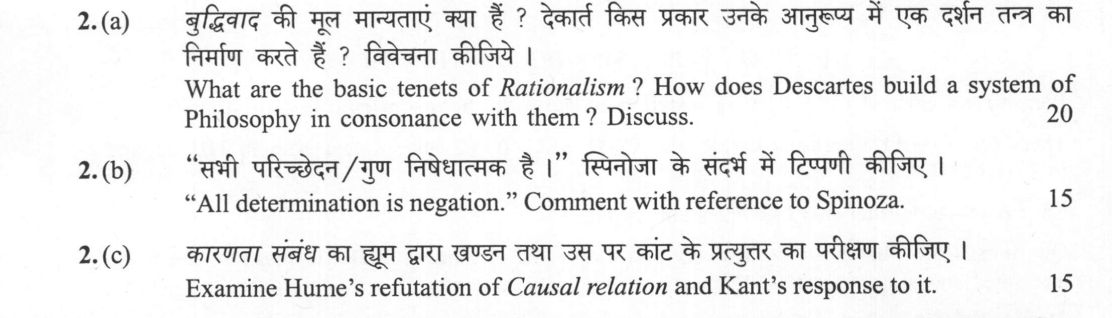
(a) What are the basic tenets of Rationalism ? How does Descartes build a system of Philosophy in consonance with them ? Discuss…
What are the basic tenets of Rationalism ? How does Descartes build a system of Philosophy in consonance with them ? Discuss. 20 marks
"All determination is negation." Comment with reference to Spinoza. 15 marks
Examine Hume's refutation of Causal relation and Kant's response to it. 15 marks
हिंदी में प्रश्न पढ़ें
बुद्धिवाद की मूल मान्यताएँ क्या हैं ? देकार्त किस प्रकार उनके अनुरूप में एक दर्शन तंत्र का निर्माण करते हैं ? विवेचना कीजिए। 20
"सभी परिच्छेदन/गुण निषेधात्मक है।" स्पिनोजा के संदर्भ में टिप्पणी कीजिए। 15
कारणता संबंध का ह्यूम द्वारा खंडन तथा उस पर कांट के प्रत्युत्तर का परीक्षण कीजिए। 15
Model answer
Written by UPSC Answer Check against this question's marking rubric, to the expected length. UPSC does not publish answers for Mains — this is one way to score well, not an official key.
Rationalism and Descartes’ Philosophical System
Rationalism posits that unassisted reason, rather than sensory experience, is the primary source of substantive knowledge. Its core tenets are the existence of innate ideas, the reality of necessary truths discoverable independently of experience, and the adoption of the geometrical-deductive method to construct a secure system of philosophy.
René Descartes rigorously implements this rationalist framework. Through his method of universal doubt (de omnibus dubitandum), he dismantles all empirical and dubitable beliefs to discover an indubitable foundation: Cogito, ergo sum (I think, therefore I am). From the self-authenticating certainty of the thinking subject, Descartes extracts the epistemic criterion of truth: whatever is perceived with clarity and distinctness is necessarily true.
To bridge subjective certainty with the objective existence of the external world, Descartes formulates the ontological and cosmological proofs for the existence of an infinitely perfect God. Because God is benevolent and not a deceiver (veracitas Dei), human cognitive faculties—when operating under clear and distinct perceptions—are epistemically reliable. God serves as the ultimate guarantor of necessary truths and the objective existence of extended matter (res extensa), thus completing Descartes' dualistic rationalist system.
Spinoza: "All Determination is Negation"
In Spinoza’s pantheistic substance monism (Deus sive Natura), only one infinite, unconditioned substance exists. Attributes constitute the essence of this substance, while individual finite things are modes—determinate modifications of substance under the attributes of Thought and Extension.
Spinoza's dictum determinatio negatio est signifies that every finite determination is fundamentally a limitation. To determine a finite mode as having a specific form A necessarily negates and excludes its being non-A. A finite entity is defined not by self-subsistent being, but by what it lacks relative to the infinite totality.
This principle provoked substantial philosophical debate. G.W.F. Hegel interpreted Spinoza’s dictum as reducing the finite world to sheer illusion or unreality that is dialectically absorbed into the undifferentiated Absolute. In modern scholarship, Harold Joachim aligns with this view, seeing determination as privation and metaphysical limitation. Conversely, Harry Wolfson argues that for Spinoza, determination does not denote sheer non-being, but the positive, actualized essence of a mode within the deterministic causal order of Nature, treating negation as a logical delimitation rather than ontological unreality.
Hume’s Critique of Causation and Kant’s Transcendental Response
David Hume dismantled rationalist causation by demonstrating that causal relations are neither intuitive relations of ideas nor directly perceived matters of fact. Experience provides only impressions of spatial contiguity, temporal priority, and constant conjunction between events; it never reveals an objective "necessary connection." Hume concluded that causal necessity is merely a psychological fiction—an instinctive habit of mind and customary association generated by repeated experience, thus driving epistemology into skepticism.
Immanuel Kant’s "Copernican Revolution" salvaged objective knowledge by reconciling rationalism and empiricism. Kant acknowledged that while all knowledge begins with experience, it does not arise from experience. He identified causality as a pure a priori category of the understanding. Causality is a synthetic a priori rule that the mind actively imposes upon sensory intuition (manifold) to synthesize it into coherent, lawful experience. Kant thus resolved Hume's challenge by distinguishing between metaphysical causation (which illegitimately seeks to know things-in-themselves or noumena) and scientific causation (which transcendentally grounds the universal, necessary laws governing the phenomenal world).
The movement from Descartes' foundational rationalism through Hume's empirical skepticism to Kant's critical philosophy demonstrates the trajectory of modern epistemology: shifting from metaphysical speculation about substance to a transcendental inquiry into the conditions and limits of human cognition.
What "Discuss" is asking you to do
Lay the issue out from more than one side — how it arose, what is claimed for it, what is held against it, and where it now stands. UPSC attaches discuss to broad topics with several live dimensions, so coverage of the dimensions earns more than the strength of your opinion.
Structure that answers it
Set the issue up → the case as it is made → the case against → the dimension both sides leave out → where the balance now lies
Where marks are lost
Listing facts with no thread between them, or arguing one side throughout and calling it a discussion.
How this answer will be evaluated
Approach
Framework: UPSC Philosophy Paper 1. (a) discuss: intro > 3-4 dimensions > example > balanced close | (b) comment: context > arguments both sides > judgment > close | (c) examine: intro > how/why with reasoning > evidence > conclusion Full marks: Precise technical vocabulary, clear reconstruction of arguments, strong counter-arguments, and balanced evaluation.
Key points expected
- Define a priori knowledge and innate ideas
- Explain the Cogito argument (cogito ergo sum)
- Detail the role of the 'clear and distinct' criterion
- Link the 'cogito' to the proof of God's existence
- Define 'determination' (determinatio) as 'negation' (negatio)
- Explain the concept of 'infinite' (infinitum) vs 'finite' (finitum)
- Link the argument to the nature of Substance (Deus sive Natura)
- Explain how finite modes are limited by other modes
Evaluation rubric
Each sub-part is marked on its own, against the marks and word limit printed on the paper.
- (a) Define Rationalism's tenets and reconstruct Descartes' system based on them. 20 marks
discuss— intro → 3-4 dimensions → example → balanced close
Must cover
- Define a priori knowledge and innate ideas
- Explain the Cogito argument (cogito ergo sum)
- Detail the role of the 'clear and distinct' criterion
- Link the 'cogito' to the proof of God's existence
Loses marks
- Biographical details of Descartes
- Confusing Rationalism with Empiricism
- Vague paraphrase of the Cogito argument
Earns more
- Mention the 'Evil Demon' (malin génie) hypothesis
- Reference the 'cogito' as the first indubitable truth
- Use the term 'methodical doubt' (dubium methodicum)
- Mention the mind-body dualism (res cogitans/res extensa)
Extra mark
- Reference to 'Meditations on First Philosophy'
- Reference to 'Discourse on the Method'
- (b) Explain the thesis 'All determination is negation' in Spinoza's context. 15 marks
comment— context → arguments both sides → judgment → close
Must cover
- Define 'determination' (determinatio) as 'negation' (negatio)
- Explain the concept of 'infinite' (infinitum) vs 'finite' (finitum)
- Link the argument to the nature of Substance (Deus sive Natura)
- Explain how finite modes are limited by other modes
Loses marks
- Confusing Spinoza's God with a personal deity
- Ignoring the logical structure of the argument
- Biographical details of Spinoza
Earns more
- Reference to 'Ethics' Part I, Proposition 8
- Use the term 'infinite in kind' (infinite in genere)
- Mention the 'causa sui' (self-caused) nature of God
- Contrast 'absolute' vs 'relative' infinity
Extra mark
- Reference to 'Theological-Political Treatise'
- Reference to 'Treatise on the Emendation of the Intellect'
- (c) Analyze Hume's critique of causality and Kant's philosophical response. 15 marks
examine— intro → how/why with reasoning → evidence → conclusion
Must cover
- Explain Hume's 'constant conjunction' and 'custom/habit'
- Detail the 'is-ought' or 'inductive' problem of causality
- Explain Kant's 'a priori' categories (specifically Causality)
- Describe Kant's 'Copernican Revolution' regarding the mind's role
Loses marks
- Confusing Hume's skepticism with Kant's idealism
- Biographical details of Hume or Kant
- Vague paraphrase of the 'constant conjunction' argument
Earns more
- Reference to 'Treatise of Human Nature' or 'Enquiry'
- Reference to 'Critique of Pure Reason'
- Use the term 'synthetic a priori' judgments
- Mention the 'transcendental deduction' of categories
Extra mark
- Reference to 'Prolegomena to Any Future Metaphysics'
- Reference to 'Metaphysical Foundations of Natural Science'
Practice this exact question
Write your answer and it is marked point by point against the model answer above — what you covered, what you missed, what you got wrong.
Evaluate my answer →More from Philosophy 2025 Paper I
- Q1 Answer the following questions in about 150 words each : 10×5=50 (a) "Ideas are timeless…
- Q2 (a) What are the basic tenets of Rationalism ? How does Descartes build a system of Philo…
- Q3 (a) "We should look not to an ideal language which derives its meaning from facts and has…
- Q4 (a) How is Husserl's account of "I think" different from that of Descartes ? Critically d…
- Q5 Answer the following questions in about 150 words each : 10×5=50 (a) Explain the ground o…