Paper I — Q5
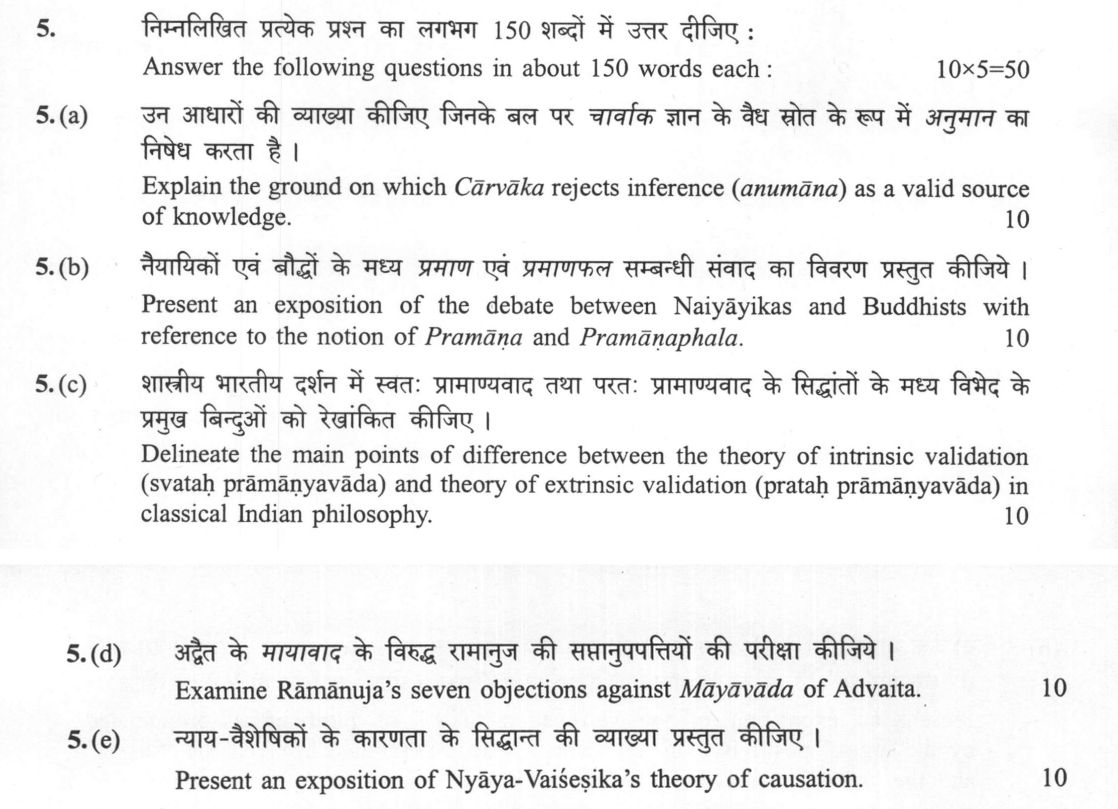
Answer the following questions in about 150 words each : 10×5=50 (a) Explain the ground on which Cārvāka rejects inference…
Answer the following questions in about 150 words each : 10×5=50
Explain the ground on which Cārvāka rejects inference (anumāna) as a valid source of knowledge. 10 marks
Present an exposition of the debate between Naiyāyikas and Buddhists with reference to the notion of Pramāṇa and Pramāṇaphala. 10 marks
Delineate the main points of difference between the theory of intrinsic validation (svataḥ prāmāṇyavāda) and theory of extrinsic validation (prataḥ prāmāṇyavāda) in classical Indian philosophy. 10 marks
Examine Rāmānuja's seven objections against Māyāvāda of Advaita. 10 marks
Present an exposition of Nyāya-Vaiśeṣika's theory of causation. 10 marks
हिंदी में प्रश्न पढ़ें
निम्नलिखित प्रत्येक प्रश्न का लगभग 150 शब्दों में उत्तर दीजिए :
उन आधारों की व्याख्या कीजिए जिनके बल पर चार्वाक ज्ञान के वैध स्रोत के रूप में अनुमान का निषेध करता है । 10
नैयायिकों एवं बौद्धों के मध्य प्रमाण एवं प्रमाणफल सम्बन्धी संवाद का विवरण प्रस्तुत कीजिए । 10
शास्त्रीय भारतीय दर्शन में स्वतः प्रामाण्यवाद तथा परतः प्रामाण्यवाद के सिद्धांतों के मध्य विभेद के प्रमुख बिन्दुओं को रेखांकित कीजिए । 10
अद्वैत के मायावाद के विरुद्ध रामानुज की ससानुपपत्तियों की परीक्षा कीजिए । 10
न्याय-वैशेषिकों के कारणता के सिद्धान्त की व्याख्या प्रस्तुत कीजिए । 10
Model answer
Written by UPSC Answer Check against this question's marking rubric, to the 150-word length. UPSC does not publish answers for Mains — this is one way to score well, not an official key.
(a) Cārvāka accepts only pratyakṣa. Inference is rejected because its decisive link, vyāpti, is itself unperceivable. To know that smoke is invariably concomitant with fire, one must observe many cases; but such observation already presumes the very inference it is meant to establish, producing anavasthā. Moreover, universal concomitance is defeated by exceptions: smoke may be doubted in wet fuel, where the expected fire is absent or the sign is ambiguous. As reported in Sarvadarśanasaṃgraha and Bṛhaspatisūtra, Cārvāka therefore says anumāna cannot yield reliable knowledge; it merely moves from a perceived sign to an unperceived object without a secure, self-evident connection. The causal mechanism is thus broken: perception gives the sign, but no valid pramāṇa can bridge it to the unperceived, so inference collapses into guesswork. Hence, for Cārvāka, the only ground of certainty is immediate sensory contact; anything beyond it is speculative and cannot be a pramāṇa.
(b) Nyāya distinguishes pramāṇa from pramāṇaphala: the former is the cause or instrument (pratyakṣa, anumāna, etc.), the latter is the resultant valid cognition that is non-misleading. In inference, Nyāya separates svārthānumāna, the knower’s own apprehension of the unperceived object, from parārthānumāna, the five-member syllogism addressed to another. The Buddhist Dignāga, in Pramāṇavārttika, challenges this by identifying pramāṇa and pramāṇaphala with sākṣātkāra, the direct apprehension of the object’s specific character and its capacity to guide action. For him, the cognition is not merely produced by a separate instrument; it is itself the valid act. Thus the debate is causal: Nyāya says an instrument brings about a result, while Dignāga says the result is the instrument’s self-revealing act. The consequence is that Nyāya can retain a distinct epistemic product, whereas Buddhism collapses the distinction into non-misleading apprehension. This also shapes the status of anumāna as a distinct pramāṇa.
(c) Svataḥ prāmāṇyavāda, defended by Kumārila Bhaṭṭa of Mīmāṃsā and by Advaitins such as Māṇḍana Miśra and Dharmarāja Adhyakṣa, holds that a cognition is valid by its own nature. The causal mechanism is immediate: when a cognition arises, it is already trustworthy unless a defect—bad light, disease, or later contradiction—removes that trust. Validity is intrinsic; error is discovered only when a subsequent experience defeats it. By contrast, parataḥ prāmāṇyavāda, especially in Gaṅgeśa Upādhyāya’s Nyāya, holds that validity is not self-evident. A cognition must be established extrinsically through verification, practical success, or anuvyavasthāna. Its corollary, parataḥ apramāṇyavāda, says invalidity too is not intrinsic but is established by external check. Thus Mīmāṃsā and Advaita make the cognition’s own character the ground of trust, while Nyāya makes the relation to later confirmation the ground. The difference is not merely verbal: it determines whether knowledge is self-authenticating or always provisional until verified.
(d) Rāmānuja, in the Śrībhāṣya, argues that Advaita’s māyāvāda is incoherent because avidyā/māyā cannot be neither real nor unreal. He gives seven anupapattis. Avasthā-viśeṣa: if avidyā is real, Brahman is not absolutely one; if unreal, it cannot produce the world. Saṃśaya-doṣa: its ontological status remains doubtful. Pramāṇa-virodha: it contradicts valid cognition, since the world is known through perception. Jñāna-virodha: ignorance cannot be both removed and the ground of experience. Kriyā-virodha: an unreal cause cannot produce real karmic results. Dṛṣṭānta-hāni: the usual examples lose force. The seventh is dṛṣṭāntānupapatti: Advaita cannot give an example for avidyā, because any example would have to be real or unreal, and neither fits. Thus the causal mechanism of māyā fails: it cannot explain how the world arises without making Brahman change or making the world unreal. This is why Viśiṣṭādvaita insists that Brahman’s real qualities and the world are not illusory or merely superimposed.
(e) Nyāya-Vaiśeṣika defend ārambha-vāda, also called asatkārya-vāda: the effect is not pre-existing in the cause but comes into being at the moment of production. The causal mechanism is a combination of five causes. In a pot, clay is upādāna and samavāyi cause, because the pot inheres in the clay through samavāya; the potter is nimitta; the pot’s form and size are asamavāyi; the prior absence of the pot is pratyavāya. Nyāya also speaks of a threefold karaka—upādāna, nimitta and saṃyoga—or, more centrally, of samavāya as the relation binding material cause to effect. This contrasts with Sāṃkhya satkārya-vāda, where the effect already exists in the cause, as thread in cloth. For Nyāya-Vaiśeṣika, causes do not merely reveal a pre-existing effect; they actively produce a new one. Hence production is not transformation of an already present entity but the arising of a new entity from real causes. This preserves the reality of change.
What "Explain" is asking you to do
Make the working of something clear — what sets it off, what follows from what, and what it produces. Explain is the Commission's mechanism word: it dominates the technical papers and the “explain why” stems, where the marks sit in the causal chain and not in the label.
Structure that answers it
State what it is → the initiating condition → the chain of cause, step by step → an instance where it plays out → what the chain produces
Where marks are lost
Describing what something looks like instead of why it works that way. Naming the stages without linking them reads as description too.
How this answer will be evaluated
Approach
Framework: Indian Epistemology and Metaphysics. (a) explain: definition/context > points in order > small example > short close | (b) discuss: intro > 3-4 dimensions > example > balanced close | (c) discuss: intro > 3-4 dimensions > example > balanced close | (d) discuss: intro > 3-4 dimensions > example > balanced close | (e) discuss: intro > 3-4 dimensions > example > balanced close Full marks: Precise technical vocabulary, clear reconstruction of arguments, strong counter-arguments, and accurate attribution.
Key points expected
- Cārvāka's rejection of inference based on the fallibility of unperceived causes.
- Naiyāyika vs. Buddhist debate on Pramāṇa as process vs. cognition.
- Svataḥ vs. Prataḥ prāmāṇyavāda: self-evident vs. action-based validity.
- Rāmānuja's critique of Advaita Māyāvāda: reality of the world and plurality.
- Nyāya-Vaiśeṣika 'sat-kārya-vāda': effect pre-exists in the cause.
Evaluation rubric
Each sub-part is marked on its own, against the marks and word limit printed on the paper.
- (a) Cārvāka's specific logical and empirical grounds for rejecting anumāna. 10 marks · 150 words
explain— definition/context → points in order → small example → short close
Must cover
- Rejection of unperceived causes (e.g., fire in smoke)
- Argument from fallibility of inference
- Assertion that perception (pratyakṣa) is the sole pramāṇa
- Critique of the logical structure of the syllogism
Loses marks
- Biographical details of Cārvāka founders
- General description of Cārvāka materialism without focusing on inference
Earns more
- Mention of the 'infinite regress' objection
- Reference to the 'unseen' (adrṣṭa) as a logical fallacy
- Contrast with Naiyāyika acceptance of inference
Extra mark
- Citation of a specific Cārvāka sutra or text
- (b) The specific epistemological conflict between Naiyāyika and Buddhist views on pramāṇa and its result. 10 marks · 150 words
discuss— intro → 3-4 dimensions → example → balanced close
Must cover
- Naiyāyika view: Pramāṇa as a process (pramāṇa-kriyā)
- Buddhist view: Pramāṇa as a valid cognition (pramāṇa-jñāna)
- Naiyāyika Pramāṇaphala: New knowledge (jñāna) or action (kriyā)
- Buddhist Pramāṇaphala: The cognition itself is the result
Loses marks
- General history of Buddhism and Nyāya
- Confusing Pramāṇa (source) with Pramāṇaphala (result)
Earns more
- Reference to Dignāga or Dharmakīrti for the Buddhist position
- Reference to Udayana or Vācaspati Miśra for the Naiyāyika position
- Discussion of the 'infinite regress' in the Buddhist view
Extra mark
- Mention of the 'pramāṇa-phala-siddhānta' debate specifically
- (c) The core differences between intrinsic (svataḥ) and extrinsic (prataḥ) theories of validity. 10 marks · 150 words
discuss— intro → 3-4 dimensions → example → balanced close
Must cover
- Svataḥ: Validity is self-evident in the cognition itself
- Prataḥ: Validity is known only through subsequent action (anuvyavahāra)
- Svataḥ: Error is a defect in the cognition (apoha)
- Prataḥ: Error is a failure of the cognition to lead to action
Loses marks
- Vague definitions of 'validity' without technical precision
- Confusing the theories with the sources of knowledge (pramāṇas)
Earns more
- Attribution of Svataḥ to Mīmāṃsā (Kumārila Bhaṭṭa)
- Attribution of Prataḥ to Nyāya (Gaṅgeśa Upādhyāya)
- Mention of the 'anuvyavahāra' (subsequent usage) argument
Extra mark
- Reference to the 'svataḥ-prāmāṇya' vs 'prataḥ-prāmāṇya' debate in the Nyāya tradition
- (d) Rāmānuja's specific philosophical arguments against Advaita Māyāvāda. 10 marks · 150 words
discuss— intro → 3-4 dimensions → example → balanced close
Must cover
- Rejection of the 'unreal' (māyā) as a category
- Assertion of the reality of the world (vyavahārika-sat)
- Critique of the 'one without a second' (ekam evādvitīyam) claim
- Argument for the reality of plurality (bheda)
Loses marks
- Biographical details of Rāmānuja
- General description of Viśiṣṭādvaita without focusing on the critique of Advaita
Earns more
- Reference to the 'sat-kārya-vāda' (real effect theory)
- Mention of the 'viveka' (distinction) between Brahman and the world
- Reference to Rāmānuja's 'Śrī Bhāṣya' or 'Vedārtha Saṅgraha'
Extra mark
- Specific mention of the 'seven objections' if the student can name them
- (e) The Nyāya-Vaiśeṣika theory of causation, specifically the 'sat-kārya-vāda'. 10 marks · 150 words
discuss— intro → 3-4 dimensions → example → balanced close
Must cover
- Definition of 'sat-kārya-vāda' (effect pre-exists in the cause)
- Distinction between 'nimitta' (efficient) and 'upādāna' (material) causes
- Example: The pot exists in the clay before it is made
- Contrast with the 'asat-kārya-vāda' of the Sāṃkhya school
Loses marks
- General description of causation without technical precision
- Confusing the Nyāya-Vaiśeṣika view with the Sāṃkhya view
Earns more
- Reference to the 'kāraṇa' (cause) and 'kārya' (effect) relationship
- Mention of the 'vyatireka' (absence) and 'anvaya' (presence) arguments
- Reference to the 'Vaiśeṣika Sūtra' or 'Nyāya Sūtra'
Extra mark
- Specific mention of the 'three types of causes' (nimitta, upādāna, and āśraya)
Practice this exact question
Write your answer and it is marked point by point against the model answer above — what you covered, what you missed, what you got wrong.
Evaluate my answer →More from Philosophy 2025 Paper I
- Q2 (a) What are the basic tenets of Rationalism ? How does Descartes build a system of Philo…
- Q3 (a) "We should look not to an ideal language which derives its meaning from facts and has…
- Q4 (a) How is Husserl's account of "I think" different from that of Descartes ? Critically d…
- Q5 Answer the following questions in about 150 words each : 10×5=50 (a) Explain the ground o…
- Q6 (a) Present a detailed account of Gautama's definition of Perception. 20 (b) How is Brahm…
- Q7 (a) Why does Śaṃkara consider Sāṃkhya Philosophy as his chief opponent (pradhāna malla) ?…
- Q8 (a) Discuss the idea of Bimba-pratibimbavāda as presented in Vedanta philosophy along wit…