Paper I — Q6
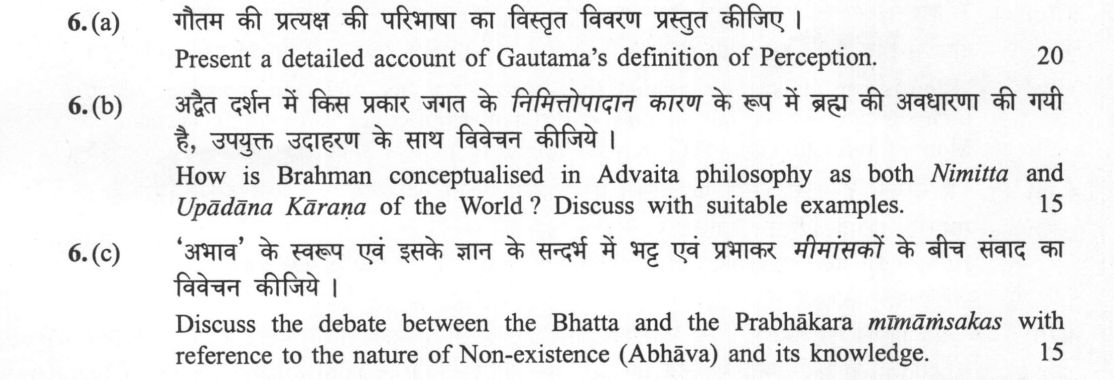
(a) Present a detailed account of Gautama's definition of Perception. 20 (b) How is Brahman conceptualised in Advaita philosophy…
Present a detailed account of Gautama's definition of Perception. 20 marks
How is Brahman conceptualised in Advaita philosophy as both Nimitta and Upādāna Kāraṇa of the World ? Discuss with suitable examples. 15 marks
Discuss the debate between the Bhatta and the Prabhākara mīmāṃsakas with reference to the nature of Non-existence (Abhāva) and its knowledge. 15 marks
हिंदी में प्रश्न पढ़ें
गौतम की प्रत्यक्ष की परिभाषा का विस्तृत विवरण प्रस्तुत कीजिए । 20
अद्वैत दर्शन में किस प्रकार जगत के निमित्तोपादान कारण के रूप में ब्रह्म की अवधारणा की गयी है, उपयुक्त उदाहरण के साथ विवेचन कीजिए । 15
'अभाव' के स्वरूप एवं इसके ज्ञान के संदर्भ में भट्ट एवं प्रभाकर मीमांसकों के बीच संवाद का विवेचन कीजिए । 15
Model answer
Written by UPSC Answer Check against this question's marking rubric, to the expected length. UPSC does not publish answers for Mains — this is one way to score well, not an official key.
Classical Indian philosophy ties epistemology, metaphysics and hermeneutics: how we know shapes what exists and how scripture is read.
(a) Gautama’s definition of perception Gautama defines pratyakṣa as indriyārthasannidhānānumānādivyatirekam jñānam, and it is unpacked as avyapadeśya, avyabhicāri and vyavasāyatmakā. Avyapadeśya means that perception is not produced by or dependent on verbal expression; it chiefly excludes śabda/testimonial cognition, while inference is excluded mainly by the requirement of sense-object contact. Avyabhicāri means non-deceptive, stable and free from doubt. Vyavasāyatmakā means determinate or decisive, giving a settled cognition of an object rather than a vague or uncertain awareness. Gautama’s pratyakṣa is divided into laukika and alaukika. The laukika type is sixfold: it proceeds through the five external indriyas and manas, the internal sense that serialises sensory contact and turns it into determinate object-awareness. Thus perception is not merely raw contact; it becomes knowledge when manas organises the contact and the mind fixes the object. Alaukika perception includes samanyalakṣaṇa, jñānalakṣaṇa and yogajñāna, where the object is not directly before the external sense but is known through a prior valid cognition or yogic power. The key internal distinction is between nirvikalpaka and savikalpaka perception. Vātsyāyana’s reading of vyavasāyatmakā stresses the determinate, word- and concept-connected stage, so that pratyakṣa is savikalpaka. Uddyotakara makes room for an earlier indeterminate contact-cognition, nirvikalpaka, before the mind supplies name, universal and relation. This debate was sharpened by Dinnaga’s sākāravāda theory of cognition, which treats cognition as objectified and insists that genuine perception is concept-free, thereby challenging Nyāya’s acceptance of a concept-laden perceptual stage.
(b) Brahman as efficient and material cause In Advaita, Brahman is conceived as both nimitta and upadāna kāraṇa of the world. As nimitta, Brahman is like the potter who brings the pot into being; as upadāna, Brahman is like the clay that constitutes the pot, or the rope misapprehended as a snake. The Chāndogya Upaniṣad’s teaching that “all this is Brahman” supports the material-cause analogy: the world is not something other than Brahman. Śaṅkara resolves this through vivartavāda: Brahman is satya, the world mithyā; it is not real parināma but apparent transformation due to adhyāsa, explained in the Adhyāsa-bhāṣya, where name and form are superimposed on Brahman. The three levels of reality clarify this: paramārthika is Brahman alone; vyāvahārika is the empirical world; pratibhāsika is the dream or rope-snake appearance. The world is real enough for action, but not ultimately real.
(c) Bhaṭṭa and Prabhākara on abhāva The Mīmāṃsā debate turns on whether non-existence is a real object of knowledge. The Bhaṭṭa school, especially Kumārila, treats abhāva as an independent padārtha, known by a separate pramāṇa, anupalabdhi. It classifies abhāva into five types: prāgabhāva, pradhvamsabhāva, atyantabhāva, anyonyabhāva and saṃsargabhāva/samyogabhāva. For Bhaṭṭa, the cognition “there is no jar on the ground” is a valid cognition of absence, not merely a failure to perceive. Prabhākara rejects abhāva as a padārtha. For him, non-existence is only the absence of a pramāṇa-siddha satta, a validly established existence. The knowledge of absence arises from the non-apprehension of the expected object after due search, and is reducible to perception or inference, not a sixth pramāṇa. The jar-on-ground example shows the issue: Bhaṭṭa says the absence itself is apprehended; Prabhākara says we apprehend the ground and the non-appearance of the jar, and infer absence. The debate therefore concerns the ontology of absence and the limits of pramāṇa.
Together they reflect the broader Indian tension between realism and idealism: Nyāya and Mīmāṃsā defend the reality of objects and absence, while Advaita subordinates empirical reality to Brahman.
What "Discuss" is asking you to do
Lay the issue out from more than one side — how it arose, what is claimed for it, what is held against it, and where it now stands. UPSC attaches discuss to broad topics with several live dimensions, so coverage of the dimensions earns more than the strength of your opinion.
Structure that answers it
Set the issue up → the case as it is made → the case against → the dimension both sides leave out → where the balance now lies
Where marks are lost
Listing facts with no thread between them, or arguing one side throughout and calling it a discussion.
How this answer will be evaluated
Approach
Framework: State the position > Argument > Strongest objection > Evaluation. (a) explain: definition/context > points in order > small example > short close | (b) discuss: intro > 3-4 dimensions > example > balanced close | (c) discuss: intro > 3-4 dimensions > example > balanced close Full marks: Precise Sanskrit terms, clear argument reconstruction, strong counter-arguments.
Key points expected
- Cite Gautama's definition (Nirvikalpaka/Anavacana)
- Define 'indriya-vṛtti' (sense-organ activity)
- Distinguish Nirvikalpaka from Savikalpaka
- Explain the role of 'anavacana' (non-verbal)
- Define Nimitta Kāraṇa (efficient cause)
- Define Upādāna Kāraṇa (material cause)
- Explain Brahman as both (Aikya)
- Provide suitable example (e.g., clay/pot)
Evaluation rubric
Each sub-part is marked on its own, against the marks and word limit printed on the paper.
- (a) Detailed account of Gautama's definition of Perception (Pratyakṣa). 20 marks
explain— definition/context → points in order → small example → short close
Must cover
- Cite Gautama's definition (Nirvikalpaka/Anavacana)
- Define 'indriya-vṛtti' (sense-organ activity)
- Distinguish Nirvikalpaka from Savikalpaka
- Explain the role of 'anavacana' (non-verbal)
Loses marks
- Biography of Gautama
- Vague paraphrase of 'perception'
Earns more
- Mention 'sākṣātkara' (direct apprehension)
- Reference to Nyāya Sūtra 1.1.4
- Contrast with later Nyāya views
Extra mark
- Sanskrit term 'anirvikalpaka'
- (b) Brahman as Nimitta and Upādāna Kāraṇa in Advaita. 15 marks
discuss— intro → 3-4 dimensions → example → balanced close
Must cover
- Define Nimitta Kāraṇa (efficient cause)
- Define Upādāna Kāraṇa (material cause)
- Explain Brahman as both (Aikya)
- Provide suitable example (e.g., clay/pot)
Loses marks
- Confusing with Dvaita views
- Missing the 'example' requirement
Earns more
- Mention 'Māyā' as the instrument
- Reference to 'Sarvam khalvidam brahma'
Extra mark
- Sanskrit term 'Nimitta-Upādāna'
- (c) Debate on Abhāva (Non-existence) between Bhatta and Prabhākara. 15 marks
discuss— intro → 3-4 dimensions → example → balanced close
Must cover
- Bhatta view: Abhāva is real (Svataḥ)
- Prabhākara view: Abhāva is relational (Pratiyogī)
- Nature of knowledge of Abhāva (Anupalabdhi)
- Contrast the two positions clearly
Loses marks
- Confusing with Nyāya views
- Failing to distinguish the two schools
Earns more
- Mention 'Anupalabdhi' as a pramāṇa
- Reference to 'Pratiyogī' (counterpositive)
Extra mark
- Sanskrit term 'Svataḥ-siddha'
Practice this exact question
Write your answer and it is marked point by point against the model answer above — what you covered, what you missed, what you got wrong.
Evaluate my answer →More from Philosophy 2025 Paper I
- Q3 (a) "We should look not to an ideal language which derives its meaning from facts and has…
- Q4 (a) How is Husserl's account of "I think" different from that of Descartes ? Critically d…
- Q5 Answer the following questions in about 150 words each : 10×5=50 (a) Explain the ground o…
- Q6 (a) Present a detailed account of Gautama's definition of Perception. 20 (b) How is Brahm…
- Q7 (a) Why does Śaṃkara consider Sāṃkhya Philosophy as his chief opponent (pradhāna malla) ?…
- Q8 (a) Discuss the idea of Bimba-pratibimbavāda as presented in Vedanta philosophy along wit…