Paper I — Q3
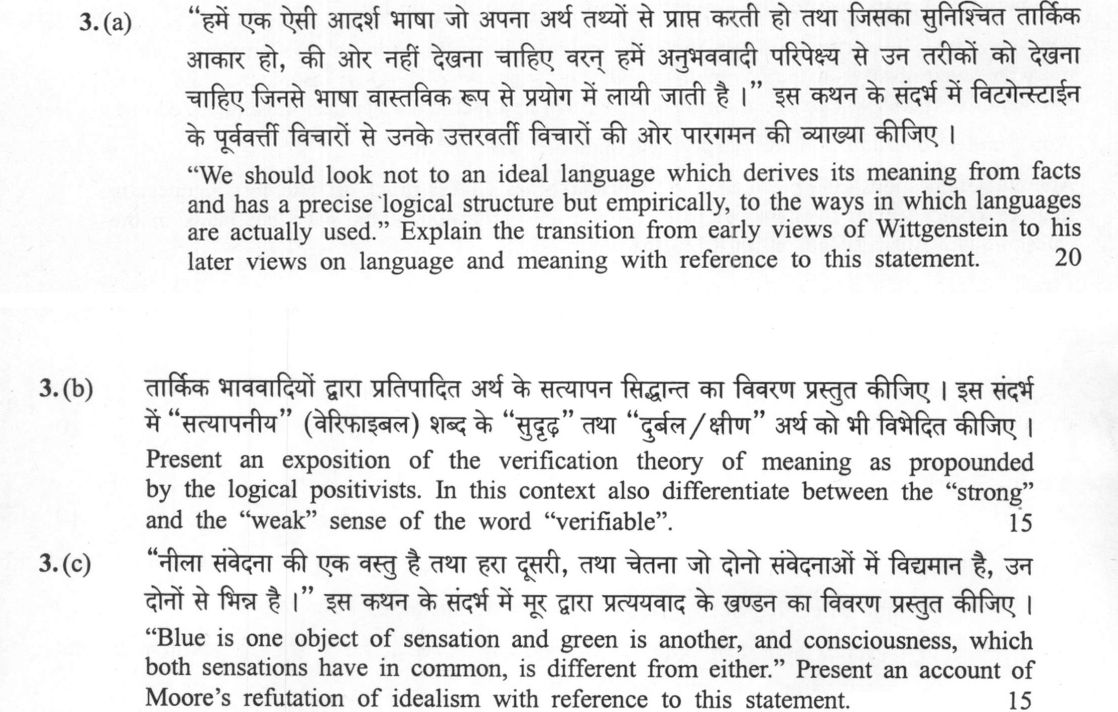
(a) "We should look not to an ideal language which derives its meaning from facts and has a precise logical structure but…
"We should look not to an ideal language which derives its meaning from facts and has a precise logical structure but empirically, to the ways in which languages are actually used." Explain the transition from early views of Wittgenstein to his later views on language and meaning with reference to this statement. 20 marks
Present an exposition of the verification theory of meaning as propounded by the logical positivists. In this context also differentiate between the "strong" and the "weak" sense of the word "verifiable". 15 marks
"Blue is one object of sensation and green is another, and consciousness, which both sensations have in common, is different from either." Present an account of Moore's refutation of idealism with reference to this statement. 15 marks
हिंदी में प्रश्न पढ़ें
"हमें एक ऐसी आदर्श भाषा जो अपना अर्थ तथ्यों से प्राप्त करती हो तथा जिसका सुनिश्चित तार्किक आकार हो, की ओर नहीं देखना चाहिए बल्कि हमें अनुभववादी परिपेक्ष्य से उन तरीकों को देखना चाहिए जिनसे भाषा वास्तविक रूप से प्रयोग में लाई जाती है।" इस कथन के संदर्भ में विटगेंस्टाइन के पूर्ववर्ती विचारों से उनके उत्तरवर्ती विचारों की ओर परागमन की व्याख्या कीजिए। 20
तार्किक भाववादियों द्वारा प्रतिपादित अर्थ के सत्यापन सिद्धांत का विवरण प्रस्तुत कीजिए । इस संदर्भ में "सत्यापनीय" (वेरिफाइबल) शब्द के "सुदृढ़" तथा "दुर्बल/क्षीण" अर्थ को भी विभेदित कीजिए । 15
"नीला संवेदना की एक वस्तु है तथा हरा दूसरी, तथा चेतना जो दोनों संवेदनाओं में विद्यमान है, उन दोनों से भिन्न है ।" इस कथन के संदर्भ में मूर द्वारा प्रत्ययवाद के खण्डन का विवरण प्रस्तुत कीजिए । 15
Model answer
Written by UPSC Answer Check against this question's marking rubric, to the expected length. UPSC does not publish answers for Mains — this is one way to score well, not an official key.
The twentieth-century analytic revolution initiated a decisive linguistic turn, shifting philosophical inquiry away from absolute idealism and psychologism toward logical and conceptual analysis of language, sensation, and meaning.
Wittgenstein: From Ideal Language to Language-Games
In the Tractatus Logico-Philosophicus, early Wittgenstein constructed a truth-conditional, atomistic model of language. Central to this was the Picture Theory of meaning: a proposition is a logical picture of reality. A strict structural isomorphism exists between language and the world—names correspond to simple objects, elementary propositions to atomic states of affairs, and complex propositions to facts. Language has an underlying logical syntax that determines the limits of thought; what can be stated clearly belongs to natural science, whereas ethics, aesthetics, and metaphysics cannot be spoken of factually but only shown (the saying versus showing distinction). The early view assumed a single, precise, ideal logical structure beneath everyday speech.
Wittgenstein later abandoned this essentialism in Philosophical Investigations, recognizing that language is not a static formal calculus mirroring atomic facts. Instead, he argued that "the meaning of a word is its use in the language" (PI 43). Language consists of an indefinite, evolving multiplicity of rule-governed activities termed language-games (PI 23), embedded in human forms of life (Lebensformen). Rejecting the search for a single universal essence of language, he introduced *family resemblances*—overlapping networks of similarities, as seen in games. Through the Private Language Argument, he demonstrated that language is inherently social and normative; subjective mental ostension cannot establish linguistic rules because sensations lack public criteria for correctness. Philosophy, therefore, ceased to be the formal construction of ideal languages and became the therapeutic description of ordinary linguistic usage.
Verification Theory: Logical Positivism and the Strong-Weak Distinction
Logical Positivists of the Vienna Circle (Carnap, Schlick) and A.J. Ayer formulated the Verification Principle to establish a demarcation between cognitively meaningful discourse and metaphysical pseudo-propositions. A synthetic proposition is cognitively significant if and only if it is empirically verifiable; otherwise, it must be tautologous (analytic) or literally nonsensical.
Ayer distinguished between two senses of verifiability: Strong Verifiability: A proposition is verifiable in the strong sense if and only if its truth can be conclusively, conclusively established by direct empirical observation. Weak Verifiability: A proposition is verifiable in the weak sense if empirical observation can render it probable or provide confirmatory evidence for it.
The Positivists were forced to shift from strong to weak verifiability because strong verification rendered universal scientific laws (e.g., "all metals expand when heated") and historical statements meaningless, as no infinite or past series of observations can be conclusively verified. However, weak verification faced fatal challenges: Carl Hempel showed that liberalizing the criterion allowed any nonsensical statement to become indirectly verifiable when conjoined with a suitable hypothesis. Furthermore, Willard Van Orman Quine demonstrated the failure of verificationist reductionism by establishing that empirical claims face the tribunal of experience as an interconnected web of belief rather than as isolated sentences. Crucially, the principle was self-refuting, as the criterion of verification is itself neither analytic nor empirically verifiable.
Moore's Refutation of Idealism and Commonsense Realism
In The Refutation of Idealism (1903), G.E. Moore attacked the foundational idealist doctrine that esse est percipi (to be is to be perceived). Moore analyzed sensations into two distinct, irreducible elements: the act of consciousness (which is identical in all experiences) and the specific object of that consciousness (such as blue or green).
Idealists like Berkeley conflated the act of awareness with the object perceived. Moore explained that consciousness is diaphanous (transparent): when we try to introspect consciousness itself, we look right through it and perceive only its object (the color blue). Because consciousness is identical whether one experiences blue or green, the object of sensation must be distinct and independent from the subjective awareness of it. Experiencing blue is an intentional relation between the mind and an external, non-mental quality.
Moore’s act-object distinction grounded his commonsense realism, later defended through his famous ostensive demonstration in Proof of an External World ("here is one hand... and here is another"). While Moore employed direct epistemological realism and conceptual analysis against idealism, later thinkers shifted toward ordinary language philosophy. Collectively, Moore’s analysis of perception and Wittgenstein’s evolving critique of ideal structures dismantled speculative metaphysics, establishing conceptual clarity and empirical constraint as the defining methods of modern analytic philosophy.
What "Explain" is asking you to do
Make the working of something clear — what sets it off, what follows from what, and what it produces. Explain is the Commission's mechanism word: it dominates the technical papers and the “explain why” stems, where the marks sit in the causal chain and not in the label.
Structure that answers it
State what it is → the initiating condition → the chain of cause, step by step → an instance where it plays out → what the chain produces
Where marks are lost
Describing what something looks like instead of why it works that way. Naming the stages without linking them reads as description too.
How this answer will be evaluated
Approach
Framework: UPSC Philosophy Paper 1. (a) explain: definition/context > points in order > small example > short close | (b) examine: intro > how/why with reasoning > evidence > conclusion | (c) account for: state the phenomenon > the causes in order of weight > conclusion Full marks: Precise technical vocabulary, clear distinction between views, strong counter-arguments, and accurate application of the quote.
Key points expected
- Define early 'picture theory' and logical atomism
- Explain the 'language game' and 'form of life' concepts
- Contrast 'meaning as reference' vs 'meaning as use'
- Apply the quote to the rejection of ideal language
- State the core verification principle of logical positivism
- Define 'strong' verifiability (empirical certainty)
- Define 'weak' verifiability (probability/likelihood)
- Explain the role of the principle in demarcating science
Evaluation rubric
Each sub-part is marked on its own, against the marks and word limit printed on the paper.
- (a) Trace the shift from the Tractatus picture theory to the Investigations' use theory. 20 marks
explain— definition/context → points in order → small example → short close
Must cover
- Define early 'picture theory' and logical atomism
- Explain the 'language game' and 'form of life' concepts
- Contrast 'meaning as reference' vs 'meaning as use'
- Apply the quote to the rejection of ideal language
Loses marks
- Biographical details of Wittgenstein's life
- Confusing early and later views without distinction
- Vague paraphrase without technical terms
Earns more
- Mention the 'private language argument'
- Reference the 'family resemblance' concept
- Cite specific examples from the Investigations
Extra mark
- Reference to the 'Ostensive definition' critique
- Mention the 'beetle in a box' analogy
- (b) Explain the verification principle and distinguish strong from weak verifiability. 15 marks
examine— intro → how/why with reasoning → evidence → conclusion
Must cover
- State the core verification principle of logical positivism
- Define 'strong' verifiability (empirical certainty)
- Define 'weak' verifiability (probability/likelihood)
- Explain the role of the principle in demarcating science
Loses marks
- Confusing verification with falsification
- Failing to distinguish strong and weak senses
- Vague description of 'empirical' content
Earns more
- Mention the 'carnap' or 'ayear' formulation
- Reference the 'analytic-synthetic' distinction
- Discuss the 'meaningless' status of metaphysics
Extra mark
- Reference to the 'Vienna Circle' manifesto
- Mention the 'verificationism' critique by Quine
- (c) Present Moore's argument against idealism using the blue/green example. 15 marks
account for— state the phenomenon → the causes in order of weight → conclusion
Must cover
- State the idealist claim (mind-dependent reality)
- Explain the 'blue' and 'green' sensation distinction
- Identify 'consciousness' as the common element
- Show how this refutes the 'all is mind' thesis
Loses marks
- Confusing Moore's argument with Russell's
- Failing to identify the 'common element'
- Vague description of 'sensation' vs 'object'
Earns more
- Reference to 'A Refutation of Idealism' (1903)
- Mention the 'common element' argument
- Discuss the 'phenomenal' vs 'real' distinction
Extra mark
- Reference to the 'common element' in other sensations
- Mention the 'mind-body' problem context
Practice this exact question
Write your answer and it is marked point by point against the model answer above — what you covered, what you missed, what you got wrong.
Evaluate my answer →More from Philosophy 2025 Paper I
- Q1 Answer the following questions in about 150 words each : 10×5=50 (a) "Ideas are timeless…
- Q2 (a) What are the basic tenets of Rationalism ? How does Descartes build a system of Philo…
- Q3 (a) "We should look not to an ideal language which derives its meaning from facts and has…
- Q4 (a) How is Husserl's account of "I think" different from that of Descartes ? Critically d…
- Q5 Answer the following questions in about 150 words each : 10×5=50 (a) Explain the ground o…
- Q6 (a) Present a detailed account of Gautama's definition of Perception. 20 (b) How is Brahm…